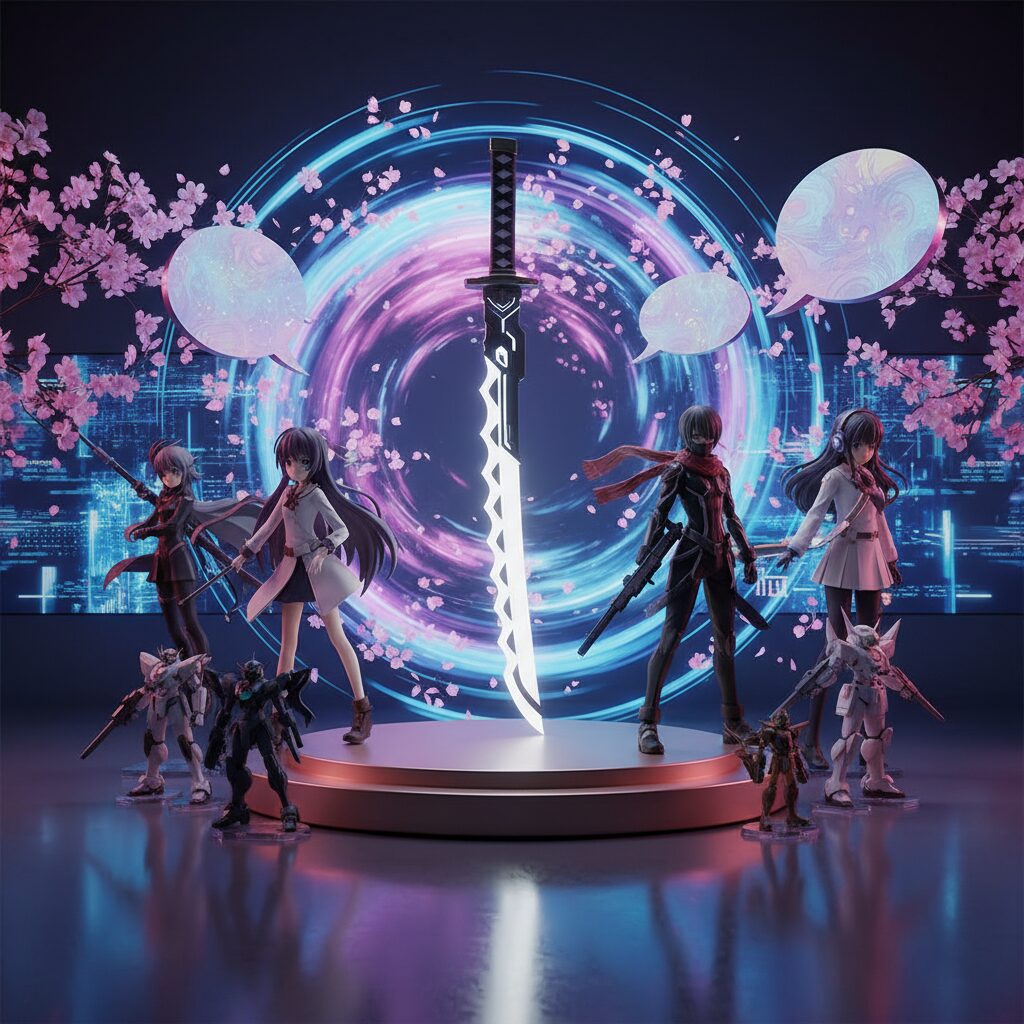
Ask the average person on the street in London or Los Angeles what they think of when they hear the word “anime,” and you’ll likely get a familiar set of responses. Big eyes. Spiky hair. Kids’ shows with screaming heroes and flashy fight scenes. A niche, perhaps, for teenagers and die-hard nerds. For decades, this was the prevailing image: Japanese cartoons, a colorful but ultimately juvenile corner of the animation world. But then, something shifted. The niche exploded. Suddenly, anime wasn’t just on late-night specialty channels; it was dominating global streaming platforms, inspiring high-fashion collections, and being name-dropped by world-famous musicians. The quiet subculture became a worldwide phenomenon.
This explosion didn’t happen because the world suddenly developed a taste for Japanese cartoons. It happened because people finally realized what anime had been all along: a sophisticated storytelling medium, capable of expressing the entire spectrum of human experience, from epic fantasy to quiet domestic drama. More importantly, it is one of the most effective, accessible, and honest conduits into the Japanese cultural psyche available. It’s a Trojan horse, smuggling complex ideas about aesthetics, social structure, and philosophy into our living rooms under the guise of entertainment. For many repeat travelers to Japan, this is the key that unlocks everything. You visit once, you see the temples and taste the ramen. But you start watching anime seriously, and on your second or third trip, you experience a profound sense of recognition. The unspoken tension in a train carriage, the meticulous dedication of a chef, the bittersweet beauty of a fleeting cherry blossom season—suddenly, it all makes sense. You exclaim, “Oh, now I get it.” This isn’t just about understanding a TV show; it’s about understanding a country.
This nuanced cultural tapestry is further illuminated by Japan’s unique practice of inemuri, offering a window into societal values as explored in the inemuri paradox.
The Cartoon That Wasn’t for Kids
To truly grasp the depth of anime, you must first discard the dominant Western assumption that animation is essentially for children. Throughout most of the 20th century, Western animation was largely controlled by studios like Disney and Warner Bros., whose business model centered on family-friendly entertainment. Animation was viewed as a genre—and that genre was “kids’ content.” Any deviation from this norm, such as Ralph Bakshi’s work in the 1970s, was seen as a controversial outlier rather than the standard.
Japan, however, followed a completely different trajectory. Its contemporary animation industry emerged in the aftermath of World War II, developing alongside the country’s manga (comic) industry. The key figure in this evolution is Osamu Tezuka, often referred to as the “God of Manga.” With creations like Astro Boy in the 1950s and 60s, Tezuka not only crafted iconic characters but also introduced cinematic storytelling techniques—panel layouts resembling camera angles, extended narratives with deep character development, and an openness to serious themes such as war, loss, and the human condition.
When these manga were adapted into anime, they carried that level of sophistication into the medium. From the beginning, anime was never confined to a single genre; it was a form and method of visual storytelling. Much like live-action films catering to various audiences, anime targeted specific demographics. There was shōnen (for young boys), emphasizing action and friendship; shōjo (for young girls), focused on romance and relationships; and importantly, seinen (for adult men) and josei (for adult women). These categories empowered creators to produce stories addressing political intrigue, psychological horror, workplace comedy, and philosophical drama—all within animated formats.
This fundamental difference is crucial. Anime wasn’t a medium that struggled to gain adult legitimacy; it was created with adult viewers in mind from the outset. Series like the space opera Legend of the Galactic Heroes explore the ethics of democracy versus autocracy with a seriousness comparable to high-end television dramas. The psychological thriller Monster is a slow-burning procedural about a surgeon tracking down a sociopath he once saved. These are far more than “cartoons with adult themes”; they are mature narratives told through the boundless visual possibilities of animation.
A Mirror to the Japanese Soul: Core Cultural Themes
Once you look beyond the giant robots or magical girls, you’ll start to notice that anime is filled with cultural concepts essential for understanding Japan. These ideas aren’t explicitly taught; rather, they are deeply woven into the narrative atmosphere, character motivations, and story resolutions. Watching anime is like absorbing a cultural education through osmosis.
Mono no Aware: The Beauty of Impermanence
One of the most widespread yet subtle themes is mono no aware (物の哀れ). This term is difficult to translate directly, but it signifies a gentle, poignant sadness for the transience of things. It represents an awareness that everything—life, beauty, youth, a perfect moment—is fleeting, and it is precisely this impermanence that makes it beautiful.
This concept lies at the heart of many of the most acclaimed anime films. Makoto Shinkai’s 5 Centimeters per Second is a masterful example of mono no aware, telling the story of childhood friends drifting apart over time. The film focuses less on romance itself and more on the beautiful, aching sadness of distance and the passage of time. The iconic image of a lone cherry blossom petal falling encapsulates the film’s entire emotional landscape. Cherry blossoms are the ultimate symbol of mono no aware in Japan: they bloom brilliantly for a week or two before fading, reminding us to cherish beauty while it lasts.
Studio Ghibli films are saturated with this feeling as well. Grave of the Fireflies offers an overwhelmingly tragic example, but even the more optimistic films carry a bittersweet tone. The ending of Spirited Away isn’t a simple, happy reunion. Chihiro must leave the spirit world behind, and the film hints that she may not even remember her experiences. The adventure was a transient, beautiful moment in her life that is now over. This is not portrayed as a depressing conclusion, but as a realistic and poignant one. It acknowledges that life is a series of hellos and goodbyes. This perspective, so central to Japanese art and literature for centuries, finds a powerful modern voice in anime, resonating with anyone who has ever felt nostalgia for a fleeting moment.
Ganbaru: The Veneration of Effort
If you’ve watched any popular action anime, you’re likely familiar with the concept of ganbaru (頑張る), even if you don’t know the term. It roughly translates to “to do one’s best” or “to persevere,” but neither phrase fully captures its cultural significance. Ganbaru emphasizes the immense value placed on effort, hard work, and tenacity in the face of overwhelming challenges. The struggle itself is honorable, regardless of the outcome.
This idea fuels nearly every shōnen protagonist. Characters like Naruto Uzumaki or Izuku Midoriya from My Hero Academia don’t begin as chosen heroes blessed with great power. They are underdogs, often underestimated or ignored, who achieve greatness through punishing, relentless training and sheer willpower. The often lengthy training arcs aren’t mere filler; they are central to the story. They celebrate the process of self-improvement, grit, and refusal to quit. This isn’t just about becoming stronger to defeat a villain; it’s about shaping one’s character through hardship.
This emphasis on effort extends far beyond battle scenes. Sports anime like Haikyuu!! (volleyball) and Run with the Wind (marathon running) are entirely rooted in the ganbaru spirit. The drama comes not only from winning or losing the big game but also from the grueling daily practices, mastering new skills, and the emotional challenge of pushing past physical and mental boundaries. This mirrors the real-life intensity of Japanese school club activities (bukatsu), where students dedicate enormous time and energy to their chosen pursuits. The cultural message is clear: talent is valuable, but hard work is revered.
Uchi-Soto: The Layers of Social Reality
One of the most perplexing aspects of Japanese society for outsiders is the complex web of social rules governing interactions. A key concept here is uchi-soto (内と外), meaning “inside/outside.” This describes the fundamental division of the world into in-groups (uchi) and out-groups (soto). Your uchi group might be your family, company department, or close-knit team. Everyone else is soto.
Your behavior, choice of language (formal vs. informal), and level of obligation all depend on whether you are interacting with someone from your uchi or soto group. This creates a public-facing self that can differ greatly from one’s private self.
Anime offers an excellent introduction to uchi-soto in practice. School-based anime perfectly illustrate this dynamic. A classroom functions as a complex ecosystem of cliques and social circles, each an uchi group. The way characters talk to their best friends is drastically different from how they address teachers or students from rival schools. Shows like K-On! or Free! celebrate the uchi group—the light music club, the swim team—as a safe space where members can drop their social masks and be their true selves.
In series like Attack on Titan, the Survey Corps embodies the ultimate uchi group. Their bond is forged through trauma and a shared, desperate goal. Within that group, there is a level of trust and informal communication unthinkable with outsiders. This dynamic explains why the “power of friendship” isn’t just a cheesy trope in anime; it reflects a cultural principle where the collective strength and cohesion of the in-group are vital for survival and success. This stands in stark contrast to the archetypal lone-wolf hero common in Western media. In Japan, the hero is almost always strongest as part of a dedicated team.
The Aesthetic Language: Visuals That Speak Volumes
Beyond its thematic content, anime utilizes a distinctive visual language that conveys meaning deeply rooted in Japanese aesthetics. The style is not merely about aesthetics; the artistic decisions themselves serve as a form of storytelling.
Ma: The Power of the Empty Space
In Western cinema, a prolonged, silent shot where nothing occurs is often viewed as poor pacing. In anime, however, it can represent the most crucial moment in a scene. This is the concept of Ma (間), which can be interpreted as a pause, an interval, or negative space. Ma involves the intentional use of emptiness to build tension, evoke emotion, and allow space for reflection. It’s the silence between notes that makes the music resonate beautifully.
Hayao Miyazaki is a master of Ma. He famously defended the inclusion of quiet, slow moments in his films, stating, “If you just have non-stop action with no breathing space at all, it’s just busyness.” Consider the silent train ride in Spirited Away, where Chihiro and No-Face sit quietly, watching the surreal, flooded landscape pass by. Nothing is spoken. Nothing “happens.” Yet the scene is profoundly powerful, conveying melancholy, transition, and wonder. It gives the audience a moment to feel, not just observe. This reflective pacing stems directly from traditional Japanese arts like ink wash painting and theater, where what is left unsaid or un-drawn holds as much significance as what is shown.
The Hyper-Detailed and the Super-Deformed
Anime functions across a fascinating visual spectrum. At one end, there is a meticulous dedication to realism in specific details. Backgrounds are often exquisitely crafted, capturing the distinct atmosphere of a cluttered Tokyo alley or a serene countryside shrine. Then there is the depiction of food. “Anime food” is a phenomenon on its own—dishes are frequently illustrated with such loving, mouth-watering precision that they appear more appealing than the real thing. This anchoring in a tangible, beautifully observed reality makes the fantastical aspects of the story more credible.
At the other end of the spectrum lies the use of chibi or “super-deformed” art styles. Instantly, a character can transform from a realistic portrayal to a miniature, simplified version of themselves to indicate a mood shift. It’s a visual shorthand for humor, embarrassment, or a sudden burst of cute aggression. A character might display a giant sweat drop to express anxiety or have their eyes bulge in shock. This flexible approach to visual representation enables incredible emotional efficiency. Instead of relying on dialogue to convey feelings, a swift stylistic change accomplishes it instantly—a technique unique and immediately understood once familiar.
Why Now? The Global Resonance
So, why did this distinctly Japanese medium ultimately conquer the world? Its cultural specificity is part of the attraction, offering a glimpse into a different perspective on life. However, its global success also depends on its ability to fulfill universal human needs that other media often overlooked.
For one, anime provided emotional honesty and narrative depth. While mainstream Western animation largely adhered to safe, family-friendly formulas, anime explored the full, complex range of human emotions. It addressed depression, social anxiety, grief, and existential dread with a sincerity that audiences desperately needed. The characters were often deeply flawed, conflicted, and relatable. This medium was unafraid to be sad, complicated, or leave stories unresolved, treating viewers of all ages with respect and intelligence.
Then there was the practical factor: the internet. In the 1990s and early 2000s, long before the rise of streaming platforms, passionate fans took it upon themselves to translate and share anime online. These “fansub” communities established a global, grassroots network that bypassed traditional media gatekeepers. Fandom wasn’t marketed to; it grew organically in online forums and chat rooms. When legal streaming services like Crunchyroll and later Netflix arrived, they tapped into a massive, pre-existing global audience that was already deeply engaged. Technology finally caught up with demand.
Ultimately, anime’s evolution from niche subculture to worldwide phenomenon is a story about connection. It linked a global audience to a rich and captivating culture they might never have experienced otherwise. It connected viewers to complex emotions and ideas they found lacking in their own popular media. And it united people, creating a global community around a shared passion. Anime is far more than just big eyes and spiky hair. It is a vibrant, diverse, and profoundly cultural art form. Once you view the world through its lens, both the animated realm and the real world waiting for you in Japan will never look the same.