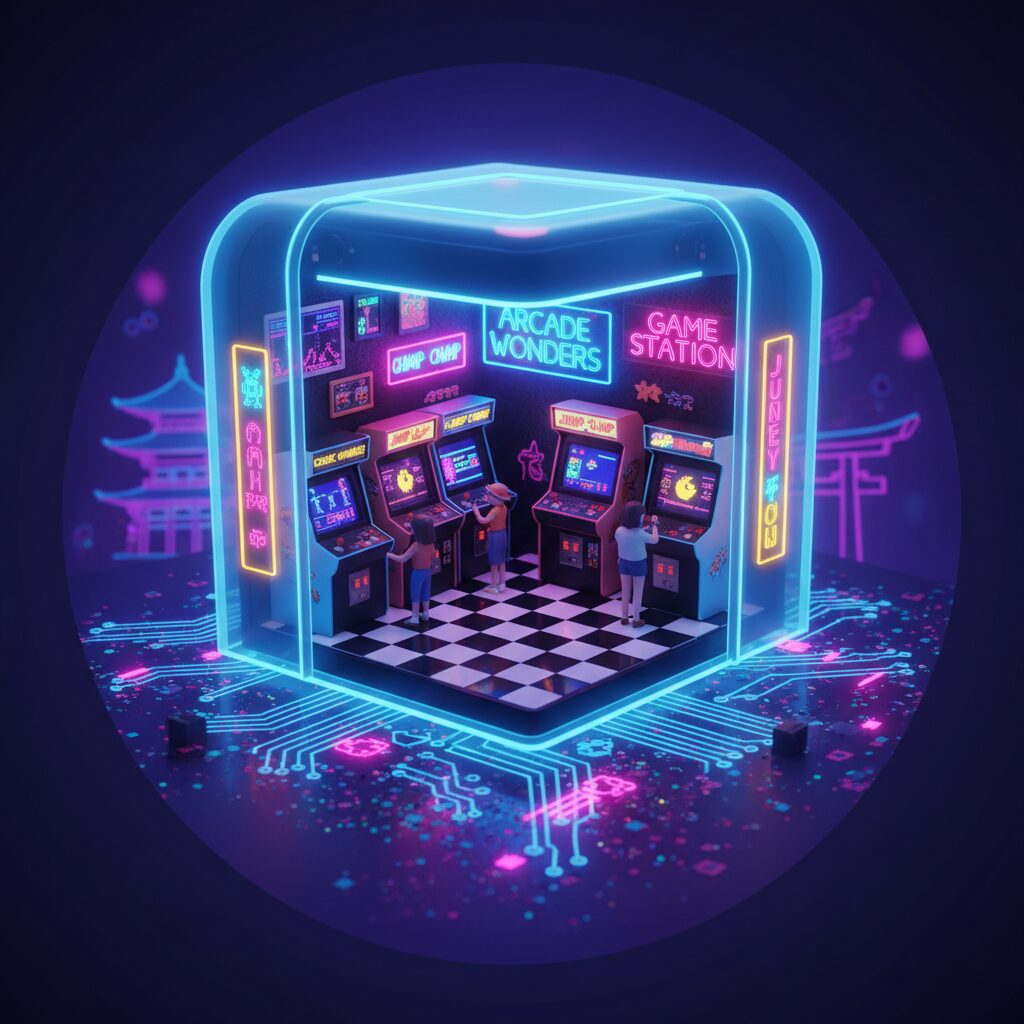
You asked me what it feels like to step into one of Japan’s old-school arcades, the ones tucked away in sleepy shotengai arcades or down the backstreets of Akihabara. It’s a great question, because the answer isn’t just about video games. The experience is a full-body sensory assault, a trip back to a version of the future that never quite happened. Forget the bright, sterile, family-friendly game centers in modern shopping malls, with their endless rows of crane games and rhythm machines. I’m talking about the real thing: the dimly lit, smoke-stained sanctuaries where the ghosts of the 1980s still live and breathe in flickering CRT screens.
Walking into one is like pushing through a temporal curtain. The first thing that hits you is the noise. It’s not a clean, digital soundscape; it’s a chaotic, analog symphony of a hundred different games all screaming for your attention at once. The chirps and laser blasts of Galaga, the guttural “Hadoken!” from Street Fighter II, the tinny synth-rock soundtrack of an old racing game—they all blend into a single, overwhelming roar. The air is thick with the ghosts of a million cigarettes, a scent now mostly banished by law but baked into the very walls and wiring. The light is low, emanating almost entirely from the glowing screens and the gaudy marquees of the game cabinets themselves. It’s a cave of pixelated dreams, a place outside of time. These arcades, or gēmu sentā as they’re known, aren’t just places to play old games. They are living museums dedicated to a very specific, very potent moment in Japanese history: the late Shōwa period and the subsequent Bubble Economy. They are subcultural hubs where a dedicated community keeps not just the machines, but a whole mindset, alive.
This journey into Japan’s nostalgic arcades also illuminates the enduring character of its traditional shotengai, where urban charm and community spirit continue to thrive.
The Dawn of the 100-Yen Universe

To grasp the retro arcade scene, you need to go back to a time before every household possessed a powerful gaming console and before the internet linked everyone. When Taito’s Space Invaders took the country by storm in 1978, it didn’t just introduce a new form of entertainment; it established a new kind of social space. The game’s popularity was so intense that it famously triggered a nationwide shortage of 100-yen coins. Arcades appeared everywhere, from dedicated halls in entertainment districts to dusty corners of coffee shops and bowling alleys.
In their early years, these venues carried a somewhat seedy, rebellious reputation. They were viewed as hangouts for truant students and leather-jacketed youths, places where the air was thick with smoke and an undercurrent of delinquency. These spaces were predominantly male, dimly lit, and tucked away, providing an escape from the strict structures of school and family life. They weren’t exactly wholesome. Yet, this image contributed to their appeal. It was a space belonging to a younger generation, a private world ruled by its own codes and hierarchies, where skill with a joystick could earn more respect than good grades.
As the Japanese economy soared in the 1980s, so did the ambition of the arcade. They became staples of the urban landscape, essential stops on the after-school or after-work social circuit. They functioned as nodes in the city’s nervous system, humming with youthful energy.
Frozen in Amber: The Bubble-Era Aesthetic
The golden era of Japanese arcades perfectly aligned with the Bubble Economy of the late 1980s and early 1990s. This was a time of intoxicating, almost delirious optimism and extravagant wealth. Japan stood as an economic powerhouse, with a national mood filled with boundless possibility. The future had arrived, dazzlingly advanced in technology. Arcades served as public showrooms for this new reality.
Flush with cash, game developers crafted experiences impossible to duplicate at home. This period introduced the taikan games—the “body-sensation” machines. These weren’t merely screens in cabinets; they were intricate, interactive sculptures. Consider Sega’s Out Run, where players sat in a replica Ferrari that tilted and rumbled as they raced through a pixelated California. Or After Burner, placing you in a hydraulic cockpit that pitched and rolled as you evaded enemy missiles. These machines were massive, costly, and thrilling. They embodied the era’s extravagance and fascination with technological mastery.
The entire retro arcade aesthetic stands as a tribute to this era. The worn joysticks with their satisfying click-clack, the concave plastic buttons that have absorbed the sweat of countless intense button mashes, the distinct hum and hypnotic scan lines of a CRT monitor. It is a deeply tactile environment. The sensory overload—the cacophony of sound, the dark room lit by bursts of color—was not a design flaw; it was the intention. It aimed to overwhelm, pulling you from everyday life into a supercharged digital world. It perfectly reflected a society intoxicated by its own success, a culture racing toward a future it believed would only grow brighter.
The Arcade as a Third Place
Beyond the technology, these arcades fulfilled an essential social role. They were a classic example of a “third place”—a setting that is neither home nor work, yet serves as a key pillar of community life. For a generation of Japanese youth, the gēmu sentā was their main third place. It was where you met friends, tested your skills, and engaged in a highly public form of social competition.
This was a community rooted in physical space, long before online multiplayer lobbies existed. The social dynamics were intricate and captivating. A crowd would naturally gather around a player nearing a high score, forming a quiet, respectful audience witnessing a moment of mastery. Local legends emerged in these spaces—players celebrated for their seemingly unbeatable skill in a particular game. Their initials atop the leaderboard symbolized a badge of honor, a visible declaration of dominance for anyone entering the arcade.
In a society as structured as Japan’s, the arcade presented a different kind of hierarchy. Your social status outside those walls was irrelevant. Age, occupation, and family background all faded away. Inside, the only thing that earned respect was skill. The quietest student in class could become a king at Street Fighter II, gaining the respect of older, tougher players through pure digital talent. It was a meritocracy of the joystick, a place where identity could be built solely on the ability to master a system.
The Long Fade and the Keepers of the Flame
The golden era was never meant to last forever. The collapse of the Bubble Economy in the early 90s marked the beginning of its decline. However, the true final blow came from within the industry itself. The launch of the Sony PlayStation in 1994, followed by the Nintendo 64, represented a significant turning point. For the first time, home consoles could offer experiences that were impressively close to, and occasionally even surpassed, what arcades provided. The motivation to spend 100 yen per play outside began to fade.
At the same time, urban environments were transforming. Rent prices soared, pushing out small, independent arcades. The industry shifted to a new model: large, bright, and clean entertainment centers aimed at attracting a wider audience. Crane games, photo booths (purikura), and music rhythm games became the main attractions, drawing couples, families, and groups of female students. The dark, smoky refuges once favored by hardcore gamers started disappearing one after another.
Yet, they never vanished entirely. A devoted few have managed to survive, operating not for profit but out of passion. These owners are often former players themselves, serving as caretakers of a fading art form. They function as mechanics, archivists, and community leaders all at once, dedicating their time to meticulously repairing 30-year-old circuit boards and hunting down rare parts to keep the machines alive. The patrons of these final havens form an unusual mix. You’ll find men in their 40s and 50s stopping in after work to relive the glory days of their youth. But there is also a younger generation of devoted gamers—enthusiasts who value the history and the harsh challenge of these classic games. This is a subculture of purists. For them, playing Dodonpachi on an original cabinet offers a completely different, more authentic experience than playing it on an emulator at home.
More Than a Machine: Preserving a Mindset
Ultimately, what these retro arcades preserve goes beyond just hardware—they preserve a mindset. At the heart of this is the culture of the “one coin.” With infinite continues available at home, failure loses its meaning. In the arcade, every game is a performance. Your 100-yen coin grants you a limited opportunity, usually three lives, to showcase your skill. This cultivates an intense sense of focus, tension, and discipline. Every move counts. The ultimate goal is to survive as long as possible on a single credit—a philosophy of efficiency and mastery that modern gaming has largely abandoned.
They also maintain a pre-internet form of social connection. In an age of Discord servers and global matchmaking, the retro arcade harks back to a time when your gaming community consisted of the people sharing the same room. You could face your rival directly. You could hear the cheers or groans of those watching you play. It was a tangible, human-centered form of interaction.
Visiting a retro arcade in Japan today is like stepping into a small act of time travel. You enter a physical archive of a nation’s ambitions, anxieties, and aesthetic sensibilities from a past era. It offers a chance to experience a particular kind of intensity—a unique blend of technology and community unlikely to be seen again. These places are noisy, cramped, and somewhat grubby. And yet, they are absolutely beautiful. They are the pixelated ghosts of the Bubble, with their flashing screens serving as a reminder that for a brief, brilliant moment, the future was a place you could visit for just 100 yen.