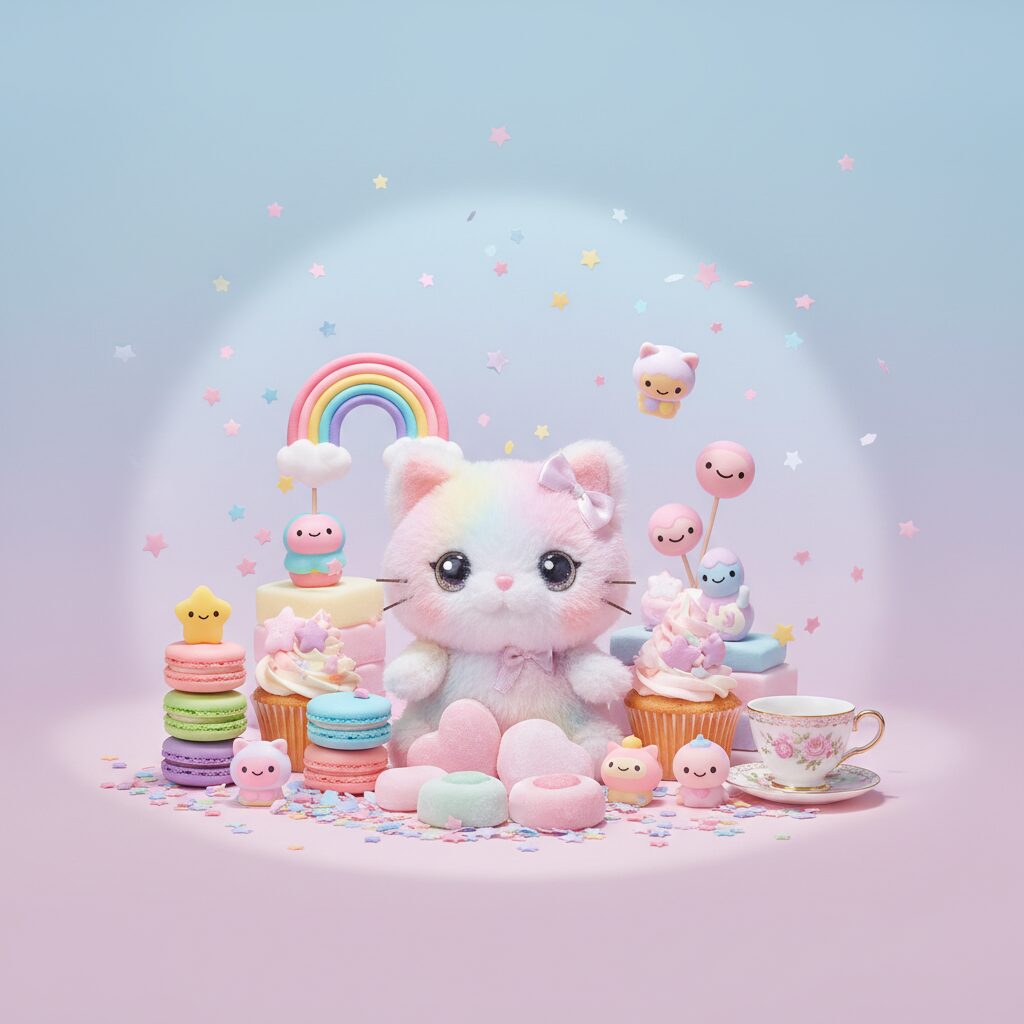
Walk into any convenience store in Tokyo, and you’ll be greeted by an army of friendly faces. They’re on your bottle of green tea, on the packaging for your onigiri, on the ATM screen, even on the public service posters plastered to the wall. These aren’t the faces of celebrities or models; they are round, wide-eyed, impossibly cheerful characters. A smiling shiba inu, a blushing rice ball, a personified drop of water. This is the world of kawaii, and for most outsiders, it’s one of Japan’s most defining—and perhaps most baffling—cultural exports. The word itself, usually translated as “cute,” feels inadequate. It’s what you might call a kitten, or a baby, or a miniature dessert. But in Japan, kawaii is so much more than that. It’s a full-blown aesthetic philosophy, a powerful communication tool, a multi-billion dollar industry, and a subtle form of social rebellion all rolled into one.
The global image of kawaii is often flat and one-dimensional, dominated by the blank stare of Hello Kitty or the electric cheeks of Pikachu. It’s seen as frivolous, childish, maybe even a little strange for a culture otherwise known for its seriousness, formality, and minimalist design. But to dismiss kawaii as simple cuteness is to miss the point entirely. It is a complex visual language that permeates every layer of Japanese society, from the boardroom to the construction site. It’s a cushion that softens the hard edges of daily life, a secret handshake that builds instant rapport, and a canvas for expressing emotions that are otherwise left unsaid. Understanding kawaii isn’t just about appreciating cute characters; it’s about unlocking a deeper understanding of the Japanese psyche itself—how people navigate social pressures, communicate indirectly, and find joy and comfort in a demanding world. This isn’t just about what’s cute; it’s about why it’s cute, and what that cuteness does.
The multifaceted charm of kawaii finds a parallel in Japan’s art scene, where the innovative energy of Shibuya-kei pop art further exemplifies the nation’s unique blend of tradition and modern creativity.
The Birth of Cute: A Quiet Rebellion in the Classroom
Although the affection for small, charming objects can be traced back centuries in Japanese literature and art, the modern phenomenon of kawaii culture has a surprisingly specific and subversive origin. It did not start in a corporate design studio, but rather in the notebooks of teenage girls in the 1970s. During a time of rapid economic growth and strict social conformity, these schoolgirls quietly rebelled against the standardized, adult world. Their chosen weapon? Handwriting.
They rejected the stiff, vertical, and angular characters of standard Japanese script, a style linked to authority and masculine tradition. Instead, they created marui ji, or “round writing.” The characters were bubbly, childlike, and tilted, often decorated with tiny drawings of hearts, stars, and cartoon faces (known as heta-uma, or “bad-but-good” illustrations). This was a radical break from the norm. The new script was more than a trend; it was a purposeful act of creating a separate, private world. It became a visual code, a language made by and for young women, deliberately hard for adults and teachers to read quickly. It allowed them to carve out an identity distinct from the one imposed by the education system and society as a whole.
Unsurprisingly, the establishment responded with alarm. Schools nationwide banned marui ji, seeing it as a lazy, childish, and improper way of writing. However, this only reinforced its role as a symbol of youth identity. The girls had invented something uniquely theirs. This aesthetic of rounded, approachable, and expressive forms established the foundational grammar for what would become the kawaii revolution. It was the first indication that “childishness” could be empowering—a way to reject the constraints of the adult world and establish new values centered on emotion, softness, and personal expression. The commercial world took notice, and companies like Sanrio soon learned to speak this new visual language fluently.
The Anatomy of Kawaii: More Than Just Big Eyes
To grasp the power of kawaii, you need to analyze its aesthetic. It’s a deliberately crafted form of charm meant to evoke a specific emotional reaction: a sense of affection and the urge to nurture and protect. While its most recognizable features borrow from neoteny—the retention of juvenile traits in adults—such as large heads, big eyes, and small bodies, the true mastery of kawaii lies in more nuanced principles.
A key element is a feeling of vulnerability. A character who is perfectly strong and capable isn’t genuinely kawaii. Instead, kawaii characters often exhibit some degree of helplessness or lovable imperfection. They may be clumsy, shy, or slightly awkward. Consider Gudetama, the lazy egg, defined by his complete lack of motivation. This cultivated vulnerability is crucial. It shifts the viewer from passive observer to potential caregiver, eliciting empathy that makes the character not only cute but also relatable and endearing. It’s a message that says, “I’m not a threat; I need your care.”
Simplicity and abstraction are equally essential. The most successful kawaii characters tend to be strikingly simple. Hello Kitty, a global symbol of kawaii, is the perfect example. She has no mouth—not due to a design mistake, but a stroke of brilliance. Without a fixed expression, she reflects the viewer’s emotions. When you’re happy, she appears happy; when you’re sad, she seems to share your sorrow. This emotional ambiguity fosters a deeper, more personal connection. The character does not impose a feeling; it absorbs yours. By reducing to essential shapes, complexity is stripped away, inviting projection and making the character a universal emotional vessel.
This combination of vulnerability and simplicity generates a powerful emotional draw. It’s an aesthetic that bypasses rational scrutiny and speaks directly to a primal instinct to care for the young and helpless. It’s not about portraying a photorealistic ideal of beauty but about forging an emotional bond through carefully designed imperfection and abstraction.
The Social Function of Cute: A Cushion for a High-Context Society
If kawaii were simply an aesthetic, it would have remained a niche interest. Its true strength, and the reason for its widespread presence in Japan, lies in its social function. In a high-context culture that values group harmony (wa) and avoids direct confrontation, kawaii acts as an essential lubricant, smoothing social interactions and conveying complex messages in a gentle, approachable manner.
Softening the Hard Edges
Everyday life in Japan is governed by rules, requests, and apologies. Kawaii offers a visual means to communicate these messages without seeming authoritarian or harsh. Take, for example, the common construction sites in Japanese cities. Rather than stark metal barricades and aggressive “Keep Out” signs, they are often adorned with panels featuring cute, bowing animals or cartoon construction workers apologizing for the noise and inconvenience. The message remains the same, but its delivery is transformed. The adorable mascot is not merely decorative; it performs a social ritual of apology. It diffuses potential frustration and reframes the inconvenience as a polite, shared experience.
This concept is evident everywhere. The police in Tokyo use charming characters like Pipo-kun to make their presence feel more like community guardianship rather than state authority. Banks display friendly animal mascots on their ATM screens to make financial transactions less intimidating. Government agencies employ kawaii characters in public health campaigns to present serious information about taxes or disaster preparedness in a way that feels supportive rather than forceful. In each instance, kawaii acts as a buffer. It softens the harsh, impersonal face of authority and replaces it with a sense of gentle, friendly guidance. It enforces rules and shares information while preserving social harmony.
A Tool for Connection and Expression
Beyond public life, kawaii serves as a deeply personal means of communication. In a culture where overt emotional expression can sometimes be viewed as disruptive or immature, cute characters and symbols provide a safe and accepted channel for conveying feelings. The popularity of messaging apps like LINE in Japan is closely tied to its vast collection of “stickers”—large, expressive cartoon images that often substitute text entirely.
A single sticker depicting a weeping bear or a dancing cat can express a broad range of emotions—apology, excitement, empathy, gratitude—with subtleties that words might find difficult to capture. It allows people to be vulnerable and emotionally open without the bluntness of text. Sending a cute sticker that says “I’m sorry” feels gentler and more heartfelt than typed words alone. It represents a low-risk, high-reward form of emotional communication, perfectly suited to a culture that values subtlety.
This extends to personal possessions as well. A salaryman might present a serious demeanor and wear a conservative suit, yet a small, cute keychain attached to his briefcase offers a glimpse into his personality. It’s a subtle act of self-expression, a way of revealing a softer side within a highly structured professional environment. Kawaii enables the expression of an inner, more playful self that might not be acceptable in more formal settings.
The Economic Engine of Kawaii: From Niche to Nation Brand
The emotional and social appeal of kawaii was swiftly transformed into a powerful economic force. Sanrio, established in the 1960s, led the way by turning the simple philosophy of “small gift, big smile” into a global empire centered on characters like Hello Kitty, My Melody, and Little Twin Stars. They demonstrated that a character didn’t require a complicated backstory or media franchise to succeed; it only needed to establish an emotional connection.
Today, this approach has been adopted nationwide. One of the most intriguing trends is the emergence of gotōchi kyara, or local mascots. Almost every prefecture, city, and even small town in Japan has its own official kawaii mascot created to represent its local culture and boost tourism. These are more than just quirky side projects; they are serious branding efforts. Kumamon, the rosy-cheeked black bear from Kumamoto Prefecture, is a global celebrity who has generated billions in revenue through merchandise and licensing. Funassyi, the energetic pear-fairy from Funabashi, became a national media phenomenon.
These mascots provide a friendly, approachable image for a place. They symbolize local specialties—a famous fruit, a historic figure, a unique animal—in a cute, memorable form. They foster an emotional bond between people and places, encouraging tourism and local product purchases. The widespread use of this strategy highlights how deeply kawaii is embedded as a tool for public relations and economic revitalization. Even the most serious and traditional institutions have embraced it. The Japan Self-Defense Forces employ cute, anime-inspired mascots in their recruitment campaigns. The Ministry of Finance has its own characters. In Japan, there is no institution too solemn to be represented by an adorable cartoon.
The Darker Side and Modern Evolutions
Certainly, a cultural force as influential as this is not without its critics and intricacies. The world of kawaii is not entirely idyllic. For decades, commentators both within and outside Japan have wrestled with its more problematic elements while also celebrating its subversive transformations.
Escapism and Infantilization?
A common critique of kawaii culture is that it encourages escapism and the infantilization of adults, especially women. The argument posits that by surrounding themselves with cute, childlike objects, individuals may be evading the harsh realities and responsibilities of adult life. This critique intersects with feminist perspectives that claim kawaii aesthetics perpetuate harmful gender stereotypes. The ideal of kawaii femininity—with its focus on high-pitched voices, helpless gestures, and a non-threatening demeanor—can be interpreted as reflecting patriarchal expectations for women to be submissive, dependent, and perpetually childlike.
Although many young women embrace kawaii as a form of empowered self-expression, the debate over whether it represents liberation or a gilded cage continues. This discussion underscores the complex role kawaii plays in navigating identity and gender roles in modern Japan. Is it a retreat into a safe, non-threatening world, or a deliberate choice to embrace an alternative set of values?
From Kimo-Kawaii to Yami-Kawaii
Lately, kawaii aesthetics have been appropriated and reimagined by younger generations to explore much darker themes. The classic, innocent form of cuteness has fractured into new subgenres that challenge its original principles. Kimo-kawaii, or “creepy-cute,” merges the adorable with the grotesque. Characters in this style often feature large, endearing eyes alongside unsettling, unnatural traits. It plays on the tension between attraction and repulsion, creating something both charming and disconcerting.
An even stronger evolution is yami-kawaii, or “sick-cute.” This subculture, centered in Tokyo’s Harajuku district, employs the visual language of classic kawaii—pastel colors, bows, and cute characters—while incorporating imagery associated with mental illness, self-harm, and medical paraphernalia. You might spot a T-shirt featuring a cute bunny holding a syringe or a pastel pink sweatshirt decorated with pills and bandages. This striking and powerful aesthetic serves as a method for young people to address taboo topics like depression and anxiety. By wrapping these dark themes in a cute guise, they make them more visible and approachable, fostering a community built around shared struggles. It is kawaii inverted, using the tools of comfort and softness to confront pain and alienation.
These developments illustrate that kawaii is neither static nor monolithic. It is a living language continuously reinterpreted and repurposed to mirror the evolving anxieties and hopes of Japanese society. From a schoolgirl’s secret code to a language for processing trauma, its capacity for reinvention is a testament to its lasting influence.
In the end, kawaii is much more than the sum of its cute elements. It serves as a sophisticated response to the pressures of living in a society that demands conformity and control. It functions as a means of managing friction, a medium for expressing emotion, a uniform for subcultures, and a brand for a nation. To focus solely on the smiling, wide-eyed characters on the surface is to overlook the profound cultural currents beneath. Kawaii is the gentle, pastel-colored armor that helps Japan navigate the complexities of its own world. In its ability to encompass both comforting warmth and unsettling darkness, it reflects a truth that is anything but simple.