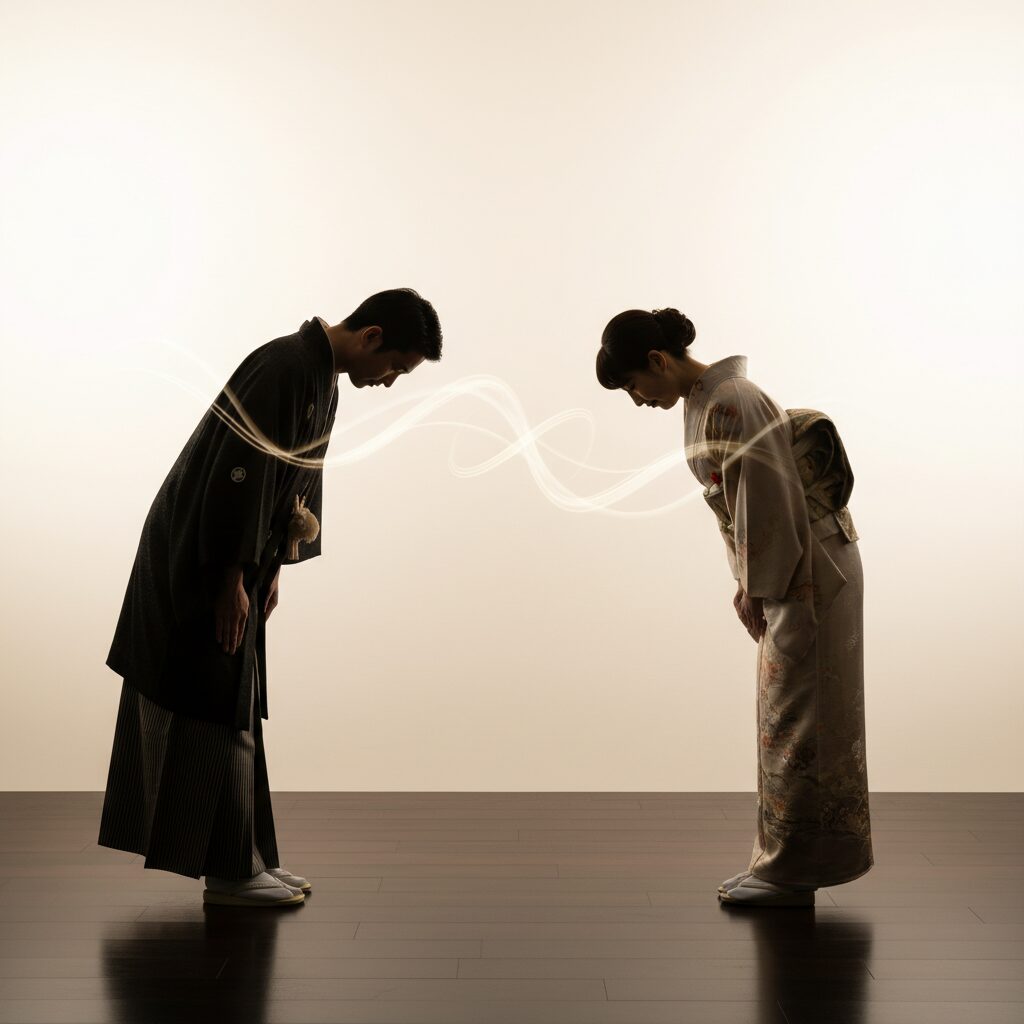
Walk around any Japanese city for ten minutes, and you’ll see it. The quick dip of the head from a convenience store clerk. The deeper, more formal bend from a hotel concierge. The almost imperceptible nod between two men in suits passing on the street. To the casual observer, it’s all just “bowing”—a charming, uniform gesture of Japanese politeness. But to think of it that way is like looking at the entire English alphabet and just calling it “writing.” You’re missing the grammar, the vocabulary, and the entire conversation happening in plain sight.
The Japanese bow, or ojigi (お辞儀), isn’t a simple gesture. It’s a complex, non-verbal language, a physical manifestation of social dynamics that communicates respect, gratitude, apology, and status with breathtaking precision. It’s a system so deeply ingrained that people will bow to an empty phone receiver when speaking to a superior. It’s a physical reflex tied to the very core of Japanese social consciousness. Understanding the nuances of the bow is to begin understanding the invisible architecture of Japanese society itself: the importance of hierarchy, the concept of social harmony (wa), and the clear lines drawn between insiders (uchi) and outsiders (soto). Forget the tourist-brochure explanations. Let’s decode what’s really being said when someone in Japan lowers their head.
The meticulous social cues discussed here find an intriguing parallel in the focused mindfulness of zen pachinko practices, which further reveals the subtle interplay of tradition and modernity in Japanese culture.
The Bedrock of the Bow: Harmony, Humility, and Hierarchy
Before discussing angles and duration, we must first address a more fundamental question: why bow at all? The Western handshake symbolizes equality, a meeting of hands on an even plane. In contrast, the bow is an expression of deference. It stems from lowering oneself physically to show respect to the person before you. This isn’t about subservience in a negative sense; rather, it acknowledges a social order that has been the foundation of the culture for centuries.
The custom has its origins in the warrior class. For a samurai, exposing the back of the neck was the ultimate sign of trust, a non-verbal indication that you posed no threat and trusted them not to strike while vulnerable. This gesture of openness evolved under the influence of Buddhist values of humility and Confucian ideals of a well-ordered, hierarchical society where everyone knows their place. Bowing became the social mechanism that kept this society functioning smoothly. It acts as a constant, silent reaffirmation of relationships, communicating, “I see you. I recognize your position relative to mine. I will behave accordingly to maintain harmony between us.”
In contemporary Japan, bowing serves as a vital tool for navigating social and professional interactions. A bow can defuse tension, convey gratitude more deeply than words, or express an apology so heartfelt it can repair a damaged business relationship. It eliminates ambiguity. You always understand your standing with someone, quite literally, by how they bow to you.
The Grammar of Bending: Angle and Context
Just as a single word can carry multiple meanings depending on context, the meaning of a bow is determined by its physical execution. The key variable is the angle of the bend from the waist. A deeper angle expresses a stronger emotion—greater respect, more sincerity, or a more heartfelt apology. Maintaining a straight back is essential; a slouched or curved back is perceived as lazy and insincere. Consider it a spectrum of formality, with three main categories everyone instinctively recognizes.
The 15-Degree `Eshaku`: The Social Punctuation
The eshaku (会釈) is the most common and casual bow, a quick nod of about 15 degrees. This is the everyday punctuation of Japanese social interaction. It’s equivalent to a friendly “hello,” a brief “thanks,” or a simple acknowledgment. You’ll witness it countless times a day. It’s the bow you offer to a colleague you pass in the hallway, the one the cashier gives you as they hand you your change, or the slight nod you make to someone who holds a door open. It’s informal, fluid, and often accompanied by a smile. It’s a gesture of light politeness, not deep respect. It keeps social interactions pleasant without interrupting the flow of the day. It simply conveys, “I acknowledge your presence.”
The 30-Degree `Keirei`: The Bow of Respect
Here, the bow becomes a more deliberate and formal gesture. The keirei (敬礼), or “respectful bow,” is a bend of about 30 to 45 degrees. This is the standard bow in most business and professional settings. It’s used to greet clients, thank a superior, or meet someone formally for the first time. The posture is more rigid: back straight, heels together, with a longer hold at the bottom of the bow. For men, hands remain straight at their sides; for women, they are typically clasped in front. The keirei is not a casual nod; it is a clear sign of respect and sincerity. It communicates, “I value you, and I take our interaction seriously.” When a department store employee welcomes you or a business partner greets you at the start of a meeting, this is the bow you’ll encounter. It sets a tone of mutual, professional respect.
The 45-Degree-Plus `Saikeirei`: The Ultimate Expression
The saikeirei (最敬礼) means the “most respectful bow.” This is a deep, slow bow of 45 to 90 degrees, held for a noticeable length of time. The saikeirei is rare and powerful, reserved for moments of extreme gravity. It is the physical expression of emotions often too intense for words. It is used to show profound gratitude, a heartfelt apology, or to demonstrate deference to someone of the highest status, such as the Emperor or a company president during a major crisis. When a company issues a public apology for a serious scandal, executives perform a deep, prolonged saikeirei in front of the cameras. It is an act of complete humility, a non-verbal plea for forgiveness. Likewise, it can express overwhelming thanks. Witnessing a saikeirei in person is a genuinely striking experience; it feels as though the air has been drawn from the room. It’s a moment of pure, unfiltered social communication that requires no translation.
Beyond the Bend: The Silent Modifiers
The angle serves as the main verb in the bowing sentence, but adjectives and adverbs add essential layers of meaning. These subtle details distinguish a routine gesture from one with genuine significance.
Gaze and Breath
Where you direct your gaze during a bow is crucial. Maintaining eye contact while bowing is seen as aggressive and disrespectful. Instead, the gaze should follow the bow’s arc, naturally lowering towards the floor. This act of averting the eyes symbolizes humility; you are not confronting the other person but showing deference. The rhythm of breathing also matters. A proper bow is often executed by inhaling while standing upright, then exhaling slowly as you bend and rise. This infuses the gesture with a calm, deliberate intention, eliminating any sense of it being hurried or thoughtless.
Duration and Repetition
The length of time you hold the bow at its lowest point conveys a great deal. A quick nod is casual and friendly. Holding the bow a beat or two longer indicates greater sincerity. In the case of a deep apology, the bow may be held for several seconds, silently expressing the depth of one’s remorse. Repetition functions as another modifier. Sometimes a single bow is insufficient. You might witness two people exchanging a series of bows, each responding to the other in a kind of “bowing rally.” A well-known example is the “elevator bow,” where a host continues bowing to guests as the elevator doors close, holding the final bow until they are completely out of sight. This is not awkwardness; it is a profound expression of ongoing respect and hospitality.
Bowing in a World of Screens and Globalism
One might expect such a traditional practice to diminish in an increasingly globalized and digital Japan. Yet, the opposite holds true. The bow has shown remarkable adaptability. The clearest example is the “phone bow.” Ask any Japanese person, and they will probably confess to doing it: bowing while on the phone with a client or superior. Although the person on the other end can’t see it, the physical gesture is so deeply ingrained in the brain’s social wiring that the body performs it automatically. It offers a fascinating insight into how muscle memory and social conditioning are intertwined.
In the age of video conferencing, a new etiquette has emerged: the seated bow. When a meeting starts or ends, participants often bow from the waist while sitting in their chairs. It’s a smaller, abbreviated form of a standing bow, but the intention remains the same. It’s a way of transferring this essential element of social etiquette into a digital setting.
Naturally, interactions with non-Japanese individuals bring a new dynamic. Most Japanese in international business do not expect foreigners to fully understand the nuances of ojigi. A simple, respectful nod of the head is generally sufficient and appreciated. Attempting a complete, formal bow without grasping the context can sometimes seem awkward or even humorous. However, comprehending the why behind the bow—the respect and humility it embodies—is much more important than perfecting the angle.
To regard the bow merely as a greeting is to miss its essence entirely. It is a constant, subtle negotiation of social distance, a physical manifestation of an entire cultural ethos. It is a language that, once you learn to recognize its patterns, reveals the complex and often unseen bonds holding Japanese society together. It reminds us that sometimes, the most important messages are conveyed without words. The next time you see someone bow in Japan, look more closely. They aren’t just bending their back; they’re telling a story.