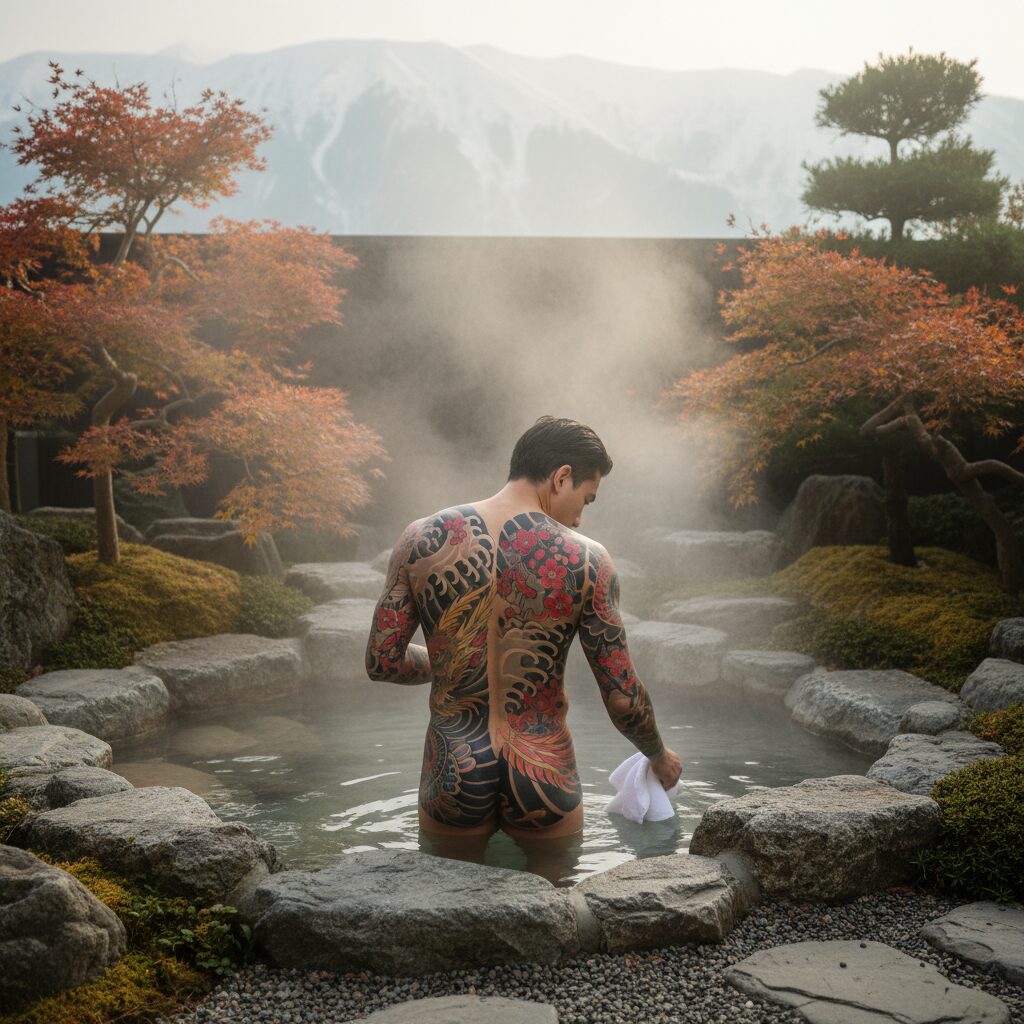
Imagine the scene. You’ve just finished a long, rewarding hike through the Hakone mountains, muscles aching in that satisfying way only a good climb can produce. All day, you’ve been dreaming of this: sinking into a steaming, mineral-rich onsen bath, the volcanic water a balm for body and soul. You arrive at the ryokan, a picture of traditional elegance, and approach the entrance to the bathhouse. And then you see it. A small, polite sign with an unmistakable pictograph: a stylized human figure, marked with tattoos, crossed out with a bold red X. Your heart sinks. Your own modest tattoo, a memento from a different time in your life, suddenly feels like a brand.
It’s a scenario familiar to many visitors to Japan, and one that often causes a mix of confusion, frustration, and even offense. Is this personal? Is it a judgment on your character? The short answer is no. The long answer is far more complicated, a story woven from threads of organized crime, ancient concepts of purity, and the powerful social gravity of the group. The onsen tattoo ban isn’t really about you. It’s a window into the cultural logic that quietly shapes modern Japan, revealing how deeply history flows beneath the surface of daily life. To understand this single rule is to begin to understand something essential about the country itself.
This complex interplay of tradition and modern attitudes is mirrored in Japan’s intriguing history of obsessive plastic model culture, which adds another layer to the country’s multifaceted identity.
The Shadow of the Yakuza
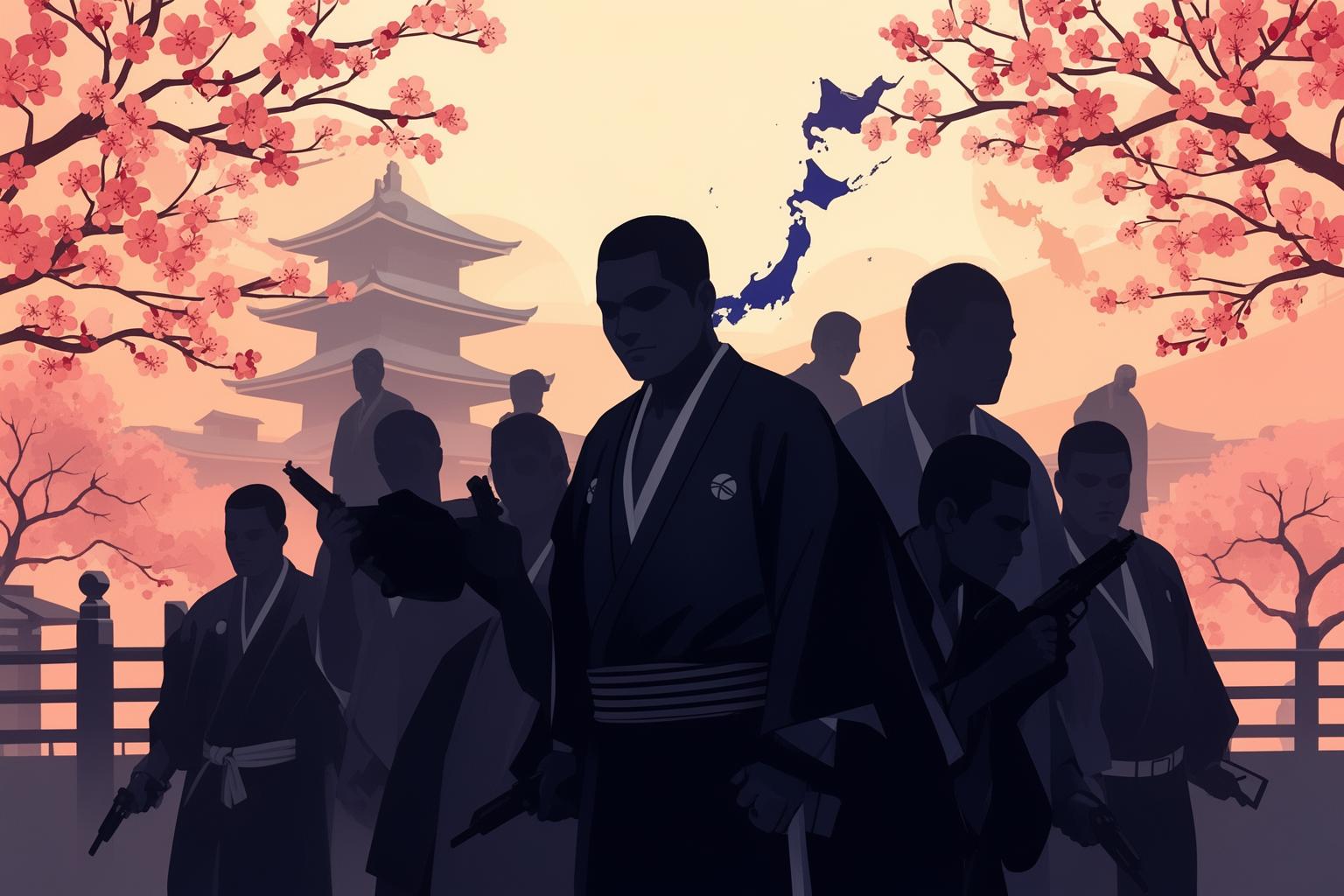
Let’s begin with the most common and straightforward explanation you’ll encounter: the yakuza. Throughout much of the 20th century, elaborate full-body tattoos—known as irezumi or horimono—were the distinctive and exclusive insignia of Japan’s organized crime groups. These tattoos were not subtle or small designs; they were bold statements. A man adorned with a full backpiece featuring a dragon, carp, or mythical hero was clearly signaling that he existed outside the norms of conventional society. He had endured countless hours of intense pain from traditional hand-poking methods (tebori) as a demonstration of his loyalty, resilience, and dedication to a dangerous, often violent underworld.
This connection became deeply ingrained in public perception. During the Showa Era (1926-1989), when yakuza were a more visible and somewhat romanticized (at least in film) part of society, their presence in onsen was genuinely troubling. An onsen is a place of vulnerability: everyone is naked, defenses are lowered, and the atmosphere is meant to be one of calm, communal relaxation. The sudden arrival of men covered in unmistakable symbols of organized crime would instantly disrupt that peace. It was intimidating, signaling that this serene environment might become the setting for gang conflicts or illicit activities. Other guests would feel uneasy, their relaxation disturbed. They would leave and likely never return.
Confronted with this reality, onsen owners and public bathhouses responded as any prudent business would: they implemented a preventative policy. The “No Tattoos Allowed” sign was not a moral condemnation of body art but a practical measure of risk management. It served as a clear, straightforward message: “We do not welcome organized crime here.” It reassured regular, law-abiding patrons that this was a safe space, free from the tension and threat symbolized by the yakuza. Essentially, the ban functioned as an anti-gang measure disguised as an aesthetic regulation. This is the historical foundation of the policy and the part of the story most people recognize. Yet, it’s only the beginning.
Purity, Pollution, and the Sacredness of the Bath
To fully understand why the ban endures long after the yakuza’s prime, we need to delve deeper—beyond the 20th century and into the core values of Japanese culture. An onsen is more than just a hot bath; it is a purification ritual. This concept is closely tied to Shinto, Japan’s native religion, which centers on the ideas of purity (hare) and pollution (kegare).
In Shinto belief, kegare refers to a state of spiritual impurity or defilement, caused by contact with death, disease, or bloodshed. It is not considered a sin in the Western sense but rather an impurity that disrupts one’s natural state and must be cleansed through ritual. Water, especially the pure geothermally heated water of an onsen, has long been regarded as a powerful means of purification. Entering an onsen is, on a subtle cultural level, an act of washing away the dirt of the outside world—both physically and spiritually. It is a return to a clean, natural state.
So, where do tattoos come into this? Historically, before tattoos were adopted by the yakuza, they were sometimes used as punishment during the Edo Period (1603–1868). Criminals were marked with tattoos on their faces or arms to permanently label them as outcasts. This practice linked tattoos to criminality and social deviance, marking the wearer as “polluted” and outside societal norms. The ink beneath the skin became a lasting sign of impurity, disturbing the body’s natural state.
Placing this historically “defiled” body into a communal space dedicated to ritual purification creates a spiritual contradiction. The reasoning, though often unconscious today, is that a tattooed body introduces a foreign, permanent element into a space intended to be pure and transient. It disrupts the sanctity of the water and the cleansing ritual. While few onsen owners would explain it this way now, this ancient cultural framework forms the invisible foundation that sustains the modern rule. It reflects a time when the divide between clean and unclean, pure and polluted, was a central organizing principle of society.
The Unspoken Rule: Maintaining Group Harmony
Beyond history and religion lies perhaps the strongest force shaping modern Japanese society: the primacy of the group. The concept of wa (和), or group harmony, forms the foundation of social interaction. It emphasizes that the smooth operation and comfort of the group take precedence over the desires or expressions of any single individual. The ideal is to maintain a frictionless, predictable, and pleasant environment for everyone. This often involves suppressing overt displays of individuality to conform to the group’s unspoken expectations.
An onsen exemplifies this principle. It is one of the rare places in a hierarchical society where everyone is, for a moment, equal. Stripped of clothes, titles, and status symbols, you become just another body sharing a communal experience. The onsen’s etiquette—washing thoroughly before entering the bath, avoiding splashing, speaking quietly—is designed to preserve this shared tranquility. It represents a collective agreement to maintain peace.
In this context, a tattoo is a bold and permanent expression of individuality. It immediately attracts attention and distinguishes the wearer from the naked, unadorned majority, disrupting visual uniformity. Even if no one consciously associates it with the “yakuza,” a tattoo can be subconsciously unsettling. It introduces an element of unpredictability into an otherwise predictable space. An elderly bather, especially, might experience a flicker of unease or intimidation, recalling Showa-era associations. Their peace and relaxation are subtly interrupted.
Within the logic of wa, that is sufficient reason. The onsen operator’s primary responsibility is to ensure that no one feels uncomfortable. If one person’s expression (your tattoo) risks causing even mild discomfort to another visitor (the elderly regular), harmony favors the person who feels disturbed. The simplest resolution is to remove the source of potential disturbance. Thus, the ban serves as a means to preserve social harmony. It’s not that they dislike you; rather, they oppose the ripple of discord your presence might cause. It is a preventative measure to avoid social friction before it arises.
Modern Realities and Slow Change
Certainly, Japan does not exist in isolation. The world has evolved, and so has the significance of tattoos. The rigid stance is beginning to ease, though very slowly. Unsurprisingly, the main catalyst for this shift is international tourism. As millions of visitors—many sporting “fashion tattoos” with no connection to crime—visit Japan, the hospitality industry is increasingly compelled to address the issue.
The Japanese government, keen to increase tourism, has even subtly encouraged onsen to be more accommodating. They have proposed measures like permitting visitors to cover small tattoos with waterproof bandages or granting entry when it’s evident that the tattoos are not linked to criminal activity. This has led to a gradual breakdown of the old consensus.
Nowadays, the onsen scene is a mosaic of different policies. Traditional, long-established establishments in rural regions tend to maintain a strict, uncompromising ban. They serve a loyal domestic clientele and see no need for change. Conversely, onsen in major cities or popular tourist destinations like Hakone or Beppu are becoming more flexible. Some openly promote themselves as “tattoo-friendly,” while others have introduced a “cover it up” rule. An increasingly popular option for tattooed visitors is to rent a ryokan room with a private onsen (kashikiri-buro). These private baths, bookable by the hour, completely avoid the communal issue, allowing guests to enjoy their experience without worrying about signs or other guests’ comfort.
This gradual change highlights the fundamental tension. On one side lies centuries of cultural inertia: the link to crime, notions of purity, and the strong desire for group harmony. On the other, powerful economic and social forces from globalization and a younger Japanese generation that perceives tattoos very differently from their elders. For now, there is no definitive solution. The rule still stands in many places, but exceptions are on the rise. The best advice for tattooed travelers is to research in advance. A quick look at an onsen’s website or a phone call to your hotel can help avoid much disappointment.
In the end, the “No Tattoos” sign is more than a rule. It’s a cultural symbol. It narrates how a society defines safe spaces, what purity means, and where the boundary lies between the individual and the group. While it may seem like an outdated, discriminatory policy, understanding its reasoning provides real insight. It reminds you that in Japan, the waters run deep, and the past is always present, simmering just beneath the surface.