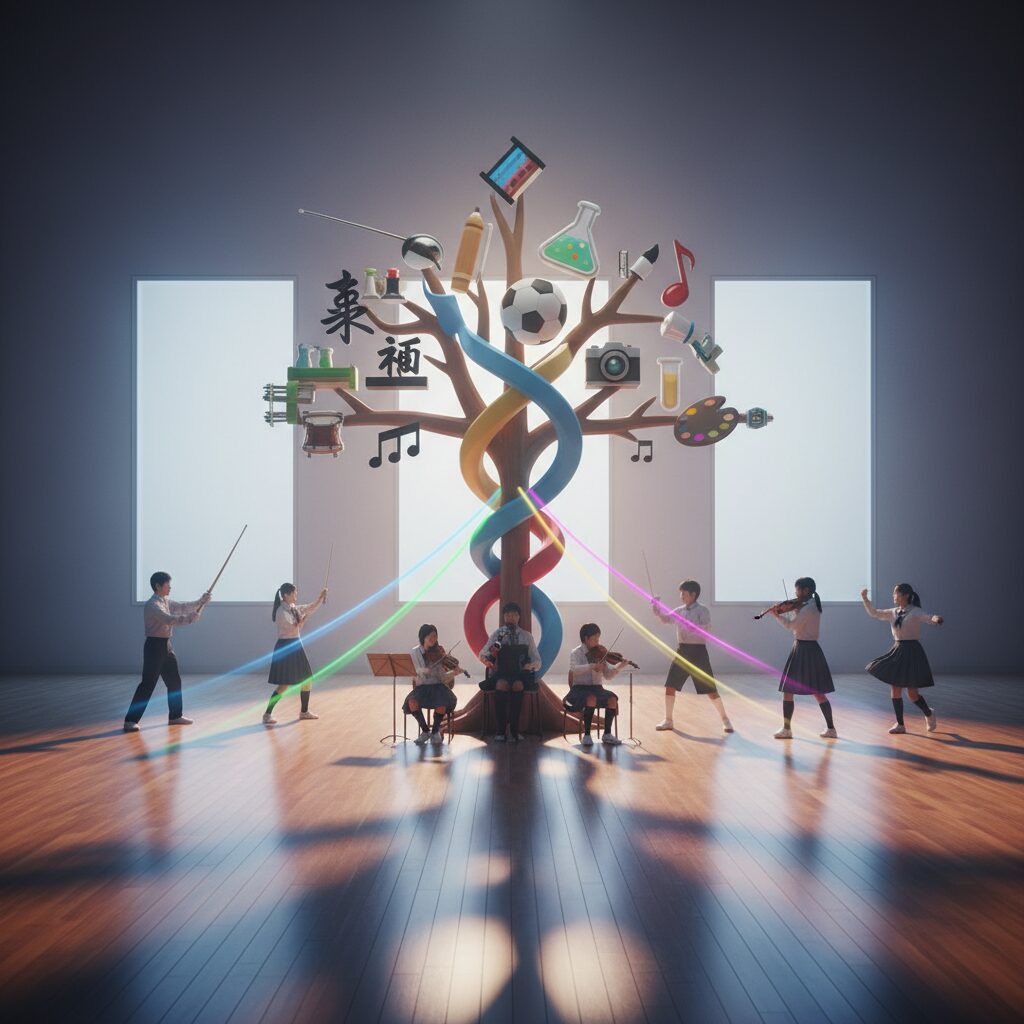
In Australia, where I grew up, after-school activities were a pleasant supplement to the main event of education. You had soccer practice on Tuesdays and Thursdays, maybe a piano lesson on Wednesdays. Weekends were largely your own. It was a balanced, sensible approach to fostering hobbies and letting kids blow off steam. When I first moved to Japan, I saw children in uniforms everywhere, at all hours, practicing, drilling, and moving with a seriousness that seemed utterly disproportionate to their age. I’d see them at 7 a.m. doing running drills before the first bell and still hear the crack of baseball bats or the unified shouts from the kendo hall long after sunset. This, I quickly learned, was bukatsu (部活), and it was nothing like the casual clubs of my youth. It was a full-body immersion, a parallel curriculum in Japanese identity.
To an outsider, the sheer intensity of bukatsu, or school club activities, can be baffling. It’s not a choice; for most junior high and high school students, it’s a given. And it’s not a hobby; it’s a commitment that rivals a full-time job in its demands on time, energy, and spirit. Forget weekends off or long, lazy summer holidays. Those are peak seasons for training camps, practice games, and tournaments. This system is a foundational pillar of Japanese society, a meticulously designed machine for instilling cultural values far more important than how to hit a curveball or play a sonata. It’s here, on the dusty sports grounds and in the hushed dojos, that Japanese youth learn the unwritten rules of hierarchy, endurance, and the absolute primacy of the group. It’s a world away from simply ‘having fun,’ and understanding it is key to understanding the pressures and priorities that shape the modern Japanese character.
This uncompromising dedication in school clubs finds a parallel in Japan’s broader cultural tapestry, where shifts in kawaii aesthetics similarly redefine youthful identity.
The Anatomy of Dedication: What Bukatsu Demands
To truly understand the scale of bukatsu, you must first discard any preconceived ideas about work-life balance. For these students, there is school, there is club, and then a sliver of time left for sleep and, if they’re fortunate, homework. The system is built around a level of dedication that, from a Western viewpoint, is astonishing.
The Schedule: From Dawn Till Dusk, Rain or Shine
The commitment is primarily one of time. The day is framed by club activities. Many of the more serious clubs, particularly in sports, have asaren (朝練), or morning practice. This means students are on campus at sunrise, running laps or practicing drills long before classes begin. Once the final bell rings in the afternoon, there’s no casual walk home. Instead, students change and head straight to their club for houkago (放課後) practice, which can last three or four hours, often ending after dark.
This is not simply a Monday-to-Friday routine. Saturdays are often full-day practice or game days. Sundays usually follow suit, especially during tournament season. National holidays become opportunities for longer, more intense training sessions rather than days off. The idea of a school vacation is very different too. Summer and winter breaks are not for relaxation but for gasshuku (合宿), multi-day training camps where students eat, sleep, and breathe their chosen activity from dawn to dusk. A typical high school baseball player might get only a handful of days off all summer—if any. Life revolves not around the academic calendar, but the club’s training timetable.
The Cost: More Than Just Time
This relentless schedule carries significant costs, both financial and personal. Parents are expected to bear a substantial financial load. Beyond the basic club fees, there are uniforms—often multiple sets for home games, away games, and practice. There’s specialized equipment, which for sports like kendo or baseball, can be extremely costly. Then come travel expenses for ensei (遠征), or away games, which may require overnight stays in other prefectures.
Additionally, there are more subtle, unspoken financial expectations. Parents might be asked to contribute to a fund for drinks and snacks for the team, or to give seasonal gifts to the komon, the teacher-advisor. For my Japanese friends with children in serious clubs, these expenses represent a significant part of the family budget. However, the greater cost is often academic. With so many hours devoted to club activities, something has to give, and that is usually study time. This creates a paradox at the heart of the Japanese education system: the very institution meant to prioritize academic achievement drives students into a grind that leaves little space for it. The solution for many is juku (塾), or cram school, which students attend late into the evening after exhausting club practice. It’s a recipe for burnout—a grueling cycle of physical and mental fatigue.
Forging a “Japanese” Character: The Real Curriculum
The true purpose of bukatsu is not primarily to create elite athletes or world-class musicians. If that were the case, training methods would likely be more scientific and less centered on repetition and endurance. Instead, the real aim is character-building—a deliberate process of molding individuals to fit within the framework of Japanese society. The skills gained through bukatsu are social and psychological, intended to endure throughout a lifetime.
The Religion of Senpai-Kōhai
The most crucial lesson in any club is the strict hierarchical relationship between seniors (senpai) and juniors (kōhai). This hierarchy forms the foundation of the entire system. From the moment a first-year student joins, they are placed at the base of a rigid pyramid. Their role is to serve, support, and demonstrate unwavering respect toward their elders. This expectation goes far beyond mere politeness. Kōhai are required to arrive early to set up equipment and stay late to clean up. They must use honorific language (keigo) when addressing a senpai, even one only a year their senior. They unquestioningly perform menial tasks such as fetching balls, carrying bags, and preparing drinks.
In return, senpai are responsible for leading and mentoring, yet their authority is nearly absolute. They can be strict, demanding, and unforgiving. This system is not regarded as bullying; rather, it is a highly organized form of social conditioning. It teaches kōhai their place, how to suppress their pride, and how to function within a vertical power structure. For senpai, it is their first real experience of authority and the responsibilities that come with it. This dynamic serves as a direct rehearsal for the Japanese workplace, where similar senpai-kōhai relationships shape interactions in the office. Bukatsu is where individuals learn to bow, to listen, and to wait their turn.
The Pursuit of “Konjō”: The Spirit of Guts
If senpai-kōhai represents the social structure of bukatsu, then konjō (根性) is its spirit. The term is challenging to translate directly but embodies grit, guts, and unyielding perseverance. It conveys the belief that character is forged through enduring hardship. Talent is secondary to effort; what matters most is the readiness to push through pain and exhaustion. Bukatsu serves as the primary crucible for nurturing konjō.
Training methods are often intentionally designed to test a student’s spirit. Consider a baseball team forced to repeat a fielding drill hundreds of times under a scorching sun until it is perfected. Imagine a kendo club practicing barefoot in a freezing dojo during winter. Think about the endless, seemingly aimless running. The rationale is that victory stems not from clever tactics or innate ability but from having a stronger will than one’s opponent. It is about cultivating the mental toughness to never give up regardless of how grueling the conditions are. This cultural emphasis on konjō explains why teams that are clearly outmatched may continue to compete with fierce intensity until the final whistle. Quitting is viewed as the ultimate failure, while enduring itself is a victory.
Wa (和): The Group Above the Self
Lastly, bukatsu serves as a powerful mechanism for teaching wa (和), or group harmony. In Japan, the needs of the group typically take precedence over the desires of the individual, and this principle is drilled into students relentlessly within their clubs. A star player who shows off or refuses to cooperate is seen as a liability rather than an asset. The aim is to create a seamless, unified unit where every member understands their role and fulfills it for the benefit of the team.
This is often enforced through collective responsibility. If one student arrives late for practice, the entire team might be required to run extra laps. When one member makes a crucial error in a game, the failure is shared by all. This fosters a strong sense of interdependence and mutual obligation. It discourages individuality and reinforces the belief that one’s identity is deeply connected to the group. The triumphant shout of a team, perfectly synchronized after long hours of practice, is the sound of many individuals being forged into a single entity. It is a powerful and, for many, deeply rewarding experience that builds bonds of friendship to last a lifetime.
The Teacher’s Burden: The Unsung Coach
At the heart of this demanding ecosystem is the komon (顧問), the teacher who acts as the club’s advisor and coach. Their role is one of the most misunderstood and challenging elements within the Japanese education system. While some teachers are genuinely enthusiastic about the activity they oversee, many are assigned to a club with little or no prior experience. It is not unusual to see an English teacher coaching the soccer team or a math teacher advising the brass band.
This role is not voluntary; it is a mandatory part of their responsibilities as teachers. The consequence is a heavy and largely uncompensated workload. The komon is expected to attend the grueling practice schedule—including early mornings, late nights, weekends, and holiday training camps. This adds up to hundreds of hours of unpaid overtime annually, significantly contributing to Japan’s well-known issue of teacher burnout. They are not just coaches; they also serve as mentors, disciplinarians, and administrators, handling everything from scheduling practice games to managing the club’s budget.
For these teachers, bukatsu presents a profound dilemma. On one hand, they are charged with maintaining this long-standing tradition of character-building. On the other, they sacrifice their own health, personal time, and family life in the process. They are the linchpins holding the entire system together, often motivated more by a sense of duty than passion, embodying the very spirit of self-sacrifice that bukatsu aims to instill in its students.
The Cracks in the System: Is Bukatsu Changing?
Despite its recognized benefits in fostering discipline and unity, the world of bukatsu is not without its darker aspects, and an increasing number of voices are calling for reform. The intense pressure and rigid structures can foster an environment prone to abuse, and the all-consuming nature of the clubs increasingly clashes with modern views on health and well-being.
The Dark Side of Discipline
The boundary between strict discipline and abuse has long been blurred in Japan. For decades, taibatsu (体罰), or corporal punishment, was regarded as a legitimate, though harsh, coaching method. Although now officially banned and much less common, stories of coaches physically striking students or subjecting them to humiliating punishments still emerge. The notorious 2012 case of a high school basketball captain in Osaka, who took his own life after relentless physical abuse from his coach, shocked the nation and sparked intense debate.
Beyond physical abuse, the psychological pressure can be overwhelming. The rigid hierarchy often leads to severe bullying of kōhai by their seniors. The relentless drive for victory has given rise to what is known as “black bukatsu” (burakku bukatsu), a term borrowed from “black companies” (burakku kigyō) that exploit employees. These clubs impose such extreme demands—with almost no days off and excessively long, often meaningless practices—that they cause physical injuries, mental health problems, and the complete collapse of a student’s academic and personal life.
A Gentle Push for Reform
In response to these growing concerns, the government and sports agencies have begun advocating for change. Recently, Japan’s Sports Agency issued guidelines recommending schools enforce mandatory rest days—at least one per week—and limit the duration of daily practices. The dialogue is gradually shifting from a purely konjō mindset toward one that embraces sports science, injury prevention, and the overall well-being of the student.
There is also an effort to gradually relieve teachers of direct responsibility for bukatsu. Some regions are experimenting with hiring external coaches and club leaders from the local community, which would bring more expertise to the clubs and ease the heavy burden on teachers. However, these reforms face substantial resistance. Many parents and older-generation coaches remain deeply committed to the traditional, high-intensity model. They argue that reducing practice time will not only weaken teams competitively but also fail to build essential character. For them, hardship is not a flaw but the very purpose of the system.
Changing bukatsu is not as simple as revising a rulebook. It requires challenging a deeply rooted cultural belief that suffering builds strength and that dedication is measured by hours on the field. This slow, generational shift is still in its early stages.
Watching a local high school team line up to bow to the field after a grueling practice, their movements perfectly synchronized and their faces marked by exhaustion and pride, reveals something far deeper than a simple after-school activity. Bukatsu is a microcosm of Japan itself. It is a system that instills extraordinary discipline, resilience, and a strong sense of belonging. It can forge lifelong bonds and teach lessons of respect and perseverance that endure into adulthood. Yet it can also suppress individuality, demand painful conformity, and push both students and teachers to their absolute limits.
For my own children, the thought of entering this world brings mixed emotions. Part of me admires the dedication and pure, wholehearted effort. But another part fears the cost. Bukatsu remains one of modern Japan’s most formative and defining institutions, a relentless mechanism shaping the individual for the good of the group. It is, for better and worse, preparation for life in a society where the game is always about more than just the game itself.