You know that first truly warm day of the year? The one where the air suddenly loses its sharp, wintery edge and carries a damp, earthy scent. It’s a feeling of universal relief, a signal that the world is tilting back towards the sun. In most places, this feeling is associated with sweet things: the first strawberries, blooming flowers, the promise of summer fruits. In Japan, however, one of the most profound and celebrated signs of spring’s arrival is a taste that’s anything but sweet. It’s bitterness.
This isn’t the mellow bitterness of dark chocolate or a strong coffee. This is a wild, green, and unapologetic bitterness, delivered by a category of ingredients known as sansai (山菜), or “mountain vegetables.” These are not the familiar, docile greens you find in a supermarket aisle. They are foraged, wild edibles that emerge from the thawing mountain soil for just a few precious weeks. Foraging for them, preparing them, and eating them is a national ritual, a culinary ceremony that connects the dinner table to the wild, untamed landscape. To understand sansai is to understand a fundamental aspect of the Japanese relationship with nature, seasons, and the very idea of what makes a flavor profound. It’s a taste that speaks of survival, awakening, and the beautiful, fleeting harshness of new life.
The fleeting bitterness of mountain vegetables offers a glimpse into Japan’s enduring culinary traditions, while the clever evolution of shokuhin sampuru practices reveals a similarly inventive approach to food.
A Taste of the Wild

First, let’s clarify what sansai are not. They aren’t simply vegetables that happen to grow on mountains. They embody wildness itself. Unlike their cultivated relatives—the perfectly uniform carrots, the compliant spinach—sansai grow by their own rules, shaped only by soil, snowmelt, and sunlight. They are the defiant shoots, buds, and stalks that push through the last patches of snow. This wildness is exactly the source of their strength and their challenging flavor.
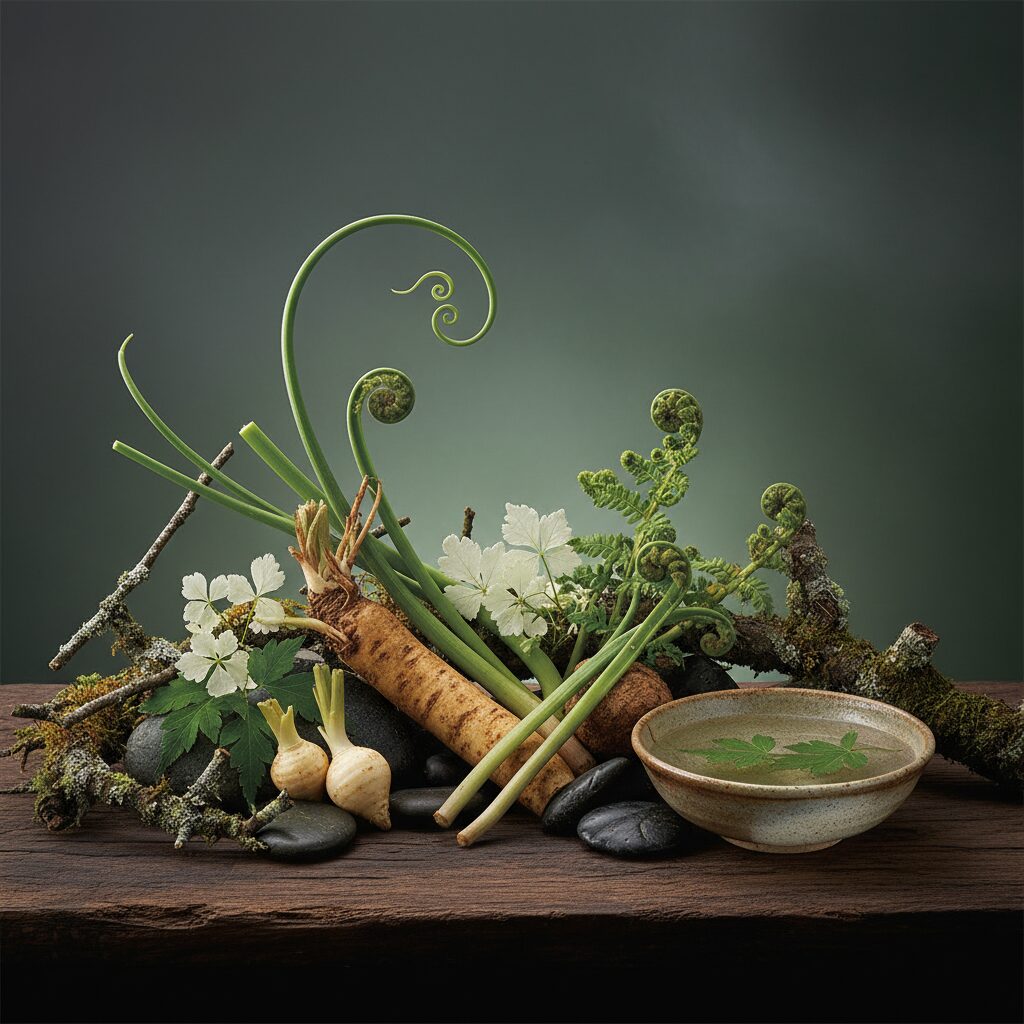
Though hundreds of varieties exist throughout Japan’s diverse mountain ranges, a few iconic types mark the season’s arrival. Perhaps the earliest and most potent sign of spring is fukinoto (蕗の薹), the flower bud of the butterbur plant. It appears as a tightly closed, pale green orb, almost alien against the still-bare forest floor. Its flavor delivers an intense burst of aromatic bitterness that can be startling to newcomers. It is often served as fuki-miso, a condiment where the minced bud is cooked with sweet miso paste, creating a powerful sweet-bitter-savory spread that enlivens a simple bowl of rice.
Next come the fiddlehead ferns. The most prized is kogomi (こごみ), the tightly coiled young shoot of the ostrich fern. Its spiral form is a perfect natural fractal, a beautiful symbol of potential and new life. Kogomi has a milder taste than fukinoto, with a distinctive crisp-yet-slimy texture that Japanese cuisine frequently celebrates. Another popular fern, warabi (蕨), or bracken, requires more careful preparation, as it contains natural toxins that must be rigorously removed before it can be eaten.
Perhaps the most esteemed of all is tara no me (タラの芽), the young bud of the Japanese angelica tree. Often called the “king of sansai,” it boasts a rich, slightly nutty and buttery flavor beneath its bold bitterness. Finding a tree at precisely the right moment, when the buds are plump but not yet leafy, is a forager’s triumph. These four—fukinoto, kogomi, warabi, and tara no me—lead the sansai season, each carrying a unique character and degree of bitterness.
The Ritual of Bitterness
In Western culinary traditions, bitterness is often a flavor to be masked or balanced out. It’s the sharp accent in a cocktail, the contrast in a salad. However, in the context of sansai, bitterness, or nigami (苦味), is the very essence. It is not a defect; it is the key element that defines these vegetables.
Traditional wisdom, which aligns with principles found in other East Asian medicinal systems, holds that animal bodies (including humans) become slow and stagnant during the long, cold winter. During this time, we consume heavier, richer foods and move less. The potent bitterness of the first spring greens acts as a natural alarm clock for the body. This nigami is believed to stimulate the digestive organs, cleanse the blood of winter’s lethargy, and flush out accumulated toxins. It serves as a physiological reset, a burst of wild energy that purges the body and prepares it for the active months ahead. Eating sansai is, in a way, an edible form of spring cleaning.
Embracing bitterness does not imply a lack of culinary finesse; in fact, it requires an even greater level of skill. A key part of preparing many sansai involves a process called aku-nuki (灰汁抜き), which literally means “removing the harshness.” Aku is a complex term referring to the astringent, sometimes toxic, and excessively bitter compounds found in wild plants. The purpose of aku-nuki is not to remove the bitterness entirely, but to soften it, to smooth its roughest edges so that the pleasant, stimulating nigami can emerge. This is achieved by parboiling the vegetables, occasionally with wood ash or rice bran, or by soaking them in water for long periods. This careful preparation is a ritual in itself—a dialogue with the ingredient, a demonstration of respect for its wild power, and a bridge between the raw mountain environment and the refined table.
The Journey from Mountain to Plate
The way sansai are consumed is fundamentally tied to how they are gathered. The journey starts not in a field, but on a mountainside with a basket and a profound well of local knowledge. Foraging, sansai-tori (山菜採り), is a beloved pastime for many, particularly in rural Japan. It’s a treasure hunt guided by a deep understanding of the local ecosystem—knowing which slopes receive the morning sun, which damp gullies shelter the finest ferns, and most importantly, how to tell delicious food apart from its toxic lookalikes. This element of risk and skill elevates sansai beyond simple ingredients; they become trophies, evidence of a connection to and knowledge of the land.
This carefully harvested bounty is then prepared following a particular culinary logic. The most common and adored method is tempura. A light, crispy batter and a quick fry in hot oil work wonders on sansai. The heat tempers the bitterness and changes the texture, producing a perfect contrast between the crunchy exterior and the tender, earthy interior. A plate of assorted sansai tempura, accompanied by just a pinch of salt, is among the finest seasonal indulgences of Japanese cuisine.
Other preparations strive for a purer expression. In an ohitashi, the vegetables are blanched, immersed in ice water to preserve their vivid green color, then steeped in a delicate dashi-based broth. This method lightly seasons the sansai without masking its natural character. For a richer preparation, they might be dressed in an aemono with a paste of sesame, miso, or tofu. And for a deeply immersive experience, finely chopped sansai can be cooked with rice (sansai gohan), infusing each grain with the subtle, aromatic essence of the mountains.
Regardless of the cooking method, the philosophy remains consistent: balance the wildness without erasing it. The chef’s role is to mediate, making the intense flavors of the mountain palatable while preserving their essential spirit.
A Taste of Fleeting Time

Ultimately, the deep appeal of sansai lies in what they symbolize: an immediate, unfiltered taste of a particular moment in time. This perfectly corresponds with the Japanese culinary concept of shun (旬), which denotes the peak season of an ingredient—the brief period when it is at its most delicious and nutritious. While many ingredients have a shun, the season for sansai is exceptionally brief. A specific variety might be ideal for just a week or two before it becomes too large, tough, or bitter. This ephemerality makes the act of eating them all the more precious.
They stand as a rebellion against the dull, seasonless reality of the modern supermarket, where everything is available year-round. You cannot have fukinoto in August. You cannot import kogomi from across the world in December. They are fiercely, uncompromisingly local and seasonal. To eat them is to engage with the genuine, tangible rhythm of the year. It serves as a reminder of a time, not long past, when survival depended on aligning with these cycles—knowing what the land would give and when.
This bond to time and place provides a sense of grounding. In a world dominated by digital abstraction and global supply chains, the sharp, bitter taste of a fern that was growing on a nearby mountain just yesterday morning offers an experience of profound authenticity. It is the flavor of snowmelt, wet earth, and the sun’s returning strength. It is the complex, challenging, and ultimately rewarding taste of a world coming back to life. The bitterness is more than just a flavor; it is a story, a concise narrative of winter’s end and life’s persistent, beautiful resurgence.