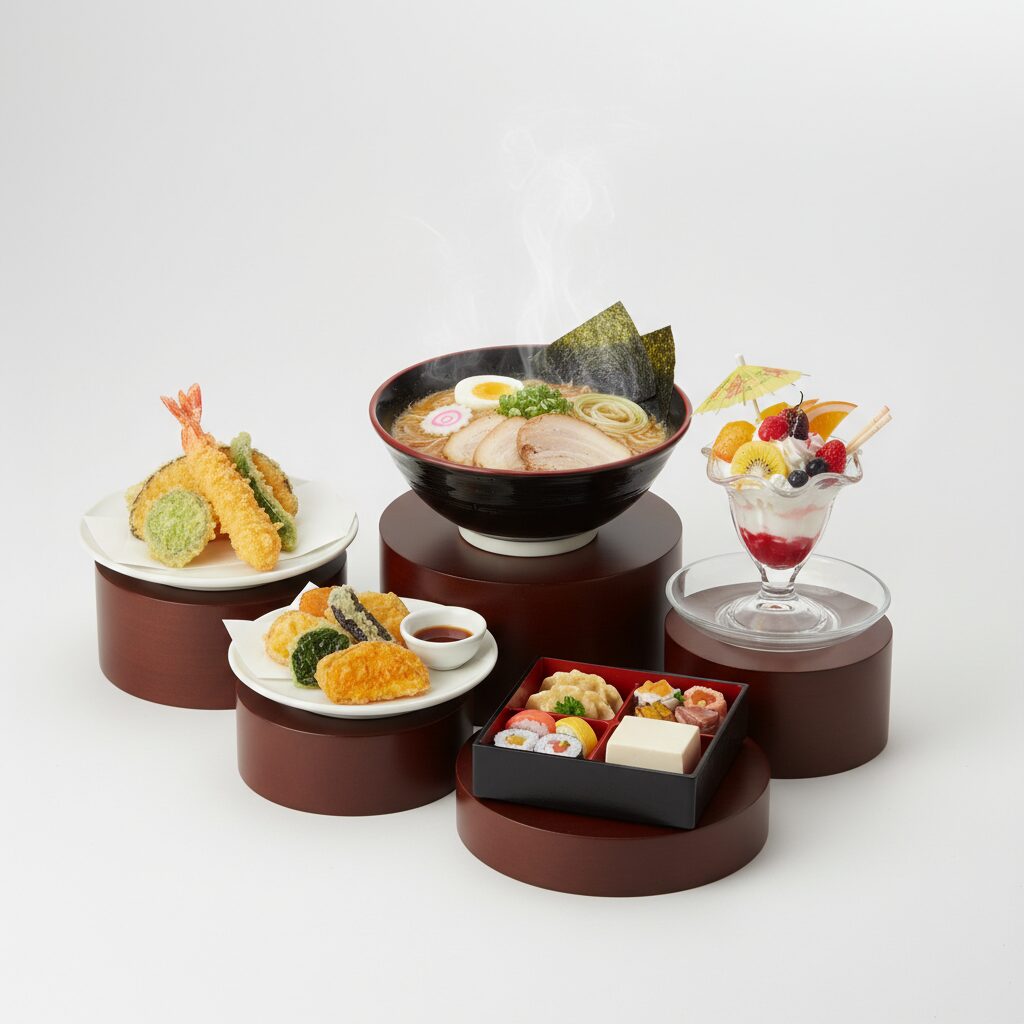
Walk down almost any street in Japan with a decent number of restaurants, and you’ll eventually encounter it: a glass case displaying a silent, perfect, and utterly baffling feast. A bowl of ramen, its broth gleaming under the fluorescent lights, seems to steam invitingly. A plate of spaghetti is frozen mid-twirl on a fork, defying gravity. A glistening piece of tuna sushi sits pristine, waiting for a diner who will never arrive. This is the strange and wonderful world of shokuhin sampuru (食品サンプル), the fake food models that are as much a part of Japan’s culinary landscape as chopsticks and vending machines. For the first-time visitor, it’s a delightful oddity. For restaurants, it’s a powerful, decades-old marketing tool. And in a fascinating twist, for a growing number of people, it’s a form of pop art. These plastic meals are far more than just menu props. They represent a uniquely Japanese fusion of meticulous craftsmanship, commercial pragmatism, and a cultural appreciation for visual presentation. They tell a story of how a clever solution to a post-war problem evolved into a celebrated craft and a global cultural export. So, how did this industry of delicious deception begin, and why does it continue to capture our imagination in an age of digital menus and Instagram food photography?
Japan’s fascination with intricate presentation seamlessly extends to innovations such as meal ticket machines that quietly revolutionize the way dining experiences are crafted.
The Birth of a Brilliant Idea

The story of shokuhin sampuru does not stem from ancient tradition but from the rapid modernization of early 20th-century Japan. It begins with a man named Takizo Iwasaki. In the early 1930s, Iwasaki, a craftsman from Gifu Prefecture, was reportedly fascinated by how drops of hot wax from a candle solidified into a flower-like shape in water. This serendipitous moment inspired an idea. He experimented at home, and the apocryphal tale suggests his breakthrough occurred when he made a wax replica of an omurice (a Japanese omelet over fried rice) so realistic that his wife couldn’t distinguish it from the real dish. Whether the story is entirely accurate or not, it embodies the spirit of innovation prevalent at the time. Iwasaki founded his company, Iwasaki Mokei, in 1932, setting the stage for an entire industry.
The true driver of the sampuru surge, however, came after World War II. As Japan’s economy recovered and expanded, cities saw a rise in department stores with basement food courts (depachika) and new restaurants offering a broader variety of dishes, including Western-style yōshoku cuisine. For many Japanese people then, dishes like spaghetti, curry rice, and breaded pork cutlets were unfamiliar. A written menu was an abstract concept. What did “Neapolitan spaghetti” actually look like? How large was the portion? The food models provided an immediate, clear answer. They acted as a visual agreement between the restaurant and the customer, a three-dimensional promise of the meal to come. They democratized dining, making it easy for anyone, regardless of their knowledge of the cuisine, to confidently enter and order. The sampuru in the window became a silent, tireless salesman, attracting passersby and simplifying the ordering process long before food photography became widespread.
From Wax to Vinyl: The Craftsmanship Behind the Illusion
For decades, sampuru were meticulously crafted from wax. Artisans would create molds using real food, pour in colored wax, and then add detailed touches by hand. This technique produced stunningly realistic results, but it had one major drawback: wax is fragile and sensitive to heat. A model left in a sunlit window display could melt into an unappetizing puddle. The industry needed a more durable material, and in the 1970s and 80s, it found one in polyvinyl chloride (PVC) and other plastics. This technological advancement not only made the models tougher but also unlocked new possibilities for color, texture, and longevity, enabling the craft to achieve unprecedented realism.
Today, creating a high-quality food model remains a deeply artisanal process, far removed from automated mass production. Mastering this craft requires years of apprenticeship. The transformation from a real dish to its everlasting plastic replica is a testament to exceptional skill and patience.
The Molder’s Art
It all begins with the real thing. A restaurant sends a perfectly prepared dish to the sampuru workshop. The first step is to make a mold. Craftsmen carefully submerge the food—whether it’s a piece of grilled fish, a heap of noodles, or a slice of cake—in silicone. This process captures every tiny detail, from the grain of the meat to the texture of the rice. Complex dishes often require multiple molds for each component. A bowl of ramen, for instance, will have separate molds for the noodles, slices of pork, bamboo shoots, green onions, and egg. It’s a breakdown of a meal into its basic parts, each recreated with precision.
The Painter’s Touch
Once the molds harden, they are filled with liquid plastic. After the plastic cures and is removed, the true artistry begins. The plain, colorless plastic pieces are handed over to the painters. Using a mix of airbrushes and fine-tipped brushes, these artisans bring the models to life. This is where the magic truly happens. They don’t just apply color; they create the illusion of temperature, texture, and freshness. They paint the subtle char marks on yakitori, the translucent sheen on raw squid slices, the golden-brown crispiness of tempura prawns. They perfect the gloss, knowing exactly how much shine to give a sauce to make it look rich and savory, or a piece of fruit to make it appear juicy. This stage is less about copying reality and more about enhancing it—making the food look its absolute best, a form of culinary hyperrealism.
The Silent Salesman: Why Sampuru Work
The lasting success of shokuhin sampuru stems from its brilliant functionality. It relies on a simple, universal human truth: we eat with our eyes first. A skillfully crafted food model conveys what a thousand words on a menu cannot. It communicates instantly and viscerally.
For international tourists navigating an unfamiliar culinary landscape, sampuru are a godsend. They completely eliminate the language barrier. You don’t need to distinguish between tonkatsu and torikatsu; simply glance at the perfectly breaded and fried cutlets in the window, point, and say, “Kore o kudasai” (“This one, please”). The models clarify portion size, ingredients, and even meal composition, managing expectations and preventing ordering errors. This straightforward, visual system makes dining out in Japan remarkably accessible and stress-free for visitors.
Beyond basic communication, sampuru excel in psychological persuasion. A three-dimensional object has presence and tangibility that a flat photograph lacks. It occupies space, casts shadows, and reflects light in a way that tricks the brain into seeing it as real food. This creates a powerful craving. The sight of a perfectly crafted plastic burger can spark a genuine hunger for a juicy, savory meal. This ability to generate desire is the essence of its marketing brilliance. It directly appeals to the most primal parts of our decision-making, bypassing logic and aiming straight for the stomach. In a competitive restaurant market, a striking window display can be the key factor that persuades a hesitant customer to step inside.
The Pivot to Pop: Sampuru as Souvenir and Art

For a while, it seemed the digital age might mark the end of shokuhin sampuru. With the advent of high-resolution food photography, online review platforms, and digital menus on tablets, some predicted that these charming yet old-fashioned plastic models would become obsolete. However, the industry proved remarkably resilient and inventive. Rather than disappearing, it cleverly adapted, embracing its novelty and attracting new audiences.
This transformation is most evident in places like Tokyo’s Kappabashi Kitchen Town, the historic center of the sampuru industry. While workshops here continue to produce hyper-realistic models for restaurants, they have also become popular tourist destinations. They now offer a wide variety of sampuru-themed novelty items. You can find keychains shaped like tiny gyoza, magnets resembling slices of buttered toast, phone cases decorated with bacon and eggs, and USB drives disguised as sushi rolls. These products shift sampuru from a business-to-business item to a quirky consumer good, serving as a perfect, quintessentially Japanese souvenir.
Additionally, many workshops have opened their doors to visitors, providing hands-on classes where people can create their own sampuru. These sessions, where participants learn to form tempura in warm water or craft incredibly realistic lettuce leaves from colored wax, have grown immensely popular. They transform a manufacturing process into an engaging cultural experience, fostering appreciation for the skill involved and offering a unique keepsake to take home.
Beyond the Display Case: The Sampuru Art Scene
This move toward public involvement has also elevated sampuru into the realm of pop art. No longer confined to exact replication, artists and craftsmen now use sampuru techniques to craft whimsical, surreal, and thought-provoking objects. You might encounter a clock with numbers replaced by twelve different pieces of sushi or a handbag that looks precisely like a bowl of ramen. These creations play with cognitive dissonance, delighting in the confusion between real and artificial. They have been showcased in art galleries and museum exhibitions worldwide, celebrated for their distinctive mix of kitsch and fine craftsmanship. This artistic evolution ensures the preservation of the skills involved, positioning them not just as a commercial trade but as a legitimate and captivating art form.
The Enduring Charm of the Perfectly Fake Meal
The journey of shokuhin sampuru reflects Japan’s modern history in miniature. It originated from post-war necessity, was refined through a profound cultural reverence for craftsmanship (kodawari), and has continually reinvented itself to remain relevant in the 21st century. This art form embodies a captivating paradox: it is devoted to creating the perfect illusion, succeeding precisely when it is mistaken for the real thing.
Today, these models serve as more than silent salesmen. They act as cultural ambassadors, educating visitors about Japanese cuisine without uttering a single word. They provide a canvas for a new generation of pop artists. They stand as tangible links to a recent past, reminding us of a time before the endless scroll of digital food images. In their flawless, unchanging stillness, they offer a moment of delicious deception—a visual feast that promises satisfaction it cannot deliver, yet satisfies a different kind of hunger: our craving for novelty, beauty, and the simple, strange joy of a perfectly crafted illusion.