You’ve seen them, even if you don’t know their name. They are a defining feature of the Japanese suburban landscape, vast collections of concrete apartment blocks arranged in stoic, geometric patterns. They are the danchi. To the casual observer, they might seem unremarkable, even grim—the architectural embodiment of utilitarian function over form. Rows upon rows of identical balconies, weathered concrete facades, and playgrounds slowly rusting in the rain. For decades, they were simply part of the background, symbols of a bygone era’s pragmatism. But look closer, and you’ll find a quiet but passionate movement dedicated to their appreciation. It’s a phenomenon known as danchi-moe. The term combines danchi (団地, literally “group land”) with moe (萌え), a word borrowed from anime subculture that describes a powerful, almost overwhelming feeling of affection and adoration. It’s a strange pairing: the tender, heartfelt emotion of moe applied to the cold, hard surfaces of mass housing. Yet, this fascination is very real. People embark on pilgrimages to photograph specific water towers, collect vintage floor plans, and celebrate the subtle design variations in window guards and staircase railings. This isn’t just about architecture; it’s a deep dive into the soul of post-war Japan. It’s about understanding how these concrete shells were once vessels for a nation’s collective dream, and how their slow decay now evokes a complex, beautiful nostalgia for a future that never quite arrived as planned.
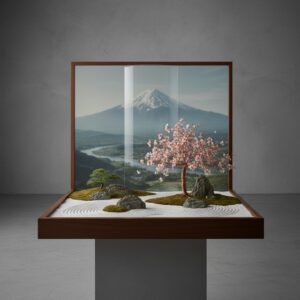
These reflections on Japan’s evolving concrete landscapes find a kindred spirit in the borrowed mountain design, which reimagines the balance between architecture and nature.
The Birth of a Modern Dream: Danchi as Post-War Utopia
To grasp the appeal of the danchi, you need to go back to the 1950s. Japan was emerging from the devastation of World War II. Its major cities lay in ruins, and a severe housing shortage afflicted the population. Families were packed into tiny, often rundown wooden homes that were not only unsanitary but also highly vulnerable to fires and earthquakes. The national mood was one of urgent need and a longing for stability—a clean, safe, and modern way of life. The solution arrived in 1955 with the creation of the Japan Housing Corporation (JHC), a government agency charged with an ambitious mission: to rebuild Japan, one apartment at a time.
The danchi were their signature project, and they were truly revolutionary. These buildings were not merely residences; they were carefully designed communities, complete with shops, parks, clinics, and schools. They were marketed to the public as the key to the akarui seikatsu, or “bright new life.” This powerful slogan promised a clear break from the dark, challenging past. For the growing salaried-man class, obtaining a place in a danchi was like hitting the jackpot—literally, since demand far exceeded supply, and apartments were often distributed through a public lottery system.
The interiors of these apartments marked a dramatic change in Japanese domestic life. The standard layout was the “2DK”—two rooms plus a combined dining and kitchen area. This was a groundbreaking idea in a country used to flexible, multi-purpose tatami rooms. The dining-kitchen, furnished with a table and chairs, encouraged the nuclear family to eat together, reflecting a Western-style ideal that contrasted with the traditional floor-based dining of multi-generational households. The fixtures were equally transformative. A shiny stainless steel sink, a private bathroom with a flush toilet, and a gas stove were more than mere conveniences; they symbolized progress, sanitation, and prosperity. For many families, this was the first time they could enjoy a level of domestic comfort and privacy their parents had only dreamed of. The danchi was engineered as a living machine, designed to foster the ideal modern Japanese family.
From Aspiration to Anachronism: The Fading Dream
The golden era of the danchi extended through the high-growth period of the 1960s and early 1970s. These complexes were lively centers of community, bustling with young families and the joyful sounds of children. They epitomized the prosperous, middle-class society that Japan aimed to build. The danchi lifestyle, once the ultimate aspiration, evolved into the national norm. However, economies and ambitions are always in flux. As Japan’s economic miracle progressed, the concept of the “good life” began to shift.
By the 1980s, the ideal started to unravel. The once-desired 2DK layouts began to feel restrictive. With rising incomes, people sought more space, greater customization, and the supreme status symbol: a detached house with a small garden. The danchi, with their strict uniformity and shared regulations, began to appear less like an ideal home and more like a temporary stop—a place one lived before affording something better. Private developers introduced larger, more upscale apartments known as “mansions,” a word that, though somewhat exaggerated, successfully marked them as a clear step up from the modest danchi.
The concrete that once represented stability and modernity started to show signs of wear. Facades were stained, and designs that were once innovative now seemed outdated and monolithic. The danchi’s social fabric transformed as well. Original residents aged, their children moved out, and the lively playgrounds grew silent. The complexes developed a reputation as places for the elderly, the isolated, and those with lower incomes. They became settings in films and TV dramas depicting isolation and social decline. The vibrant dream of the 1950s had turned into a worn, concrete relic.
The Rebirth of Cool: Unpacking Danchi-Moe
So why, after this prolonged decline, has the danchi undergone a cultural revival? The appeal of danchi-moe arises from a far more intricate place than mere architectural admiration. For a generation raised in the relative prosperity and stability of the late Heisei and Reiwa periods, these structures are not reminders of a cramped past but artifacts of a captivating, almost otherworldly era.
At its core, danchi-moe is a form of nostalgia, albeit an unusual one. It’s a longing for an age of collective optimism that its younger admirers never directly experienced. They view the clean lines and rational layouts as a vision of a simpler, more hopeful time. This was a phase when the government, corporations, and citizens seemed united by a common goal: rebuilding and enhancing society for all. The danchi symbolizes a future imagined in the mid-20th century, a type of real-world retro-futurism. It stands as a tangible connection to a time when a stainless-steel sink could be revolutionary and a concrete apartment a palace in the sky.
The aesthetic charm is unmistakable, fitting into several main categories. First, there is the raw elegance of the materials and forms, appreciated similarly to the admiration of Brutalism. Danchi enthusiasts value the honesty of exposed concrete, the rhythmic repetition of windows and balconies, and the imposing sense of scale. They find beauty in the steadfast functionalism of the design. Second, there is a fascination with the details that disrupt the uniformity. Fans hunt for unique architectural types, such as the experimental “star-shaped” terrace houses (hoshi-gata) or buildings featuring unusual pilotis (open ground floors). They pore over the graphic design of building numbers, the particular curve of a metal railing, or the playful, often abstract forms of concrete playground equipment that now resemble forgotten modernist sculptures. Lastly, there is an appreciation for the patina of age—an urban wabi-sabi of sorts. Water stains, crawling ivy, and subtle color changes in repaired concrete are not seen as imperfections but as a beautiful testament to time, weather, and the myriad lives lived behind those walls.
A Space for Imagined Community
The fascination goes beyond the physical buildings to include the social life they were intended to nurture. Danchi-moe is deeply connected to a yearning for a type of community that many feel is missing from modern Japanese society. The very design of a danchi complex was a social experiment.
The buildings were frequently arranged around central courtyards, playgrounds, and green areas to deliberately create spaces for spontaneous interaction. The layout encouraged residents to leave their private apartments and engage with their neighbors. Communal meeting halls, shared laundry drying areas, and benches placed along walkways were common features. For danchi enthusiasts, these areas evoke an idealized memory of the past: a time when neighbors knew each other’s names, children played freely and safely in groups, and a true sense of mutual support prevailed. They view the balconies not as isolating private spaces but as semi-public stages where everyday rituals—hanging laundry, tending to plants—were shared, weaving a visible, lively fabric of community life.
This sharply contrasts with the experience of living in a modern Tokyo “mansion,” where residents often never interact with one another, and advanced security systems reinforce a feeling of anonymous, isolated privacy. When a danchi fan photographs a row of futons drying over balconies, they are capturing more than just a colorful pattern. They are preserving a trace of communal spirit, a remnant of a time when daily life was more interconnected. It is a poignant, almost melancholic appreciation of a social model that has largely vanished, maintained in the concrete landscape of these aging complexes.
The Keepers of the Concrete Flame
The community of danchi enthusiasts forms a diverse and devoted subculture. It includes architects, designers, and urban planners who appreciate the projects from a technical perspective, but most are simply passionate amateurs. They are photographers who spend their weekends capturing the quiet beauty of these complexes, viewing them not as housing but as monumental sculptures. They are urban explorers who respectfully roam the public spaces, noting the unique features of each site. They are collectors searching for old JHC pamphlets, original apartment floor plans, and even vintage door hardware.
Online, they gather on blogs and social media to share their findings. One person might post a series of photos focused solely on the different designs of water towers—some cylindrical, some boxy, some standing on impossibly slender legs. Another might compile a catalog of playground slides, ranging from whimsical elephant shapes to abstract concrete spirals. This process of observing, cataloging, and sharing transforms the ordinary into something worthy of study and admiration. It creates a shared history and language around these often overlooked structures.
This movement is, in its own quiet way, an act of preservation. In a country known for its relentless cycle of scrap-and-build, where buildings are frequently demolished after just thirty or forty years, danchi-moe stands as a counter-cultural statement. It claims that these places hold value beyond their immediate function. It insists that post-war Japan’s story is written in their concrete walls, and that this history deserves to be remembered, celebrated, and, above all, seen anew. It’s about discovering profound beauty not in ancient temples or gleaming skyscrapers, but in the modest, everyday architecture that shaped the lives of millions.
To fall in love with a danchi is to realize that a building is never just a building. It is a promise made at a particular moment in time. The danchi represented a promise of modernity, health, and a new kind of family life. The fact that this promise aged and was replaced by new dreams does not diminish its poignancy. If anything, it deepens it. Danchi-moe is the act of looking at these weathered concrete giants and recognizing them not as failures or relics, but as monuments to a powerful and enduring human desire: the simple, profound wish for a better place to call home.