
If you’ve ever lost a weekend to a Japanese role-playing game—a JRPG—you know the loop. You start as a plucky, underpowered hero in a quiet village. Your first enemy isn’t a dragon; it’s a slime, a ridiculously weak creature that poses almost no threat. You defeat it. You gain a few experience points (EXP) and maybe a pittance of gold. You do this again. And again. For hours, you engage in this repetitive, almost meditative cycle of battling low-level monsters. It’s called “grinding.” Slowly, painstakingly, your stats inch upward until, finally, a triumphant sound effect announces you’ve reached Level 2. You’ve learned a new skill. You can now take on the slightly more formidable giant bat outside the next town. This is the fundamental grammar of the JRPG: small, persistent efforts accumulate into tangible growth, unlocking the next stage of the journey.
Now, imagine taking that exact logic and applying it to everything. Not just a game, but your job. Your hobbies. The way you learn to cook, speak a language, or even clean your apartment. This isn’t just a metaphor in Japan; it’s a deeply embedded social behavior, a cultural operating system that runs quietly in the background of daily life. The concept of “leveling up” through continuous, incremental practice is one of the most powerful, and often unspoken, frameworks for understanding Japanese society. It explains the quiet dedication of the office worker, the obsessive focus of the hobbyist, and the serene mastery of the artisan. It’s a mindset where the grind isn’t a chore to be endured, but the very substance of the path forward. To understand Japan is to understand that for many, life is a JRPG, and the goal isn’t just to beat the final boss, but to find meaning in the grind itself.
Japan’s relentless pursuit of incremental mastery echoes not only in its daily grind but also in the nostalgic revival of 80s city pop, where cultural evolution and enduring passion converge.
The Game as a Mirror
It’s no accident that the JRPG genre, honed in games like Dragon Quest and Final Fantasy, originated in Japan. These games are more than just exports; they embody a cultural ethos. The core gameplay loop distills a gamified version of the national approach to learning and self-improvement. It’s a narrative that feels inherently natural and logical to the Japanese mindset: greatness is not innate, it is developed, one EXP at a time.
Look at the structure. You never begin with great power. You start deliberately weak, a blank slate. Your first tasks are mundane. This reflects the traditional apprenticeship system in Japan, where a newcomer (kohai) starts with the simplest duties—sweeping the floor, making tea, observing. These aren’t merely chores; they are the initial, low-level monster battles. They teach discipline, humility, and meticulousness. In the workplace, a new employee doesn’t lead a major project on day one. They learn how to answer the phone properly, format documents according to company standards, and bow at the correct angle. Each task, executed well, is a small victory, earning a few more points on the board.
Then comes the leveling up. In the game, it’s a clear, satisfying milestone. In real life, it’s when your senior (senpai) or manager finally entrusts you with a slightly more complex responsibility. You’ve mastered the basics, so now you draft part of the report instead of just making copies. You’ve unlocked a new skill. This system, seen everywhere from corporate training programs to martial arts dojos, is based on the belief that mastery is a staircase, not a rocket launch. Each step must be climbed in order. Skipping levels isn’t just impossible; it’s viewed as arrogant and disruptive to the group.
This JRPG model offers a comforting sense of clarity and fairness. The rules are straightforward: if you invest time and effort, you will advance. It’s a predictable, reassuring meritocracy of perseverance. The game values persistence more than flashy, innate talent. The hero who grinds for ten hours to defeat a boss is nobler than the prodigy who wins effortlessly. This is an essential distinction. In Japanese culture, the process—the sweat, repetition, and dedication—is often prized over the final result. Visible effort itself is a mark of character. The game, and by extension life, isn’t about finding clever shortcuts; it’s about traveling the entire path, no matter how long it takes.
The Ghosts in the Machine: Historical Roots of the Grind
This mindset did not simply emerge with the introduction of the Nintendo Famicom. Rather, it is a contemporary reflection of principles that have shaped Japanese identity for centuries. To truly understand the salaryman meticulously refining a spreadsheet, you must first recognize the shadows of the samurai and the artisan standing behind him.
The Way of the Warrior
The samurai class, despite its martial romanticism, was founded on relentless, lifelong training known as shugyo. This was not merely about learning to fight; it was a path of spiritual and mental cultivation through perfecting a craft. A swordsman would not just practice cutting techniques; he would drill the same basic stance and the simple draw of the blade thousands upon thousands of times. The aim was not simply to become a skilled fighter but to reach a state of complete unity between mind, body, and sword—a state of enlightened mastery where technique becomes instinct.
Deeply influenced by Zen Buddhism, this philosophy emphasized that the journey of improvement was endless. There was no “Level 99.” There was always a higher state of understanding, a more refined movement, a deeper level of focus to attain. This fostered a culture where dedication to a single path, a michi or “Way” (as in kendo, the way of the sword, or chado, the way of tea), was the ultimate expression of a meaningful life. This legacy persists in modern Japanese reverence for specialization and long-term commitment. Changing paths is not merely a career decision; it can feel like a betrayal of all the EXP painstakingly accumulated.
The Soul of the Craftsman
Alongside the warrior was the shokunin, the artisan or craftsman. The shokunin spirit represents the purest distillation of the leveling-up mentality. It embodies the idea that a person has both a social and spiritual obligation to work to the absolute best of their abilities, continually improving their craft for the benefit of all. Whether a sushi chef, carpenter, or potter, their work is far more than a job—it is their identity and contribution to society.
An apprentice to a master shokunin might spend years doing nothing but washing rice. Not months, but years. This represents the ultimate grind. They learn the subtle differences in water temperature, the texture of the grain, and the precise feel of perfectly cooked rice. They battle the same low-level monster every day, gaining an infinitesimal amount of new knowledge each time. The master does not simply hand down a list of secret techniques; knowledge must be earned through repetition and deep, personal observation. Only after mastering these foundational levels is the apprentice allowed to move on to the next stage, perhaps learning to prepare the vinegar, and eventually, many years later, to handle the fish.
This system, which values methodical, long-term dedication over immediate results, was solidified during the Edo period’s prolonged peace. With society stabilized under a rigid class system, people turned inward, refining their assigned roles to extraordinary levels. This is why you can find families making the same type of sweets or forging the same type of scissors for ten generations. They aren’t striving for radical innovation; they seek a fractional improvement on their ancestors’ perfection. They are engaged in a multi-generational quest to max out their stats.
When Japan industrialized in the late 19th and 20th centuries, these feudal values—loyalty, discipline, and incremental improvement—were directly transplanted into the new factories and corporations. The company became the new domain, the CEO the new lord, and the salaryman the new samurai, dedicating his life to the corporate “Way.” The grind continued, just in a different setting.
The Modern Dungeon: Grinding in Daily Life
Walk around Japan today, and you’ll notice the JRPG leveling system in action everywhere. It’s the unseen framework supporting education, work, and leisure.
The Religion of Practice
Visit a Japanese high school after the final bell, and you won’t find an empty building. Instead, you’ll hear the steady bounce of basketballs, the synchronized shouts from the kendo hall, and the concentrated silence of the calligraphy club. These after-school activities, or bukatsu, are far from casual hobbies. They are serious commitments where the philosophy of relentless effort is ingrained from an early age.
In bukatsu, practice reigns supreme. Students, guided by their senpai, drill fundamentals endlessly. In baseball, it’s repetitive fielding practice. In choir, it’s singing the same scales for an hour. The focus is on perfecting the kata, the set form or pattern. The belief is that genuine skill and creativity emerge only after these foundational forms are ingrained to the point of automaticity. It’s about building muscle memory, whether for a tennis swing or a brushstroke. Here, you learn that progress is slow and often invisible day-to-day, but the accumulation of daily effort—the daily EXP—is the sole path to mastery.
The Quest for Qualifications
Another example of the leveling-up mindset is the widespread enthusiasm for shikaku, or official licenses and certifications. The Japanese job market, especially for administrative roles, puts significant weight on concrete proof of skills. A résumé is less about experience and more like a character sheet listing your unlocked abilities.
People dedicate months or even years of their free time studying for exams such as the TOEIC (Test of English for International Communication), Boki (bookkeeping), or various IT certifications. Each certificate represents a recognized level-up. A TOEIC score of 600 is good, but 730 marks a higher tier, and over 900 places you in an elite class. These scores and certifications act like badges, clearly signaling your skills and commitment to self-improvement to potential employers. Gaining a new shikaku is a side quest that grants a permanent stat boost for your career. It’s a way of managing your own progress, grinding in your own time to prepare for the next challenge.
The Office as a Tutorial Level
Inside a typical Japanese company, the leveling-up system is formalized. New employees aren’t expected to innovate initially; they’re expected to learn. The senpai-kohai relationship serves as the central mechanism of this real-life tutorial. The kohai (junior) learns by observing, imitating, and being corrected by their senpai (senior).
Workflows tend to be highly procedural. There’s a correct way to do everything, from stapling documents (top-left corner, at a 45-degree angle) to composing emails. Mastering these procedures is the first stage of the game. Your performance is judged not by brilliant ideas but by your ability to flawlessly follow the established process. While this may feel restrictive to outsiders, it provides a clear and stable path for advancement from the inside. By diligently learning the rules and reliably completing your tasks, you’ll gradually be entrusted with more responsibility. Your level increases. It’s a transparent, if rigid, system built on trust and proven competence.
The Social Logic: Why We All Grind Together
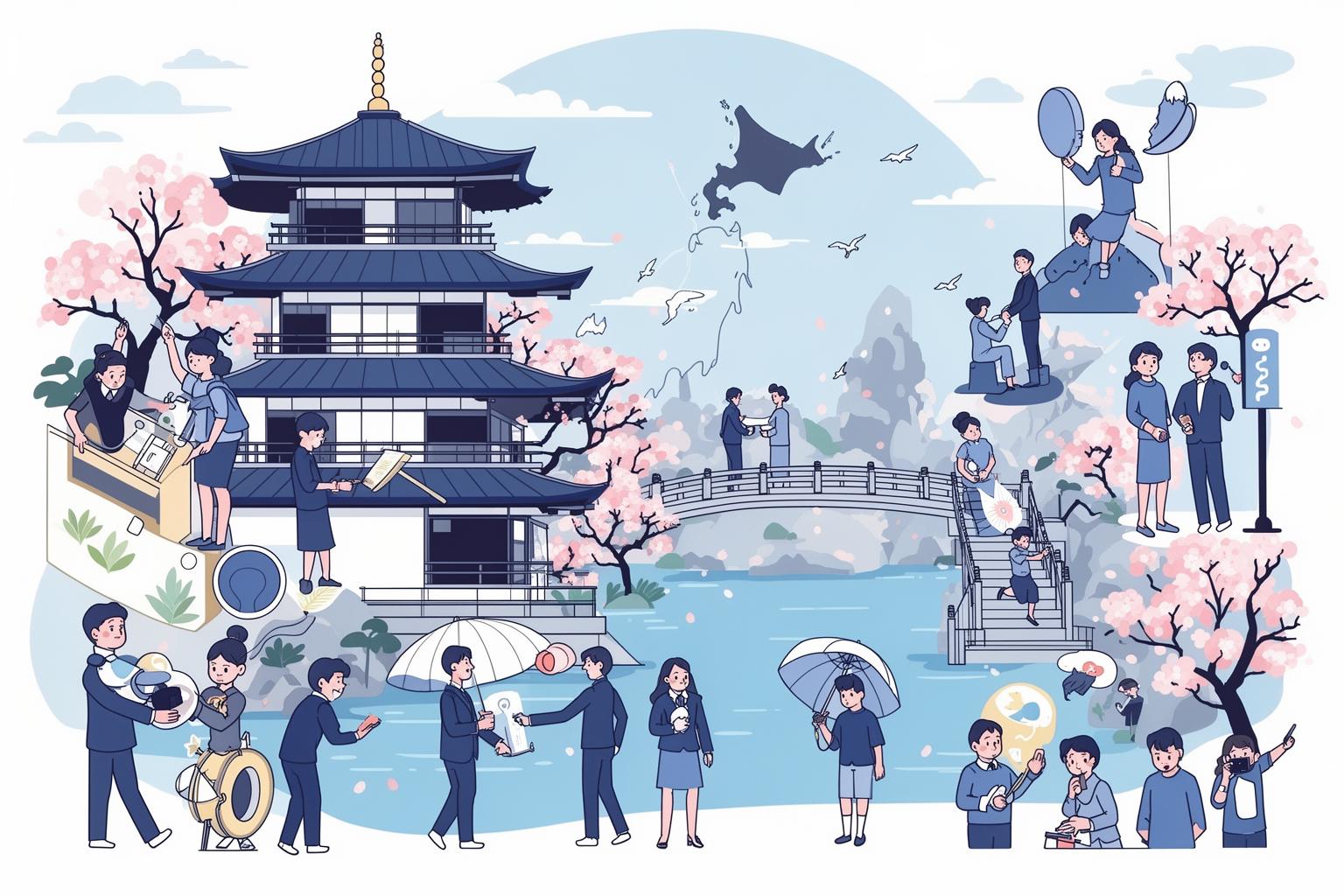
This cultural preference for gradual progress is not random. It is deeply rooted in the core principles of Japanese society, especially the concept of wa (和), meaning group harmony.
The Virtue of Process
In a society that prioritizes the collective over the individual, predictable behavior is highly valued. The slow and steady grind is reliable. Everyone understands the journey, and everyone knows their role along the way. A sudden genius who disrupts the established order by skipping levels threatens this harmony. They unsettle others and introduce uncertainty. Consequently, the culture honors not the brilliant rebel, but the hardworking team player who consistently puts in the effort.
There is a shared belief that effort is a great equalizer. Not everyone is born a genius, but everyone can work hard. Valuing the process of hard work—the ganbaru spirit—over innate talent fosters a more inclusive and stable social fabric. It conveys that everyone has a meaningful way to contribute, as long as they are committed. When you see a colleague working late, the instinctive response is not pity, but quiet respect for their dedication. They are grinding for the benefit of the team.
Security in the Grind
This system also offers a strong sense of psychological security. In a world filled with ambiguity, the JRPG model of life provides a clear formula: Effort → Experience → Growth. It frames life’s challenges not as insurmountable barriers, but as monsters that can be overcome with sufficient preparation. If you fail an exam, the solution is straightforward: you haven’t grinded enough. You must return, fight more low-level monsters (do additional practice problems), and come back stronger. This shifts failure from a personal judgment to a simple tactical issue.
This mindset is a powerful resilience tool. It nurtures the belief that any skill can be learned and any obstacle overcome through persistent effort. It represents a deeply optimistic outlook, even if the path it suggests is demanding. It embodies the belief that you can, quite literally, level up through life’s challenges.
When the Game Becomes a Prison
For all its strengths, this cultural operating system has a darker side. When the boundary between life and the game becomes completely blurred, the grind can turn into an inescapable, destructive force.
The Final Boss is Burnout
The most notorious outcome is karoshi, or death from overwork. This occurs when the grind never ends and the game offers no save points or exit screens. The unrelenting pressure to show effort and be the last to leave the office can drive individuals to sacrifice their health, their families, and ultimately their lives. The same dedication praised as a virtue becomes a fatal flaw when pushed to the extreme.
Furthermore, the system is built on a promise: that your grind will be rewarded. In Japan’s decades of economic stagnation, this promise has often failed. Young people today observe their parents’ generation, who devoted their entire lives to a single company, being forced into early retirement. They see that no matter how hard they work, the path to a stable, prosperous life is no longer assured. When the game’s core mechanic—that effort equals reward—is revealed to be rigged, it results in widespread disillusionment, apathy, and rejection of the traditional corporate grind.
The Inability to Change Classes
The JRPG model also imposes immense social pressure to stay on your chosen path. In games, switching your character’s class midway is often difficult or inefficient; you lose progress and have to start over. In Japanese society, this pressure is magnified significantly. Quitting a job after just a year or two is frequently seen as a sign of weakness or unreliability. Leaving the sports team you joined in your first year of high school is viewed as betrayal. The social cost of “re-rolling” your character is extremely high.
This rigidity can trap people in unfulfilling careers and life situations. The fear of losing all their hard-earned social and professional EXP can be paralyzing, preventing them from exploring new paths where they might find greater happiness or success. The very system that offers a clear path forward can also become a cage, punishing anyone who dares to step off it.
Life, unlike a JRPG, is not a linear story. It is messy, unpredictable, and rarely rewards effort in a straightforward, mathematical way. While the mindset of incremental improvement is a powerful tool, Japan is now confronting the limits of a cultural script written for a more stable and predictable world.
Yet, the spirit of the grind persists because, at its core, it is about more than just work or social conformity. It’s about a belief in the transformative power of dedication. It’s what allows a ramen chef to spend thirty years perfecting a single bowl of soup, or an animator to spend a month drawing a three-second sequence until it flows like water. It reflects a profound, almost spiritual, commitment to mastery in a world that often values novelty and speed.
To view Japan through the lens of a JRPG is to see a culture that finds beauty and meaning in the process. It’s the recognition that true strength doesn’t come from the final, dramatic blow to the dragon, but from the thousands of slime battles leading up to it. It’s the belief that a life well-lived is one spent quietly and diligently leveling up.