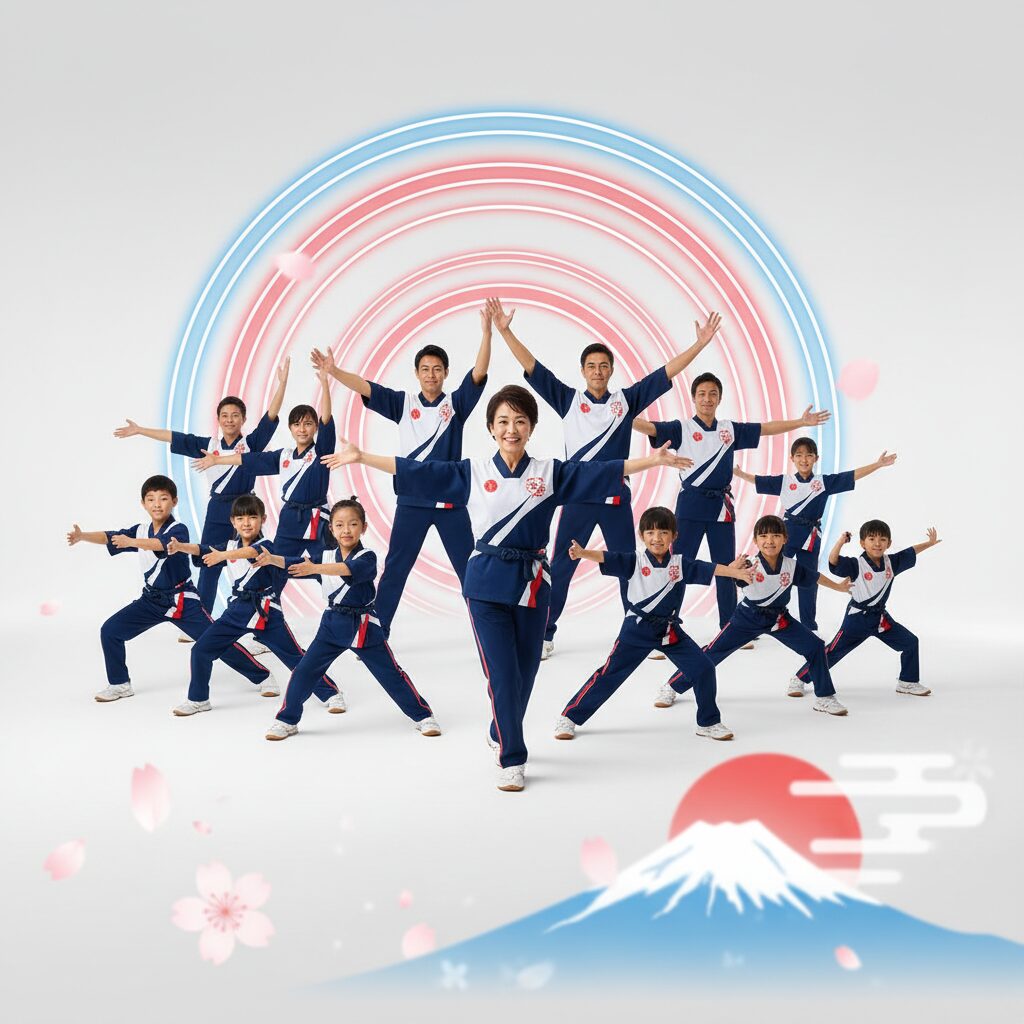
If you ever find yourself in a Japanese neighborhood park around 6:30 on a summer morning, you’ll likely encounter a scene that feels both deeply familiar and slightly surreal. The gentle, slightly tinny melody of a lone piano will drift from a portable radio perched on a bench. Gathered in loose rows on the dirt ground will be a collection of people: sleepy elementary schoolers in shorts, elderly women in visors, a few salarymen on their way to the train station. And as the calm, encouraging voice of an announcer counts off the beats, they will all begin to move in unison. Arms stretching up, bodies bending sideways, knees lifting in a gentle rhythm. This is Radio Taiso, or Radio Calisthenics, and it is one of the most deceptively simple yet profoundly significant daily rituals in Japan. It’s more than just a morning stretch; it’s a piece of living history, a tool for social cohesion, and a quiet testament to the Japanese emphasis on the collective. To understand Radio Taiso is to understand something fundamental about how community is built and maintained here—not through grand gestures, but through small, repeated, synchronized actions. You asked why this simple routine is such a big deal, and the answer is a fascinating journey through a century of Japanese history, from imperial ambition to post-war reinvention and the quiet persistence of a shared national habit.
The collective routine not only nurtures physical harmony but also cultivates a mindful balance reminiscent of an iaidō practice that underscores Japan’s enduring commitment to inner focus.
For Health, For Empire: The Unexpected American Origins
You might be surprised to discover that the blueprint for this iconic Japanese activity was actually American in origin. In the 1920s, the Metropolitan Life Insurance Company in the United States sponsored a widely popular radio program featuring morning exercises, aimed at improving the nation’s health and, presumably, reducing insurance claims. Some Japanese officials visiting the U.S. at that time took notice. They viewed it not merely as a health campaign but as a potent instrument for nation-building.
A Tool for a Modernizing Nation
Back in Japan, the concept was adapted and shaped to align with a specific national agenda. The late 1920s was marked by intense nationalism and rapid industrialization. The government aimed to cultivate a population that was physically fit, disciplined, and unified. A healthy citizen meant a productive worker and a capable soldier. In 1928, to celebrate the coronation of Emperor Hirohito, the Ministry of Communications, together with the national broadcaster NHK and the Ministry of Education, officially introduced “National Health Calisthenics,” or Kokumin Hoken Taiso. This was the first version of what is now known as Radio Taiso.
The routine was carefully crafted by experts to be simple enough for everyone—from young children to the elderly—to perform with ease. The objective was standardization. By having the entire nation move in unison, at the same time, following the same broadcast, the government cultivated a strong sense of collective identity and discipline. It served as a physical embodiment of the slogan “a rich country, a strong military” (fukoku kyōhei). The exercises aired nationwide every day, becoming a mainstay in schools, factories, and government offices. Participation was not just encouraged; it was often expected, a daily patriotic obligation carried out for the empire’s benefit.
The Soundtrack of a Society
The lasting influence of Radio Taiso lies not only in the exercises themselves but also in the sensory experience, which has been ingrained in the national consciousness for generations. The broadcast’s sound is as iconic as the movements.
The Unmistakable Piano Melody
The routine is led by a simple, almost wistful piano tune. It’s not an energetic workout track; rather, it is methodical, clear, and maintains a steady rhythm instantly familiar to nearly everyone in Japan. That music serves as a powerful cue for memory and nostalgia. Hearing it can bring people back to childhood summer mornings or the beginning of a school sports day. Alongside the music is the calm, encouraging voice of the instructor counting the movements—ichi, ni, san, shi (one, two, three, four)—in a steady, reassuring pace. This auditory hallmark created a shared experience that transcended location. A child in a rural village in Kyushu and an office worker in a Tokyo skyscraper were connected, for three minutes each day, by the same sound and the same movements.
The Machinery of Mass Participation
The NHK infrastructure, the national public broadcaster, was vital to its success. With its vast reach, the broadcast could reach every corner of the country, ensuring consistency. Schools made it a compulsory part of morning assemblies and sports festivals (undōkai). Factories and corporations incorporated it as a pre-shift warm-up, believing it enhanced worker safety and productivity. It became a widespread ritual, a piece of clockwork that helped structure the rhythm of the day for millions. It was a top-down initiative effectively woven into the grassroots fabric of daily life.
From Imperial Tool to Community Glue
The end of World War II marked a significant turning point for Radio Taiso. Like many institutions linked to the old regime, it came under the scrutiny of the Allied Occupation forces.
A Post-War Ban and Rebirth
Immediately after the war, GHQ (General Headquarters of the Allied Powers) banned the broadcast. They regarded the exercises as overly militaristic and as tools of state-enforced conformity, part of the framework that had led the country into war. The focus on group movement and synchronized action conflicted with the new democratic ideals being introduced. However, the practice was too popular and deeply rooted to vanish completely. Public demand for its return was strong, with many citizens highlighting its real health benefits and the sense of routine it offered during a chaotic post-war period. In 1951, a new version was launched. The exercises were redesigned to emphasize general health and well-being, stripped of their explicit nationalistic and militaristic implications. This rebranded Radio Taiso was promoted not as a state duty but as an enjoyable, healthy activity for fostering democratic communities.
The Summer Vacation Stamp Card: A Childhood Rite of Passage
It is this post-war version that solidified Radio Taiso’s role as a key part of community life, most notably through the tradition of summer vacation radio calisthenics (natsu yasumi no rajio taisō). This is when the practice truly comes alive for most Japanese people. Throughout the long summer break, local neighborhood associations organize daily morning gatherings in nearby parks or schoolyards. Children receive a stamp card (rajio taisō kādo). Each day they attend, they get a colorful stamp. The simple act of collecting these stamps serves as a strong motivator. At the end of the week or vacation period, children who have completed their cards are rewarded with a small prize—usually candy, juice, or stationery. It’s a straightforward, effective system. The ritual encourages children to leave the house at a set time, adds some structure to their unstructured vacation days, and gives them a chance to socialize with peers in a lightly supervised setting. For parents, it offers reassurance, knowing their kids start the day with a healthy, communal activity. For the neighborhood, it strengthens community bonds. Elderly residents who often help organize the events get to interact with the younger generation, fostering a natural intergenerational connection. It’s a child’s first real introduction to civic participation, to showing up for the group. This is social cohesion being built in real time, one stamp at a time.
The Persistence of a Collective Habit in Modern Japan
In a hyper-modern, increasingly individualistic Japan, one might expect a seemingly old-fashioned, collectivist ritual like Radio Taiso to have disappeared. Although its prevalence has certainly declined from its peak, it remains a surprisingly resilient and adaptable part of the culture.
Beyond the Schoolyard: The Office and the Nursing Home
Many companies, especially in traditional sectors such as manufacturing and construction, still start the workday with Radio Taiso. It is viewed as a practical way to warm up before physical labor, helping to reduce the risk of injuries. Additionally, it serves a social purpose, marking a transition from individual life to the collective work environment. This brief, shared ritual aligns everyone—from factory floor workers to managers—before the day’s tasks commence. Its most important modern role, however, may be in elder care. The exercises are gentle, low-impact, and can be performed while seated. For seniors in nursing homes and day-care centers, Radio Taiso is an ideal activity. It offers mild physical stimulation, aids mobility and balance, and importantly, it is familiar. It is a comforting routine they have known their entire lives, providing a reassuring connection to their youth.
Why It Endures: The Unspoken Value of Synchronicity
Why does it continue? In an era of personalized fitness apps and boutique yoga studios, what draws people to a standardized, three-minute routine broadcast over the radio? The answer is that Radio Taiso was never truly about achieving peak physical fitness. It centers on the value of the group. Its purpose lies not in the outcome but in the process—the act of moving together. In a culture that has traditionally emphasized group harmony (wa), synchronizing your body with others is a powerful, non-verbal affirmation of belonging. It reinforces the sense that you are part of something larger. It is a low-stakes, high-reward investment in community. It requires no special equipment, no fees, and almost no time. Its very accessibility is its strength. This collective rhythm acts as a form of social glue, a quiet, physical counterpoint to the isolating trends of modern life.
Though fewer young office workers participate today, and some urban schools have discontinued the summer tradition, Radio Taiso is far from extinct. It remains a piece of shared cultural muscle memory. That piano melody unlocks a particular feeling—of summer mornings, of community, of a time when the entire nation seemed to move to the same simple beat. It is a historical document expressed through motion, a practice that began as a tool for imperial control and evolved into a humble, enduring pillar of neighborhood life. It reminds us that sometimes the strongest communities aren’t built on grand proclamations, but on the quiet, steady rhythm of showing up and stretching together.