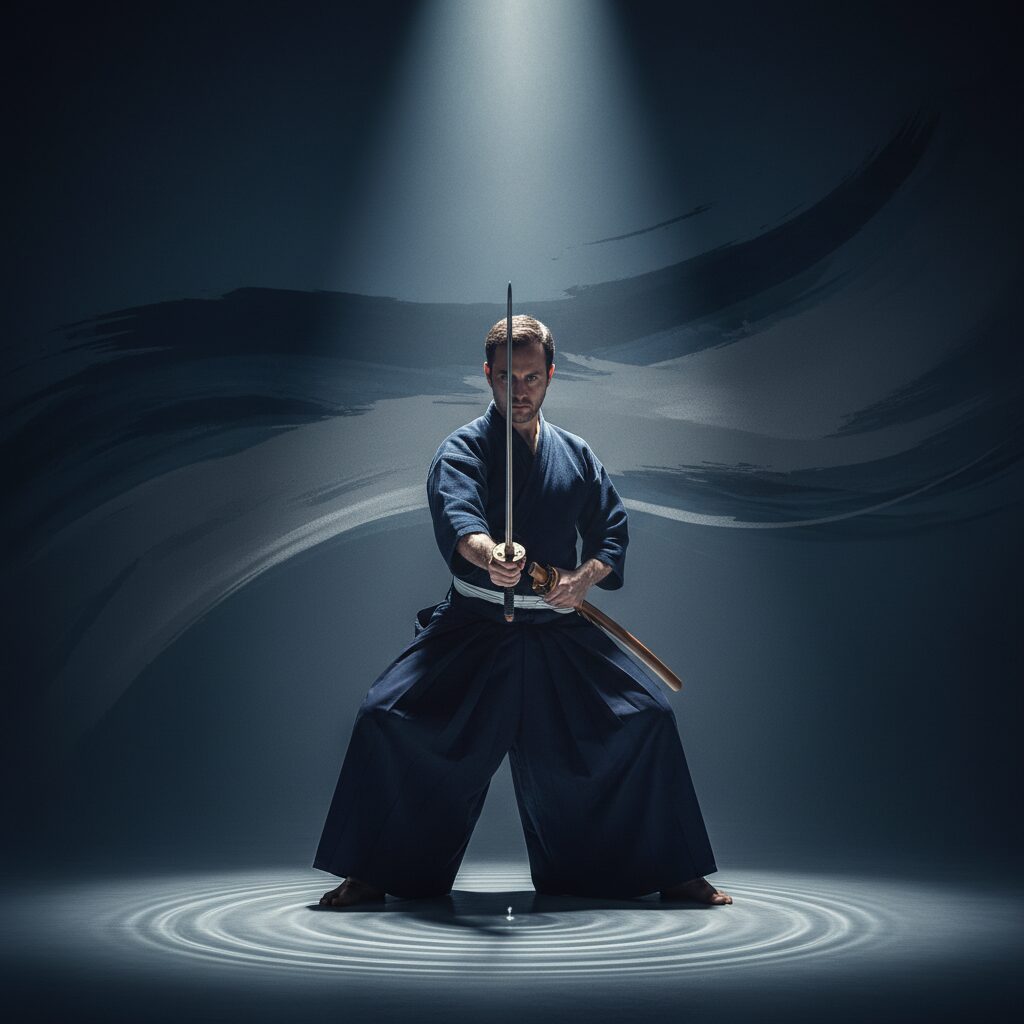
Ask someone to picture a samurai sword, and their mind probably jumps to a scene from a movie. Two warriors, a clash of steel, a dramatic, lightning-fast draw that ends a duel before it even begins. It’s an image of explosive violence, of decisive, deadly action. And while that’s part of the katana’s history, it has almost nothing to do with why a growing number of people in modern Japan—and around the world—are picking one up today. They’re practicing a martial art called Iaidō, and for most, the opponent they face is not a rival swordsman, but their own restless mind.
Iaidō, often translated as “the way of mental presence and immediate reaction,” is the art of drawing the sword, cutting, and sheathing it in a single, fluid motion. Unlike Kendo, which involves sparring with bamboo swords, Iaidō is almost always practiced solo. It’s a quiet, introspective discipline performed through a series of prescribed forms, or kata. From the outside, it can look like a slow, hypnotic dance. From the inside, it’s an intense exercise in focus, precision, and self-control. This isn’t about learning to fight; it’s about learning to be perfectly present. The sword becomes less a weapon and more a tool for self-discovery, a mirror that reflects your inner state. To understand Iaidō is to look past the blade and into the philosophy it embodies: a search for stillness in a world of constant motion.
Embracing the calm and focus of Iaidō, many modern practitioners also appreciate how Japanese culture values reading nuanced social cues to navigate unspoken interpersonal dynamics.
More Than a Sword: The Philosophy of the Draw

The essence of Iaidō lies not in the physical techniques themselves, but in the principles that guide them. Even before a student learns how to properly hold a sword, they are introduced to concepts that transform the practice from mere movements into a profound mental discipline. This philosophical groundwork is what distinguishes Iaidō from pure swordsmanship. It represents the ‘why’ behind every precise angle, every controlled breath, and every silent moment of awareness. Without it, one is merely waving a piece of metal; with it, one engages in a dialogue with centuries of wisdom about conflict, composure, and the nature of the self.
Saya no Uchi de Katsu: Victory Within the Scabbard
One of the most fundamental ideas in Iaidō is saya no uchi de katsu, meaning “victory within the scabbard.” This phrase turns the entire purpose of martial arts upside down. The highest form of skill and the ultimate expression of mastery is to win a conflict without ever drawing the sword. This is not about cowardice; rather, it reflects a level of awareness and presence so deep that one can defuse a situation, spiritually overpower an opponent, or avoid confrontation altogether by sheer composure. The sword stays sheathed. Peace remains intact. This represents the true victory.
In practice, this concept influences every element of the art. It encourages a mindset that is defensive rather than aggressive. The kata of Iaidō always begin from a non-combat state. The practitioner might be seated, walking, or standing, simply going about their daily life, when suddenly faced with an unavoidable attack. Drawing the sword is a response, not an initiation. This nurtures a profound sense of calm and preparedness without eagerness for battle. The aim is to cultivate a spirit so centered and serene that it deters aggression. One learns to wield a deadly weapon in order to understand how to never need to use it.
Zanshin: The Lingering Mind
Another essential principle is zanshin, literally meaning “lingering mind” or “remaining spirit.” Zanshin is a state of relaxed, sustained awareness that persists after a technique is completed. In Iaidō, the kata does not conclude at the final cut or even when the sword is returned to its scabbard. It finishes only when the mind has fully absorbed the consequences of the action and returned to a calm, yet fully aware, state.
Picture completing a complex, intense task. The natural impulse might be to immediately relax and let the mind go slack with relief. Zanshin is the opposite. It is the quiet moment after sheathing the sword, when the practitioner remains spiritually alert, eyes scanning, posture steady. It represents mindful follow-through. This state guards against surprise attacks from a second, unseen opponent. More broadly and philosophically, zanshin involves carrying the focus developed during practice into everyday life. It means finishing a conversation and staying present rather than immediately reaching for your phone. It means leaving a meeting while remaining mentally engaged, not just physically absent. It serves as a powerful antidote to the fragmented attention so prevalent in modern life.
The Anatomy of a Movement: Deconstructing Kata
An Iaidō kata is a brief story expressed through movement. Each one conveys a narrative—an imagined scenario involving one or more opponents—and a unique emotional tone. Although there are hundreds of kata across various schools or styles (ryū), they all share a common structure composed of four fundamental elements. Mastering these components forms the physical foundation of the practice. Each element is a discipline in its own right, requiring thousands of repetitions to perfect, yet they must seamlessly flow together into one continuous, uninterrupted action.
Nukitsuke: The Initial Draw and Cut
This is the explosive core of the kata. Nukitsuke involves the simultaneous drawing of the sword from its scabbard (saya) and delivering the initial cut. It occurs in an instant. The movement originates not from the arm but from the body’s center—the hips and legs. The left hand, holding the saya, pushes backward as the right hand pulls the hilt forward. This opposing action creates a lightning-fast draw. The blade’s edge often strikes the opponent as it clears the scabbard. Beyond speed, nukitsuke emphasizes precision and timing. It must be perfectly controlled, with the sword stopping exactly at the intended target. It is the crucial moment, the point of no return, where potential energy transforms into kinetic action.
Kirioroshi: The Decisive Downward Cut
Following the draw, the next key element is the kirioroshi, the primary downward cut. This is the large, powerful, and iconic vertical slash most commonly associated with the samurai. The sword is raised high above the head, then brought down in a perfectly straight line, propelled once again by the body’s core. The power arises from the entire body moving in harmony, making the sword feel less like a tool and more like a natural extension of the practitioner’s center of gravity. The intention is not to hack with brute force but to slice with flawless technique, allowing the blade to do the work. It demands great control to ensure the cut is precise and stops exactly where intended, embodying both strength and restraint.
Chiburi: The Symbolic Blood Shake
After the final cut, the practitioner performs chiburi, the symbolic act of shaking blood from the blade. The form of chiburi varies significantly between schools. It can be a sharp wrist flick, a wide circular motion, or a slow, deliberate blade retraction. While it originated as a practical movement, its meaning in modern practice is purely symbolic. It represents a moment of mental cleansing. It marks the end of conflict, the clearing of the weapon, and by extension, the clearing of the mind from the aggression and intensity of the earlier actions. It acts as a physical punctuation mark, allowing the practitioner to transition from combat to a peaceful state, preparing for the final and most challenging step.
Nōtō: The Art of Sheathing
If nukitsuke is the explosive start, nōtō—the act of returning the sword to the scabbard—is the calm, deliberate, and meditative conclusion. It is often regarded as the most difficult and important part of the kata. Unlike the draw, nōtō is performed slowly, gracefully, and without looking down. The left hand guides the mouth of the scabbard while the right hand slides the blade’s spine along the webbing of the left hand until the tip finds the opening. This requires exceptional proprioception and control. Hastening nōtō or fumbling with the opening reveals a scattered mind. A clean, smooth nōtō displays complete composure and presence of zanshin. It is the physical expression of containing power, putting violence aside, and returning to stillness. In essence, it embodies the concept of saya no uchi de katsu.
The Dojo: A Space for Repetition and Refinement
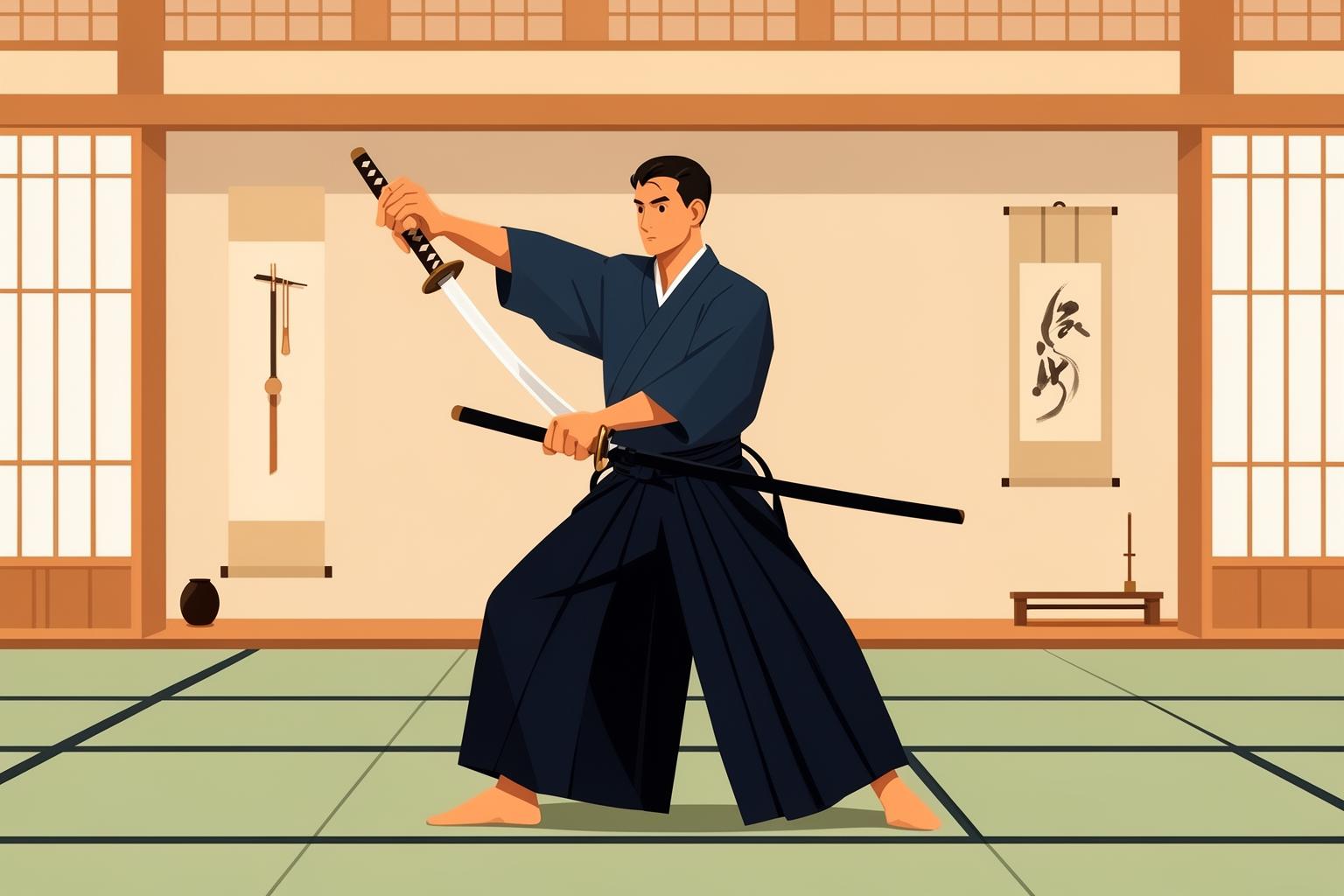
The Iaidō dojo stands in stark contrast to the lively atmosphere found in most martial arts training halls. It is a place of deep silence, where the only noises are the rustle of garments, the gentle glide of feet on wooden flooring, and the clear, sharp hiss of a blade slicing through the air. This ambiance is intentional and vital. The dojo serves as a laboratory for self-discovery, a minimalist environment designed to eliminate distractions and compel the practitioner to face solely their own movements, thoughts, and flaws.
The Uniform and the Tools
Practitioners usually wear a keikogi (a durable jacket similar to those in Judo or Kendo) along with a hakama, the wide, pleated trousers traditionally worn by samurai. The seven pleats of the hakama—five in the front and two at the back—are often said to symbolize the seven virtues of Bushidō, the samurai code: justice, courage, benevolence, respect, honesty, honor, and loyalty. Donning the uniform marks the first step toward shifting one’s mindset from everyday life to the focused state required for practice.
The primary tool, naturally, is the sword. Beginners use an iaitō, a training sword usually made from an aluminum-zinc alloy. It mirrors the weight, balance, and fittings of a real katana but remains unsharpened, making it safe for repeated practice of drawing and sheathing. Only advanced practitioners, often after years of dedicated training and with their teacher’s approval, use a shinken, a live, razor-sharp steel blade. Transitioning to a shinken is a significant milestone, introducing real danger that demands a higher level of focus and respect for the art.
The Silence of Practice
What stands out most to an observer is the silence. There are no kiai (martial artists’ shouts) to direct energy. There is no sparring or impact between bodies or weapons. Instructors offer corrections in quiet, controlled tones. The practice resembles a collective meditation in motion. Students may line up and perform a kata in unison, their movements synchronized to create a powerful sense of shared purpose. At other times, each student may practice different kata at their own rhythm, absorbed in their personal focus.
This quiet setting is essential. It allows practitioners to hear the subtle sounds of their technique. A well-executed draw and cut produces a distinct whistling sound called tachikaze. Hearing it signals proper blade alignment and speed, while its absence indicates a flaw in technique. The silence compels inward concentration. With no external opponent to respond to, the true battle is internal: against a wandering mind, physical fatigue, and the frustration of a movement that doesn’t feel right. The opponent is one’s own imperfections, and the dojo is the arena where these are confronted, again and again.
Finding Stillness in Motion: Iaidō in Modern Life
Why would anyone in the 21st century devote themselves to an art that originated on the feudal battlefields of Japan? For most, the reason has little to do with combat. Iaidō endures and flourishes because it provides something increasingly rare in modern society: a path to mental stillness through disciplined physical movement. It serves as a sanctuary from noise and a training ground for focused attention.
A Moving Meditation
Iaidō is often referred to as a form of moving meditation. While practitioners of seated meditation (zazen) aim to quiet the mind by stilling the body, an Iaidō practitioner achieves this by engaging in a task so complex and precise that there is no mental capacity left for distractions. You cannot worry about a work deadline or a difficult conversation when you are focused on drawing a four-foot blade, maneuvering it around your body, and sheathing it without injury. The kata requires your complete and undivided attention.
This intense concentration acts as a mental cleanser. For the hour or two of practice, the constant internal chatter falls silent. Anxieties about the past and future fade, leaving only the immediate, tangible reality of the present moment: the feel of the hilt in your hand, the balance of the blade, the position of your feet, the rhythm of your breath. When you leave the dojo, the external problems remain, but your relationship with them has often shifted. The mind, having been guided into a deep calm, is better prepared to face them with clarity and composure.
Who Practices Iaidō Today?
The demographic in a typical Iaidō dojo is remarkably diverse. You’ll find university students, salarymen, artists, engineers, and retirees training side-by-side. The gender balance is often more equal than in many other martial arts. What unites them is not a wish for self-defense, but a pursuit of something deeper—discipline, self-improvement, a connection to Japanese culture, or simply a quiet space for personal growth.
One of the most beautiful aspects of Iaidō is that it is a lifelong journey. Unlike sports or more physically demanding martial arts with a peak age, Iaidō can be practiced and refined well into one’s 70s and 80s. As physical strength naturally declines with age, the emphasis shifts even more toward technical precision, efficient movement, and the depth of one’s mental and spiritual insight. The journey never ends. There is no moment when you have “mastered” Iaidō. There is always another layer of subtlety to explore, another flaw in your form to correct, another level of calmness to reach.
The Sword as a Mirror
Ultimately, the practice of Iaidō is not about the sword itself; it is about the self. The katana serves as a uniquely unforgiving tool for self-reflection. Its polished surface literally reflects your physical form, while the practice as a whole reflects your internal state. If your mind is unsettled, your hands will shake and your nōtō will be awkward. If your ego is inflated, you will rely on brute force instead of technique, resulting in clumsy and inefficient movements. If you are distracted, your focus will wane, and the clean lines of the kata will break down.
The sword reveals everything. It offers immediate, honest feedback. In this way, the aim of training is not merely to improve at wielding a sword, but to use the process of learning to wield a sword to become a better version of yourself. The discipline is to polish the spirit and forge a character that is calm, resilient, and aware. The sword is only the grinding stone. The true victory is, and always has been, the one achieved inside the scabbard—within the quiet confines of your own heart and mind.