You’ve probably seen them. If you’ve spent any time in Japan outside the tourist centers, it’s an unavoidable sight. Swarms of teenagers in identical tracksuits, buzz cuts for the boys, functional ponytails for the girls. You see them on the trains at the crack of dawn on a Saturday, see them jogging in unison along a riverbank on a sweltering August afternoon, hear their rhythmic shouts echoing from a school field long after the sun has set. This is bukatsu, the world of Japanese school clubs, and it is far more than a simple after-school hobby. It’s a full-time commitment, a parallel universe of discipline and hierarchy that runs alongside academic life.
Most outsiders see it as a charming expression of Japanese diligence. A testament to teamwork. But if you look closer, you’ll realize you’re not just watching a baseball practice or a kendo drill. You’re watching the foundational training for the Japanese corporate world. The punishing hours, the unwavering respect for seniority, the collective responsibility, the suppression of the individual for the sake of the group—it’s all there. The intense, often brutal, world of bukatsu is the crucible where the quintessential Japanese salaryman is forged. It’s the factory floor where the software of conformity, endurance, and group harmony is installed, long before they ever set foot in an office. To understand the Japanese workplace, with its legendary long hours and unique social dynamics, you have to start here, on the dusty fields and in the echoing gymnasiums of its schools.
These rigorous school club rituals not only forge future corporate leaders but also mirror broader cultural practices, as seen in Japan’s innovative vending machine culture, where discipline and ingenuity seamlessly converge.
What Exactly is Bukatsu?
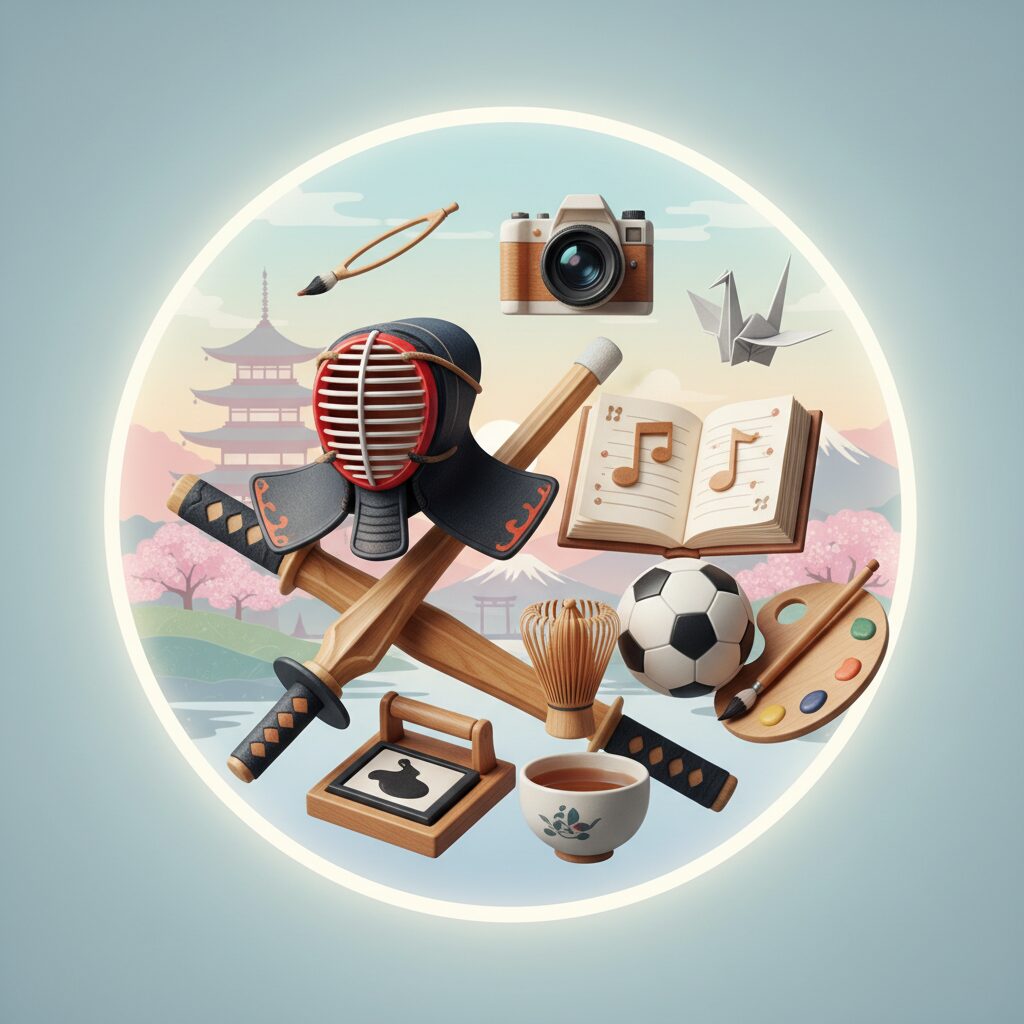
At its core, bukatsu (部活) refers to school-sponsored extracurricular clubs, which are an integral part of junior high and high school life in Japan. Although joining is technically voluntary, there is significant social pressure to participate. Students who do not join a club may be seen as outsiders or as lacking commitment to their personal growth. These clubs are generally categorized into two groups: cultural clubs, called bunka-bu (文化部), and sports clubs, or undō-bu (運動部).
Cultural clubs (bunka-bu) encompass a wide variety of activities, ranging from traditional and peaceful pursuits such as calligraphy (shodō) and tea ceremony (sadō) to more contemporary and specialized interests like manga drawing, computer programming, or train study clubs. While these clubs demand dedication, their intensity is typically lower; they are serious but not all-consuming.
In contrast, the undō-bu are where the intense commitment is found. These are the sports teams, including baseball, soccer, volleyball, basketball, judo, kendo, track and field, and more. For students involved in these clubs, bukatsu is not merely a hobby but their central identity. Practice is rigorous—often starting two hours before school, continuing for three to four hours after school, and lasting all day on Saturdays and frequently Sundays as well. School holidays aren’t breaks but opportunities for even more intensive training, culminating in demanding multi-day camps known as gasshuku (合宿).
These gasshuku camps are infamous for their toughness, usually held in remote areas where students spend their time eating, sleeping, and training from dawn to dusk. The purpose goes beyond enhancing athletic skills; it aims to build character, instill discipline, and create a strong team spirit through shared challenges. Because of this huge time commitment, many students’ lives revolve entirely around their club. Their teammates form their main social circle, and the club’s rules and values influence their conduct both in school and beyond.
The Bedrock of Society: The Senpai-Kōhai Hierarchy
To truly grasp bukatsu, one must first comprehend the strict hierarchical structure that defines it. This is the realm of senpai (先輩), the senior members, and kōhai (後輩), the junior members. This relationship, called jōge kankei (上下関係), mirrors the social hierarchy of Japanese society at large, from the workplace to the family.
When a first-year student joins a club, they start at the very bottom of the hierarchy. Their role is not to play but to serve. They handle all the menial tasks: cleaning the clubroom, carrying equipment, preparing training grounds, fetching drinks for the seniors, and even doing the team’s laundry. They are the first to arrive and the last to leave, with their own practice often beginning only after fulfilling all duties to their senpai.
Language plays a crucial role in this hierarchy. A kōhai must use keigo (敬語), the formal, honorific Japanese, when addressing any senpai. They must greet their seniors with loud, clear shouts of “Good morning!” (Ohayō gozaimasu!) or “Thank you for your hard work!” (Otsukaresama desu!). Questioning a senior’s orders is never allowed. The senpai, in turn, hold absolute authority. They are responsible for teaching juniors not only the skills of the sport but also the traditions and unwritten rules of the club. They can serve as mentors and protectors but also as disciplinarians, reprimanding and punishing juniors even for minor infractions.
This system serves as a direct, intentional rehearsal for corporate life. When a new graduate enters a Japanese company, they become kōhai once again. They are expected to show deference to their senior colleagues and superiors (senpai and jōshi), learn by observing, take on undesirable tasks without complaint, and master the complex etiquette of the workplace. The years spent in bukatsu have already prepared them for this dynamic. They know how to navigate a vertical hierarchy, show respect to superiors, and accept their place at the bottom while they learn the ropes. The shift from sports team to corporate team is nearly seamless.
Forging the Spirit: Gaman and Konjō
Beyond the social structure, bukatsu serves as an intense training ground for the Japanese psyche. Two key concepts lie at the heart of this training: gaman (我慢) and konjō (根性).
Gaman is frequently translated as “patience” or “endurance,” but this fails to fully capture its depth. It embodies the virtue of enduring what seems unbearable with stoicism and dignity. It involves suppressing personal feelings of pain, exhaustion, or frustration for the sake of the group. In bukatsu, this is instilled through relentless drills that push students to their physical and mental limits. Picture a baseball team fielding a thousand grounders under the scorching summer sun, or a judo team sparring endlessly until they can barely stand. Complaining is out of the question. Showing weakness is viewed as a failure not only of the body but of character.
Closely linked is konjō, which translates to “grit” or “willpower.” It signifies the belief that a determined spirit can overcome any physical barrier. This forms the basis of what is sometimes called seishin-ron (精神論), or the “theory of spirit.” A coach might yell at a player that they aren’t really tired—that it’s all in their mind. The aim is to break down a student’s perceived limits and rebuild them with a spirit that refuses to give up. Water breaks might be limited, not solely for physical conditioning, but as a test of mental endurance.
This philosophy has deep origins in pre-war Japanese military training, and its influence is unmistakable. The outcome is an individual conditioned to endure extreme hardship without complaint. Now consider the traditional Japanese workplace. Long hours of overtime are not merely about workload; they represent a demonstration of loyalty and dedication. Facing a challenging and tedious project becomes an opportunity to show your gaman. Pushing through exhaustion to meet a deadline displays your konjō. The mindset nurtured on the playing field—the belief that silent suffering is a virtue and that spirit can conquer circumstance—is precisely the mindset that has driven Japan’s economic miracle and, conversely, fueled its infamous overwork culture.
The Individual Vanishes: Group Harmony and Collective Punishment
If there is one fundamental rule in Japanese society, it is the priority of the group over the individual. The proverb “The nail that sticks out gets hammered down” (Deru kui wa utareru, 出る杭は打たれる) is ingrained from an early age. Bukatsu is where this lesson is reinforced with uncompromising intensity.
Team success is paramount. Individual statistics or moments of personal glory take a backseat to the smooth operation and victory of the collective. This embodies the principle of wa (和), or group harmony. Actions are evaluated based on whether they serve the team’s interests. A skilled player who is selfish or disregards the coach’s strategy is often sidelined in favor of a less talented but more compliant, team-focused member. The aim is to build a cohesive unit where every part is interchangeable and works flawlessly in unison.
To uphold this group-first mindset, many clubs apply the concept of rentai sekinin (連帯責任), or collective responsibility. If one team member is late to practice, the entire group may be required to run laps. If a student forgets part of their uniform, everyone must do push-ups. This fosters a strong system of peer pressure and self-regulation. Each member is accountable not only for their own conduct but also for that of their teammates. It becomes everyone’s responsibility to ensure no one deviates, as one person’s error results in consequence for all.
This dynamic carries over directly into the corporate world. In Japanese companies, projects are almost always undertaken as group efforts. The concept of consensus-building (nemawashi) before meetings is essential for preserving wa. Openly opposing a superior or a group decision is considered a serious breach of etiquette. When mistakes occur, blame is frequently accepted by the entire section or department, not solely the individual at fault. The manager will publicly apologize on behalf of the team. This sense of shared destiny, this conviction that “we are all in this together,” serves as a powerful force for unity, learned through the collective hardships and successes of bukatsu.
The Unspoken Costs and Glimmers of Change
This system is remarkably effective at cultivating diligent, resilient, and team-oriented workers, but it comes with a price. For decades, the darker side of bukatsu remained an open secret. The intense pressure and absolute authority wielded by coaches and senpai fostered an environment susceptible to abuse.
Taibatsu (体罰), or corporal punishment, was once a widespread and accepted aspect of coaching. Physical violence, verbal abuse, and severe hazing were often justified as necessary means to build character. Although this has become less tolerated in recent years, accounts of harsh training methods and psychological abuse still emerge. The system can also suppress creativity and individuality. Students are taught to obey rather than innovate, learning to set aside their own opinions in favor of group consensus. The same traits that produce compliant workers can hinder dynamism and adaptability.
Moreover, the significant time commitment required by intense bukatsu can negatively affect academic performance and leave little room for other interests or social life outside the club. The well-being of both students and teachers who serve as club advisors—often working long hours for minimal extra compensation—is an increasing concern.
In recent years, efforts toward reform have gained momentum. The Japanese government has introduced guidelines to restrict the number of practice days and hours, urging clubs to allow at least one or two days off each week. The aim is to establish a healthier balance among club activities, academics, and personal time. This echoes a similar transformation occurring in the corporate sector. Younger generations of Japanese workers are beginning to challenge traditional norms. The guarantee of lifetime employment is diminishing, and the willingness to devote one’s entire life to a company is declining. There is a rising demand for improved work-life balance, more flexible working arrangements, and a corporate culture that prioritizes individual well-being.
The Echo in the Office
The connection is unmistakable; it is a straight path. The young boy who learned to bow perfectly and greet his baseball coach becomes the new employee who does the same with his section chief. The girl who spent her weekends cleaning tennis courts without complaint becomes the office worker who willingly takes on additional tasks to support her team. The student who endured a demanding gasshuku by drawing on their konjō becomes the salaryman capable of pulling an all-nighter to complete a presentation.
Bukatsu serves as the social and psychological training ground for corporate Japan. It is a highly effective, though sometimes rigorous, system for instilling the values needed to thrive in a society that prioritizes the collective above all else. It teaches hierarchy, endurance, harmony, and the language of respect. So, the next time you see a group of Japanese students in matching tracksuits, moving in unison, recognize that you’re witnessing more than just a sports team. You’re observing a rehearsal for the life ahead—a life marked by dedication, perseverance, and belonging to something greater than themselves, for better or worse.