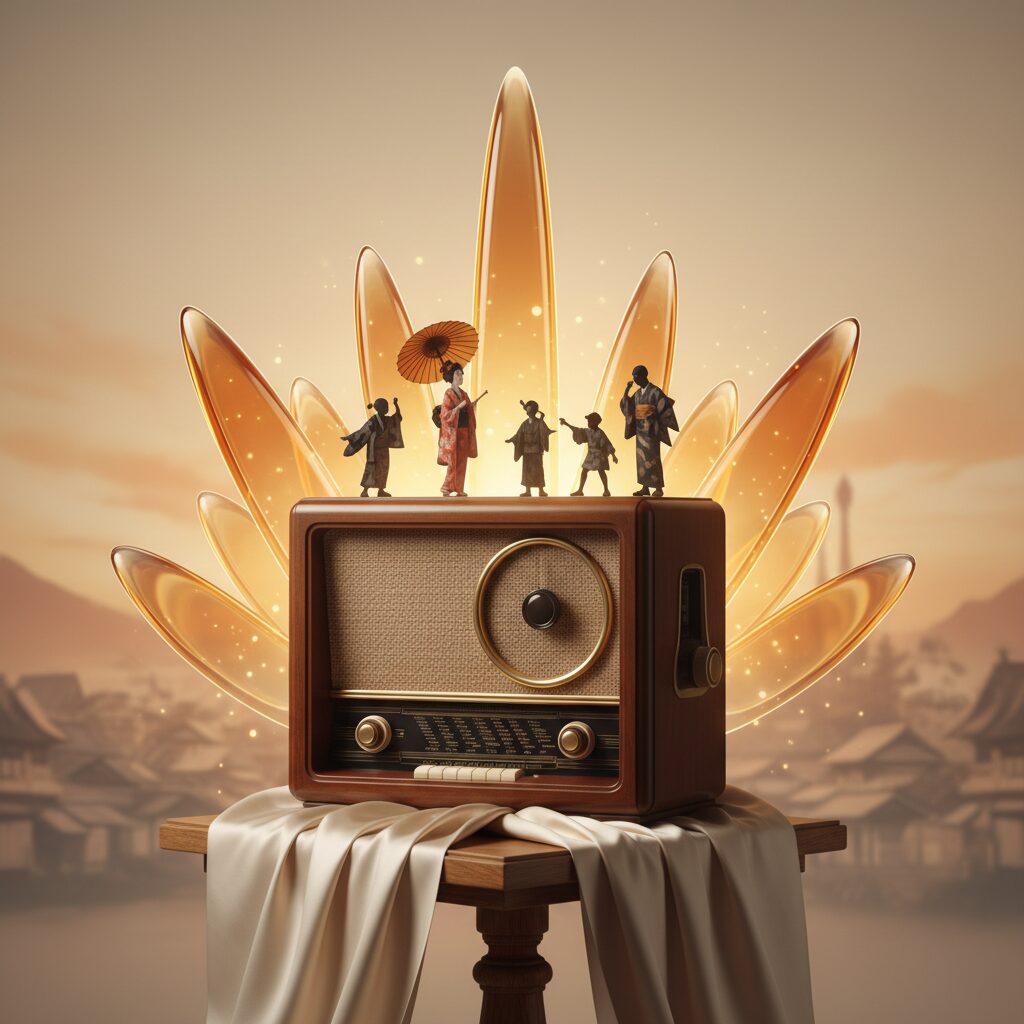
If you spend enough time in Japan, especially outside the tourist-heavy centers of Tokyo or Kyoto, you’ll eventually hear it. It might be during a sweltering August morning, drifting through an open window from a nearby park. Or perhaps you’ll catch it on a walk past a primary school, where hundreds of children are lined up in the yard. It’s the sound of a simple, slightly tinny piano melody, cheerful and unfailingly consistent. And with it comes a sight that can feel like a time warp: people, young and old, moving in perfect, gentle synchronicity. They stretch their arms to the sky, bend at the waist, and rotate their bodies in a sequence of thirteen familiar movements. This is Rajio Taisō, or Radio Calisthenics, a three-minute morning ritual that has been a fixture of Japanese daily life for nearly a century.
For an outsider, the scene raises immediate questions. In a nation synonymous with hyper-modernity, a place of bullet trains and bewilderingly advanced toilets, why does this seemingly archaic, government-sponsored group exercise persist? It looks like something from a black-and-white newsreel, yet it’s practiced with unselfconscious regularity from the northern tip of Hokkaido to the southern islands of Okinawa. Millions participate every day. It’s more than just a quaint habit or a national fitness program. Rajio Taiso is a living artifact, a thread woven through the complex fabric of Japan’s 20th-century history. To understand this simple morning workout is to understand something profound about the country’s relationship with community, conformity, and the quiet power of routine. It is a physical echo of a past that has never truly disappeared.
This enduring morning ritual not only anchors Japan’s daily rhythm, but it also reflects a broader cultural tapestry that can be further appreciated by exploring Japan’s artful fake food displays.
The Birth of a National Habit
The story of Rajio Taiso originates not in Japan, but in the United States. In the 1920s, the Metropolitan Life Insurance Company (MetLife) sponsored a fifteen-minute radio broadcast aimed at promoting a healthier lifestyle among its policyholders. The program, which featured light calisthenics set to music, quickly gained popularity. Japanese officials visiting the US at the time took notice. They saw a brilliant, modern method to utilize the emerging technology of radio for a national initiative: enhancing the physical health of the population.
An American Idea, A Japanese Purpose
When the concept was introduced to Japan, it was modified with a distinctly Japanese sense of purpose. The late 1920s was a time of intense nationalism and rapid industrialization. The government sought ways to create a strong, healthy, and unified citizenry, prepared to serve as soldiers in the Imperial Army and workers in the country’s expanding factories. A standardized, daily exercise routine broadcast across the nation proved to be the ideal tool.
In 1928, to mark the coronation of Emperor Hirohito, the first National Health Exercise Program was broadcast nationwide by NHK, the national public broadcaster. Experts designed the movements to be simple enough for everyone—from young children to the elderly—to perform easily. The objective was not athletic achievement but broad participation and the establishment of a collective habit. From its beginning, Rajio Taiso was a top-down initiative, a form of social engineering aimed at building a physically and spiritually resilient nation.
The Sound of the Empire
Throughout the 1930s and into the Pacific War, Rajio Taiso became an unavoidable aspect of daily life. It was performed in schools to start the day, in factories to prepare workers for their shifts, and in neighborhood associations to nurture community spirit. The shared experience of hearing the same piano melody simultaneously and moving as a single body fostered a powerful, subliminal sense of national unity.
The routine went beyond mere physical education; it was a civic ritual. Participation was a quiet demonstration of one’s duty to the group and, by extension, to the nation and the Emperor. The synchronized movements served as a physical metaphor for the ideal society envisioned by the nation’s leaders: orderly, disciplined, and united in purpose. In the years leading up to and during the war, this simple exercise became a daily reinforcement of the collectivist ideology that underpinned Japanese militarism.
Post-War Purge and Unlikely Revival
Following Japan’s defeat in 1945, the Allied Occupation began, led by American forces under General Douglas MacArthur. The Supreme Commander for the Allied Powers (SCAP) initiated an extensive effort to demilitarize and democratize the nation, which included dismantling institutions and symbols linked to the former regime. Rajio Taiso, closely associated with wartime nationalism and group conformity, became an obvious target.
Banned by the Americans
In 1946, the Occupation authorities officially prohibited the broadcast and practice of the original Rajio Taiso. They considered it a tool of militaristic indoctrination, arguing that the focus on synchronized group movement stifled individualism in favor of an unhealthy collectivism. The sight of hundreds moving as a single entity was viewed as a physical representation of the mindset that had driven Japan into war. The piano music ceased, and the national ritual ended abruptly.
A Softer, Gentler Calisthenics
However, the ban did not endure for long. The Japanese public, having lost many familiar routines, genuinely missed the morning exercises. There was widespread demand for its return—not for nationalist reasons but for its straightforward health and community benefits. Acknowledging this, Japanese authorities, including the Ministry of Education, the Ministry of Health and Welfare, and NHK, collaborated to develop a new version that would be acceptable to the occupiers while embraced by the public.
In 1951, shortly before the Occupation ended, a new Rajio Taiso was introduced. This is the version still practiced today. Though it resembled the original, the changes were substantial. The new routines—Rajio Taiso Dai Ichi (Number 1) and the slightly more vigorous Dai Ni (Number 2)—were redesigned from scratch by medical professionals and physical education experts. The emphasis shifted from militaristic discipline to scientific principles of health and physiology. These exercises were specifically created as a full-body workout to enhance flexibility, circulation, and balance for people of all ages.
This revival marked a significant transformation. Rajio Taiso was reborn, free from its imperial-era ideological associations. It evolved from a state-imposed tool for national mobilization into a cherished public practice, voluntarily adopted by the people for its own merit. The custom had outlasted its original political intent.
The Mechanics of a Morning Ritual
Part of what makes Rajio Taiso so enduring is its complete simplicity and predictability. It serves as a cornerstone of daily life, as dependable as the sunrise. The infrastructure supporting this habit has been in place for decades and is seamlessly woven into the daily rhythm.
The Unchanging Melody
Every morning at 6:30 AM, NHK Radio 1 airs the familiar piano tune. The broadcast remains nearly identical each time. A calm, encouraging male voice signals the start and guides listeners through each of the thirteen movements of Rajio Taiso Dai Ichi, a routine lasting about three minutes and ten seconds. The instructions are clear and paced gently: “First, the exercise for stretching the arms and legs,” or “Next, the exercise for strengthening the muscles of the arms and chest.”
The music itself serves as a powerful nostalgic trigger for anyone raised in Japan. It is an acoustic landmark of childhood, instantly transporting people back to sleepy summer mornings or chilly schoolyards from their youth. The melody is as ingrained in the national consciousness as cherry blossoms in spring or cicadas in summer.
The Summer Stamp Card
For children, the most memorable experience with Rajio Taiso occurs during summer vacation. Across neighborhoods nationwide, a cherished tradition unfolds. Every morning for several weeks, local kids gather in a designated park or public square to perform the exercises together. This is not a mandatory school event but a community-run activity, often organized by the local neighborhood association (chōnaikai).
To encourage participation, each child receives a rajio taiso kādo—a stamp card. For each day they attend, they earn a stamp, usually given by one of the elderly residents who leads the group. Watching the card fill up becomes a source of great pride. At the end of the summer session, a completed or nearly completed card can be traded for a small reward, such as a bag of candy or some school supplies. As a parent here, I have seen my own children carefully track their stamps, driven less by the prize and more by the simple satisfaction of completing the task.
This tradition does more than keep children active. It subtly teaches routine and responsibility. It offers a daily point of contact that links children with their neighbors, especially the older generation. It grounds them in their local community, giving them a sense of belonging to a particular place. It is a low-stakes, high-impact form of social bonding that grows one stamp at a time.
Rajio Taiso in the 21st Century: An Anachronism or an Anchor?
Decades after its post-war resurgence, Rajio Taiso continues to hold a steady, if quieter, influence on Japanese society. Although its role has shifted, its presence remains evident in unexpected areas of modern life, prompting debate over whether it is a cherished tradition or an outdated emblem of conformity.
From Factory Floors to Office Cubicles
The workplace still stands as one of the few places where organized, mandatory Rajio Taiso persists. Many companies, especially in construction and manufacturing where physical labor is common, start the workday with a group session. The reasoning is practical: it warms up muscles, lowers injury risk, and sharpens focus. Construction teams across Japan can be seen performing the familiar stretches before beginning their tasks.
Even some white-collar offices continue the practice. Though less frequent, the morning exercises are viewed as a way to foster team spirit and shake off morning sluggishness. For some employees, it’s a welcome break and a chance for shared activity. For others, particularly younger workers, it can feel like a paternalistic and slightly embarrassing relic from a more rigid time—a forced display of group conformity before work really starts.
A Greying Army of Devotees
Head to any moderately sized park in Japan at 6:30 AM, and you’ll find Rajio Taiso’s most devoted practitioners: the elderly. For many senior citizens, this daily routine anchors their social lives. It is an indispensable appointment that provides structure, gentle exercise, and, above all, human connection.
These groups are extraordinarily committed. They meet every day, rain or shine, seeking shelter under pavilions when needed. The workout itself is almost secondary to the social ritual. Before and after the three-minute broadcast, they chat, exchange news, and simply enjoy each other’s company. In a country with a rapidly aging population and growing concerns about social isolation among the elderly, Rajio Taiso acts as a vital grassroots remedy. It offers a free, accessible, and self-supported community network.
Resistance and Reinvention
Naturally, not everyone embraces it. Many Japanese associate Rajio Taiso with the compulsory conformity of their school days and avoid it altogether. They view it as a symbol of group-oriented pressure they wish to leave behind in adulthood. For them, performing synchronized movements in public represents the opposite of personal freedom.
However, the routine has shown an impressive ability to adapt. Local governments have developed dialect-specific versions of the instructional voiceover, adding regional pride. Fitness instructors share high-intensity or modified variants on YouTube. Its iconic music and movements are frequently parodied or honored in films and TV shows, highlighting its deep cultural imprint. It is so ingrained in the national consciousness that it serves both as a symbol of strict tradition and a subject for playful reinterpretation.
What It All Means: The Lessons of Rajio Taiso
So, what does this straightforward three-minute exercise truly reveal about Japan? It demonstrates that a habit, once established, can develop a life of its own, far exceeding its original purpose. It represents a physical expression of several fundamental cultural values that continue to influence Japanese society, even amidst change.
It highlights a profound appreciation for continuity and nostalgia. In a nation that has undergone immense transformations over the past century—from empire to devastation to economic powerhouse—Rajio Taiso remains a rare, uninterrupted connection to the past. The shared experience of performing these exact same movements creates a tangible bond between generations.
It reflects the subtle emphasis on the group over the individual. The strength of Rajio Taiso lies in its collective practice. Moving together fosters a sense of belonging and shared identity. It serves as a quiet daily reminder that one is part of a greater whole, whether that be a company, a community, or the nation itself.
It embodies the cultural significance of routine and habit (shūkan). In Japan, there is a belief that greatness—or at least well-being—is attained not through grand, sporadic acts but through small, consistent daily efforts. Rajio Taiso perfectly exemplifies this philosophy: a brief daily commitment that produces long-term benefits for both personal health and social cohesion.
Ultimately, Rajio Taiso’s story is one of resilience. Created by an imperial government, prohibited by an occupying force, and later embraced again by the people for their own reasons, it may seem simple or even slightly amusing to outsiders. But for millions in Japan, the familiar piano notes that sound at 6:30 every morning are more than a call to exercise. They are the sound of continuity—the steady, quiet heartbeat of a nation stretching and bending, but never breaking, as it welcomes a new day.