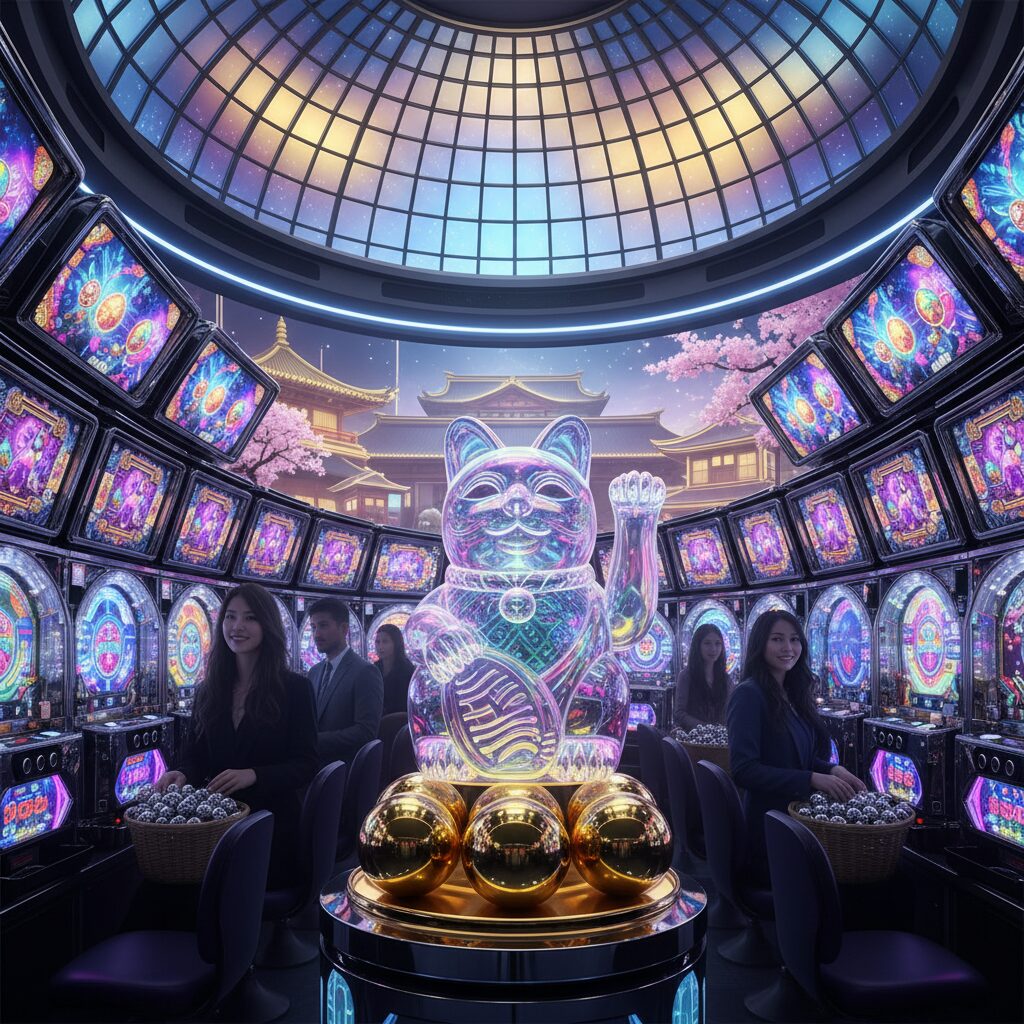
Walk down almost any busy street in a Japanese city, past the serene temples and meticulously organized convenience stores, and you will inevitably hear it. First, it’s a faint, distant rattle, a strange electronic shimmering. As you get closer to a set of garish, sliding glass doors, the sound intensifies into a deafening, metallic waterfall. Peek inside, and you’re met with a sensory onslaught: rows upon rows of people sitting transfixed before brightly lit machines, a haze of stale cigarette smoke (now thankfully diminishing), and the overwhelming, continuous roar of a billion tiny steel balls cascading against brass pins. This is a pachinko parlor, Japan’s deafening, dazzling temple of quasi-gambling. It’s an experience that seems to contradict every stereotype of a quiet, orderly, and reserved Japan. And yet, it’s an utterly mainstream part of the cultural landscape, a multi-billion-dollar industry hiding in plain sight.
The central paradox of pachinko is this: Japan has some of the strictest anti-gambling laws in the developed world. Betting on almost anything is illegal. You cannot, by law, walk into a casino, put money on a sports team, or play a hand of poker for cash. Yet these parlors, which look and feel for all the world like casinos, operate openly in every prefecture. Millions of people play every day, walking out with cash in their pockets when they win. How is this possible? The answer isn’t a simple one. It’s a story woven from a brilliant legal loophole, post-war desperation, deep-seated cultural needs, and a complex social history that is rarely discussed openly. To understand pachinko is to understand Japan’s fascinating ability to compartmentalize, to create and maintain a system of rules and then build an elaborate, socially accepted mechanism for bending them. It’s more than just a game; it’s a cultural institution, a form of meditation, a source of controversy, and a window into the Japanese psyche.
The juxtaposition of pachinko’s high stakes and regulated chaos with other Japanese cultural quirks, such as oshi-katsu fan activities, further illustrates the nation’s intriguing balance of tradition and modernity.
What Exactly Is Pachinko? The Mechanics of the Game
Before we delve into the legal complexities and cultural importance, it’s crucial to grasp what a person is actually doing in one of those parlors. It’s easy to confuse a pachinko machine with a Western-style pinball machine, but that comparison is superficial at best. They are fundamentally different devices, designed for a different kind of interaction.
More Than a Pinball Machine
A pachinko machine features a vertical playing field housed within a glass-encased cabinet filled with a dense array of brass pins, small gates, and spinning elements. Unlike pinball, it has no flippers. The player doesn’t react to a ball in motion. Instead, the primary—and often sole—control is a single knob located on the lower right side of the machine. The player starts the game by inserting either cash or a pre-paid card, which releases a cascade of small, silver steel balls into a tray.
Your task is simply to turn this knob. That’s all. Turning it adjusts the power of a spring-loaded plunger that launches the balls, one by one, up a chute on the left side of the machine. From there, gravity takes over. The ball tumbles down through the maze of pins, bouncing unpredictably. The objective is for the ball to land in a specific, small winning pocket, often near the machine’s center. Most balls will just fall to the bottom and be lost. It’s a game demanding fine motor control and great patience. A slight twist of the knob alters the launch velocity, changing the ball’s trajectory just enough to possibly find a lucky path through the pins. Players often discover a “sweet spot” and try to hold that exact pressure on the knob for hours, letting hundreds or even thousands of balls fly in hopes of hitting the jackpot.
The “Fever” State
This mechanical game of chance is only part of the story. The real innovation in pachinko came with integrating digital technology. Modern machines are hybrids, combining the analog cascade of steel balls with a large digital screen in the center that operates like a slot machine. When a ball successfully enters the central winning pocket, it doesn’t just award a few extra balls; it triggers the digital slot machine. Three reels spin, often featuring characters from popular anime, movies, or TV shows. If the numbers or symbols on the reels line up—such as 7-7-7—you’ve hit the jackpot, known in Japan as ōatari (大当たり), or “big hit.”
At this moment, the machine explodes into action. Lights flash, celebratory music blares, and a gate at the bottom of the machine opens for an extended period. This is “fever mode” (フィーバー). For several minutes, nearly every ball you launch is directed into a special payout pocket, releasing a flood of new balls into your tray. One jackpot can generate thousands of balls, which fall into plastic buckets at your feet with a satisfyingly loud clatter. This blend of a slow, repetitive mechanical task with the sudden, explosive reward of a digital slot machine forms the heart of its addictive design. It creates a powerful feedback loop that keeps players hooked.
The Sound and the Fury
Then there’s the noise. The sound inside a pachinko parlor is not accidental or incidental; it’s a fundamental part of the experience. It’s a physical wall of sound, often exceeding 100 decibels, made up of the clatter of millions of steel balls, the cacophony of music and sound effects from hundreds of machines all playing simultaneously, and announcements blaring from overhead speakers. This is not merely for entertainment. The noise fulfills a deep psychological role. It isolates you. So loud that conversation is impossible, you become cocooned in your own little world, focused solely on the machine before you. The roar blocks out the sounds of the outside world and even those within the parlor—you can’t easily tell if the person next to you is winning or losing. It encourages a trance-like state, a focused meditative zone where only the knob in your hand and the dance of the silver ball matter. It is, in its own unique way, a form of escapism through total sensory overload.
The Great Legal Loophole: How “Not Gambling” Works
So, you’ve struck a massive jackpot, with several large buckets overflowing with thousands of silver balls. This is where pachinko performs its legal alchemy, converting a straightforward gambling win into something entirely different. The whole industry depends on an ingenious, unspoken agreement called the “three-shop system,” or santen hōshiki (三店方式).
The Three-Shop System
This system is a masterstroke in plausible deniability, dividing what should be a single transaction into three legally distinct stages. It is universally recognized by players, parlor owners, and the police, yet this carefully crafted fiction is what keeps the entire operation legal.
Step 1: The Parlor. Inside the parlor, you bring your buckets of winnings to an automated counting machine that tallies them and prints a receipt. You then take this receipt to the prize counter. It is crucial to understand that at no time can the parlor staff give you cash for your balls, as that would violate the penal code against gambling. Instead, you exchange your winnings for “special prizes” (tokushu keihin). These are usually small, sealed plastic cases containing a tiny sliver of gold or a similarly worthless token. They serve no practical purpose and are clearly just placeholders for monetary value.
Step 2: The “Independent” Exchange Window. With your special prizes in hand, you must leave the pachinko parlor. Nearby—often just around the corner, down a narrow alley, or sometimes even in a hidden spot on a different floor of the same building—is a small, discreet booth. It may be marked with a simple sign like “TUC Shop” or something similarly unassuming. This is the system’s second shop. You slide your plastic-encased gold tokens through a small opening, and an unseen clerk hands back the equivalent value in Japanese yen. On paper, this establishment is an entirely separate business from the pachinko parlor, specializing in buying these specific little trinkets.
Step 3: The Wholesaler. The cycle completes with the third, unseen participant: the wholesaler. At day’s end, this wholesaler purchases all the special prizes from the TUC Shop. The wholesaler then sells those same prizes back to the pachinko parlor at a slightly higher price, ready to be given out to the following day’s winners. This creates a continuous, closed-loop circulation of the prize tokens.
Plausible Deniability
The brilliance of this system lies in the fact that no single entity is directly involved in gambling. The parlor provides merely a game of skill and entertainment where the prizes are novelty items. The exchange booth acts as a secondhand goods dealer, buying items from willing sellers. The wholesaler functions simply as a distributor. Although these three businesses are financially linked in a symbiotic relationship, this connection is an open secret the law chooses to overlook. The police fully acknowledge this arrangement. It allows the industry to be regulated, taxed, and controlled, rather than driven underground into the hands of explicitly criminal organizations. It is a uniquely Japanese solution: a pragmatic, face-saving compromise that upholds the letter of the law while permitting a reality society has come to accept.
The Social and Historical Roots of the Silver Ball

Pachinko’s unusual, semi-legal status and its deep roots in Japanese life cannot be fully grasped without tracing its origins back to the tumultuous 20th century. It was not created in a corporate office; rather, it evolved naturally from the aftermath of war and the margins of society.
From Child’s Toy to Post-War Staple
The earliest precursor to the game was the “Corinthian Game” from Chicago, a simple children’s bagatelle-style toy that gained popularity in Japan during the 1920s. It was then rebranded and modified into a vertical game called pachi-pachi, named after the clicking sound made by the balls. For a time, it was a modest amusement found in candy stores, where children could win sweets. The modern, adult version of pachinko truly took shape in the immediate post-World War II period. Japan was devastated, its cities destroyed, and its people demoralized and impoverished. In this harsh context, inexpensive diversions were highly sought after. Pachinko parlors, often little more than wooden shacks in black markets springing up nationwide, provided an accessible form of escape. For just a few yen, someone could lose themselves in the game for an hour, forgetting hunger and hardship. It required no intricate strategy or social interaction, only a few coins and some luck. Its popularity surged, making it one of the earliest and most visible entertainment industries during Japan’s post-war recovery.
The Zainichi Connection
Another important aspect of this history, often left unspoken in Japan, is the significant involvement of the Zainichi Korean community. Zainichi Koreans are ethnic Koreans whose families came to Japan, frequently through forced labor, during Japan’s colonial rule over Korea. After the war, they and their descendants remained in Japan but encountered systemic discrimination. They were often denied Japanese citizenship and excluded from many mainstream professions and corporate jobs. Seeking economic opportunities, many Zainichi entrepreneurs entered industries on society’s fringes—businesses viewed as less respectable by mainstream Japanese society. These included running restaurants, bars, and most notably, pachinko parlors. They dedicated immense effort and business savvy to this growing industry and eventually came to dominate it. Even today, it is estimated that a significant portion—some claim over half—of Japan’s pachinko parlors are owned by individuals of Korean descent. This has created a complex and sometimes tense dynamic. The industry has served as a powerful source of economic empowerment for a marginalized community but has also been the focus of political controversy, including persistent (and often exaggerated) allegations of financial links to North Korea, as some Zainichi groups have historically maintained ties to Pyongyang.
The Bubble Era and Beyond
Pachinko reached its peak during Japan’s “Bubble Economy” of the late 1980s and early 1990s. With enormous disposable income circulating, the industry soared. Parlors evolved from shabby halls into vast, multi-story entertainment complexes, dazzling with neon lights and offering increasingly advanced machines. At its height in the mid-1990s, the pachinko market was valued at an astounding ¥30 trillion (over $200 billion), with nearly 30 million people—almost a quarter of Japan’s population—playing regularly. Since then, the industry has experienced a slow but steady decline. The collapse of the economic bubble, an aging player demographic, competition from more engaging home entertainment like video games and smartphones, and tighter government regulations aimed at curbing gambling addiction have all impacted it. The number of parlors has dropped by more than half from its peak, yet pachinko remains a substantial economic force.
The Pachinko Player: A Profile in Escapism
So who is the person sitting in front of that machine for hours on end, seemingly indifferent to the world around them? The common stereotype is often a middle-aged or elderly man, chain-smoking and passing time during his retirement. While that group is certainly represented, the reality is much more varied. You’ll find salarymen in suits dropping by to unwind after a grueling day at work, young university students killing time between classes, and housewives looking for a brief, anonymous escape from their domestic responsibilities.
A Zone of Anonymity
The cultural appeal of the pachinko parlor lies in what it provides: a temporary escape from the rigid social structures of Japanese society. Japan is a culture that highly values the group, harmony (wa), and fulfilling one’s social duties. From the workplace to the family, behavior is often guided by roles and relationships. The pachinko parlor offers a counterbalance. It is a space of pure, unfiltered individualism. Once seated at your machine, you enter a personal bubble. No one expects small talk. No one cares about your job title or family background. You are judged solely by your luck with the silver balls. Amid the deafening clamor, social pressures fade away. This intense, isolating concentration can serve as a potent form of stress relief, helping clear the mind of all the worries and responsibilities waiting outside those sliding glass doors. It’s a kind of mindfulness achieved not through quiet reflection, but through a deliberate sensory overload.
The Dark Side: Addiction and Social Stigma
However, this powerful psychological draw has a deeply troubling side. Pachinko addiction is a significant and recognized social problem in Japan. The machine’s design—the near-misses on the digital slots, the variable ratio reinforcement of jackpots, the immersive lights and sounds—is crafted to be captivating, and for some, dangerously addictive. The Japanese term for addiction, izonshō (依存症), is often associated with pachinko. The media frequently covers tragic stories, the most heartbreaking involving parents leaving young children unattended in hot cars for hours while they play, sometimes with fatal outcomes. This has prompted increased public pressure and government regulation. Recently, rules have been introduced to cap the maximum payout of a single jackpot, aiming to make the game less volatile and addictive. Despite its widespread popularity, pachinko carries a social stigma. It’s not a pastime one proudly includes on a resume. Many view it as a vice, a sign of weakness, or a waste of time and money, even among players themselves. This dual nature—as both a common leisure activity and a source of shame—is key to its cultural role.
The Future of the Parlor in a Changing Japan

The pachinko industry stands at a crossroads, confronted by a shrinking domestic market, an aging customer base, and the impending arrival of legalized casino gambling. Its continued existence hinges on its capacity to evolve with the times.
The Pachi-Slot Evolution
One of the most notable changes has been the emergence of the pachi-suro, or pachi-slot. These machines now dominate much of the parlors’ floors and resemble traditional Las Vegas-style slot machines more closely. They use tokens instead of balls and rely almost entirely on digital reels. Importantly, they introduce a perceived skill component: players must press a series of buttons to stop the spinning reels, and well-timed presses can slightly improve the chances of winning. This feature has drawn a younger audience, especially fans of anime and video games, since many pachi-slots are themed around hugely popular franchises like Neon Genesis Evangelion, Street Fighter, or Mobile Suit Gundam. These machines offer elaborate animated storylines and bonus rounds, transforming the gambling experience into interactive entertainment. Although they still operate under the same three-shop prize exchange system, their gameplay is faster and better suited to contemporary entertainment tastes.
The Specter of Legal Casinos
The greatest existential challenge to pachinko’s dominance comes from the recent legalization of “Integrated Resorts” (IRs) in Japan. After decades of debate, the government has finally approved the development of large-scale hotel and casino complexes, with the first expected to open in Osaka around 2030. This raises a critical question: when given the option of state-sanctioned, glamorous casinos, will people still be drawn to the noisy, utilitarian pachinko parlors? Supporters of the industry argue pachinko will endure because it occupies a different niche. It’s casual, accessible, and inexpensive for short sessions. One can drop into a local parlor for thirty minutes on the way home from work, whereas visiting a massive casino resort will be a special event, a destination experience. Pachinko is an everyday diversion; casinos will be reserved for vacations. Nonetheless, this competition will surely push the pachinko industry to innovate further and perhaps improve its gray-market reputation.
A Fading Roar?
Pachinko is a living relic, a vibrant, flashing echo of Japan’s Showa Era that has survived well into the 21st century. It stands as a monument to a legal fiction, a symbol of the nation’s post-war resilience, and a refuge for those seeking a brief escape from a world of rigid expectations. Though the industry is smaller than it once was and the once-deafening roar of the parlors may be gradually fading, it is far from extinct. Pachinko remains a powerful emblem of Japan’s complex relationship with rules, money, and social release—a place where, for the cost of a few thousand yen, anyone can sit in splendid isolation, turn a small knob, and wait for the rush of silver balls to momentarily wash the world away.