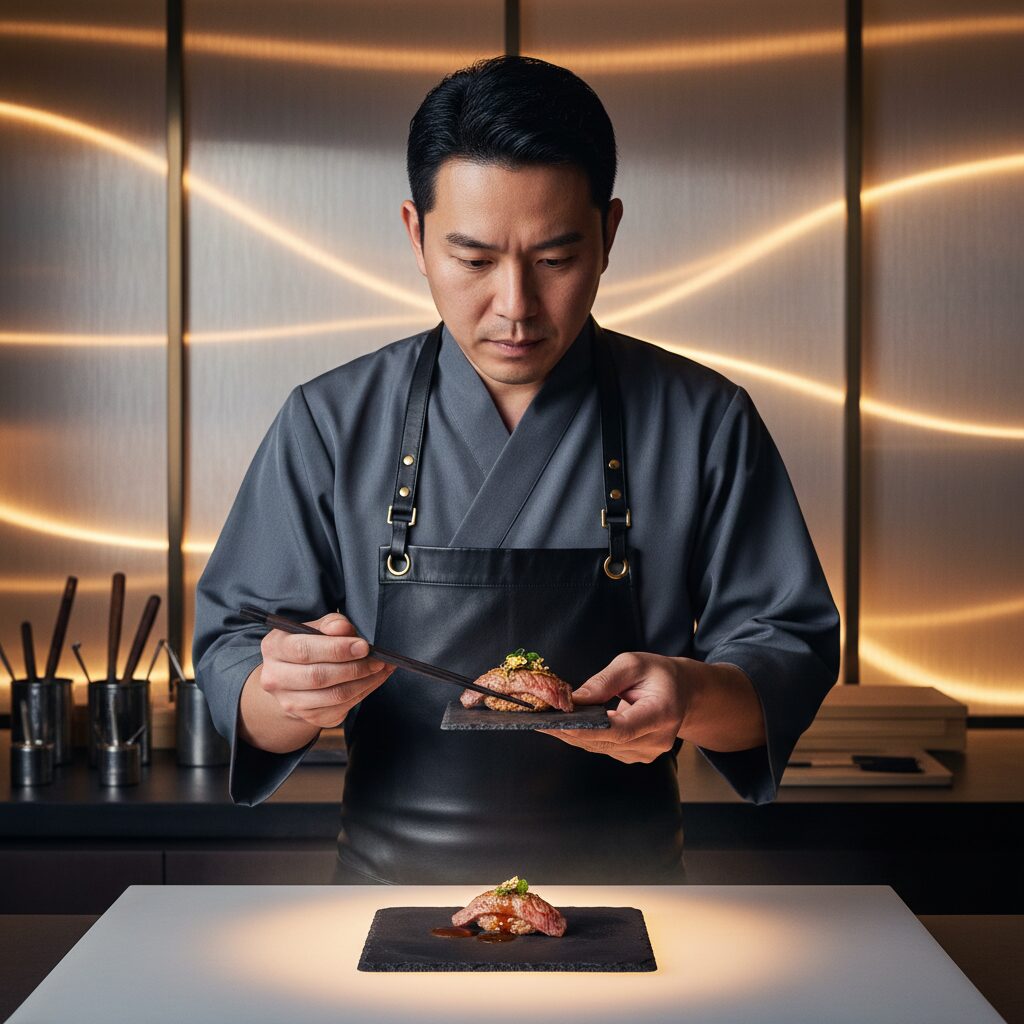
Picture a Tokyo office building at nine o’clock on a Tuesday night. Through the vast glass windows, you can see rows of desks, most still occupied. The glow of monitors illuminates faces locked in concentration. But if you look closer, you might notice something else. You might see a young designer staring at a blank screen, having finished her work hours ago, but waiting for her section chief to leave first. You might see a project manager, his team’s proposal just rejected, bowing crisply to his superior and saying nothing more than “I understand,” betraying no hint of the weeks of squandered effort. You might see a team leader accepting responsibility for a subordinate’s mistake, absorbing the criticism without a flicker of expression. This isn’t just diligence. It’s a performance of a deep-seated cultural virtue, a concept that is arguably one of the most crucial, and most misunderstood, pillars of Japanese society: gaman (我慢).
Ask a Japanese person to translate gaman, and they might offer words like “patience,” “endurance,” or “perseverance.” But these English equivalents are too thin; they don’t capture the weight of it. Gaman is not the gritty, proactive resilience celebrated in the West. It’s not about “bouncing back” or “pushing through” with a can-do attitude. Gaman is the art of enduring the seemingly unbearable with quiet internal strength and dignity. It is stoicism in the face of hardship, self-control in moments of frustration, and a disciplined suppression of personal desire for the sake of a greater good—be it the family, the team, or society at large. It is a virtue measured not in action, but in the lack of it: the complaint not voiced, the tear not shed, the exhaustion not shown. This silent strength is the invisible architecture supporting much of modern Japanese life, and nowhere is its presence more powerful, or its consequences more complex, than within the nation’s demanding work culture.
This quiet fortitude not only underpins the relentless endurance expected in Japanese work culture but also echoes the broader challenges faced by modern workers, as seen in the freeter dilemma.
The Roots of Gaman: More Than Just Patience
To grasp why a simple word holds such deep cultural significance, you must look beyond the modern office tower. The spirit of gaman is woven from centuries of philosophical, religious, and social influences. It’s a mindset shaped by island geography, where typhoons, earthquakes, and tsunamis are not abstract dangers but recurring realities. Survival in such an environment has always required collective resilience, an ability to endure hardships without fracturing the community.
Philosophically, its origins run deep into the roots of Zen Buddhism and Confucianism. Buddhism teaches acceptance of suffering as an inherent part of life and the path to enlightenment through detachment from worldly desires and emotions. Gaman reflects this, viewing endurance not as punishment but as a means of cultivating inner peace and character. It is the practice of accepting what cannot be changed and directing one’s energy inward. Confucian ideals, imported from China, emphasized a strict social hierarchy, loyalty, and the importance of fulfilling one’s duty to the group. Expressing personal grievances or desires could disrupt this delicate social equilibrium. Gaman became the lubricant for this social system, allowing individuals to subordinate their feelings to preserve collective harmony, or wa (和), the most esteemed of Japanese social values.
Then there is the powerful influence of Bushido, the way of the samurai. The warrior code placed the highest value on stoicism, self-discipline, and enduring pain without complaint. A samurai was expected to face death calmly and to suppress all signs of fear or weakness. While the samurai class disappeared with the Meiji Restoration in 1868, its ideals were repurposed and spread to the general populace as a model of Japanese character. The stoic warrior became the archetype for the ideal citizen, and later, the ideal company employee: loyal, disciplined, and capable of great self-sacrifice.
These historical forces combined to foster a culture where enduring hardship quietly is not seen as weakness but as profound strength. It demonstrates maturity, reliability, and dedication to the group. To complain is perceived as childish, selfish, and burdensome to others. Gaman, therefore, is not merely personal perseverance; it is a social duty. It represents the quiet, steady effort to maintain the smooth surface of society by concealing the turbulent waters of one’s own struggles.
Gaman in the Office: The Unwritten Rulebook
When Japan embarked on its rapid industrialization and post-war economic miracle, these deeply rooted values were directly applied to the corporate world. The company became the new clan, the boss the new feudal lord, and the employee the new loyal retainer. Gaman was no longer about enduring a poor harvest or facing an enemy in battle; it was about enduring long hours, immense pressure, and unspoken expectations in service of corporate Japan. It appears in countless ways, forming an invisible code that every employee learns to interpret.
The Silent Overtime
One of the most apparent yet unspoken expressions of gaman is the culture of long working hours. Although the official workday may end at 6 PM, the office often remains occupied well beyond that time. This isn’t always due to workload; it often stems from tsukiai (付き合い), or the obligation to keep others company. Leaving on time, especially before your superiors, can be seen as a lack of dedication or team spirit. So, you stay. You might be tidying your desk, reading industry news, or simply staring at your screen, but your physical presence is a demonstration of loyalty. It is a collective endurance. Staying late without complaint is a strong signal that you are a serious, committed team member. Leaving early is perceived as putting your own comfort above the group, a minor betrayal of the collective spirit. This silent pressure to remain is a daily test of one’s gaman.
The Mask of Composure
In a Western office, a passionate debate or visible frustration may be viewed as signs of engagement. In many Japanese workplaces, however, such displays indicate immaturity. Gaman requires the suppression of strong emotions. Whether dealing with a difficult client, an impossible deadline, or a demanding boss, the expectation is to maintain a calm, neutral, and polite demeanor. This is the principle of tatemae (建前), the public face one presents, often masking the true feelings, or honne (本音).
This isn’t about being dishonest; it’s about preserving social harmony. Overt displays of anger or disappointment can create discomfort and cause others to “lose face.” By maintaining composure, one carries the emotional burden alone so as not to burden others. This stoic professionalism is highly esteemed. The colleague who can withstand immense pressure without showing it is viewed as reliable and strong, while the one who complains or shows visible stress is seen as weak and unable to manage responsibilities. Here, gaman serves as emotional armor.
The Unasked Question
Another subtle form of gaman is the hesitation to ask for help or admit confusion. Doing so may suggest that you lack the capability to handle your tasks or that you question a superior’s instructions, potentially causing them to lose face. The expectation is to listen carefully, read the air (kūki o yomu), and solve problems independently. This can result in hours of silent struggle with an issue that a simple question might have resolved in minutes. It is a form of intellectual endurance. Young employees especially feel strong pressure to prove their value by overcoming challenges on their own. Admitting the need for help is tantamount to admitting failure. Thus, they endure uncertainty, hoping to find a solution before anyone notices their struggle. This can cultivate remarkable problem-solving abilities but also leads to avoidable mistakes and unnecessary stress.
Taking One for the Team
Perhaps the ultimate expression of gaman in the workplace is the readiness to sacrifice for the group. This can involve volunteering for undesirable tasks, working through holidays to meet deadlines, or, most significantly, accepting blame for a collective failure. When a team makes an error, it’s common for the leader or a designated member to take full responsibility, even if not directly at fault. This act of public self-criticism protects the rest of the group and allows the problem to be resolved without a disruptive and disharmonious process of assigning individual blame. It is an act of supreme gaman, absorbing a personal blow to preserve the team’s integrity and harmony. This self-sacrificial spirit binds many corporate teams, fostering a strong sense of shared identity and loyalty.
The Double-Edged Sword: Gaman’s Modern Consequences
For decades, this culture of gaman was praised as a crucial factor in Japan’s economic success. It fostered a workforce that was highly dedicated, resilient, and quality-oriented. The capacity to endure hardship without complaint played a vital role in rebuilding the nation after the war and in positioning Japanese brands as global leaders in quality and reliability. There is a clear benefit to a culture that values perseverance and collective responsibility.
The Virtuous Side: Resilience and Reliability
The positive traits of gaman are undeniable. It cultivates a strong sense of responsibility and attention to detail. Employees culturally conditioned to endure often go to great lengths to ensure their work is flawless, not wanting to burden their colleagues with errors. This contributes to the high standards of quality for which Japan is renowned. Additionally, this shared cultural value fosters a predictable and stable work environment. You can usually count on your colleagues to carry out their duties without drama or complaint, which establishes a foundation of quiet trust. In genuine crises, such as the aftermath of the 2011 earthquake and tsunami, this capacity for collective endurance was clearly demonstrated. People waited patiently in orderly lines for scarce resources, cooperated to clear debris, and faced immense tragedy with a quiet dignity that impressed the world. This was gaman expressed on a national scale.
The Darker Side: Burnout and Stagnation
Nevertheless, the relentless pressure to endure has a severe, darker side. The expectation to suppress stress and work excessive hours directly contributes to the phenomenon of karoshi, or death from overwork. When employees feel unable to go home, take a sick day, or speak up about an unsustainable workload, the physical and mental strain can become fatal. The silence demanded by gaman means that problems like depression, anxiety, and burnout often remain unaddressed until it is too late. Seeking psychological help has long been stigmatized, perceived as admitting that one’s gaman is insufficient.
This culture of silent endurance also creates obstacles to progress and innovation. A workplace where people fear voicing dissent or pointing out flaws is one that struggles to adapt or reform. Inefficient processes persist simply because no one wants to disrupt the harmony by complaining. Poor ideas from superiors remain unchallenged as junior employees are expected to endure them quietly. This can result in corporate rigidity and an inability to respond to a rapidly evolving global market. The very harmony gaman seeks to preserve can turn into a stifling conformity that hinders creativity and critical thinking.
Is Gaman Fading? A Generational Shift
For many young Japanese entering the workforce today, the equation is changing. They grew up in a Japan marked by economic stagnation rather than miraculous growth. They have witnessed the price their parents’ generation paid for their loyalty to their companies: absent fathers, stressed-out mothers, and lives entirely consumed by work. Unsurprisingly, their priorities are shifting.
The ideal of lifetime employment at a single company is breaking down, replaced by a more pragmatic approach to careers. Job-hopping, once viewed as a sign of disloyalty, is becoming more common as young professionals seek better conditions, more meaningful work, and—most importantly—a healthier work-life balance. They are less willing to sacrifice their personal lives and mental health for a company that may not guarantee their long-term security.
This shift is creating friction between generations. Older managers may see younger employees who leave work on time or take all their vacation days as lacking gaman and commitment. Younger employees, in turn, often regard the traditional way of working as irrational and unsustainable. The Japanese government has acknowledged the problem, launching nationwide “work style reform” initiatives aimed at limiting overtime hours and promoting more flexible working arrangements. These top-down efforts clearly indicate that the country’s leadership understands the old model, driven by extreme gaman, is no longer sustainable.
This does not mean gaman is disappearing. It is too deeply ingrained in the cultural psyche for that. Rather, it is being renegotiated and redefined. For many in the younger generation, strength is not only about silent endurance. It also involves the courage to speak up about an unhealthy work environment, the wisdom to establish boundaries between work and life, and the self-awareness to seek help when needed. The goal is shifting from merely enduring hardship to actively creating a better, more sustainable way of working and living.
The conversation in Japan is gradually moving from how much one can endure to how well one can live. The silent, stoic strength of gaman, once the unquestioned driving force of the Japanese workplace, is now being challenged. While its core virtues of resilience, dignity, and a sense of collective responsibility will undoubtedly endure, the expectation of limitless self-sacrifice is being questioned. Modern Japan is quietly re-evaluating its most cherished virtue, seeking a new balance between the strength to endure what is necessary and the courage to change what is no longer bearable.