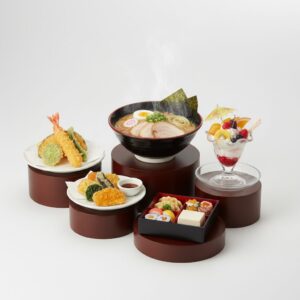
The first time you see it, your brain stumbles. There, behind a pane of immaculate glass, is a perfect bowl of ramen. The broth has a deep, fatty sheen. The slices of chashu pork are delicately marbled. A soft-boiled egg, split open, reveals a jammy, molten-orange yolk. Thinly sliced green onions are scattered with impossible precision. But it’s the noodles that break your sense of reality—they are suspended mid-air, held aloft by a pair of floating chopsticks, captured in the very act of being lifted for a bite that will never happen. You know it isn’t real, but every signal your eyes are sending insists that it is. You can almost smell the pork broth.
This is the world of shokuhin sanpuru, or Japanese food samples. These hyper-realistic models are a ubiquitous feature of the Japanese streetscape, gracing the windows of everything from humble ramen joints and old-school coffee shops to high-end department store restaurants. For the first-time visitor, they are a charming, photogenic curiosity. For the seasoned resident, they are an indispensable part of the dining landscape. But they are far more than just three-dimensional, plastic menus.
These incredible fakes are a window into the Japanese psyche. They are a cultural artifact born of a specific moment in history, a testament to the nation’s obsession with craftsmanship, and a physical manifestation of the deep-seated principle of omotenashi, or wholehearted hospitality. To understand the logic behind these perfect plastic meals is to understand something fundamental about the rituals and expectations surrounding food in Japan. This isn’t just about showing you what’s for dinner; it’s about making a silent, powerful promise before you even step through the door.
The intriguing realism of these plastic meals hints at the broader spectrum of Japan’s culinary theatrics, where the captivating tezutsu hanabi vividly illustrates a raw, ritual danger that complements the artful deception of fake food.
The Birth of a Delicious Lie

The story of shokuhin sanpuru doesn’t begin in a sterile laboratory or a marketing boardroom. Instead, it starts, according to legend, with a fortunate accident in the 1920s. Takizo Iwasaki, a man from Gifu Prefecture, was working with wax for medical models when a drop of molten candle wax landed on the cool surface of his tatami mat. As it solidified, it formed a delicate, flower-like shape that perfectly captured the mat’s intricate woven texture. A lightbulb went off. If wax could so accurately replicate a simple texture, what else might it be able to imitate?
His first genuine food model was a simple omelet, or omuraisu. It was so realistic that when he showed it to his wife, she couldn’t distinguish it from the real dish. Iwasaki realized he had discovered something significant. He established his company, Iwasaki Mokei, in 1932, and the industry was born. Yet, for the art form to truly thrive, it needed a catalyst—and that came with Japan’s rapid post-war modernization.
As Japan’s economy surged in the mid-20th century, a new urban middle class arose with disposable income and a craving for novelty. Department stores, featuring grand dining halls, became temples of this emerging consumer culture. These venues were eager to introduce the public to a tempting variety of Western and Chinese dishes that were still unfamiliar to the average Japanese palate: items like spaghetti, curry rice, Salisbury steak, and cream soda floats. The challenge was, how do you sell a dish that no one had ever seen or heard of? A written menu description is abstract. A photograph can be misleading.
This is where Iwasaki’s wax models offered the ideal solution. They functioned as a visual dictionary for a transforming culinary landscape. A sanpuru display let potential customers see exactly what “Spaghetti Napolitan” looked like, understand its portion size, and grasp the combination of ingredients without any prior knowledge. It served as an educational tool as much as a marketing one, democratizing new dining experiences and lowering the barriers for a curious but cautious public. The fake food models weren’t a gimmick; they were a vital interface between tradition and modernity, guiding an entire nation’s evolving taste.
More Real Than Real: The Shokunin’s Soul in Plastic
The early models were crafted from wax, which had notable disadvantages. They were fragile and prone to melting or fading when exposed to direct sunlight—a major issue for window displays. The next significant advancement in the industry arrived with the introduction of plastics, particularly polyvinyl chloride (PVC). This durable and versatile material transformed the craft, enabling more intricate details, more stable colors, and a longevity that wax could never achieve. It also raised the artistry to a new level.
Referring to the creators of shokuhin sanpuru as mere factory workers greatly underestimates their role. They are shokunin—master artisans deeply committed to their craft. Their work is a deliberate and meticulous process that combines technical skill with an artist’s sensibility, typically starting with real food.
Initially, a restaurant sends a perfectly prepared dish to the sanpuru workshop. The artisans examine it carefully, photograph it from every angle, and then produce silicone molds for each individual element—every pork slice, bamboo shoot piece, and noodle strand. Liquid plastic is poured into these molds and baked until solid. But this is only the beginning. The true magic shines in the painting and finishing stages.
An unpainted plastic model is a blank, lifeless surface. It’s the shokunin’s task to infuse it with life. Using airbrushes and precise paintbrushes, they meticulously build layers of color to capture the subtle gradients of grilled fish skin, the translucent shimmer of squid sashimi, or the charred edges of a yakitori skewer. They have developed a vast collection of proprietary techniques to replicate every imaginable food texture. The crisp, bubbly appearance of tempura batter is often achieved by carefully dripping heated plastic into warm water. The fizz of a carbonated drink is recreated by intentionally adding air bubbles into clear resin. To form a head of lettuce, an artisan pours layers of green and white plastic onto water, gently molds it into leaf shapes by hand, then fuses the leaves together with heated air.
This is not mass production. While some common items might be produced in batches, most sanpuru are custom-made for a specific dish on a particular restaurant’s menu. The aim is not to create a generic ramen model, but an exact replica of that restaurant’s unique bowl of ramen. It is an art of extreme precision—an obsessive pursuit of perfection akin to the spirit of a master calligrapher or swordsmith, applied to a piece of plastic tempura.
The Silent Salesman: Omotenashi in the Display Case

To a Western observer, the most natural question is, “Why go to all this trouble?” In a world filled with glossy photos and detailed menus, isn’t this a bit… excessive? But that question completely misses the point. The sanpuru display case is more than just an advertisement; it’s a deep expression of omotenashi, the uniquely Japanese hospitality concept centered on anticipating and meeting a guest’s needs before they even ask.
A written menu, no matter how detailed, can be unclear. “Hearty portion” means different things to different people. A photograph can be styled and lit to appear better than the actual dish. A shokuhin sanpuru, however, is a promise. It serves as a visual contract. It tells the customer, “This is what you will receive. Not something similar. This, exactly.” The portion size displayed in the window is the portion size that will arrive at your table. The number of shrimp in the tempura model is the number of shrimp you’ll get. The exact arrangement of pickles and rice in a teishoku (set meal) display will be replicated on your tray.
This elimination of all uncertainty is a powerful form of customer service. It removes the anxiety of ordering, a small yet meaningful daily stress. For a foreign tourist who cannot read any Japanese characters, the system is a godsend. You can simply bring the waiter outside and point. For a parent with a picky child, it lets the child see exactly what they will get. For anyone feeling rushed or unsure, it reduces the choice to a purely visual decision.
In the fast-paced, high-turnover restaurants of urban Japan, this efficiency is also an essential part of the service ritual. A customer who knows exactly what they want before sitting down is a customer who orders quickly, is served quickly, and finishes their meal promptly, allowing the next person to take their seat. The sanpuru display is the first step in this finely tuned process, a silent greeter that prepares you for a smooth and predictable dining experience. It’s hospitality that begins right on the sidewalk.
Reading the Code: How to Interpret a Sanpuru Display
Once you grasp the concept of sanpuru, you can start reading the display case like a text, one that reveals a lot about the restaurant itself. It’s a carefully curated narrative, with every element placed intentionally.
The arrangement is not random. Restaurants use visual hierarchy to steer your choice. Their most prized dish, the ichioshi or specialty, will almost always be the most prominent model. It could be physically larger, positioned at eye-level in the center of the case, or be the most dynamic-looking model—the one with the “lifted noodles” or the artfully sliced steak. This is the restaurant’s way of saying, “If you only order one thing, make it this.”
Set meals, or teishoku, are presented with all their components clearly laid out. This lets you quickly evaluate the value. You can see the main dish, the bowl of rice, the miso soup, and the small side dishes (kobachi) of pickles or vegetables. It’s a transparent display of what you’re getting for your money.
Notice what’s new and emphasized. Seasonal specials or limited-time offers are often given a prominent spot in the display, sometimes with extra signage. It’s the display’s method of keeping the menu fresh and current.
Lastly, the condition of the display itself is a strong hint. Are the models clean, vibrant, and well-lit? This suggests a restaurant that takes pride in its appearance and pays close attention to detail. Are the models dusty, faded, or showing signs of wear? This could indicate negligence that may also affect the kitchen. A restaurant’s care for its fake food often reflects its care for its real food.
From Restaurant Window to Pop Culture Icon

For decades, shokuhin sanpuru was purely a functional craft, limited to serving as a B2B product for the restaurant industry. However, in recent years, it has emerged from the display case and stepped into the world of pop culture and art. The very artistry and hyper-realism that make it effective have also captured the fascination of a broader audience.
The heart of this craft, Gujo Hachiman in Gifu prefecture—Takizo Iwasaki’s hometown—has become a popular destination for sanpuru enthusiasts. Workshops there and in other places like Tokyo’s Kappabashi “Kitchen Town” now offer DIY experiences where visitors can create their own wax and plastic tempura or lettuce leaves. What was once a secretive trade has transformed into an interactive cultural activity.
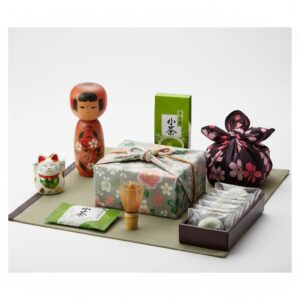
This growing public interest has given rise to a booming industry of sanpuru-themed merchandise. Today, you can find incredibly realistic keychains shaped like gyoza, phone cases that resemble plates of curry rice, USB drives disguised as sushi, and refrigerator magnets that are perfect miniatures of ramen bowls. These items have become sought-after souvenirs—a quirky and distinctively Japanese way to express a love of food. The craft has evolved from a practical tool into a playful form of edible-looking art.
This cultural recognition is perhaps the highest praise for the craft. The shokuhin sanpuru is no longer just a silent salesman; it has become a celebrated symbol of Japanese ingenuity and a treasured piece of cultural heritage. It embodies a flawless blend of the practical and the poetic—an art form born from the simple need to advertise a plate of spaghetti, which has developed into a masterful craft capturing the essence of the nation’s cuisine in plastic.
So the next time you stand before one of these vibrant display cases, pause and look beyond the initial novelty. See it for what it truly is: a gesture of hospitality, a legacy of craftsmanship, and a visual narrative of Japan’s food rituals. It’s a delightful deception, but one that reveals a profound truth.