Walk up to the veranda of a Zen temple in Kyoto, and you might be confronted with a sight that feels like a quiet riddle. Before you stretches a walled enclosure, not filled with blooming flowers or lush greenery, but with a flat expanse of raked white gravel and a handful of moss-fringed rocks. There is no water, no sound of a babbling brook. There is only stillness, stone, and meticulously patterned sand. A common first reaction, even for the most open-minded traveler, is a polite but persistent internal question: “Is this it?”
This, in essence, is the karesansui, or dry landscape garden. And to answer that question, yes, this is it. But “it” is something far more profound than an empty plot of land. This is not a garden in the Western sense of cultivating nature for decoration or pleasure. It is a garden about nature—an abstract, philosophical model of the universe in miniature. It’s a contemplative tool, a sermon delivered in stone, designed not to dazzle the senses but to quiet the mind. To understand a Japanese rock garden is to learn a new language, one where emptiness speaks volumes and a single stone can represent a mountain, an island, or even the whole of existence.
These gardens are a direct reflection of the Zen Buddhist principles that shaped them. They are not meant to be passively admired for their beauty, but actively engaged with from a single, fixed viewpoint. You don’t walk through them; you sit with them. They challenge you to look beyond the literal and find the essence of nature—its structure, its rhythms, its immense power and its deep quiet—distilled into its purest forms. This is landscape architecture as a spiritual practice, a place where the goal is to stop thinking and simply see.
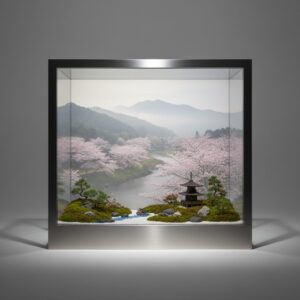
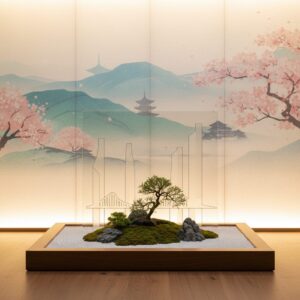
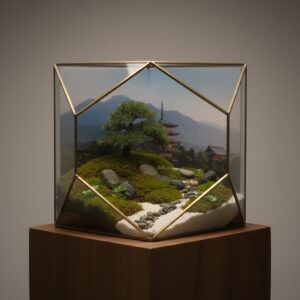
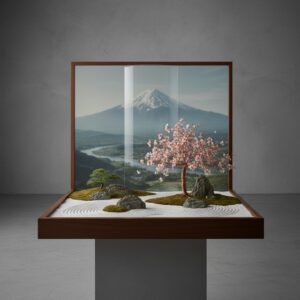
The garden’s subtle meditation on space and silence echoes the philosophy of borrowed scenery that dissolves the boundaries between the interior and nature.
The Art of Absence: From Imperial Ponds to Zen Emptiness
The karesansui garden did not simply emerge spontaneously. It was a radical transformation, a purposeful removal of elements to reveal something more fundamental. To fully appreciate the profound minimalism of a rock garden, it helps to understand what preceded it—and the philosophical shift that made such minimalism possible.
A Brief History of Subtraction
Long before Zen Buddhism firmly took hold in Japan, aristocratic gardens were lush, elaborate, and designed for pleasure. During the Heian period (794–1185), nobles created expansive paradise gardens intended to replicate mythical landscapes. These included large ponds with islands, ornate bridges, and pleasure pavilions where the court enjoyed boating parties, poetry contests, and the changing seasons. The aim was immersive and romantic: to recreate an idealized, beautiful world and live within it. Water was a central, tangible feature.
The transformation began during the Kamakura (1185–1333) and Muromachi (1336–1573) periods, with the rise of the samurai class and the introduction of Zen Buddhism from China. Zen brought a radically different worldview, emphasizing self-discipline, austerity, and the pursuit of enlightenment through meditation (zazen). This philosophy resonated deeply with the stoic samurai warriors, who valued discipline and mental strength.
This mindset gradually reshaped Japanese aesthetics. The focus shifted from external beauty and sensory pleasure to internal insight and simplicity. Gardens ceased to be merely places of entertainment and became spaces for training the mind. The water, plants, and lush beauty of earlier paradise gardens were slowly removed. What remained was the essential framework—the “bones” of the landscape: rock and sand. The garden evolved from a space to enter into a space to contemplate—a tool for meditation.
The Garden as a Koan
To truly understand the purpose of a karesansui garden, it is helpful to think of it as a visual koan. In Zen practice, a koan is a paradoxical question or story posed by a master to a student. Famous examples include, “What is the sound of one hand clapping?” or “If you meet the Buddha on the road, kill him.” Koans are not meant to be solved by logic; they are designed to exhaust the rational, analytical mind, pushing the student into a more intuitive state of awareness where enlightenment can emerge.
A karesansui garden functions in exactly this way. It presents a paradox: a “dry landscape” meant to represent mountains and water (sansui literally means “mountain-water”). It offers no easy answers or clear images. You look at a rock, but are meant to perceive a mountain. You look at raked sand, but are meant to sense the presence of the ocean. This abstraction invites your mind to engage in the act of creation. It does not tell a story; it invites you to find one. The garden is a silent question, and the answer lies not in its layout but in the stillness it evokes within you.
Reading the Landscape: The Grammar of Rock and Sand
A dry landscape garden may appear simple, yet its design is governed by a complex and ancient set of principles. Every element is intentional, placed according to rules honed over centuries. Learning to interpret these elements is akin to understanding the vocabulary of this silent language.
The Stones as the Main Characters
In a karesansui garden, the rocks (ishi) take center stage. They are not random geological pieces but carefully selected and arranged performers on a natural stage. They are regarded as the “bones” of the earth, vessels of natural energy and time. The art of their placement, called ishi-gumi, is a highly esteemed craft.
Stones are picked for their shape, color, texture, and personality. They may be tall and upright, low and arching, or flat and reclining. Their arrangement forms a dynamic composition filled with tension, harmony, and balance. They are rarely placed symmetrically or in straight lines, instead following the asymmetrical patterns found in nature. A group of three rocks—a triad—is common, often symbolizing the Buddhist trinity. Other formations might imply a crane and a tortoise (symbols of longevity) or a tiger leading her cubs across a river.
More abstractly, these stones represent mountains and islands in a miniature world. A tall, rugged stone becomes a sacred peak piercing the clouds. A cluster of smaller, smoother stones becomes a chain of islands in a vast sea. The empty space between the rocks is as crucial as the stones themselves, creating a sense of distance and depth. The whole arrangement is a lesson in balance, illustrating how opposing forces coexist in dynamic equilibrium.
The Ripples of Emptiness: Sand and Gravel
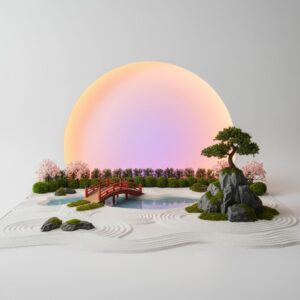
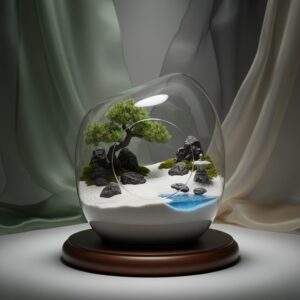
If the rocks are the islands, the carefully raked sand or gravel (shirakawa-suna, or white river sand) represents the water. This element is the garden’s most iconic and contemplative feature. The act of raking, practiced by monks as part of their daily ritual, is a form of active meditation known as samon. It demands intense focus and physical control. The patterns are never random.
Straight, parallel lines suggest calm, still waters, like a serene sea or quiet lake. Swirling, concentric circles around a rock mimic ripples spreading from a disturbance or the currents flowing past an island. These patterns are temporary, vulnerable to rain, wind, and falling leaves. Their constant upkeep is a physical reminder of the Buddhist concept of impermanence (mujō). Everything is in flux.
Beyond symbolizing water, the vast expanse of white gravel also embodies a deeper idea: emptiness or the void (mu). In Zen, emptiness is not viewed negatively; it is the source of all potential, a state of pure being before form and thought arise. The white sand acts as a blank canvas, a space of profound stillness on which the viewer can project their own consciousness. It clears the visual field, allowing the forms of the rocks to stand out with greater clarity.
The Supporting Elements: Moss, Shrubs, and Borrowed Scenery
Though defined by minimalism, karesansui gardens are not always entirely free of plant life. These elements, however, are used sparingly, serving as carefully selected highlights rather than the main focus.
Moss is often encouraged to grow around the bases of rocks. It symbolizes age, moisture, and the gentle persistence of nature. Its deep green provides a soft, living contrast to the hard, gray permanence of the stones. It evokes the fertile shore of an island or the forested foothills of a mountain.
Shrubs such as azaleas or dwarf pines may be planted along the edges or as isolated accents. They are meticulously pruned and shaped to harmonize with the rock composition, never allowed to grow wild or dominate the scene. Their role is to add texture, a touch of seasonal color, and to help define the scale of the landscape.
A far more striking element is the use of shakkei, or “borrowed scenery.” This ingenious design technique incorporates elements from the landscape beyond the garden’s walls into the composition. A distant mountain, a cluster of trees, or even the roof of a neighboring temple can become a backdrop for the garden, perfectly framed by its walls or the posts of the viewing veranda. This method makes the small, enclosed space feel limitless, seamlessly linking the finite garden with the infinite world beyond.
The Viewer’s Role: You Are the Final Element
A karesansui garden is incomplete without a viewer. Its meaning is not contained solely within the rocks and sand; rather, it is co-created in the mind of the observer. The entire design revolves around this interaction.
A Space for Contemplation, Not Recreation
You will scarcely find a path leading into a dry landscape garden, as they are not meant for strolling. Instead, one is intended to sit on the engawa, the polished wooden veranda of the adjacent temple building, and simply observe. This fixed viewpoint is essential. It transforms the garden into a living tableau, a three-dimensional painting that shifts with the changing light and seasonal moods.
By maintaining physical separation, the garden encourages a unique form of engagement. You cannot approach a rock for a closer look; instead, you must engage with it from a distance, using your imagination and intellect. The space becomes purely visual and contemplative, a screen for meditation. The veranda acts as a formal frame, separating the everyday world from the spiritual landscape before you.
Finding Your Own Meaning
Due to their abstraction, these gardens resist a single, fixed interpretation. While a famous rock grouping might be said to represent a specific legend, that is only a starting point. The true aim is for you to discover your own meaning—or better yet, to transcend the need for meaning altogether.
The garden functions as a mirror, reflecting your inner state. On a busy, anxious day, its stillness may feel unsettling or dull. On a calm, reflective day, you might perceive infinite depth and serenity in its simple forms. The goal is to release the urge to name and categorize everything. Stop trying to “figure it out.” Instead, be fully present with the composition. Let your eyes follow the lines in the sand. Feel the weight and balance of the stones. Observe the dance of shadow and light.
In this quiet state of observation, the internal monologue begins to dissolve. The garden’s abstraction offers just enough focus for the mind without allowing it to become entangled in complex stories. It is in this mental stillness that a deeper understanding—one beyond words—can emerge.
Where to Experience the Silence: Iconic Karesansui Gardens
While the principles of karesansui are evident in temples throughout Japan, a select few gardens in Kyoto stand as unrivaled masterpieces of this art form.
Ryoan-ji, Kyoto: The Ultimate Enigma
Perhaps the most renowned and mysterious rock garden worldwide, Ryoan-ji exemplifies karesansui abstraction. Fifteen rocks of varying sizes are arranged in five small clusters within a sea of white gravel. The arrangement is a masterful balance of harmony and perspective. From any single spot on the viewing veranda, only fourteen rocks can be seen at once. It is said that only through enlightenment can one perceive all fifteen simultaneously.
The garden’s designer and its meaning remain mysteries that have inspired centuries of debate. Some interpret it as islands in the sea, a tigress with her cubs, or mountain peaks rising above the clouds. Others view it as a symbol of infinity or a koan on the nature of perception. Ryoan-ji provides no straightforward answers, which is exactly its strength. It is the ultimate visual koan.
Daisen-in, Kyoto: A Stone Narrative
Unlike the stark abstraction of Ryoan-ji, the garden at Daisen-in, a sub-temple of Daitoku-ji, offers a more explicit symbolic and narrative expression. In a small L-shaped space, the garden uses rocks and sand to depict a complete life journey, inspired by a Chinese landscape painting. It begins with a tall rock symbolizing a mountain source, from which a dry waterfall flows down. This stream becomes a river, winding through obstacles (symbolizing life’s challenges) and past symbolic rock formations such as a turtle and a treasure boat, before finally emptying into a wide ocean of white sand that represents the void or afterlife. It is a powerful, compact story told entirely through stone.
Beyond Temples: Modern Interpretations
The influence of karesansui aesthetics reaches far beyond ancient temple grounds. Its principles of minimalism, asymmetry, and the significance of negative space have profoundly impacted modern art, architecture, and design. The work of Japanese-American artist and landscape architect Isamu Noguchi, for instance, deeply reflects the spirit of the rock garden. The clean lines, natural materials, and the emphasis on creating contemplative spaces in modern minimalist architecture and interior design owe a considerable debt to this centuries-old Japanese tradition.
The Enduring Power of Emptiness
The Japanese dry landscape garden stands as a striking testament to a worldview that values richness in restraint and beauty in simplicity. It directly opposes a culture dominated by constant noise and stimulation, instead offering a sanctuary for silence and reflection. It teaches that what is omitted often holds as much significance as what is included.
To sit before a karesansui is to engage in a centuries-old practice of mindfulness. It invites you to slow down, observe carefully, and awaken your imagination. It serves as a reminder that the essence of nature is not always found in its grandest displays but sometimes in its most minimal and fundamental forms. The next time you come across one of these mysterious spaces, don’t ask, “Is this all there is?” Rather, take a seat, take a breath, and listen to the silent sermon of the stones. You may be surprised by what you discover in the quiet.