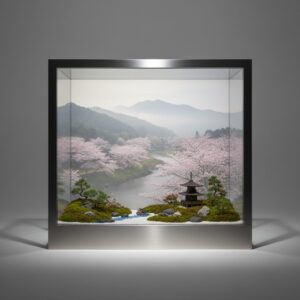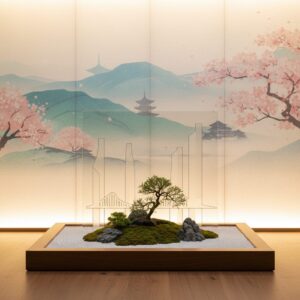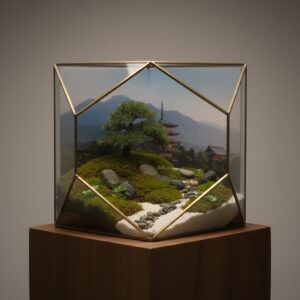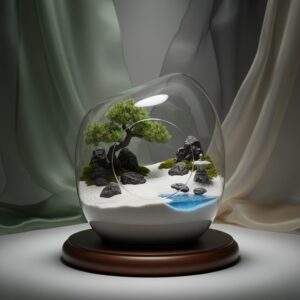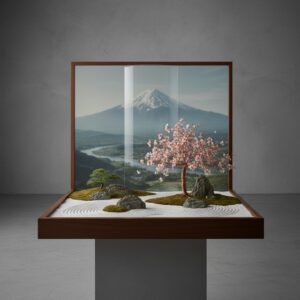
You’re standing in a Japanese garden, perhaps in Kyoto. It feels serene, meticulously composed, yet not entirely contained. Your eyes follow a line of carefully placed stones, past a sculpted pine tree, over a low, moss-covered wall, and suddenly you’re looking at a forest-cloaked mountainside miles away. The mountain isn’t in the garden, of course. But somehow, it feels like it is. It feels like the garden’s true back wall is the distant peak itself, and the sky is its ceiling. The space, which you know is physically defined by a simple fence or wall, feels boundless. This isn’t an accident, nor is it just a lucky view. This is a deliberate, centuries-old design philosophy known as shakkei.
Translated as “borrowed scenery,” shakkei (借景) is the art of incorporating the landscape outside a garden’s formal boundaries into its own design. It’s a technique that turns a distant mountain, a neighboring temple roof, or even a grove of trees into a vital component of the garden’s composition. It’s the ultimate act of creative framing, a visual sleight of hand that makes a finite space feel infinite. But to see shakkei as merely a clever trick to make small gardens feel bigger is to miss the point entirely. It’s far more than a design hack. It is a profound statement about the Japanese relationship with nature, a physical manifestation of a worldview that sees humanity not as nature’s master, but as a humble participant within it. Understanding shakkei is to understand how a culture views its place in the world, and how it translates that philosophy into physical space.
Discover the harmonious interplay between nature and design by exploring our article on understanding shakkei.
Beyond the Fence: Decoding the Illusion of Shakkei
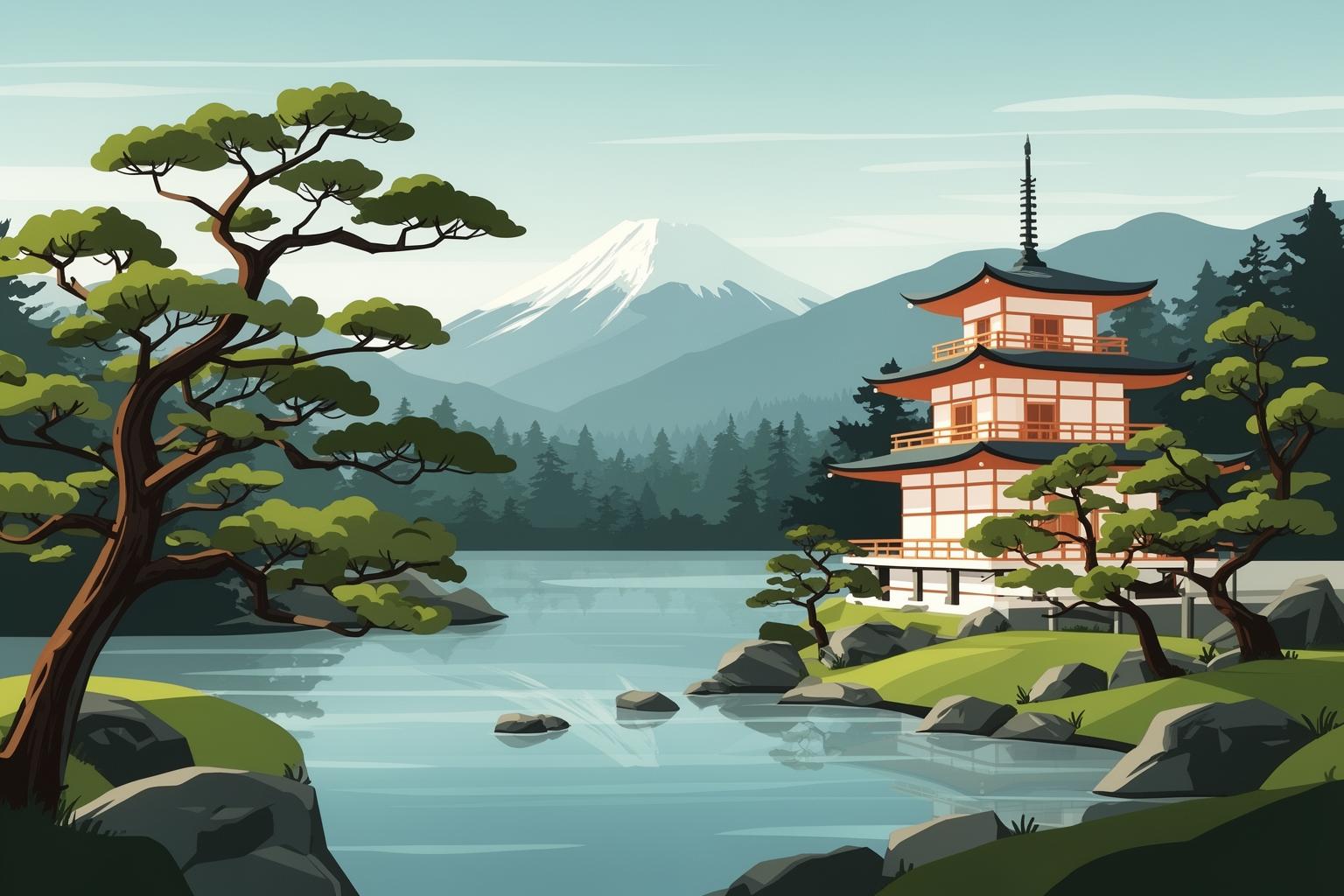
The fundamental principle of shakkei is surprisingly straightforward in concept but remarkably challenging to perfect in practice. It involves crafting a seamless visual flow from the foreground to the distant background. The garden itself serves as the bridge connecting the viewer to the borrowed scenery. This is not merely about placing a garden where there happens to be a nice view. Instead, it is a careful art of composition, where every element in the garden is arranged with the distant landscape in mind.
The Frame and the View
Consider a master landscape painter. They don’t simply paint the mountain; they compose the entire scene, using foreground trees and mid-ground hills to create depth and direct the viewer’s gaze. A shakkei garden functions in exactly the same way. The garden’s designer is an artist working with rock, water, and plants, and their canvas stretches to the horizon.
The key lies in creating a “middle ground.” This is the area of the garden that connects immediate, human-scale features—a stone lantern, a water basin, the veranda you stand on—to the expansive, borrowed landscape. A carefully pruned pine tree might have branches shaped to echo the slope of a distant mountain. A hedge could be trimmed low to conceal a village or road in the middle distance, revealing only the untouched natural scenery beyond. This selective concealment is as essential as the reveal. The garden’s boundaries are often disguised or made from natural materials that blend in, ensuring the shift from the curated garden to the wild landscape feels smooth and organic.
The result is a collapse of perceived distance. The remote mountain stops being a separate object “over there” and instead becomes a commanding backdrop anchoring the intimate scene before you. The garden’s limits don’t end at the wall; the wall is simply a gateway into a much larger vista. This is why the space feels so expansive—you’re not just looking at a garden, you’re looking through it toward the larger world.
The Four Types of Borrowing
While the borrowed mountain is the most iconic image, the concept of shakkei is notably versatile. Classical garden texts formalized the technique into four distinct types, highlighting the depth and subtlety of the practice. These are not strict rules but rather a vocabulary describing different ways a garden can interact with its surroundings.
First is enshaku (遠借), or “distant borrowing.” This is the classic form, integrating mountains, hills, or even the sea into the garden’s view. It is the grandest expression, linking the small, man-made space to the monumental forces of nature. The gardens of the Shugakuin Imperial Villa in Kyoto offer some of the finest examples, using the surrounding Higashiyama mountains as a living, breathing backdrop.
Next is rinshaku (隣借), “neighbor borrowing.” This approach is more intimate and often urban. A garden might borrow the elegant tile roof of a nearby temple, the tree canopy of an adjacent park, or even the wall of a notable building. It creates a shared sense of beauty and continuity within a denser environment, acknowledging that the garden’s space is part of a broader community fabric.
Then there is gyōshaku (仰借), “upward borrowing.” This incorporates elements above the garden, such as the sky, clouds, or flying birds. A pond might be designed not only for its own appeal but also for how it reflects the changing sky, bringing the vastness of the heavens into the enclosed garden space. The sky acts as a dynamic ceiling, shifting its mood with the weather and time of day.
Finally, there is fushaku (俯借), “downward borrowing.” This is the opposite of upward borrowing, focusing on elements below the main viewpoint. A garden situated on a slope might include views of a river valley or lake below. It can also refer to reflections used in gyōshaku, where the borrowed sky is mirrored on the water’s surface, creating a downward-facing element within the design.
The Cultural Roots: Why Borrow When You Can Own?
The philosophy of shakkei sharply contrasts with many Western garden traditions, especially the formal European styles. Consider the gardens of Versailles: they stand as monuments to human control. Nature is tamed, clipped into perfect geometric forms, and arranged in strict symmetry radiating from the central palace. This design powerfully expresses man’s dominion over the natural world. The garden acts as an extension of the king’s authority, imposing a rational, ordered universe upon the wildness of nature.
Shakkei represents the philosophical opposite, beginning with an act of humility. The designer acknowledges that the most beautiful elements—such as mountains, the sky, and the changing seasons—are beyond human ownership or control. Rather than trying to dominate or replicate nature, the goal is to engage in a respectful dialogue with it. The gardener does not own the mountain; instead, they are simply privileged to frame a view of it for a fleeting moment. This worldview is deeply rooted in Japan’s indigenous Shinto and imported Buddhist traditions.
A Dialogue with Nature, Not a Command
Shintoism, Japan’s native animist faith, sees divinity in natural objects. Mountains, ancient trees, waterfalls, and unique rock formations are often regarded as kami, or gods. These are not resources to be exploited but powerful presences to be revered. A garden that “borrows” a sacred mountain is therefore not just creating a pleasing view; it is drawing the power and sanctity of that kami into the human realm. The garden becomes a threshold, a place of connection between the everyday world and the divine natural world.
Buddhism, particularly Zen, introduced ideas of interconnectedness and the illusion of the self as separate from the universe. A Zen-influenced garden is intended not for entertainment but for meditation and contemplation. Shakkei fits this purpose perfectly. By visually dissolving the barrier between the finite garden and the infinite landscape, it helps the viewer dissolve the boundary between their individual self and the vast cosmos. It serves as a physical lesson in non-duality, illustrating that the division between “inside” and “outside,” “man-made” and “natural,” is ultimately artificial.
The Beauty of Impermanence and Suggestion
Shakkei also embodies two other key principles of Japanese aesthetics: the appreciation of impermanence and the power of suggestion. A garden with a borrowed view is never exactly the same twice. The distant mountain might be shrouded in mist one morning and clear against a blue sky the next. Its colors shift from the fresh green of spring to the fiery red of autumn and the stark white of winter. The garden’s beauty is dynamic, dependent on the weather, the light, and the seasons—forces entirely beyond the gardener’s control. This embraces the Buddhist concept of mujō (無常), or impermanence, finding beauty not in static perfection but in the fleeting, ever-changing nature of existence.
Additionally, shakkei is an art of suggestion rather than explicit declaration. By pointing to something vast and magnificent beyond its boundaries, the garden sparks the imagination. It does not attempt to contain all of nature’s beauty within its small space. Instead, it offers a carefully composed glimpse, hinting at a whole world beyond. This aesthetic of omission and evocation is highly valued in Japanese arts—from ink wash painting (sumi-e), where empty space holds as much meaning as the brushstrokes, to haiku poetry, which uses a few simple words to evoke deep feeling or vast scenes. The garden doesn’t provide everything; it invites the viewer to complete the picture in their own mind.
Shakkei in Practice: Where to See the Masterpiece Unfold
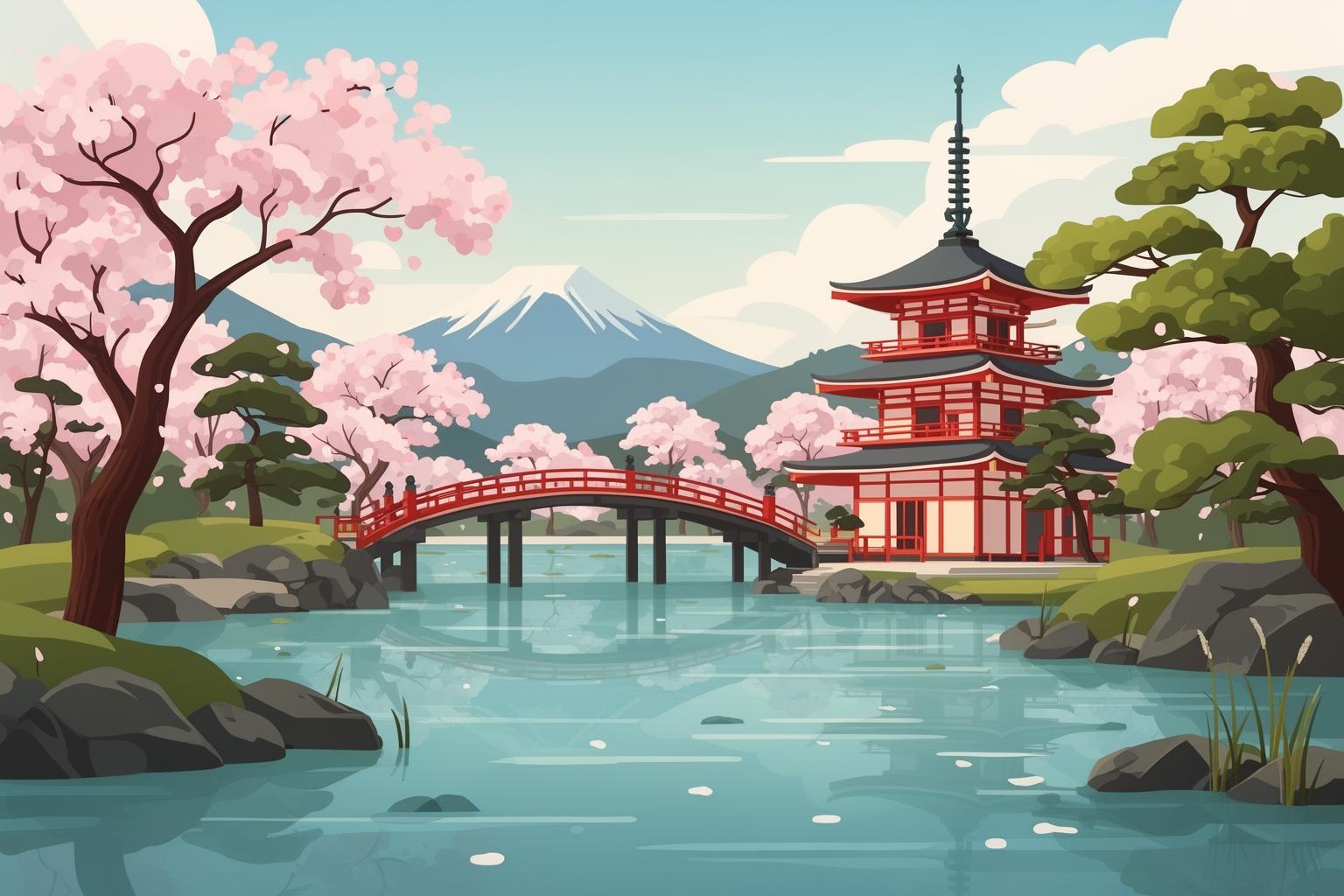
While the philosophy is compelling, the true essence of shakkei can only be fully appreciated through experience. Across Japan, several gardens are revered as exemplary masterpieces of the form, each imparting a distinct lesson in the art of borrowing.
The Imperial Canvas: Shugakuin Imperial Villa, Kyoto
Often regarded as the ultimate expression of shakkei design, the Shugakuin Imperial Villa is not just a single garden but a vast estate featuring three distinct gardens arranged on a hillside in northeastern Kyoto. The Upper Villa, in particular, stands out as a masterclass. Visitors follow a path that deliberately conceals the view, heightening anticipation. Upon arriving at the Rinun-tei teahouse, the entire panorama unfolds. Below lies a large, man-made pond, and beyond it, the villa’s meticulously maintained landscape seems to blend seamlessly with the rolling ridges of the surrounding Higashiyama and Kitayama mountains. The pond’s edge and the dam that forms it are engineered to be nearly invisible, creating the illusion that the mountains rise directly from the water’s edge. Rather than being a garden with a view, it feels like standing on a balcony overlooking the entire world. It is a breathtaking, imperial-scale demonstration of harmonizing the man-made with the natural.
The Urban Oasis: Murin-an, Kyoto
Shakkei is not limited to grand imperial estates. Murin-an, a compact Meiji-era villa and garden, showcases how the technique can be adapted to a confined, residential setting. Designed by the renowned gardener Ogawa Jihei VII, the garden features a bright, open lawn with a meandering stream—a style that was revolutionary at the time. However, its true brilliance lies in its focused intent. Every element—the gentle slope of the lawn, the placement of rocks, the alignment of trees—is arranged to perfectly frame a view of the distant Higashiyama mountains. A dense forest at the garden’s rear boundary screens out the urban clutter of modern Kyoto, creating a serene, green buffer that connects the lawn directly to the mountain peak. This is a brilliant example of selective borrowing, proving that even in a city, a pocket of infinite space can be created.
The Picture-Perfect Frame: Adachi Museum of Art, Shimane
For an almost surreal, hyper-polished interpretation of shakkei, one must visit the Adachi Museum of Art. For over a decade, its garden has been recognized as the best in Japan, and deservedly so. It is less a garden to stroll through and more a series of living paintings viewed from inside the museum. Large plate-glass windows serve as literal picture frames, showcasing meticulously composed scenes. The most renowned is the “Dry Landscape Garden,” where white gravel and carefully arranged rocks transition seamlessly into a hillside of clipped azaleas and pine trees, which in turn merge with the natural, untamed mountains beyond the museum grounds. The boundary between the cultivated garden and the borrowed wild mountains is almost impossible to distinguish. This is shakkei as high art, a stunning illusion that blurs the line between the museum’s collection of masterpieces on the walls and the living masterpiece just outside the window.
The Modern Echo: Shakkei Beyond the Garden Walls
The influence of shakkei extends beyond traditional gardens. Its core principles—framing views, merging indoor and outdoor boundaries, and honoring the natural setting of a structure—are deeply ingrained in modern Japanese architecture.
Architecture as a Frame
When you encounter a work by renowned contemporary architects like Kengo Kuma or Tadao Ando, you are often witnessing the spirit of shakkei in action. A large floor-to-ceiling window in a minimalist living room that perfectly frames a solitary, graceful cherry tree represents a modern interpretation of shakkei. Likewise, a concrete building featuring a carefully cut opening that reveals a narrow glimpse of the sea exemplifies this approach. These architects use the building itself as the “middle ground” connecting the interior human space with the external natural environment. They employ light, shadow, and materials to lead the eye outward, integrating the surrounding landscape into the experience of occupying the building. This is more than simply having large windows; it is an intentional act of composition—borrowing the outside scenery to define the inside space.
The Mental Landscape
Ultimately, shakkei is more than a technique in gardening or architecture; it is a mindset. It fosters a way of perceiving the world that encourages awareness of context and interconnection. It teaches us that our small, controlled environments are not isolated bubbles but are inherently linked to the broader, wilder world beyond. In an age when we often feel estranged from nature, shakkei serves as a powerful reminder that we are always part of it. The walls we construct are merely temporary, permeable boundaries.
To stand in a garden that borrows a mountain is to engage in an act of deep optimism and humility. It is to acknowledge that the greatest beauty lies beyond our reach, yet with care, skill, and reverence, we can create a place that allows us, even briefly, to feel connected to that boundless beauty. The garden dissolves its borders and, through this, invites us to do the same.