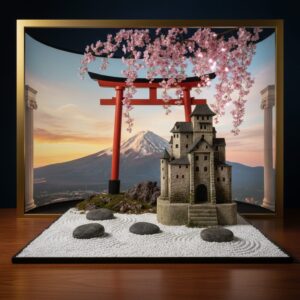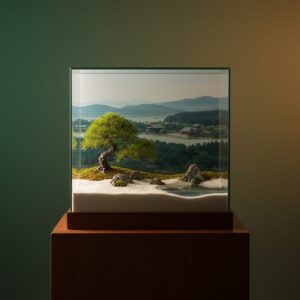
There’s a moment that happens in certain Japanese gardens. It’s a quiet click in the mind, a sudden recalibration of scale. You’ll be walking along a path of meticulously raked gravel, past carp gliding through a pond no bigger than a living room, and your eyes will follow the line of a carefully clipped azalea hedge. But instead of stopping at a wall, the hedge seems to dissolve. Your gaze travels over it, across a valley you didn’t know was there, and lands on the hazy, blue-green shoulder of a distant mountain. Suddenly, the garden isn’t a small, enclosed space anymore. That mountain, miles away, is somehow part of it. The garden has no end. It feels infinite.
What you’re experiencing isn’t magic, but it’s close. It’s a design philosophy, a deep-seated cultural perspective on space and nature made manifest. It’s called shakkei, written with the characters for “borrow” (借) and “scenery” (景). Borrowed scenery. It’s one of the most profound and elegant concepts in Japanese landscape architecture, and once you understand it, you’ll never see a garden—or a view—the same way again.
This isn’t just about finding a spot with a nice backdrop. Shakkei is the deliberate, artistic act of incorporating the surrounding landscape into the composition of a garden. The gardener doesn’t just build in a location; they build with it. That distant mountain, the neighboring temple’s pagoda, a swath of forest, even the sky itself—these are not outside the garden. They are the main event, the final, un-creatable element that completes the design. The garden becomes a frame, a stage, and a bridge to the wider world. It’s an architectural acknowledgement that the most beautiful things are those we can never own or build ourselves. We can only borrow their beauty for a moment. This article is about how, and more importantly why, Japanese garden masters perfected this art of looking beyond the wall.
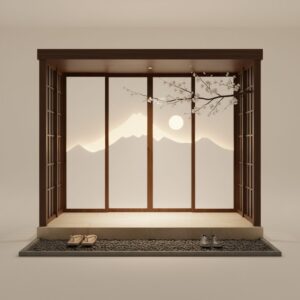
This profound connection between interior and exterior spaces is echoed in the architectural philosophy of the genkan, which serves as a transitional zone between the outside world and the inner home.
The Illusion of No Boundaries

To truly understand shakkei, it helps to consider what it is not. Take the grand gardens of Europe, such as Versailles. While magnificent, their design philosophy centers on control—imposing human will upon nature. Straight lines, perfect geometric patterns, and imposing walls mark a clear divide: here lies the tamed, ordered world of humanity, and beyond it, the untamed wilderness. It’s a declaration of power and dominion.
A traditional Japanese garden using shakkei follows a completely opposite principle. It expresses integration and humility. The designer’s aim is not to conquer nature, but to harmonize with it. The boundary between the created space and the natural world is deliberately blurred, made porous, or even erased entirely. The wall, if present, is often a low hedge or a carefully placed bamboo screen, meant not to block the view but to selectively frame it—concealing unwanted elements like a neighboring roof or power line, while perfectly showcasing the beautiful parts.
This reveals much about cultural perspectives. In the West, property lines are absolute—legal and physical boundaries defining what is “mine.” Shakkei, however, suggests a more fluid notion of ownership and space. Can you truly own a view? The garden answers no. You can only be a temporary caretaker, curating the experience of seeing it. But the mountain itself belongs to everyone and no one. It’s a deeply Zen approach to design. By relinquishing the desire to control and contain, the garden acquires a vastness its physical size alone could never achieve. It’s an act of surrender that results in a greater, more expansive beauty.
This is why that moment of recognition occurs. Your brain, used to clear boundaries, suddenly encounters a composition that defies containment. The garden before you is the foreground, the carefully placed trees and stones the middle ground, and the mountain the background—all woven into a seamless, unified vista. It’s both an optical illusion and a philosophical one. It invites you to see yourself not as the master of a small, private domain, but as a small part of a vast, interconnected landscape.
The Architect’s Toolkit: How the Trick Is Done
Creating this seamless illusion involves far more than simply leaving a gap in the hedge. It is a highly refined art that depends on a comprehensive set of techniques crafted to deceive the eye and uplift the spirit. The garden designer acts much like a film director, precisely controlling what you see, when you see it, and how you see it.
The Crucial Middle Ground
The true brilliance of shakkei does not lie in the distant view itself but in the skillful manipulation of the middle ground (chuukei). This area exists between the immediate foreground of the garden (where you stand) and the borrowed scenery in the distance. Without a carefully designed middle ground, the distant mountain would feel disconnected, resembling a poster hung on a wall. The challenge is to create a visual bridge.
Designers employ various techniques here. They might plant trees in the middle distance that echo the shapes or colors of the trees on the far hills, establishing a sense of continuity. A thoughtfully positioned, low hedge might effectively block out the visual clutter of the town below, allowing your gaze to leap directly from the garden to the pristine mountainside. This produces a “perfected” nature, an idealized scene more beautiful than reality. The middle ground’s role is to eliminate the mundane, leaving only the garden and its grand borrowed backdrop.
Framing the View
Japanese architecture has long recognized the power of framing. Rather than vast, open picture windows, traditional buildings use screens, pillars, and eaves to create smaller, carefully composed vistas. The engawa, or veranda, exemplifies this. Sitting on the engawa, the pillars and roofline naturally frame the view. You’re not merely observing a landscape; you’re gazing at a living painting that shifts with the light, weather, and seasons.
Gardens employing shakkei embrace this principle continually. A window inside a tea house might be designed to frame a single cherry tree with a slice of the distant hill behind it. The gap between two sculpted pine trees could be perfectly aligned to capture the roof of a nearby temple. This framing serves two purposes: it directs your attention to what is important and transforms the natural scenery into an artwork. By being contained and intentionally composed, the view attains a new level of beauty and meaning.
The Art of Conceal and Reveal
Another essential principle is miegakure, meaning “hide and reveal.” The most stunning view is seldom presented all at once upon entry. That would be too direct, too simple. Instead, the garden path guides you on a journey. It may wind behind a small bamboo grove, completely obscuring the view. You might pass through a dark, enclosed area. Then, as you turn a corner or step onto a raised platform, the entire vista suddenly unveils itself. The effect is dramatic and emotionally impactful. It becomes a moment of discovery, a reward for the journey.
This technique builds anticipation, making the final reveal far more striking. By managing the flow of information, the designer ensures you appreciate the borrowed scenery not as a static backdrop but as the climax of a carefully crafted experience. It’s the difference between viewing a beautiful picture and witnessing a story unfold before your eyes.
Masterpieces of Borrowed Scenery
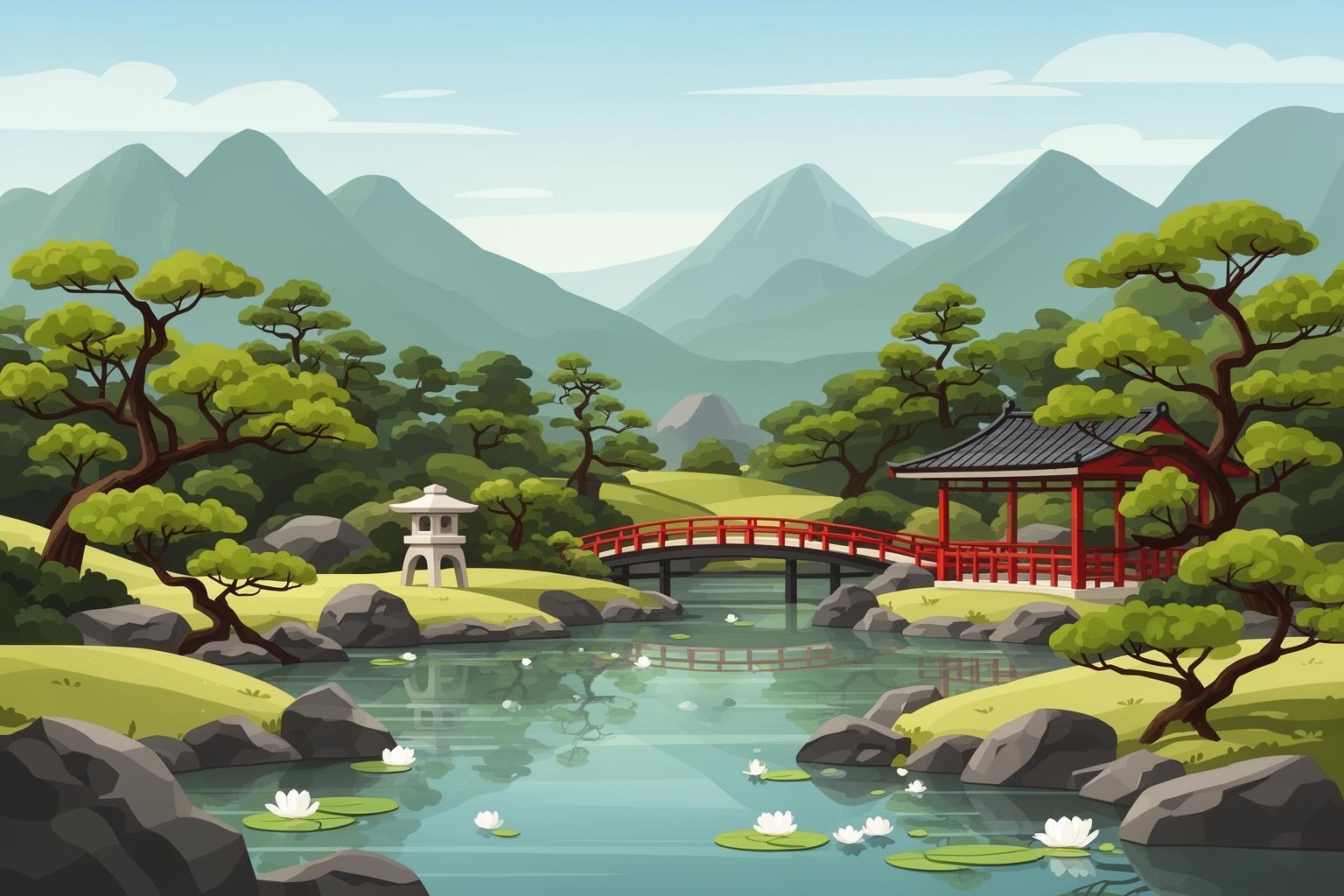
Although the principles of shakkei are evident in gardens throughout Japan, a select few stand out as outstanding examples of this art form, each employing the technique in a distinct way to create a unique effect.
Adachi Museum of Art, Shimane Prefecture
Arguably the most renowned modern example of shakkei, the garden at the Adachi Museum of Art is not so much a garden to stroll through as it is a series of living paintings viewed from inside the museum. The museum’s founder, Adachi Zenko, saw the garden itself as a work of art—a “living Japanese scroll.”
Large plate-glass windows inside the museum serve as frames, looking out onto a meticulously maintained landscape of white sand, moss, and carefully pruned pines that seamlessly blend into the natural mountains beyond. No visible boundaries separate them. The gardeners work with remarkable precision, even climbing the hills in the background to ensure that the wild trees harmonize perfectly with the cultivated ones. The effect is stunning. It feels as though the distant mountains were painted by the same hand that raked the gravel. This is a powerful example of architecture manipulating perspective, transforming a natural view into a gallery-worthy work of art that is pristine, perfect, and breathtakingly beautiful.
Shugaku-in Imperial Villa, Kyoto
For a grand, imperial-scale shakkei, there is nothing to surpass Shugaku-in. Situated in Kyoto’s northeastern hills, this expansive villa comprises three separate gardens linked by pine-lined avenues. The journey itself enhances the experience. You ascend through the lower and middle gardens, which are beautiful in their own right but serve as a prelude.
The true highlight is the Upper Villa. After a steady climb, you arrive at a large pond, Yokuryu-chi (Dragon Bathing Pond). From the highest point on the pond’s edge, a pavilion called Rin’un-tei offers a breathtaking view. The pond below mirrors the sky, while a large, clipped hedge in the middle ground conceals the city beneath. Beyond it stretches the full panorama of the western Kyoto mountains and the surrounding farmland, extending to the horizon. It is perhaps the most magnificent demonstration of shakkei in all of Japan. The scale is vast. You feel as if you are floating above the world, with the entire Kyoto basin embraced in this single garden design. This view was created to highlight the imperial family’s power and grace, symbolizing that their domain extended beyond the villa to encompass the entire visible landscape.
Entsu-ji Temple, Kyoto
Shakkei does not always evoke grand, sweeping landscapes—it can also be intimate, focused, and contemplative. Entsu-ji, a small, quiet temple in northern Kyoto, exemplifies this more subtle approach. The garden itself is modest, merely a patch of moss and stones.
Seated on the veranda of the main hall, the wooden pillars perfectly frame the view. A low, clipped hedge marks the garden’s edge. Just beyond it, a cluster of tall, slender cedar trees rise, and centered precisely between those trees, Mount Hiei’s unmistakable silhouette stands in the distance—a sacred guardian mountain of Kyoto. The composition is impeccable. The pillars create a frame within a frame, the hedge conceals suburban houses, and the trees direct the gaze upward. The garden’s purpose is to foster a serene, sacred connection to that specific mountain. It’s not about borrowing a generic landscape but about incorporating a particular, spiritually significant landmark as the focal point for meditation. Here, shakkei serves as a tool for contemplation.
Tenryu-ji Temple, Arashiyama
Located in Kyoto’s bustling Arashiyama district, Tenryu-ji’s Sogenchi Teien (Sogen Pond Garden) is one of the oldest surviving gardens of its kind—and a masterpiece of integration. Centered around a large pond, rocks and pine trees encircle its perimeter, but its true brilliance lies in how it incorporates the famous Arashiyama mountains, including Mount Kameyama, into its backdrop.
There is no visible division. The trees along the pond’s edge merge seamlessly into the dense forest covering the mountainside. The garden’s slope appears to continue naturally up the mountain’s incline. It feels less like borrowing the mountain and more like the garden is an extension of the mountain itself—a small cultivated clearing at the foot of a great wilderness. Especially in autumn, when the maple trees blaze with reds and golds, the effect is stunning. The garden becomes a vibrant burst of color that links the human world with the wild, seasonal beauty of nature in the most direct and powerful way.
More Than a Pretty View: Shakkei as a Mindset
To view shakkei as merely a clever design technique is to miss its essence. It represents the physical manifestation of a deeply ingrained cultural and philosophical viewpoint. It’s a way of perceiving the world that prioritizes connection over separation and harmony over control. In a culture that has always lived in close proximity to the awe-inspiring and often destructive forces of nature—earthquakes, typhoons, volcanoes—this yearning for harmony is more than an aesthetic preference; it is a survival strategy.
Shakkei embodies a particular humility. The garden designer, regardless of skill, implicitly acknowledges that their creation is never complete. They recognize that the greatest beauty exists beyond their boundaries—in the mountains, forests, and skies that have stood for ages. Their role is not to fabricate beauty from nothing but to unveil the beauty already present. They are not the composers of the entire symphony, but the arrangers of the opening notes, allowing nature to perform the grand finale.
This philosophy permeates other facets of Japanese aesthetics. Consider the presentation of a traditional Japanese meal, where each dish emphasizes the natural flavor and color of one seasonal ingredient. Think of the art of ikebana, flower arranging, where the empty space around the blossoms is as significant as the flowers themselves. In these arts, the aim is not to overpower or dominate the material, but to listen to it and express its inherent beauty in the clearest and most graceful way.
So, the next time you find yourself in a Japanese garden—or simply gazing out a window—try to see through the eyes of a shakkei master. Look beyond the immediate. Seek the connections. Notice what lies in the foreground, the middle ground, and beyond. Observe how the shape of a tree before you might echo the contour of a distant hill. See the wall not as a boundary, but as a frame.
You may find the world feels a bit larger, a bit more interconnected. Shakkei imparts a simple yet profound lesson: the beauty of the space you occupy is often shaped by its relationship with the world you’ve welcomed in. It’s an art of looking outward, a reminder that we are all part of a vast, interconnected landscape.