Walk through neighborhoods like Ikebukuro or Akihabara in Tokyo, and you’ll inevitably see it. You might not recognize it at first, but the clues are everywhere. A woman with a large tote bag, its clear front panel meticulously arranged with dozens of identical keychains featuring the same anime boy. A group of friends at a cafe, all drinking different brightly colored cream sodas, posing for photos with small acrylic standees of pop singers next to their glasses. A massive digital billboard counting down the days to a new single release, with fans stopping to take a reverent picture. This isn’t just casual fandom. This is a lifestyle. This is oshi-katsu.
At its core, the term translates to something like “supporting one’s push,” which sounds a bit clunky in English. A better way to think of it is “the act of ardently supporting a favorite person or character.” That person is your oshi—the one you ‘push’ or promote. And the katsu, short for katsudou (activities), encompasses the entire universe of things you do to support them. It’s a deeply involved, often expensive, and all-consuming subculture that has moved from the fringes to become a major economic and social force in Japan. Forget the simple idea of being a fan who just buys an album or watches a show. Oshi-katsu is an active, participatory, and profoundly personal journey. It’s about weaving your devotion into the fabric of your daily life, finding community with fellow believers, and channeling your passion into a vibrant, colorful, and highly structured expression of love.
The passion for personalized expression in oshi-katsu echoes across Japan, as seen in how the unspoken rules of JDM culture illustrate a similar blend of tradition and innovation.
What Exactly is an ‘Oshi’? The Heart of the Devotion
To understand oshi-katsu, you first need to grasp the concept of the oshi. The term derives from the verb osu (推す), meaning “to push,” “to endorse,” or “to recommend.” In this context, your oshi is the one person you wholeheartedly support. It’s an active declaration. You’re not merely a passive admirer; you are an advocate, a promoter, a loyal subject in their realm.
This differs from simply having a favorite actor. The connection is deeper and more intense. The term suggests a level of dedication that surpasses mere preference. Your oshi is the individual whose success feels like your own, whose struggles affect you personally, and whose career you invest in both financially and emotionally. It’s a one-sided relationship, naturally, but the sense of contribution is the whole point.
The range of potential oshi is broad and continually growing. Classic examples come from idol pop groups, both male and female, such as the extensive families of Johnny & Associates (now SMILE-UP.) or the 48-Group projects like AKB48. Yet, the scope extends much further. Voice actors, known as seiyuu, attract devoted fanbases. Actors in 2.5D musicals—stage plays based on anime and manga—are huge stars. Then there is the entire realm of fictional characters from anime, manga, and video games, who are just as ‘real’ in the oshi-katsu world as their human counterparts. YouTubers, virtual streamers (VTubers), K-pop idols, and even athletes can all be someone’s oshi. The object of devotion can be almost anything, as long as it sparks that unique, focused passion.
The ‘Katsu’ in Oshi-Katsu: A Symphony of Activities
So, what does it truly mean to “do” oshi-katsu? It involves a collection of rituals, purchases, and creative expressions that give fandom its structure and significance. This is where passion takes a physical form, shifting from an emotion into a series of intentional, often intricate actions.
The Pilgrimage: Concerts, Events, and Sacred Spaces
For many, live events represent the ultimate experience. Attending a concert is not merely about enjoying music; it’s an interactive ritual. Fans arrive early, often dressed in outfits subtly alluding to their oshi. They exchange photo cards and merchandise in the plaza outside the venue. Inside, the dark arena bursts into a sea of color from battery-powered light sticks, or penlights. Each fan holds a light programmed to their oshi’s designated “member color,” changing it throughout the show to support whoever is center stage. The synchronization is awe-inspiring. Fans also learn complex chants and hand movements (wotagei) to perform during songs, fostering a powerful sense of collective energy that uplifts the performers. It’s a physical embodiment of their shared support.
Beyond concerts, there are other, more intimate ways to connect. Handshake events, popularized by idol groups like AKB48, provide fans a brief moment of contact with their oshi in exchange for a coupon found inside a CD. Talk events, pop-up cafes themed around specific anime, and collaboration events with department stores become temporary pilgrimage destinations. To the devoted, these spaces hold a sacred quality, offering the chance to be physically closer to their beloved figure and to share that experience with fellow fans.
The Economy of Affection: Merchandise and Gacha Culture
Merchandise, commonly referred to as “goods” (グッズ), forms the lifeblood of oshi-katsu. It’s more than collecting souvenirs; it’s the primary way fans offer tangible financial support. The product variety is vast: acrylic standees (akusuta) to display at home or carry on outings, tin badges (kanbajji) and keychains to decorate bags, clear plastic folders (kuria fairu), and, naturally, countless varieties of photos and photo cards (toreka).
Much of this merchandise is sold in “blind boxes” or through a randomized lottery system known as gacha. Buyers don’t know which character or member they’ll receive until after purchase and unboxing. This system is both frustrating and ingenious. It drives repeat purchases in hopes of obtaining your oshi and fuels a lively secondary market. After major events, fans gather to trade unwanted duplicates, holding signs or calling out their offerings and needs. It’s a micro-economy built on luck, persistence, and a common goal: completing the set and bringing their oshi home.
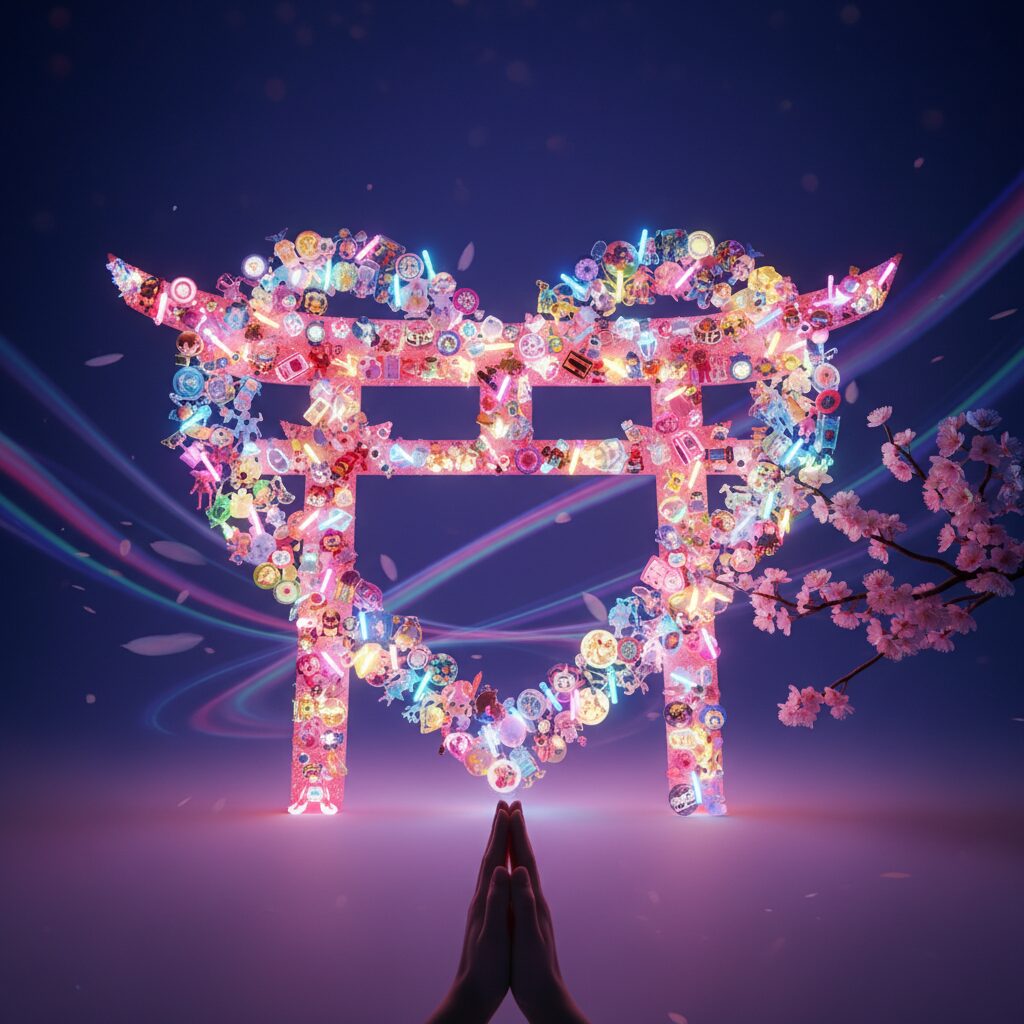
This culture has given rise to the ita-bag (literally “painful bag”). These handbags or backpacks have a clear vinyl window on the front to display a densely packed, perfectly arranged collection of badges, keychains, and charms featuring a single character. It’s a public proclamation of devotion, transforming a simple accessory into a portable shrine. Rather than being embarrassing, a carefully curated ita-bag is a source of pride, showcasing one’s dedication and aesthetic sensibility.
A Technicolor Life: Integrating the Oshi into Daily Existence
Perhaps the most distinctive aspect of oshi-katsu is how it permeates every part of daily life, coloring it with the hues of one’s devotion. As noted, most idols and characters have an “image color” or “member color.” This becomes a key part of a fan’s identity. They actively seek out clothing, makeup, stationery, and accessories in their oshi’s color. A fan of a character associated with green might carry a green phone case, wear green nail polish, and favor matcha-flavored treats.
This aesthetic integration is celebrated through various practices. One of the most popular is the hon-nin fusai no tanjoubikai, or “birthday party without the person themselves.” On their oshi’s birthday, fans rent a private room at a karaoke bar or restaurant, order a custom cake decorated in the oshi’s image color, and arrange their merchandise for an elaborate photoshoot. They celebrate together, raising a toast to someone who is absent, sharing a communal ritual of appreciation.
Another common ritual involves taking merchandise on outings. A fan might bring their oshi’s acrylic stand to a fancy cafe and photograph it next to a slice of cake. This is called nui-dori (photographing stuffed dolls) or simply taking a photo with your oshi. It’s a way of creating new memories that include their favorite character, blending a fictional or distant presence into the tangible reality of their own life.
The Roots of Devotion: Why Does Oshi-Katsu Resonate So Deeply?
To an outsider, the level of dedication may appear extreme. However, oshi-katsu has become a mainstream phenomenon because it satisfies several deep-rooted social and emotional needs. It’s more than just a hobby; for many, it serves as a crucial source of identity, community, and joy.
From Otaku to Mainstream
Traditionally, intense fandom in Japan was linked to otaku culture, which carried a somewhat negative stigma for decades. It was often seen as a male-dominated, socially awkward, and niche interest. While that stereotype was always an exaggeration, oshi-katsu represents a significant transformation. The term itself is newer, trendier, and has been enthusiastically adopted by young women. It has redefined intense fandom as something fashionable, creative, and socially acceptable. Magazines feature articles on crafting the perfect ita-bag or how to do your makeup in your oshi’s colors. Oshi-katsu has come out into the open, celebrated for its passion and aesthetic appeal rather than kept hidden away.
Finding Community and Identity
In a society that can sometimes feel rigid and isolating, oshi-katsu offers an immediate and powerful sense of community. When you find someone else who supports the same obscure character from a mobile game or the same backup member of an idol group, an instant connection forms. This shared enthusiasm transcends differences in age, occupation, or background. Social media platforms like Twitter serve as vital hubs where fans connect, share information, organize group merchandise orders, and celebrate their oshi’s achievements together. These online and offline networks provide an essential support system built on mutual understanding.
Additionally, your choice of oshi becomes part of your identity. It reflects what you value—whether it’s a character’s kindness, an idol’s dedication, or a voice actor’s talent. The way you express your fandom, from the creativity of your ita-bag to the passion in your online posts, is a form of self-expression.
A Safe and Structured Passion
There is also comfort in the inherent structure of the fan-oshi relationship. It offers the emotional highs of admiration and affection without the messy complexities of real-world romantic relationships. The oshi will never disappoint you by forgetting your anniversary or leaving their socks on the floor. It is a one-sided, parasocial relationship, and that predictability is a key part of its appeal. It provides a safe outlet for your emotions.
The activities involved are also highly goal-oriented. There are clear objectives: collect every photo card from a new set, secure tickets to the next concert, collaborate with other fans to get a hashtag trending on Twitter. Reaching these goals offers a regular, satisfying sense of achievement that might be harder to find elsewhere in life. It’s a hobby that rewards you in predictable, emotionally fulfilling ways.
Oshi-Katsu as a Modern Japanese Phenomenon
Ultimately, oshi-katsu is much more than just a quirky subculture. It serves as a powerful lens for understanding modern Japan. It is an economic force, generating billions of yen in sales and fueling entire industries dedicated to supporting fans, from specialized bag makers to photo printing services for merchandise shoots. It signifies a societal shift toward valuing experiences—the excitement of a concert, the joy of a birthday celebration—over simple ownership.
Above all, it stands as a testament to the human desire for passion and connection. It is a beautifully intricate, visually vibrant, and deeply sincere way of engaging with the world. It offers structure, community, and a burst of brilliant color in everyday life. So, the next time you see someone carefully cleaning a small acrylic figure at a café, you’ll understand. You’re not merely seeing a fan. You’re witnessing a quiet, personal, and profound act of devotion. You’re witnessing oshi-katsu at its purest.