Someone once asked me what the most “Japanese” thing I’d ever seen was. They were probably expecting an answer about a Kyoto temple, a perfectly plated kaiseki meal, or maybe some obscure village festival. I told them it was a grainy, black-and-white photograph of a man in a loincloth, his face painted dead white, screaming silently inside a dilapidated tent pitched on a muddy riverbank in Tokyo. That, I explained, was Japan. Not the whole story, of course, but a part of the soul that the guidebooks and glossy travel shows conveniently leave out.
That image comes from the world of Angura, the Japanese underground theater movement of the 1960s and 70s. The word itself is a casual Japan-glish corruption of “underground,” and it perfectly captures the raw, unpretentious, and slightly grimy spirit of the whole affair. This wasn’t polite, sit-down-and-applaud theater. This was a cultural riot. It was a collective nervous breakdown staged in leaky tents, smoky coffee shops, and crowded Shinjuku streets. Angura was bizarre, grotesque, nonsensical, and often deeply unsettling. It was also one of the most vital and honest artistic movements to ever erupt from the country’s post-war psyche. To understand Angura is to understand the deep anxieties and furious passions churning beneath the surface of Japan’s miraculous economic recovery—a story of a nation desperately trying to wrestle its own ghost.
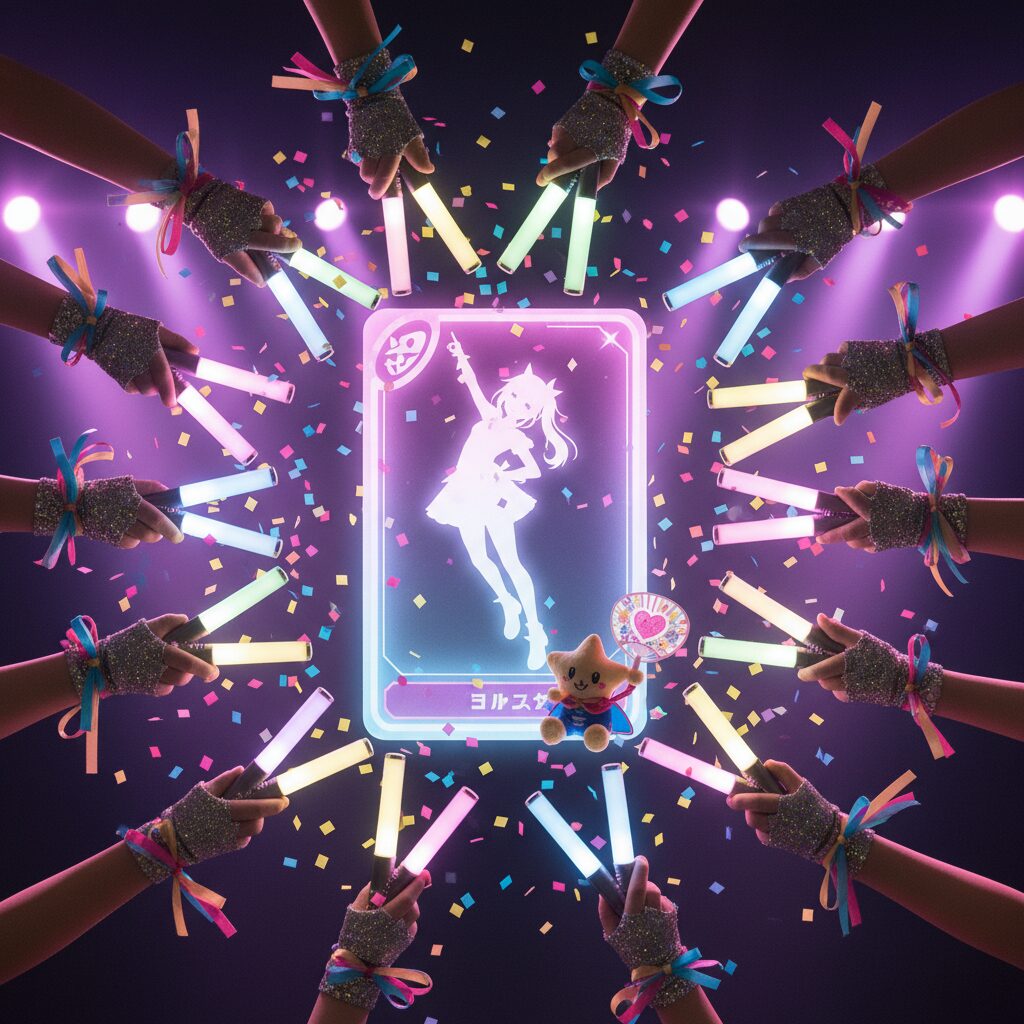
The unbridled energy of Angura finds a modern parallel in the passionate subcultures of Japanese fandom, where devoted enthusiasts challenge conventional norms in Japan’s contemporary cultural landscape.
A Society at its Breaking Point
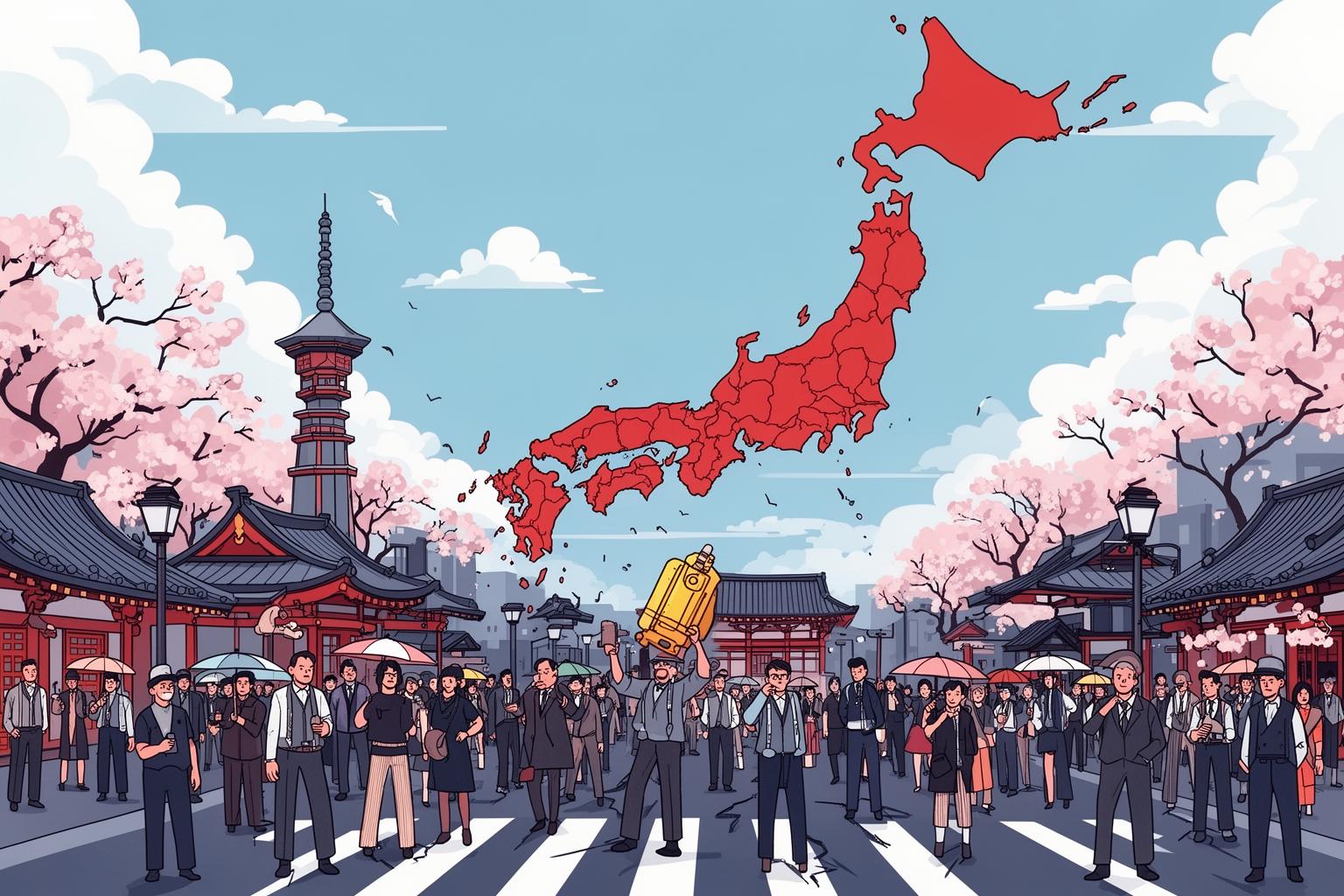
To truly grasp why Angura had to emerge, you must understand the pressure cooker that was 1960s Japan. The decade began with the massive Anpo protests against the US-Japan Security Treaty, during which hundreds of thousands of students and citizens flooded the streets, only to confront riot police and political indifference. The dream of a new, democratic Japan, born from the ruins of World War II, felt like a sham. For the younger generation, their parents’ world of quiet perseverance and national rebuilding seemed like surrender, a trade of cultural soul for economic success.
This was the era of the “Japanese economic miracle.” Tokyo was a sprawling construction zone, alive with the energy of the 1964 Olympics, the first held in Asia. The iconic Shinkansen bullet train stood as a shining symbol of progress. The country was growing wealthy, becoming modern, and eagerly presenting a polished, Western-friendly image to the world. Yet for many artists and intellectuals, this new identity felt hollow, a cheap disguise worn to cover deep wounds. The trauma of the war, the atomic bombings, and the humiliating defeat had been glossed over, not truly faced. There was a profound sense of rootlessness, a feeling that in the rush to modernize, Japan was cutting ties with a darker, more authentic past.
The existing theatrical world offered no comfort. On one side were the ancient, highly codified forms like Noh and Kabuki. Beautiful, yes, but they seemed like museum relics, completely disconnected from the chaotic reality of modern life. On the other side was Shingeki, or “New Theater,” which had dominated modern theater for decades. The problem was that Shingeki was itself imported, based on Western psychological realism—think Ibsen and Chekhov. Its practitioners were intellectuals who presented verbose, cerebral plays for a bourgeois audience. To the radicalized youth of the 60s, Shingeki was just as stuffy and irrelevant as Kabuki. It was talking-head theater in an era that demanded a primal scream.
Angura was that scream. It was a fierce rejection of both the ossified traditions of the past and the sterile, imported modernism of Shingeki. It sought to forge a theater that was uniquely Japanese, not by retreating into sanitized folklore, but by digging deep into the nation’s subconscious—its myths, its perversions, its repressed memories, and its ghosts. It was a theater of the body, sweat, mud, and blood, refusing to be confined by the polite boundaries of a proscenium arch.
The Mad Triumvirate of the Underground
Like any genuine revolution, Angura had its fiery leaders. Although the movement was a sprawling, chaotic ecosystem of countless small troupes, three individuals stand as its undisputed pillars. They differed wildly in their methods and philosophies, yet all shared a singular goal: to break the fourth wall and drag theater, kicking and screaming, into the raw mess of life itself.
Shūji Terayama: The Alchemist of Chaos
If Angura had a ringmaster, it was Shūji Terayama. Poet, playwright, filmmaker, photographer, and masterful provocateur, Terayama was a force of nature. His theater troupe, Tenjō Sajiki (named after the film Les Enfants du Paradis, meaning “the peanut gallery”), was less a company and more a surrealist circus of societal outcasts. He actively recruited runaways, delinquents, and misfits, believing that their lived experience of alienation was more valuable than any formal acting training.
Terayama’s philosophy can be summarized by his famous slogan: “Throw away your books, rally in the streets!” He aimed to dissolve the boundary between art and life, between performer and audience. For him, a play wasn’t something you passively watched; it was an event that happened to you. His productions were notorious for their confrontational nature. Actors might emerge from the audience to hurl insults, drag spectators onto the stage, or steal their belongings. In one famous street performance, actors dressed as businessmen would suddenly collapse at a busy intersection, forcing bewildered pedestrians to navigate the “crime scene.”
His aesthetic was a fever dream of Freudian psychology, circus freak shows, and twisted nostalgia. He was obsessed with his childhood in rural Aomori, and his plays contain recurring motifs: overbearing mothers, grotesque father figures, funerary imagery, and a yearning for a past that was likely fictional from the start. His stages were cluttered wonder-cabinets of strange objects, inhabited by dwarves, hunchbacks, drag queens, and bodybuilders. His most famous play, La Marie-Vison (The Mink Marie), is a surrealist tale of a boy prostitute and his relationship with a life-sized, articulated doll—a perfect encapsulation of his fixation on the intersection of innocence and perversion.
Terayama viewed theater as social therapy and a small-scale crime. He sought to shock the complacent bourgeoisie from their stupor, forcing them to confront the weirdness and darkness lurking beneath the surface of their orderly lives. He even created a play mailed to a single audience member in a box, a piece of conceptual art that completely overturned the idea of a communal theatrical experience. For Terayama, theater wasn’t about storytelling; it was about creating a memory, a scar.
Jūrō Kara: The Poet of the Riverbank
While Terayama operated with the chaotic energy of a punk rock showman, Jūrō Kara was Angura’s romantic, wandering poet. His theater, Jōkyō Gekijō (Situation Theater), famously performed in a massive red tent that they would illegally pitch in public parks, shrine grounds, and dry riverbeds. The tent itself was a powerful political symbol. It rejected established cultural institutions and declared solidarity with the dispossessed—the transient workers, the homeless, and the forgotten people living on the margins of Japan’s economic miracle.
Kara’s theater was deeply physical and elemental. He rejected the psychological dissections of Shingeki, instead advocating for a theater of the body—the “privileged body” of the actor, capable of expressing what words could not. His actors underwent intense physical training, and his plays featured raw, visceral action. Water was ever-present—actors wrestled in pools of it, emerged dripping from hidden tanks, or were drenched by sudden downpours. The mud of the riverbank floor was not mere scenery but a primal element connecting the performance to the earth.
His stories were non-linear and illogical. They were lyrical, fragmented narratives flowing like dreams, blending Japanese folklore, detective story elements, and a profound sense of natsu-kashisa, a deep, often painful nostalgia for a lost world. Kara’s characters often searched for something—a missing person, a forgotten memory, a sense of belonging. They wandered through a landscape irreversibly altered by modernity, haunted by the ghosts of a pre-war Japan that felt both mythical and tantalizingly close.
To witness a Jōkyō Gekijō play in the red tent was an immersive, almost sacred experience. The outside world faded, replaced by the scent of damp earth, the heat of stage lights, and the mesmerizing energy of the performers. Kara created a self-contained universe, a temporary autonomous zone where societal rules were suspended and a different, more primal reality emerged. He gave voice and stage to outcasts, discovering a strange, bruised beauty in the lives left behind by progress.
Tadashi Suzuki: The Austere Disciplinarian
If Terayama was the agent of chaos and Kara the romantic poet, Tadashi Suzuki was the stern Zen master. He was the formalist of the Angura movement, deeply concerned with theory and rigorous discipline. While he shared the others’ disdain for the empty psychologism of Shingeki, his response was not to embrace chaos, but to forge a new, intensely controlled physical language for the stage. This became the world-renowned Suzuki Method of Actor Training.
Working with his company, Waseda Shō-gekijō (later renamed SCOT), Suzuki argued that Japan’s modernization had weakened the human body, rendering it incapable of generating the raw energy essential for powerful theater. He looked to the stylized, foot-centric movements of traditional Noh and Kabuki, not to imitate them, but to distill their essence. He developed grueling exercises to reconnect actors with their center of gravity, build immense lower-body strength, and control breath with near-superhuman precision. His training involved much stomping, slow, deliberate walking, and holding statuesque poses for long durations. He called it the “grammar of the feet.”
Suzuki believed this intense physical discipline could unlock a universal, pre-cultural form of expression. He famously applied his method to Greek tragedies like The Trojan Women and Clytemnestra. The results were electrifying. By stripping away Western psychological layers and replacing them with his highly physical, Japanese-inflected movement vocabulary, he exposed the raw, animalistic core of these ancient stories. A grieving queen’s sorrow wasn’t shown through a trembling lip but through a slow, agonizing drag of the foot across the stage—a powerful, controlled physical act that conveyed despair more profoundly than any spoken line.
In the 1970s, Suzuki relocated his company from bustling Tokyo to the remote, snowbound village of Toga in Toyama Prefecture. There, they transformed traditional Gassho-zukuri farmhouses into theaters, creating a theatrical commune. This was the ultimate expression of his philosophy: a retreat from modern distractions to intensely focus on theater’s fundamental craft. Suzuki’s work proved that the underground movement wasn’t solely about rebellion and chaos; it was also about forging a new, powerful, and fiercely disciplined kind of beauty.
The Look and Feel of a Nightmare
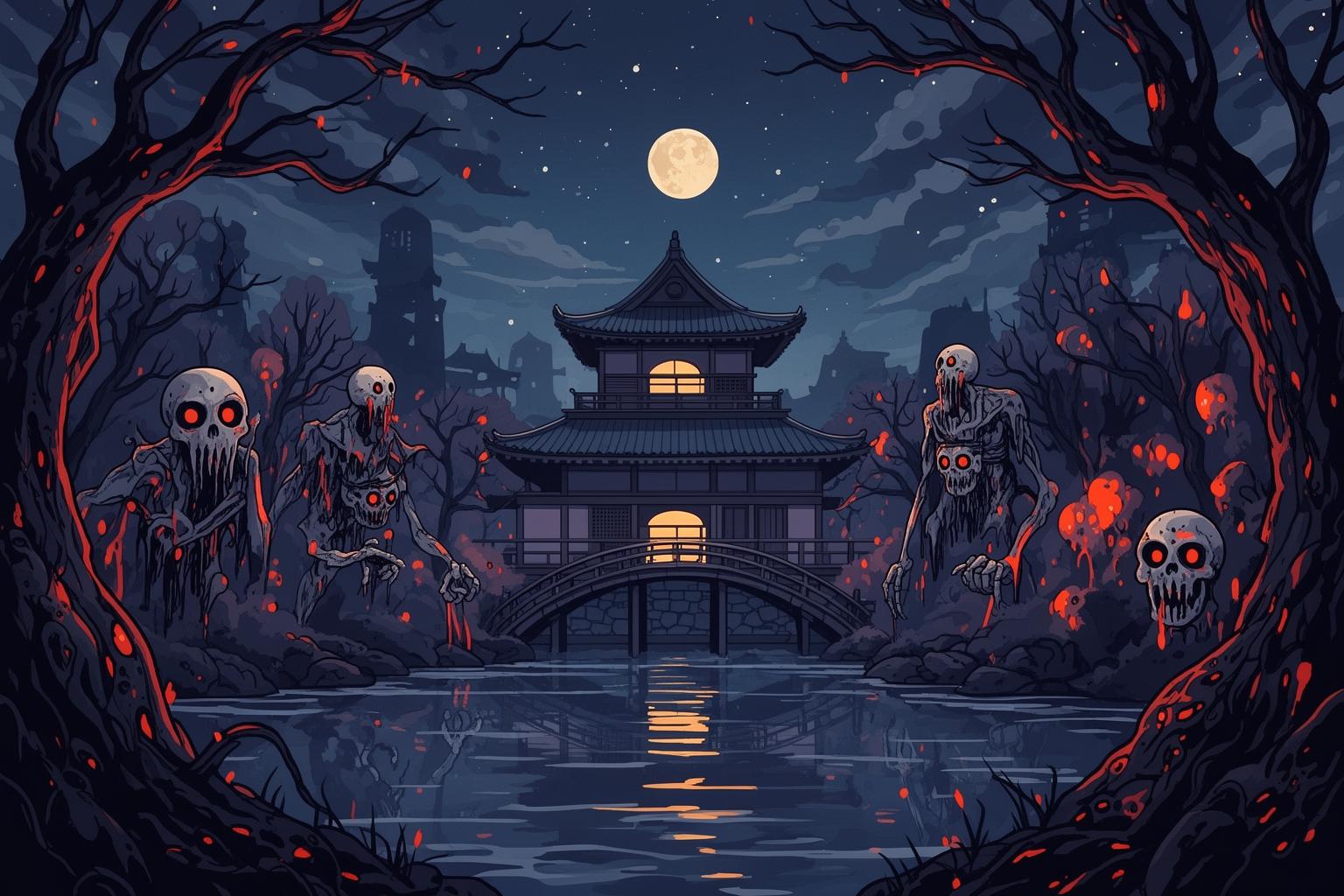
Beyond the philosophies of its auteurs, Angura cultivated a unique and unforgettable aesthetic. It was a visual language steeped in the grotesque, the fractured, and the surreal, deliberately distancing itself from the clean lines and pastel hues of modern, consumerist Japan.
Makeup was frequently extreme, drawing from the white-painted faces of Kabuki but pushing them into the macabre. The shironuri (white-painted face) of Angura was not about stylized beauty; it sought to create a mask of death, a ghostly pallor that erased individual identity and transformed performers into living ghosts or shattered dolls. Eyes were often encircled with dark makeup, producing a hollow, skull-like appearance.
Costumes were seldom pristine. They often appeared tattered, dirt-stained, as if recovered from the ruins of a firebombing. Performers wore distorted versions of traditional Japanese garments, military uniforms from forgotten wars, or bizarre, surreal assemblages defying categorization. Nudity was common but rarely erotic; it served as a tool of shock and vulnerability, stripping away social pretense to reveal the raw, animalistic body beneath.
The performance spaces themselves were integral collaborators. The rejection of conventional theater buildings was essential. Kara’s red tent fashioned a nomadic, tribal ambiance. Terayama’s use of the streets transformed the entire city into a potential stage, drawing everyone into the performance. They played in cramped basements, abandoned warehouses, and smoky jazz cafes. The close proximity of the audience, combined with the blurred line between stage and seating, created an atmosphere both intimate and claustrophobic. You couldn’t escape the scent of the actors’ sweat or the intensity of their gaze. This was a theater that invaded your personal space, provoking a deeply visceral reaction.
The Ghost in the Machine: Angura’s Lingering Legacy
By the end of the 1970s, the intense political urgency that had driven Angura began to fade. The student movements lost momentum, and Japan slipped into the hyper-consumerist haze of the 1980s bubble economy. The raw anger and existential angst of Angura started to feel out of sync with the times. The movement splintered, with many of its key figures pursuing new directions. Terayama’s death in 1983 marked the symbolic close of an era.
Yet Angura did not simply vanish. It seeped into the fabric of Japanese culture, and its spirit continues to haunt the nation’s artistic landscape. Its most direct successor is Butoh, the “dance of darkness.” Butoh pioneers like Tatsumi Hijikata worked closely with Angura artists, sharing a common inspiration: the fractured post-war body and the exploration of the grotesque. Butoh’s slow, deliberate movements, its often-distorted forms, and its shironuri makeup clearly carry forward the Angura aesthetic.
In mainstream theater, directors who came of age during the Angura era, such as Hideki Noda, infused its spirit of playful deconstruction and high-energy performance into the 80s and 90s, albeit in a more refined and accessible style. The core idea that theater could be chaotic, non-linear, and visually spectacular was permanently embedded in the cultural consciousness.
Perhaps most strikingly, as someone deeply engaged with anime, I see Angura’s influence everywhere. The surreal, dreamlike logic and psychological complexity of Satoshi Kon’s films, like Perfect Blue and Paprika, feel like a direct legacy of Terayama’s cinematic experiments. The fusion of hyper-modernity and grotesque biology in the body-horror of Shinya Tsukamoto’s Tetsuo: The Iron Man embodies Angura’s spirit translated into cyberpunk cinema. The high theatricality, focus on alienated youth, and deconstruction of social roles in anime such as Kunihiko Ikuhara’s Revolutionary Girl Utena would be unimaginable without the path paved by Tenjō Sajiki.
Angura was more than just a theatrical movement. It was a national exorcism, a generation’s attempt to confront the ghosts their parents had tried so hard to bury. It was messy, contradictory, and often frustratingly opaque. But it was also urgently necessary. It tore open the placid surface of post-war Japan to reveal the beautiful, terrifying, and profoundly human chaos beneath. It was the scream in the immaculate garden, a reminder that the most compelling truths often lie not in the pristine center, but in the muddy, neglected margins.