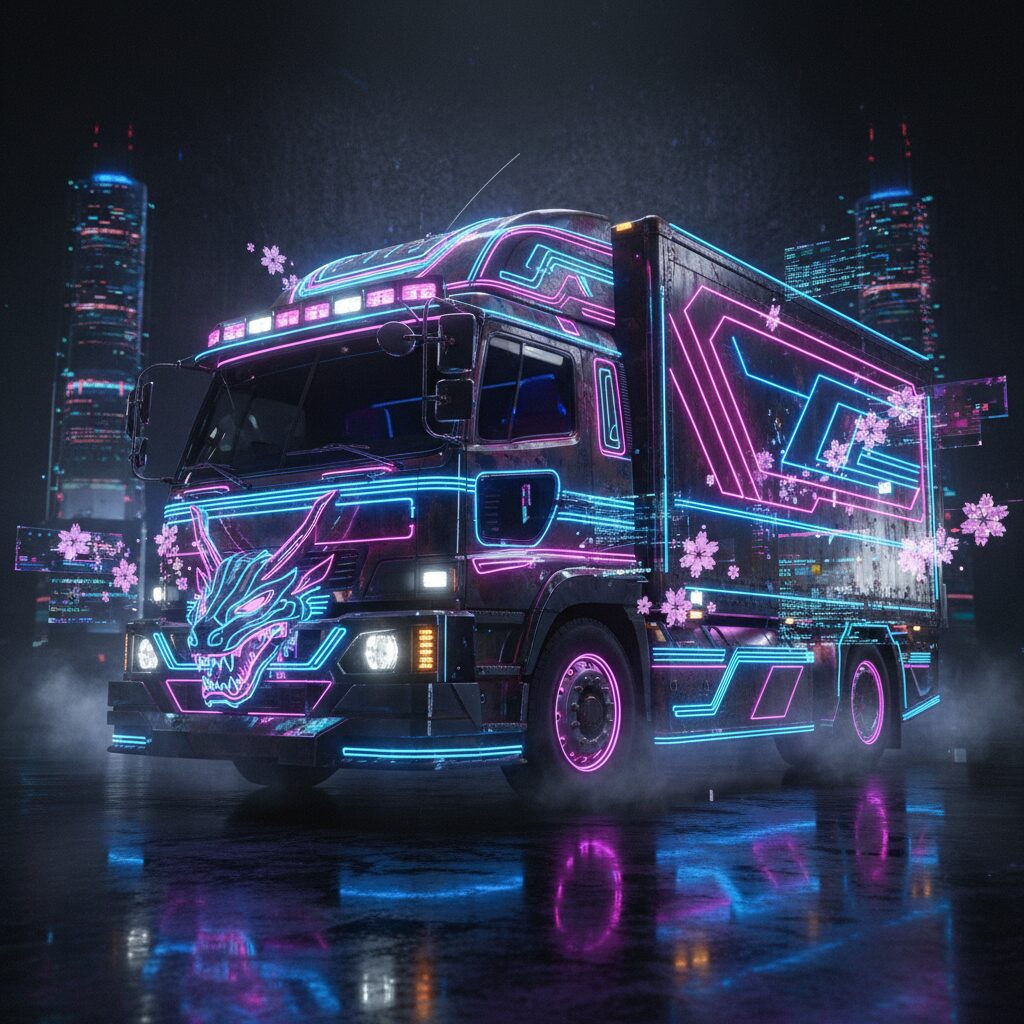
You’ve probably seen pictures. Maybe you stumbled across them late at night online, or caught a glimpse in a music video. A multi-ton freight truck, but transformed. It looks less like a vehicle for hauling frozen fish and more like a rolling Shinjuku skyscraper that just won a war against a rainbow. It’s covered in mirror-finish chrome, murals of roaring dragons, and enough lights to rival a city’s New Year’s Eve display. Your first thought is probably, “What am I even looking at?” Your second is, “Why?”
Welcome to the world of Dekotora, a uniquely Japanese subculture that is loud, unapologetically extravagant, and far more profound than it first appears. The name is a simple portmanteau of “decoration” and “truck,” but that’s like calling a cathedral a “decorated building.” It doesn’t capture the spirit, the history, or the sheer, unadulterated passion that drives men to spend fortunes turning their work vehicles into mobile masterpieces. This isn’t just about cool trucks; it’s a story about blue-collar pride, artistic expression in the face of conformity, and a brotherhood forged on the highways of Japan. Forget what you think you know about car culture. We’re diving into something else entirely.
Embodying an unapologetic spirit of creative rebellion, today’s Dekotora movement echoes the trailblazing energy of Japan’s 80s bad boys, whose revolutionary style still influences contemporary Japanese subcultures.
From Fish Markets to a Film Frenzy

Like many of Japan’s most fascinating subcultures, Dekotora didn’t emerge out of thin air. It arose from the mud, grease, and saltwater of the nation’s post-war economic boom. Its origins are deeply rooted in the tough, practical world of long-haul trucking, specifically within the fishing ports of Tohoku, Japan’s northeastern region.
The Original Midnight Express
During the 1960s and 70s, transporting fresh fish from ports like Hachinohe to Tokyo’s massive markets was a harsh, time-critical task. These were not corporate drivers operating within a standardized fleet. They were independent owner-operators, modern-day cowboys whose survival depended on speed, dependability, and determination. The competition was intense. To prove their skill and stand out, drivers began personalizing their rigs with small touches—a few extra marker lights, a custom mudflap, a painted emblem. It was a statement: “I am the best. My truck is the fastest. I get the job done.”
These early customizations were functional, stemming from pride in their work. However, they planted a seed. The notion that a truck was more than a tool but an extension of the driver’s identity started to take root. It was a humble start, a few sparks of individuality on the dark expressways. Then, in 1975, a movie was released that poured gasoline on that spark, setting off a nationwide blaze.
The ‘Truck Guys’ Phenomenon
That movie was Torakku Yarō (Truck Guys). It was a wild, comedic, action-filled film series chronicling the escapades of two truckers, Momojiro Hoshi and his sidekick Jonathan. The true star, however, wasn’t an actor—it was Momojiro’s truck, the Ichiban Boshi (First Star). Adorned with intricate paintings, custom metalwork, and a dazzling array of lights, it was unlike anything most of Japan had ever seen.
The series was a tremendous success. It glamorized the trucker lifestyle, portraying drivers not as hardened laborers, but as chivalrous, free-spirited heroes of the open road—modern samurai, loyal to their friends and fiercely independent. Suddenly, truckers were cool. More importantly, the Ichiban Boshi set a standard. It defined the Dekotora aesthetic, turning it from a collection of isolated modifications into a unified style. Drivers nationwide saw it and thought, “I can do that.” They aspired to be more than just truckers; they wanted to be Truck Guys. The race was on to build the most extraordinary rigs on the road.
Anatomy of a Chrome-Plated Beast
To those unfamiliar, a Dekotora truck may appear to be a chaotic burst of parts. However, there is a method behind the madness. Every component is thoughtfully selected and often custom-made, contributing to a cohesive, albeit overwhelming, whole. Constructing one is an art that merges metalworking, electrical engineering, and painting into a unique, mobile sculpture.
The Symphony of Steel and Light
Let’s begin with the exterior, the part that captures attention. The base is typically a standard Japanese truck from brands like Hino, Isuzu, or Fuso. But that’s where the ordinary stops.
The standout features include the massive, protruding bumpers called maedashi bumpers and the towering visors extending over the windshield. These are usually crafted from stainless steel or chrome-plated metal, engraved with intricate patterns. The truck’s sides are covered in custom panels, while the roof often bears a large array of lights and horns dubbed a “rocket launcher.”
And then there are the lights. Oh, the lights. We’re talking hundreds, sometimes thousands, of individual bulbs. Boxy lanterns known as andon feature names, poems, or slogans painted on them. Rows and rows of marker lights in every imaginable color line the truck. There are strobes, beacons, and under-chassis neon lights that give the impression the truck is floating on a bed of illumination. The driver controls this mobile galaxy from a sophisticated switchboard inside the cab, able to create varied patterns and displays at will.
Finally, there is the artwork. The flat surfaces, particularly the rear cargo doors and side panels, serve as canvases for breathtaking airbrushed murals. The themes draw heavily from classic Japanese culture: fierce kabuki actors in dramatic poses, mythical creatures such as dragons and phoenixes, graceful carp swimming upstream (koi no takinobori, a symbol of perseverance), and legendary heroes. It’s not graffiti; it’s high art, executed with remarkable skill, transforming a freight hauler into a moving gallery.
The Inner Sanctum
The attention to detail extends beyond the exterior. The cab of a Dekotora is just as elaborate, if not more so. It serves as the driver’s castle, command center, and living space all at once. Stepping inside is like entering a different world.
You’ll find dashboards and door panels adorned with quilted leather or crushed velvet. The steering wheel might be replaced by a gilded, ornate piece. Overhead, a genuine crystal chandelier might hang, casting a warm light. Seating is often reupholstered with luxurious traditional textiles like Nishijin-ori brocade from Kyoto. Some drivers even include small tatami mat sections or shoji screen-style dividers. It is the complete opposite of a spartan, utilitarian environment. It is a home, a personal sanctuary crafted for comfort and luxury on long, solitary journeys.
The Soul of the Subculture: Who and Why?
So, we’ve defined what Dekotora is. But the more significant question is why. Why would anyone invest the cost of a small house into a work vehicle? To grasp that, you need to understand the drivers behind the wheel and the cultural context they inhabit.
More Than a Hobby, It’s an Identity
Dekotora is essentially a blue-collar movement. Most of its enthusiasts are owner-operator truckers. This isn’t a pastime for wealthy executives; it’s a passion project for working-class men (and a few women) who own both their rigs and their businesses. Trucking in Japan, as in other places, is grueling, often thankless work. It entails long hours, thin profit margins, and extended periods away from home. Society tends to regard it as unskilled labor.
Dekotora stands as a powerful, dazzling rebuttal to that stereotype. It allows drivers to take immense pride in their profession and their vehicle. By turning a basic commercial tool into a one-of-a-kind work of art, they declare their individuality. In a society that often values collective harmony and conformity, Dekotora is a bold, chrome-adorned proclamation of self. It says, “I am here. I am a craftsman. My work has meaning, and my truck is my soul.” Every custom part, every light, every brushstroke reflects the owner’s personality, taste, and philosophy.
The Brotherhood of the Road
While the trucks themselves are fiercely individualistic, the culture is highly communal. Drivers form clubs called utamakai. These clubs are the foundation of the Dekotora scene, offering friendship, technical advice, and a shared sense of identity. They often have impressive names such as the Zenkoku Utamakai (All-Japan Utamakai) or the Kanto Midorikai.
Throughout the year, these clubs host large meetups and charity events, usually at convention centers or spacious parking lots. Hundreds of trucks gather, parked in orderly rows with their lights shining brightly against the night sky. It’s a stunning spectacle. Drivers, their families, and fans stroll through the aisles, admiring the craftsmanship, exchanging stories, and sharing tips on the best chrome fabricators. These events blend car shows with family reunions.
Importantly, many of these gatherings support charitable causes. Utamakai frequently raise funds for disaster relief—a critical issue in earthquake-prone Japan—or for local community projects. This effort consciously counters the old outlaw image once linked to truckers, showcasing a positive, community-minded image. They are not merely rebels; they are organized contributors to society, channeling their spectacular hobby for the greater good.
The Road Ahead: Challenges and Evolution
For all its brilliance, the future of Dekotora is not without challenges. This subculture, which exploded in the 70s and reached its peak in the 80s and 90s, now faces a new set of economic and regulatory realities.
The Cost of Chrome
The biggest obstacle is, unsurprisingly, money. A full Dekotora conversion can range from $50,000 to well over $500,000, in addition to the cost of the truck itself. These are enormous sums for independent truckers, especially in a competitive and often unstable industry. The parts are almost always custom-made by specialized workshops, and the labor is intensive.
Beyond the initial outlay, the modifications entail practical costs. The extra weight from all the steel and chrome reduces fuel efficiency and payload capacity. Then there’s the notorious shaken, Japan’s extremely strict biennial vehicle inspection. Many of the most extreme modifications, such as oversized bumpers and certain lighting setups, are technically illegal for road use. Drivers often spend days removing parts to pass inspection, only to reinstall them afterward—a costly and time-consuming bureaucratic routine.
A Fading Roar?
The subculture is also experiencing a demographic shift. The original generation of drivers inspired by Torakku Yarō are now approaching retirement. The younger generation of truckers is smaller, and many are company drivers who don’t own their vehicles and thus cannot modify them. Economic pressures and the dedication required make it a tough hobby to pursue.
As a result, the number of truly extravagant Dekotora on Japan’s highways has declined from its peak. You are far less likely to see one randomly on the road today than thirty years ago. The scene is smaller, more concentrated, and mainly exists at dedicated meetups.
Despite this, the spirit of Dekotora endures. Its influence has spread far beyond Japan’s expressways, inspiring artists, fashion designers, and filmmakers around the world. The cyberpunk aesthetic owes a clear debt to these neon-drenched giants. While the golden age may have passed, Dekotora has secured its place as one of the most visually striking and culturally rich subcultures Japan has ever produced. It stands as a testament to the universal human desire to find beauty and identity through our labor, and to leave a bright, shining mark on the world—even if that mark is on the back of a ten-ton truck.