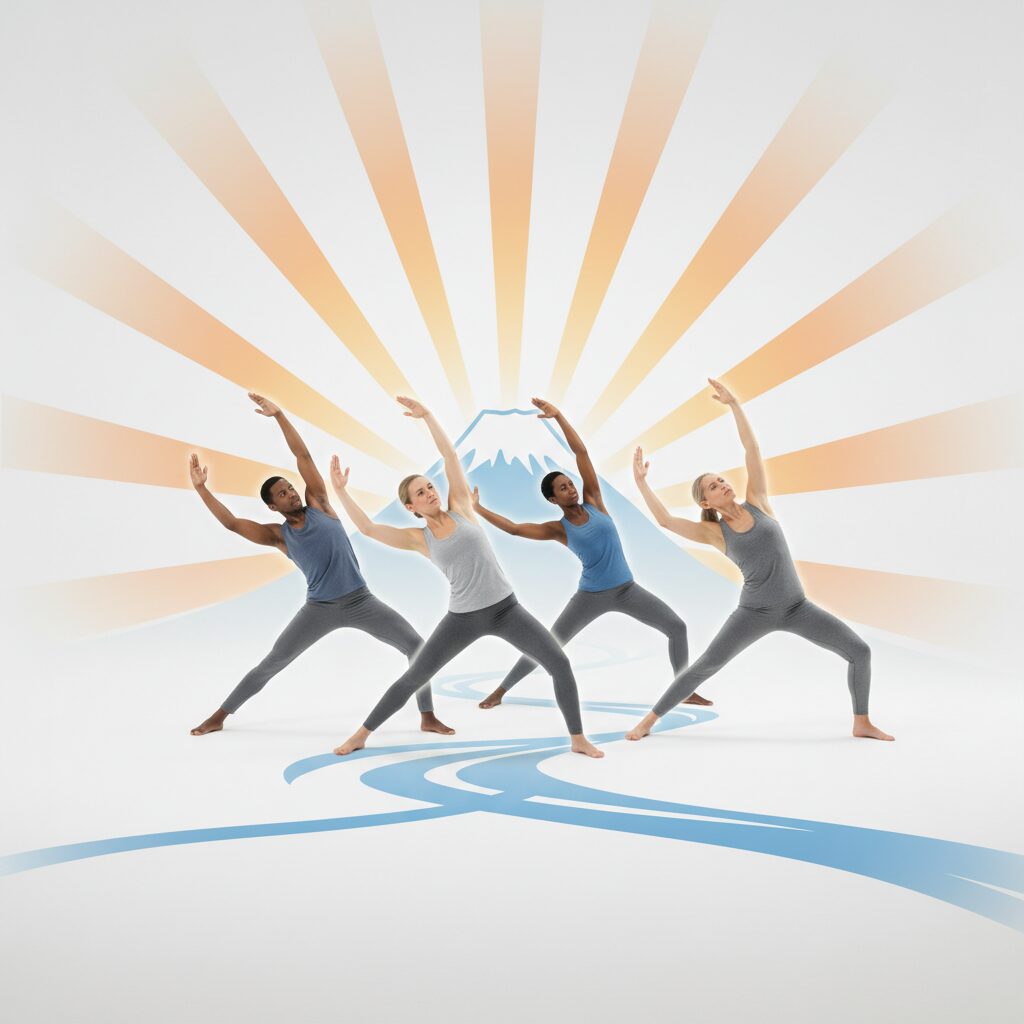
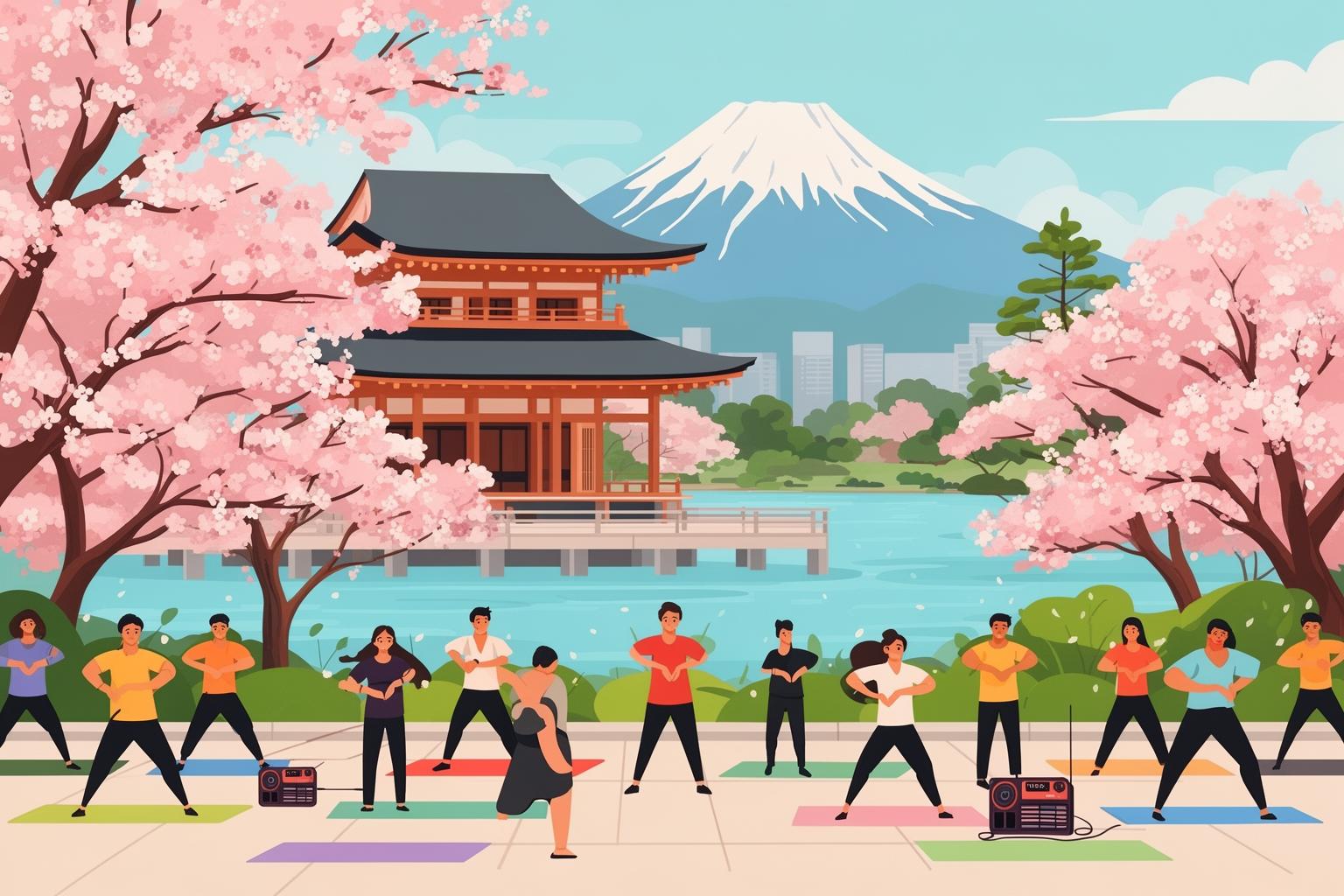
Walk through a Japanese park around 6:30 AM on a weekday, and you’ll likely encounter a scene that feels both strangely futuristic and deeply traditional. Dozens, sometimes hundreds, of people—retirees, office workers on their way to the station, parents with young children—stand in loose formation. Then, a gentle, slightly tinny piano melody floats from a public radio or a portable boombox. As the first notes play, every single person begins to move in perfect, unhurried synchronicity. Arms raise, bodies twist, knees bend. It’s a silent, gentle ballet performed by an entire community.
This isn’t a spontaneous flash mob or a niche fitness class. This is Radio Taiso (ラジオ体操), or Radio Calisthenics, a national institution as ingrained in the daily rhythm of Japan as the morning train schedule or the first pot of green tea. For nearly a century, this simple, three-minute exercise routine has been the official start to the day for millions, broadcast religiously by the national public broadcaster, NHK. It happens in schoolyards before the first bell, on factory floors before the machinery whirs to life, and in neighborhood squares where the elderly gather to greet the day. The movements are simple, the music is unchanging, and the participation is widespread.
To an outsider, it can seem perplexing. In an age of personalized fitness apps, high-intensity interval training, and boutique yoga studios, why does a nation famed for its technological advancement and forward-thinking design cling to such a simple, uniform, and seemingly old-fashioned ritual? The answer has little to do with burning calories or achieving peak physical performance. The truth is, Radio Taiso is not really about exercise. It’s a physical manifestation of some of the deepest-held values in Japanese culture. It’s a daily lesson in group harmony, a testament to the power of routine, and a quiet affirmation of a collective identity. To understand this clockwork calisthenics is to understand something fundamental about the mindset that shapes Japanese society.
This sense of communal rhythm that characterizes Radio Taiso is also reflected in the enthusiastic spirit of school sports day events across Japan.
The Sound of the Nation Waking Up
To truly understand Radio Taiso, you need to begin with the sound. The music is instantly recognizable to anyone who has spent time in Japan. It’s not an intense workout anthem; rather, it’s a simple, lilting piano melody that feels encouraging and slightly nostalgic, like a tune from a child’s music box. Over this music, a calm, clear, and reassuring male voice guides participants through the movements, not with the sharp commands of a drill sergeant, but with the steady rhythm of a patient teacher: “First, let’s start by stretching our arms and expanding the chest… ichi, ni, san, shi… one, two, three, four.”
There are technically two main routines. Radio Taiso Dai Ichi (Number One) is the classic version, the one everyone from kindergarteners to centenarians knows by heart. It comprises 13 movements designed for people of all ages and fitness levels. It’s a full-body warm-up aimed at improving circulation, loosening joints, and balancing the body. The movements are gentle and flowing: raising arms overhead, bending from side to side, rotating the torso, bending the knees. It’s meant to awaken the body, not tire it out.
Radio Taiso Dai Ni (Number Two) is the more athletic counterpart. Broadcast immediately after the first, its movements are more vigorous and complex, intended to build strength and muscular coordination. You’ll notice more jumping, deeper leg bends, and stronger arm motions. While Dai Ichi encourages universal participation, Dai Ni is often preferred by younger groups, such as school sports teams or physically active workers, to properly prepare for a day of exertion.
The ritual is most prominent during summer vacation. For elementary school students, Radio Taiso becomes a key part of their holiday routine. Every morning, children from the neighborhood gather at the local park or schoolyard. Each child carries a small attendance card, the rajio taisō kādo. After finishing the exercises, they hurry to a volunteer parent or community leader to receive a stamp—a flower, a cartoon animal, or a simple circle—for that day. Filling the card becomes a source of pride and a gentle motivation to keep a daily routine even when school is out. It’s a child’s first concrete lesson in the cultural value of consistency.
More Than Just a Stretch: The Cultural Mindset
If you ask someone why they practice Radio Taiso, you might receive a practical response such as: “It feels good,” “It wakes me up,” or “It’s beneficial for my health.” However, the true reasons behind its remarkable longevity and cultural significance run much deeper. The routine serves as a masterclass in reinforcing the fundamental principles of the Japanese social mindset.
The Primacy of the Group
The most essential concept at work is wa (和), which roughly means harmony, social cohesion, and peaceful unity within a group. In Japanese culture, the needs and identity of the group often take precedence over individual desires. Radio Taiso physically embodies wa. When performing the exercises, you are not an individual striving for personal achievement, but part of a larger collective, moving in perfect unison with those around you. Your attention is not on yourself, but on synchronizing your rhythm and form with the group. This daily act of coordination powerfully reinforces, without words, the idea that “we are all in this together.” It smooths out individual differences and aligns everyone to a shared purpose and a common starting point for the day.
The Power of Shared Rhythm
Japanese society functions according to a set of predictable, shared rhythms. The fiscal year begins in April, the school year follows suit, and train schedules are famously punctual. This cultural preference for structure and predictability creates a sense of stability and mutual understanding. Radio Taiso serves as the daily metronome that sets this rhythm. At 6:30 AM, millions across the archipelago engage in the exact same activity. This shared experience weaves an invisible thread of connection. It acts as a collective deep breath before the nation dives into the day’s work, establishing a baseline of order and routine from which the day’s complexities can unfold.
Continuity is Power
There is a deeply respected Japanese proverb: keizoku wa chikara nari (継続は力なり), meaning “continuity is power” or “perseverance is strength.” The culture highly values small, consistent efforts extended over long periods. This philosophy underpins everything from the meticulous practice of traditional crafts to the corporate concept of kaizen (continuous improvement). Radio Taiso exemplifies this principle through daily practice. It is not an intimidating, high-intensity workout likely to be abandoned after a few weeks, but a simple, three-minute commitment. The benefit arises not from a single session, but from the cumulative impact of thousands performed over a lifetime. It teaches that lasting results come not from dramatic, heroic acts, but from quiet, steadfast diligence. The summer vacation stamp card is often the first structured lesson children receive in this: the goal isn’t to excel at the exercises, but to show up daily.
A Gentle Form of Social Discipline
While participation is rarely explicitly mandatory in public spaces, in certain settings like schools and traditional companies, there is a strong social expectation to join in. This is not a harsh or authoritarian discipline, but rather a gentle, communal way of focusing everyone’s attention and energy. At a construction site, it serves as a practical method to ensure all workers are awake, alert, and physically ready, reducing the risk of accidents. In an office, it symbolizes the transition from personal time to company time—a ritual that briefly dissolves hierarchical barriers as everyone, from department heads to new hires, performs the same simple movements. It is a way of expressing, “We are now a team, ready to work.”
An Unexpected History: From American Insurance to Imperial Japan
The story of Radio Taiso is not, as many might assume, an age-old Japanese tradition dating back centuries. Its origins are surprisingly modern and international, which makes its full assimilation into Japanese culture all the more intriguing.
The idea was directly inspired by a 1920s American health campaign. The Metropolitan Life Insurance Company, through a clever piece of public health marketing, sponsored a radio program that broadcast fifteen minutes of morning calisthenics to listeners in major US cities. The reasoning was straightforward: a healthier population meant fewer insurance claims.
Japanese officials from the postal ministry, who also oversaw the national life insurance system, visited the United States and recognized the potential of this broadcast. They sought a way to enhance the general health and fitness of the Japanese populace, especially after military conscription exams exposed concerning health trends. They adapted the American concept for a Japanese audience, commissioning a set of exercises designed to be accessible to everyone.
Radio Taiso was officially launched in 1928 to mark the coronation of Emperor Hirohito. This imperial endorsement instantly gave the practice a sense of national significance. It was promoted as a patriotic activity, encouraging citizens to build a strong, healthy nation in service of the emperor. Its connection with the postal insurance system helped it spread swiftly through a vast, trusted national network.
As Japan moved towards war in the 1930s and 40s, the exercises were repurposed for more nationalistic objectives. The emphasis shifted from general health to cultivating a physically robust and disciplined population prepared for mobilization. The aspect of group conformity was strongly stressed. Performing Radio Taiso became a daily display of one’s loyalty and dedication to the nation’s unified spirit.
This close association with wartime militarism led to its immediate ban by the Allied forces during the post-war occupation of Japan. It was perceived as a tool of totalitarianism, symbolizing the ideology that needed to be dismantled. However, the practice had become so popular and deeply ingrained in the daily routines of ordinary people that there was widespread demand for its return. People longed for the simple health benefits and the sense of community it fostered.
In 1951, a new version of Radio Taiso was developed and introduced, this time under the auspices of the public broadcaster NHK, along with the Ministries of Education and Health, and the postal insurance system. The new routines were carefully crafted by medical and physical education experts, stripped of overt military and nationalist elements, and rebranded as a purely democratic and scientific tool for public health. This version has been broadcast without interruption ever since, becoming the definitive soundtrack of Japan’s post-war recovery and subsequent economic miracle.
Radio Taiso in the Modern Workplace and Beyond
Though the image of an entire office performing synchronized stretches might seem like a thing of the past, Radio Taiso remains a staple in many sectors of the Japanese economy. In modern, internationally oriented tech companies or creative agencies in Tokyo, group workouts are rare. However, in manufacturing plants, construction firms, municipal government offices, and numerous traditional companies, the day still starts with that recognizable piano melody.
For these organizations, the ritual serves several purposes. Practically, it acts as a safety measure, warming up muscles before a day of physical work to help prevent injuries. More importantly, it serves as the morning chōrei, or briefing, uniting the team. It’s a moment for everyone to check in, both physically and mentally, and to begin the workday together. It marks a shift in mindset from the individual to the collective, preparing the team for cooperative efforts.
Perhaps Radio Taiso’s most crucial modern role is in Japan’s rapidly aging society. For millions of senior citizens, the daily 6:30 AM gathering in the park is more than just exercise; it is a vital social lifeline. It gives them a reason to leave the house, a regular chance to interact with neighbors, and a gentle form of exercise that helps maintain mobility and balance. In a country where social isolation among the elderly is a growing issue, these simple community gatherings serve as powerful tools to combat loneliness and promote a sense of belonging. The familiar routine offers comfort and stability, while the group setting ensures community members look out for each other.
A Personal Reflection: The Feeling of Moving as One
As a foreigner in Japan, my initial experience with group Radio Taiso was that of an awkward onlooker. Standing on the edge of a park, I observed dozens of people moving with a practiced grace that felt simultaneously intimate and impenetrable. The first time I was invited to join, I was overwhelmed by self-consciousness. My movements seemed clumsy and exaggerated, and my timing was always slightly behind everyone else’s.
However, after a few days of regular participation, a shift occurs. You stop deliberately thinking about the movements. The music becomes a cue, and your body starts to respond instinctively. You begin to sense the subtle push and pull of the group’s energy. There’s a quiet satisfaction in raising your arms at exactly the same time as the person beside you, in catching the collective rhythm of bending knees and rotating shoulders.
In that moment, you cease to be an individual. You become part of a smooth, flowing whole. It’s a deeply different sensation compared to the Western approach to fitness, which often emphasizes hyper-individualism—headphones in, focusing on personal metrics, competing against your own best. Radio Taiso has no performance goals. Its sole purpose is participation. The reward is not a sculpted body but the simple, profound feeling of belonging. It is a form of kinetic communication, a shared moment of agreement that the day has started, and we face it together.
The Unspoken Message of the Morning Stretch
Radio Taiso has persisted for nearly a century, enduring imperial reigns, devastating wars, foreign occupation, and rapid technological advancements. Its survival is not due to being the most efficient workout, but because it perfectly encapsulates Japanese cultural ideals in just three minutes.
It serves as a physical prayer for group harmony. It is a daily reminder of the virtue of persistence. It acts as a social metronome, synchronizing the rhythm of the nation. It provides a structured, reliable start to a world that is often chaotic and unpredictable. From the kindergartener receiving their first stamp to the factory worker preparing for the assembly line to the retiree greeting neighbors in the park, the simple act of stretching together strengthens community bonds and the unspoken social contract foundational to Japanese society.
So next time you’re in Japan and hear that gentle piano melody in the early morning air, don’t just think of it as a quaint exercise routine. Listen more closely. You’re hearing the quiet, rhythmic heartbeat of a culture—a clockwork calisthenics that sets the nation’s pace, one synchronized stretch at a time.