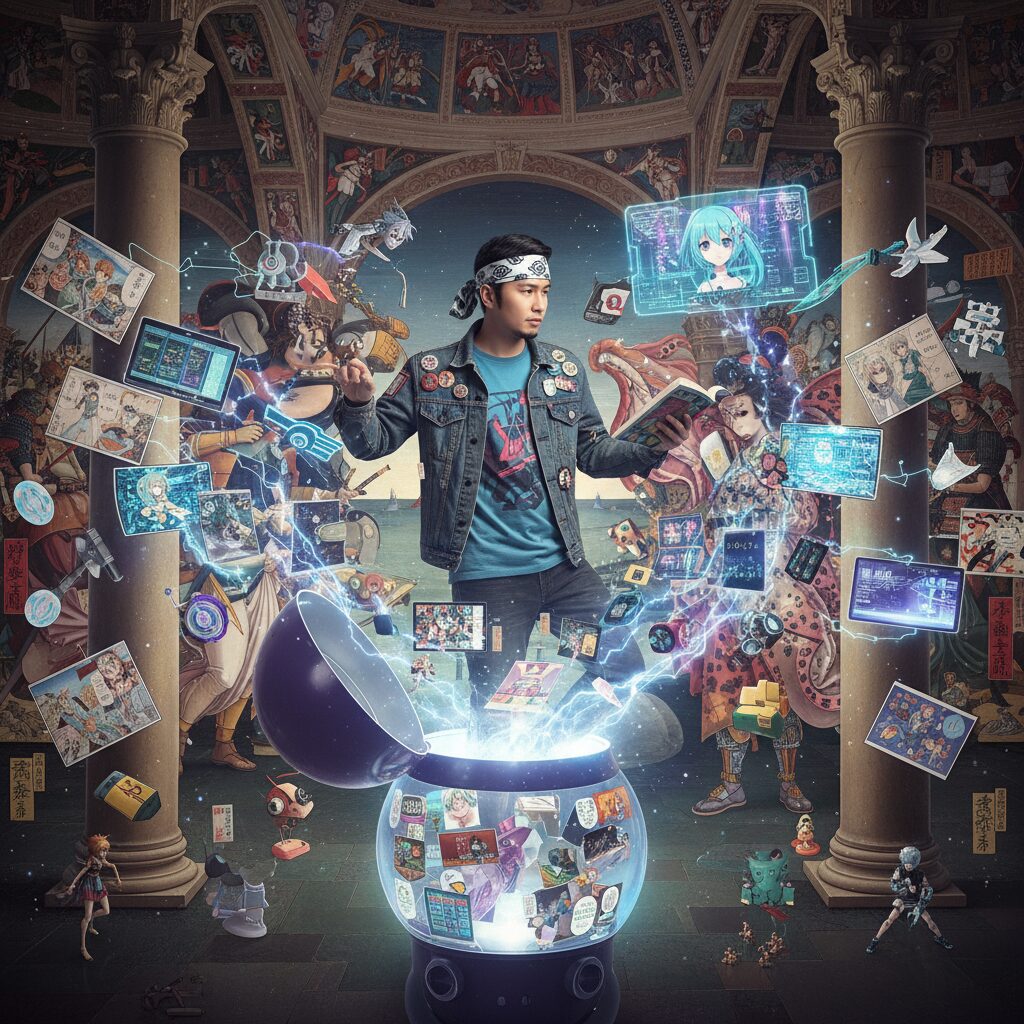
You’ve heard the word ‘otaku,’ I’m sure. In London, Los Angeles, or Manila, it’s practically a compliment. It means you’re in the know. You can distinguish your shōnen from your shōjo, you follow your favorite manga artists on social media, and you probably have a strong opinion about which streaming service has the best anime catalog. To be an otaku, in the global sense, is to be a dedicated, knowledgeable fan of Japanese pop culture. It’s a badge of honor in a connected world where niche interests are a form of social currency.
But if you were to rewind the clock to 1990s Japan, that same word would have landed with the force of a physical blow. It wasn’t a compliment; it was an accusation. To be called an otaku was to be branded as a social failure. The word conjured a grim, specific image: a reclusive young man, unkempt and overweight, living in a messy room filled with comics and figurines, incapable of normal human interaction. He was seen as jobless, passionless in any “productive” sense, and potentially dangerous. Otaku were the pariahs of a society built on conformity, group harmony, and tireless contribution to the economic machine.
So what happened? How did a term that was once synonymous with social deviancy transform into a celebrated identity, one that now powers a multi-billion dollar global industry and is even promoted by the Japanese government itself? This wasn’t a simple rebranding. It was a cultural earthquake, a long, slow battle for legitimacy fought across decades of economic turmoil, technological revolution, and generational change. The story of the otaku is the story of modern Japan struggling with its own identity, and of a subculture that didn’t just survive being misunderstood—it thrived, and in doing so, reshaped the mainstream in its own image.
The transformation of the otaku identity mirrors other pivotal shifts in Japanese culture, such as the resurgence of 80s Japanese city pop, which captures nostalgia and reinvention in equal measure.
The Birth of a Slur: The 1980s and the Otaku Panic
To grasp the venom the word once carried, you need to trace it back to its seemingly innocent beginnings. In the late 1970s and early 1980s, the term had not yet become an identity; it was simply a pronoun. ‘Otaku’ (お宅) is a formal, polite way to say ‘you’ or refer to someone’s home. Among emerging fan groups—circles of science fiction enthusiasts, anime model builders, and amateur manga artists who met at conventions—it evolved into a slightly awkward, overly formal inside joke. Instead of addressing one another with the more common ‘anata’ or by name, they used ‘otaku.’ It indicated a shared social awkwardness, a mutual recognition that they belonged to a particular, nerdy tribe. It was quirky, but harmless.
A Stereotype Forged in Prosperity
This took place against the backdrop of Japan’s Bubble Economy. The nation was an economic powerhouse, and society revolved around a single, monolithic ideal: the salaryman. A man’s expected life course was a straight line from a reputable university to a prestigious corporation, where he would exchange lifetime loyalty for lifetime security. Success was measured by overtime hours, brand-name suits, and a family neatly maintained in a suburban home. It was a culture of extreme conformity, where stepping outside the norm wasn’t merely frowned upon; it was regarded as a mark of failure.
In this strict environment, the growing otaku subculture stood out, and not positively. These were mostly young men opting out, emotionally if not always physically. Instead of channeling their energy into climbing the corporate ladder or social advancement, they focused on hobbies considered juvenile and unproductive: anime, manga, video games, and intricate sci-fi models. They built a world of their own, one governed by a different value system. In a society that valued the collective, their intense, personal passions were viewed as selfish. In a culture that prized face-to-face networking, their preference for fan conventions and mail-in newsletters was seen as reclusive. The media began portraying these men as peculiar, stunted adults unwilling to mature.
The Crime That Turned a Label into a Curse
This simmering suspicion erupted into a full-blown moral panic in 1989. The catalyst was a man named Tsutomu Miyazaki. Over the course of a year, Miyazaki abducted and murdered four young girls in one of the most gruesome crime sprees in modern Japanese history. When police finally arrested him, the media swarmed his apartment, and their findings became the story’s centerpiece. His small room was packed floor to ceiling with a vast collection of videotapes—thousands of them, containing anime, slasher films, and child-focused pornography.
The association was made immediately and irrevocably. The media dubbed him “The Otaku Murderer.” His horrific acts were not portrayed as the deeds of a deeply disturbed individual but as the inevitable product of his otaku lifestyle. Reports dwelled on images of his anime collection, implicitly linking a love for animation to violent, perverse fantasies. The term ‘otaku’ ceased to be a quirky insider pronoun. Instead, it became a media-defined label for a potential monster. The word became inseparable from notions of social isolation, sexual deviance, and violent threat.
Overnight, being an otaku became a profound source of shame. Admitting to enjoying anime or manga risked association with Miyazaki. People concealed their hobbies. Collectors boxed up their prized items. The stereotype was solidified: an otaku was a creepy, unproductive member of society, brooding in a bedroom filled with escapist fantasies, a ticking time bomb of social pathology. For a generation, the subculture retreated deep underground, its name transformed into a powerful and painful slur.
The “Lost Decade” and the Seeds of Change
The very system that had once condemned the otaku was on the verge of collapse. In the early 1990s, the speculative bubble that had driven Japan’s economic miracle burst spectacularly. The stock market crashed, real estate values nosedived, and the country descended into a prolonged period of economic stagnation known as the “Lost Decade.” The social contract was broken. The promise of lifetime employment disappeared, and the previously unquestioned salaryman ideal was exposed as an empty assurance.
A Faltering Mainstream
For the young people coming of age in the 90s, the world their parents had known was gone. The path of conformity no longer guaranteed success. This widespread disillusionment opened a crucial space for subcultures. If the mainstream couldn’t provide security or fulfillment, why not seek it elsewhere? The anxieties and alienation once confined to the otaku fringe began to feel universal. Suddenly, escapism no longer seemed unproductive; it appeared a rational response to a grim reality.
It was during this time that a pivotal work of art emerged, one that spoke directly to this new national mood. In 1995, the anime series Neon Genesis Evangelion premiered. Created by Hideaki Anno, a director who was himself shaped by otaku culture, the show deconstructed the giant robot genre. Its hero was not a brave, hot-blooded pilot but a deeply depressed and anxious teenage boy crushed under overwhelming responsibility. The series was dense, psychologically complex, and rich with themes of trauma, isolation, and the desperate search for human connection. It became a massive mainstream hit precisely because it reflected the anxieties of a generation adrift. Evangelion was a landmark achievement. It showed that otaku culture wasn’t merely about childish power fantasies; it could produce sophisticated, emotionally resonant art that spoke to the entire country. It was a work made by otaku that compelled everyone else to take their world seriously.
The Rise of the Digital Fortress
While the economy stagnated, technology surged ahead. The spread of personal computers and the rise of the public internet in the mid-90s proved a godsend for the ostracized otaku. This was a space where identity was fluid, judged not by appearance or social skills but by the quality of knowledge and passion of contributions. Online forums and early websites became virtual sanctuaries. Otaku, often early technology adopters, flocked to these new digital communities.
In these spaces, they could discuss their favorite anime frame-by-frame, debate intricate details of a video game’s lore, and share fan-made art and fiction without fear of judgment. The internet enabled them to build a resilient, decentralized culture on their own terms. It validated their expertise and reinforced their identity away from the scornful eyes of mainstream society. This digital network became the incubator for the next phase of otaku evolution, transforming them from isolated consumers into a connected, creative collective.
Reclaiming the Word: Otaku Go Pro
With a newfound sense of online community and the quiet confidence gained from witnessing their culture produce works like Evangelion, otaku began to evolve from passive consumers into active creators. This shift was crucial to their eventual redemption, as it enabled them to showcase tangible skills, economic influence, and cultural impact.
The Creative Economy of Comiket
The most powerful expression of this creative drive was Comiket (Comic Market). Originating in the 1970s as a modest gathering, by the 1990s and 2000s it had grown into a massive biannual event, attracting hundreds of thousands of attendees. Comiket serves as a marketplace for dōjinshi—self-published manga, novels, and art books. While much of this work is derivative, building on existing popular series, it remains a tremendous engine of creativity. Producing a dōjinshi requires skills in writing, drawing, layout design, printing management, and marketing.
Comiket proved that otaku were not merely passive dreamers; they were entrepreneurs, artists, and logistical experts. They were independently creating a grassroots economy outside the bounds of traditional corporate structures. The event’s scale and commercial vitality became impossible for mainstream society to overlook. This was more than a hobby; it was an industry driven by immense passion and expertise.
The Akihabara Renaissance
This emerging economic power found a tangible home in Tokyo’s Akihabara district. Formerly known simply as “Electric Town” for its electronics retailers, Akihabara began transforming in the late 1990s and early 2000s into the world’s first otaku mecca. As demand for anime, manga, and video games surged, specialty stores replaced many appliance shops. The streets were plastered with enormous anime advertisements. Maid cafes, where waitresses dressed in costumes and treated customers like masters of a private estate, began to appear, offering a safe social space on otaku terms.
Akihabara became a physical embodiment of otaku identity. It was a place where their interests were not just tolerated but formed the core of the commercial landscape. The opening of the AKB48 Theater in 2005 solidified this transformation, creating a new kind of idol culture where fans could have a direct, supportive relationship with performers. Walking through Akihabara, visitors were no longer outsiders—they were the primary audience. This tangible recognition was a key step in reducing the stigma around otaku identity.
The Expert as Hero
The final piece in this transformation was a change in media portrayal. A turning point came with the 2004 phenomenon Densha Otoko (Train Man). It began as a purportedly true story on a large online forum, where a shy, awkward otaku recounted how he rescued a woman from a drunkard on a train. Encouraged by anonymous online friends, he gradually gained confidence and asked her out. The story became a bestselling book, a blockbuster film, and a popular TV drama. For the first time, an otaku was the protagonist of a mainstream romantic narrative—depicted not as a dangerous outcast but as a pure-hearted, sincere hero whose passion and knowledge were ultimately endearing.
Densha Otoko helped promote a new understanding of the term. The focus shifted from social awkwardness to passion. An otaku became someone with exceptional depth of knowledge in a particular area. Society began recognizing various types of otaku: not only anime fans but also ‘train otaku’ (tetsudō otaku) who could identify trains by engine sounds, ‘history otaku’ (reki-jo) with encyclopedic knowledge of the Sengoku era, and ‘tech otaku’ leading digital innovation. Passion was reframed as expertise. This newfound respectability coincided with the Japanese government’s “Cool Japan” initiative, aimed at exporting Japanese pop culture as a form of soft power. Suddenly, otaku’s deep knowledge was no longer a liability but a valuable national asset.
The Otaku Today: A Spectrum of Identity
Today, the term ‘otaku’ exists in a complex, multifaceted state. Its evolution from slur to subculture to mainstream signifier is complete, yet its meaning has become more nuanced than ever.
Global Export and Semantic Shift
As anime and manga spread worldwide, the word ‘otaku’ traveled with them. Detached from the historical association with Tsutomu Miyazaki and the social pressures of 1980s Japan, the term was embraced by international fans to signify something simple and positive: “I am a huge fan of Japanese culture.” This global acceptance, in turn, influenced Japan itself. Witnessing people worldwide proudly adopt the label helped further neutralize its negative connotations at home. It became more difficult to criticize a group serving as an unofficial cultural ambassador to the world.
However, this globalization has also softened the term’s original intensity. For many longtime otaku in Japan, the word implies a level of devotion and encyclopedic knowledge that surpasses mere enjoyment of a few popular shows. It represents a profound, life-altering commitment to a chosen field. The casual, international use of the term can sometimes feel like it diminishes that dedication.
Lingering Shadows and Internal Hierarchies
The old, negative stereotype has not been entirely erased. While it is now acceptable, even trendy, to be a film otaku or a fashion otaku, the traditional image linked to obsessive anime or idol fandom still carries echoes of the past stigma. Media coverage may still revert to this classic caricature when discussing social recluses or online harassment. The pariah of the 1980s still lingers in the cultural subconscious.
Moreover, the otaku world is not a monolith. It is a vast ecosystem with its own internal hierarchies and unspoken rules. Distinctions exist between different fandoms, creators and consumers, and those whose interests are more socially acceptable versus those that are not. The journey to acceptance was not a universal pardon but the creation of a more complex and layered cultural space.
Ultimately, the redemption of the otaku is a story of resilience. The word evolved because Japanese society changed. The collapse of the bubble economy compelled the nation to rethink its rigid definition of success. The rise of the internet gave voice and community to the marginalized. And the undeniable quality and global appeal of the culture they built forced the mainstream to take notice.
To call yourself an otaku in Japan today is a deliberate choice. It is a declaration of loving something without reservation. It signifies investing time, money, and intellectual energy into mastering a world of your own choosing. It stands as proof that deep, focused passion is not a mark of social failure, but a powerful catalyst for creativity and connection. The otaku’s journey from society’s darkest margins to the core of global culture is a compelling reminder that today’s fringe often becomes tomorrow’s mainstream.