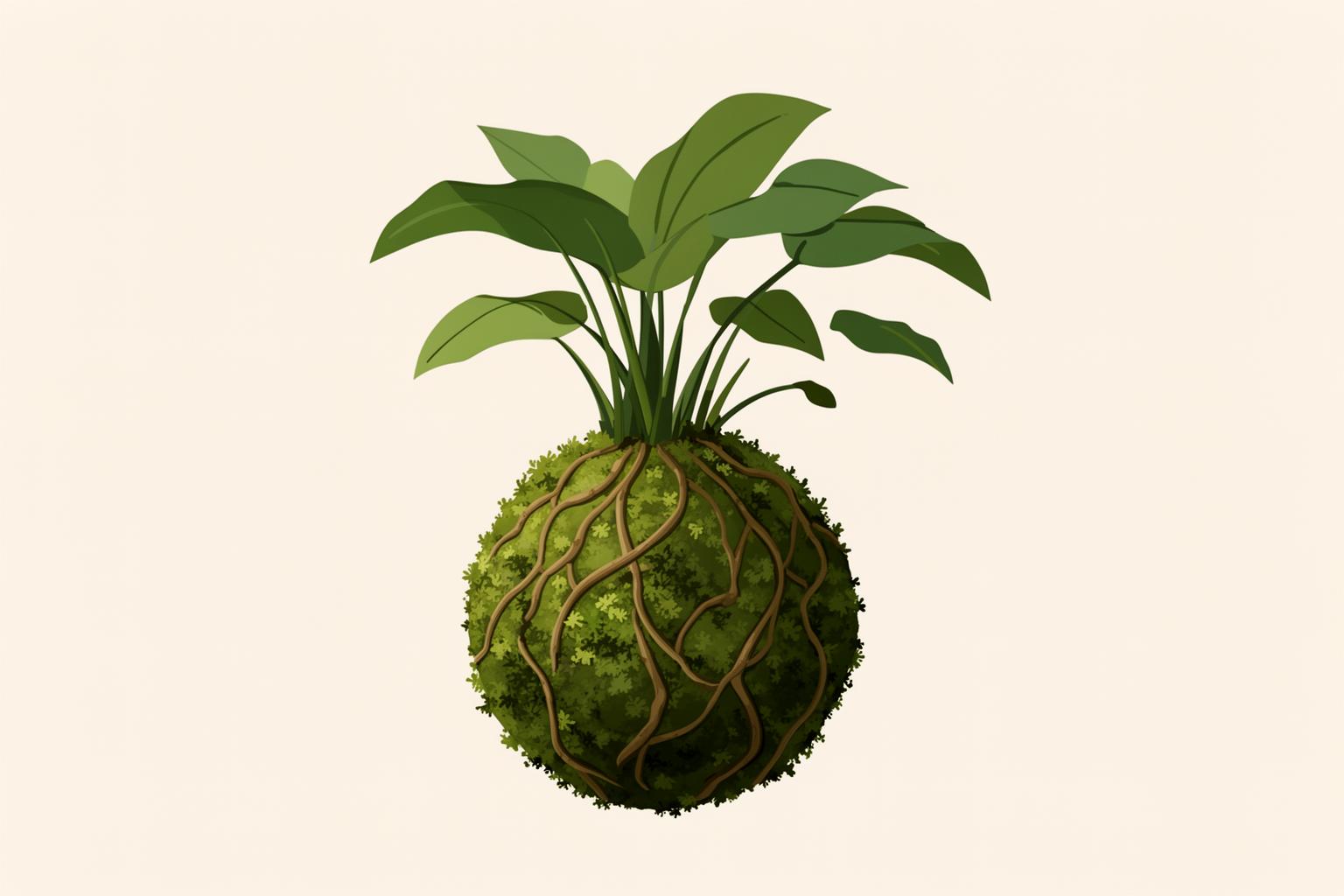
You’ve probably seen them, even if you didn’t know their name. A perfect, fuzzy green sphere of moss, cradling a plant whose roots are mysteriously contained within. Sometimes they sit on a simple ceramic dish. Other times they hang in the air, suspended by a single thread, slowly turning like a tiny, living planet. This is a kokedama (苔玉), which translates with beautiful simplicity to “moss ball.” But to call it just a moss ball is like calling a cathedral just a pile of stones. It misses the entire point.
In a world saturated with plastic pots and mass-produced home decor, the kokedama feels like a quiet rebellion. It’s a piece of the forest floor, carefully cultivated and brought into your home. It’s not just a container for a plant; it is the plant’s world. It breathes. It changes. It asks for a different kind of attention. Unlike a potted plant, which separates the cultivated from the wild with a ceramic or plastic barrier, a kokedama dissolves that boundary. The container is alive, an integral part of the whole.
So, what is this captivating object really about? It’s tempting to see it as just another aesthetic trend, another piece of Japan-inspired minimalism that looks good on social media. And while it certainly does look good, its roots run much deeper than a fleeting design fad. The kokedama is a physical manifestation of some of the most profound ideas in Japanese culture about nature, beauty, and our place within the world. It’s a living sculpture that carries the DNA of centuries-old artistic traditions like bonsai and ikebana, but presents them in a way that feels humble, accessible, and deeply personal. To understand the moss ball is to understand a particular way of seeing the world—one that finds beauty in imperfection, meaning in simplicity, and a universe in a handful of soil and moss.
Integrating natural elements into our daily rhythm can also help relieve modern stress, as seen in the benefits of shinrinyoku, which reveal a deeper connection to nature’s restorative power.
The Aesthetics of Imperfection: Wabi-Sabi in Moss Form
Before discussing the history or technique, we first need to consider the feeling that a kokedama evokes. It is quiet, unassuming, and deeply calming. It doesn’t demand attention. This feeling is closely connected to the Japanese aesthetic concept of wabi-sabi (侘寂), a worldview that is famously difficult to translate but crucial for understanding much of Japanese art and design. At its heart, wabi-sabi is about finding beauty in imperfection, impermanence, and incompleteness. It celebrates the modest, humble, and unconventional.
Embracing the Wabi-Sabi Worldview
A brand-new, perfectly symmetrical, machine-made object lacks wabi-sabi. Instead, it is the old, weathered wooden gate, the slightly irregular handmade tea bowl, and the rustling of dry leaves that embody this quality. Wabi-sabi values the natural cycle of growth, decay, and death. It recognizes life’s fleeting nature and finds a profound, melancholic beauty in that transience.
A kokedama is wabi-sabi brought to life. From the moment it is created, it begins to transform. The moss may show patches of brown or yellow. As you water it, its color shifts from a dry, pale green to a rich, vibrant emerald. Over time, the string binding it may age and change color. The plant itself grows, its leaves might be torn or nibbled by a pet, and eventually, it will die. A kokedama is not a fixed object of perfection; it represents a dynamic process. Its beauty lies in its subtle, ongoing evolution. Caring for one means engaging with this process, noticing the small changes, and valuing them as signs of life rather than imperfections.
The Power of Asymmetry and Simplicity
Western aesthetics have traditionally favored symmetry—the grand, balanced facades of Greco-Roman architecture, the meticulously arranged figures in Renaissance paintings. In contrast, traditional Japanese aesthetics often embrace asymmetry, reflecting a desire to mimic nature, which is rarely perfectly symmetrical. A tree branch rarely grows in a straight line, and a river rarely carves a perfectly geometric path.
The kokedama perfectly illustrates this principle. There is the simple, almost-perfect sphere of the moss ball, a man-made shape. But from this foundation emerges the organic, unpredictable growth of the plant. A fern will produce delicate, uneven fronds. An orchid may send out a single, arching stem of flowers. The contrast between the simple, contained moss ball and the free, asymmetrical life it supports gives the kokedama its visual energy and elegance. It is controlled wildness. The focus remains on the plant’s essence, stripped of any distractions. There is no ornate pot or decorative gravel. There is only the plant, its roots, the soil, and the moss holding it all together. This profound simplicity invites you to look more closely and appreciate the form of a single leaf or the texture of the moss itself.
A Living Link: Roots in Bonsai and Ikebana
Kokedama did not emerge out of nowhere. It is a contemporary offshoot of a long and rich tradition in Japanese horticultural arts. Its main predecessors are bonsai and ikebana, and understanding these reveals the thinking behind the creation of the moss ball.
The ‘Nearai’ Bonsai Connection
Most people imagine bonsai as a miniature, gnarled tree in a shallow ceramic pot. However, bonsai comes in many styles, one of which is called nearai (根洗い), meaning “root wash.” In the nearai style, a tree is cultivated for years in a pot. Once its root system becomes dense and strong enough to hold the soil together without the pot, it is removed and displayed on a flat slate or a special dish. The intricate, tangled network of roots becomes a central part of the aesthetic. You are not only seeing the tree itself but also its foundation and life force made visible.
Kokedama can be viewed as a folk-art, accessible version of nearai bonsai. It takes this fundamental idea—valuing the root ball itself—and simplifies it. Rather than waiting years for roots to strengthen, the soil is shaped manually into a ball and wrapped in moss. This democratizes the concept, allowing anyone to create a display that honors the whole plant system, from root to leaf. While a master’s nearai bonsai is the result of immense patience and skill, a kokedama offers a more immediate, hands-on connection to the same principle.
Ikebana’s Influence on Form and Space
Ikebana (生け花), the Japanese art of flower arrangement, is much more than simply placing flowers in a vase. It is a disciplined art form that harmonizes nature and humanity. Ikebana arrangements do not aim to create dense, colorful bouquets. Instead, they emphasize shape, line, and form. Crucially, ikebana masters regard the empty space around the flowers and branches as equally important as the elements themselves. This negative space is known as ma (間).
Ma is a fundamental concept in Japanese arts and can be translated as a gap, interval, or pause. It is the silence between musical notes that gives a melody its impact, the unpainted section of a scroll that focuses the image. Kokedama, especially when displayed suspended, perfectly embodies ma. The single green orb hangs in space, creating a focal point within the emptiness. The space around it becomes active, guiding the viewer’s eye to the object’s simple form. Even when set on a dish, a kokedama is usually displayed alone, commanding both the surface and its surrounding space. This is a direct inheritance from ikebana: the understanding that an object’s power is defined as much by the space it occupies as by the object itself.
More Than a Plant Pot: The Philosophy of the Sphere
Why choose a sphere? Why moss? The shape of the kokedama is intentional. It carries a profound cultural and philosophical significance that transforms it from a simple horticultural method into something deeper.
A Miniature Ecosystem
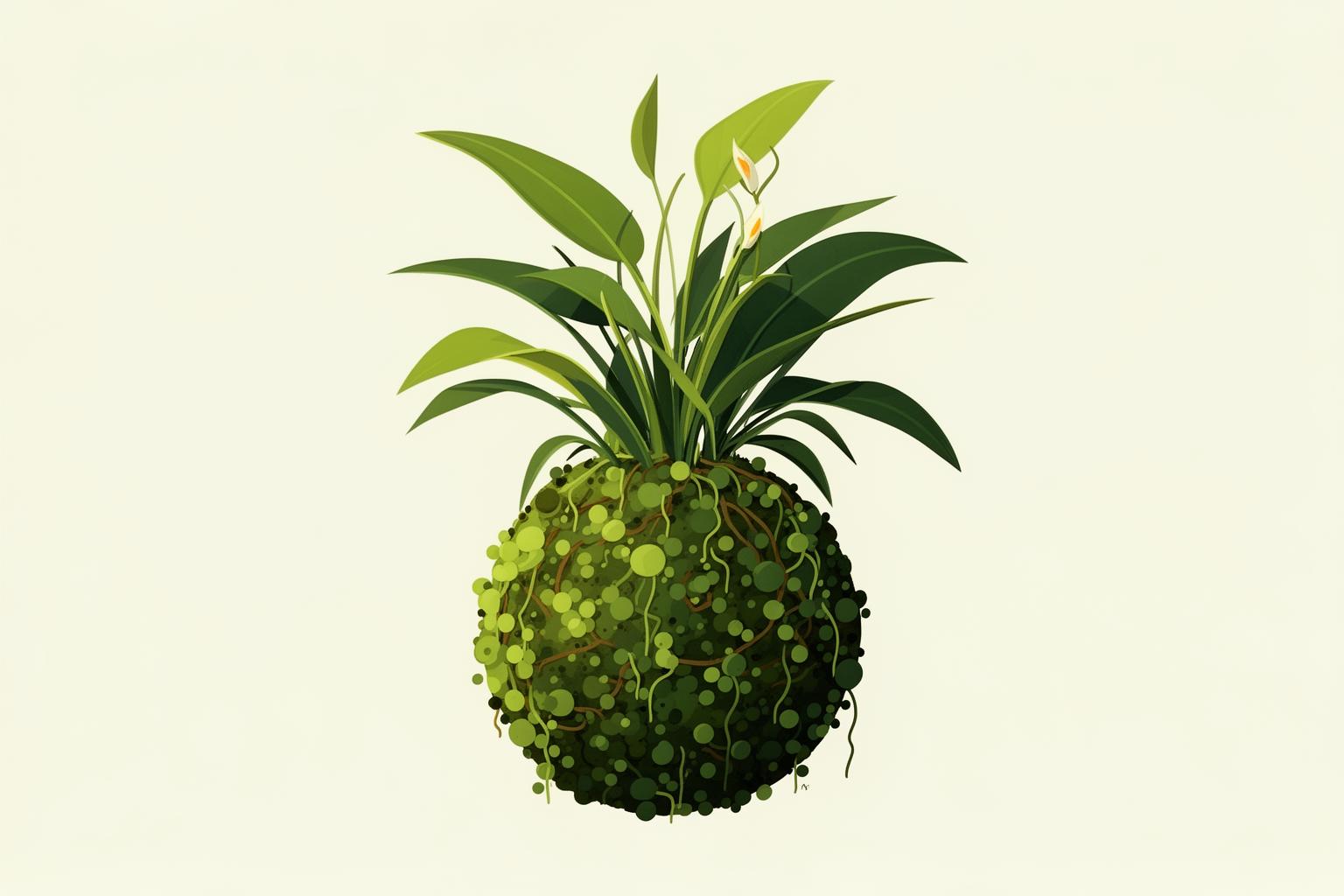
Central to the kokedama is the idea that it represents a complete, self-contained world. It’s like a tiny planet, a small landscape you can hold in your hands. The soil supplies nutrients, the plant grows toward the light, and the moss serves as a living, breathing skin. This green layer helps retain moisture, but it is also a plant itself. This concept of a small, self-sustaining ecosystem reflects a core aspect of the Japanese worldview, influenced by Shintoism, Japan’s native religion. Shintoism is animistic; it believes that kami (gods or spirits) inhabit all things, especially natural objects like ancient trees, unique rocks, waterfalls, and even moss. Thus, a kokedama is not merely a decorative item. It is a vessel for a tiny fragment of the living world, a microcosm of nature’s interconnectedness. It brings a concentrated piece of that sacred natural energy into the home.
Bringing Nature In, Respectfully
Japanese cities are famously crowded. For millions living in compact apartments in Tokyo or Osaka, having a private garden is an impossible luxury. The connection to nature, which is so fundamental in the culture, must be found in smaller, more personal forms. This is the environment in which arts like bonsai and kokedama flourish. They are not about controlling or conquering nature, but about welcoming a small part of it into your space and acting as its respectful caretaker. A kokedama on a windowsill quietly evokes the forest, serving as a living connection to the changing seasons. Its health reflects the indoor environment and the care given to it. It is a relationship, not just a possession.
The Act of Creation as Meditation
The act of creating a kokedama is as meaningful as the finished piece. It is a deeply tactile and meditative practice. The process begins by mixing different types of soil. A typical blend includes a heavy, clay-like black soil called keto, combined with a granular, porous soil like akadama. Water is gradually added, kneading the mixture until it reaches a dough-like consistency. Then, a small plant is gently cleaned at the roots, and the soil ball is carefully molded around them. The aim is to form a firm, compact sphere. Finally, fresh moss sheets are wrapped around the soil, holding the whole together with twine or thread. Each step demands focus and a delicate touch. There is the earthy scent of the soil, the cool dampness of the moss, and the repetitive, soothing motion of wrapping the string. For those moments, the outside world slips away. It’s just you, your hands, and these elemental materials. This process embodies mindfulness, grounding you in a simple, creative act. You are not merely making a plant pot; you are shaping a small world.
The Modern Kokedama: From Garden Center to Design Studio
While rooted in tradition, the kokedama is very much a part of contemporary Japanese life and has evolved into a global phenomenon. Its transformation from a niche horticultural art to an international design icon is a story unto itself.
A Global Phenomenon
In recent years, kokedama have surged in popularity across North America, Europe, and beyond. You can find DIY kits online, join workshops in trendy urban areas, and purchase pre-made moss balls in design boutiques and garden centers. This worldwide expansion highlights its universal appeal. Its minimalist style perfectly complements modern interior design trends, and its compact size makes it ideal for urban living. However, this rise in popularity has sometimes led to the kokedama losing some of its deeper cultural context. It is often presented merely as a “cool, potless plant,” a fun craft activity, without any reference to wabi-sabi, nearai bonsai, or the philosophy of ma. Though visually appealing, some of its essence gets lost in translation.
Kokedama in Japanese Urban Life
In Japan, the kokedama holds a more nuanced role. It is both traditional and thoroughly modern. You’ll find them in the serene, tatami-matted rooms of a traditional ryokan (inn) as well as hanging in stark, minimalist concrete cafes in Tokyo’s trendiest neighborhoods. They are embraced by high-end interior designers and sold in humble local flower shops. Their adaptability is their strength. They can add a rustic, natural warmth to a sleek, contemporary space or enhance the organic materials of a traditional Japanese home. For many young Japanese living in small urban apartments, a kokedama is the perfect green companion. It takes up little space but offers a strong visual and spiritual connection to nature.
Choosing Your Companion
The personality of a kokedama is almost entirely shaped by the plant it houses. The choice is personal, and different plants produce vastly different effects. Shade-loving ferns, with their delicate fronds, evoke a soft, lush, forest-like atmosphere. Small flowering plants such as miniature orchids or azaleas provide a seasonal burst of color. Aromatic herbs like rosemary or lavender can add an extra sensory layer. Even small, budding trees can be used to create a true mini-bonsai effect. The key is selecting a plant whose needs align with the environment you can offer. The relationship between the plant and its mossy abode is what makes each kokedama a unique, living work of art.
The Care and Keeping of a Small World

Living with a kokedama calls for a different mindset compared to caring for a typical houseplant. It requires a more intuitive and attentive connection. The care involved is a ritual that deepens the bond between the caretaker and this small piece of nature.
A Ritual of Attention
You don’t water a kokedama with a watering can. Instead, you give it a bath. The main approach is to submerge the moss ball in a bowl of water for several minutes until it is fully saturated and no longer releases air bubbles. Then, you lift it out, gently squeeze to remove excess water, and place it back on display. The essential part is knowing when to water it. The best way is by touch—you simply pick it up. When it feels light, it’s thirsty; when it feels heavy and dense, it’s hydrated. This simple, physical act of checking its weight creates a direct, tactile connection. It compels you to pay attention and learn the rhythm of your plant’s needs. Occasionally misting the moss, especially in dry indoor environments, helps keep the green surface lively. This regular, hands-on care becomes a small, peaceful ritual during the day, a moment to pause and focus on a living thing.
The Beauty of Aging
Over time, your kokedama will begin to tell a story—this embodies the wabi-sabi principle. A well-cared-for kokedama will not stay in a state of suspended perfection. The plant will grow, perhaps becoming slightly unruly. Roots might eventually poke through the moss ball, signaling vigorous life within. The moss may thin in places or be accompanied by other volunteer greenery. The string may eventually need replacing. These changes are not failures; they are the patina of age, the visible record of life unfolding. An aged kokedama, with weathered moss and a mature plant, holds a character and dignity that a new one cannot. It becomes a true companion, a small living sculpture sharing your space, your light, and your seasons.
A Universe in Your Palm
Ultimately, the modest kokedama holds great power precisely because of its simplicity. It is neither grand nor imposing, nor does it demand to be the center of attention. Instead, it extends a gentle invitation: to slow down, to observe more closely, and to appreciate the beauty found in the small and imperfect. It descends from rich artistic and philosophical traditions, yet it carries this heritage with subtlety. It is a design object that feels both timeless and thoroughly modern.
Holding a kokedama in your hands is like holding a distilled worldview. It reminds us that even the most complex systems arise from the simplest elements: soil, water, moss, and life. It brings a piece of the natural world indoors, serving as a quiet companion that connects you to nature’s rhythms. In our noisy, fast-paced, and often detached world, the kokedama is more than just a plant encased in a moss ball. It is a silent teacher, a focus for meditation, and a small, green, living universe resting in the palm of your hand.