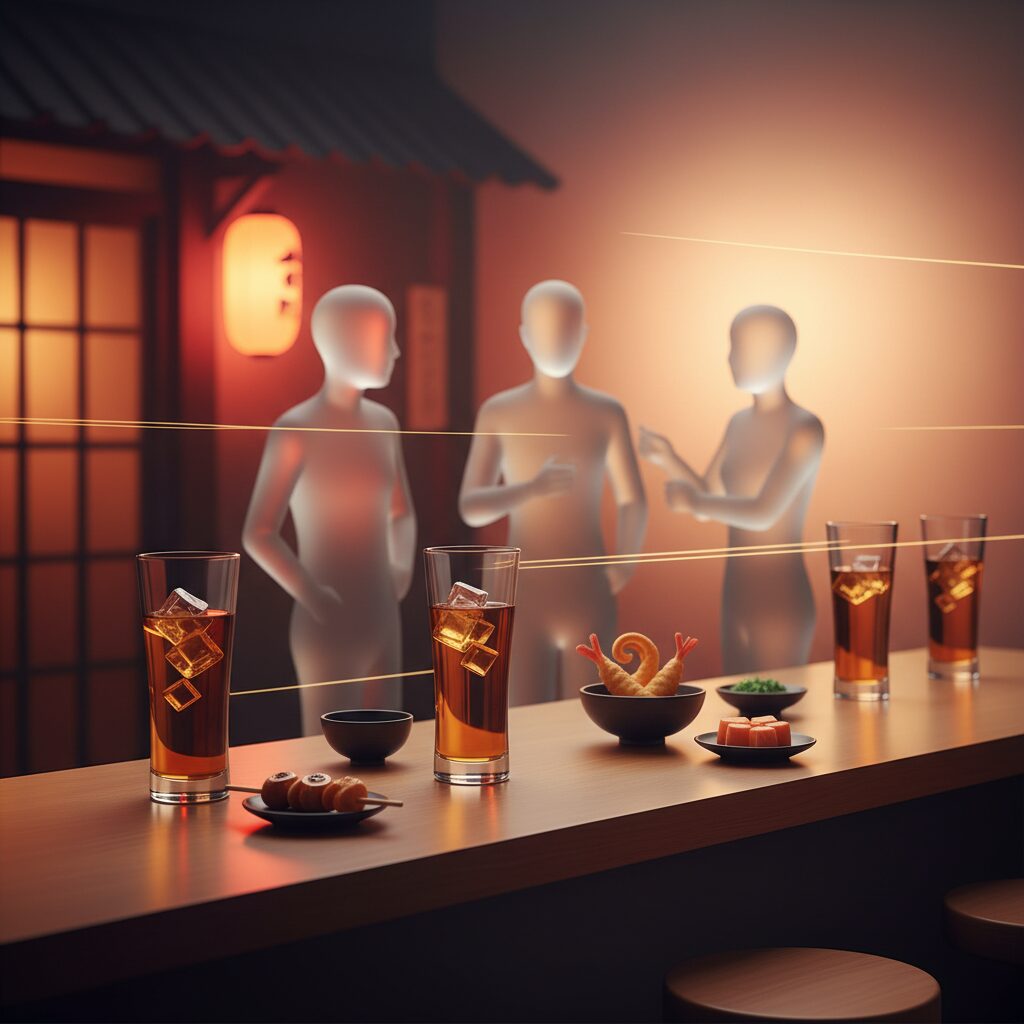
You see them tucked under railway arches, spilling warm light onto rainy sidewalks, or squeezed into the ground floor of a nondescript office building. They are little more than a counter, a cook, and a crowd. From the outside, a Japanese tachinomi, or standing bar, looks like a curious form of self-punishment. After a ten-hour day hunched over a desk, navigating the intricate social minefield of a corporate office, why on earth would anyone choose to spend their evening on their feet, pressed shoulder-to-shoulder with strangers? It seems to defy all logic. In a culture renowned for its pursuit of comfort and meticulous design, the standing bar feels like a deliberate, almost aggressive, rejection of it.
But that’s because we’re asking the wrong question. The point of a tachinomi isn’t to find comfort. The point is to find release. This isn’t a place you go to settle in; it’s a place you go to transition out. For countless Japanese office workers, that sliver of counter space, that single glass of beer, and the very act of remaining upright is not an inconvenience—it’s a crucial, carefully calibrated social and psychological reset. It’s a pressure valve for a society that runs on high pressure. To understand the tachinomi, you have to understand that its greatest feature isn’t what it offers, but what it deliberately withholds: a chair. And in that absence, a unique form of freedom is found.
This drive to transform everyday pressures into a brief, electrifying communal escape also finds expression in the frenetic energy of pachinko parlors, where the randomness of chance becomes a shared ritual in modern Japan.
A Deliberate Discomfort: The Psychology of Standing
To truly understand the essence of the tachinomi, you must first shed the Western concept of a bar. It’s not a lounge, nor a place meant for long, meandering conversations. Rather, it serves as a liminal space—a human loading dock between the structured demands of work and the private comfort of home. The act of standing is the essential key that marks this transition.
The Anti-Lounge
Consider the sensation of sinking into a plush barstool or cozy booth: your body relaxes, your posture softens, and you signal to yourself and others that you’re settling in for a lengthy stay. The tachinomi is specifically designed to avoid this. Standing keeps you mildly alert; your muscles engaged, your posture active, and you remain subconsciously aware that your time is limited. You can’t get too comfortable, and that’s entirely intentional.
This enforced transience serves as a crucial buffer. The Japanese workday is ruled by strict schedules and an unspoken code of social obligations. The most dreaded among them is the nomikai, the official company drinking party. At a nomikai, seating is arranged by rank, you’re expected to pour drinks for your superiors, and you must play the loyal employee even after hours. It’s an extension of the office, just with more alcohol. The tachinomi counters this dynamic. By standing, you physically assert your independence. This is your time, however brief. You aren’t settling in for another work-related chapter; you’re grabbing a moment of respite before heading home. It’s a pit stop for the soul, not a parking spot.
The Great Equalizer
Japanese corporate culture is a model of hierarchy. Meeting room seating arrangements function as a political map, the depth of a bow reveals status, and language shifts depending on whether you’re addressing a senior (senpai) or a junior (kohai). This vertical structure shapes the workday, generating a constant, low-level performance anxiety.
Step into a tachinomi, and all that dissolves. When everyone stands at a narrow counter, there’s no head of the table, no seat of power. The department manager (bucho) and the newly hired graduate are simply two people on the same level, both trying to catch the bartender’s eye. The physical space flattens the social hierarchy. This subtle yet powerful effect cannot be overstated. It fosters a type of interaction nearly impossible within the formal confines of the office or a seated izakaya.
Strangers strike up conversations—a rare phenomenon in many other Japanese social environments. People chat about the food, the flickering news on the small television, or the quality of the sake. These are fleeting, low-stakes connections, free from the weight of professional identity. For that brief half hour, you’re not your job title. You are simply a person, standing, sharing a small space and a common need for a drink and a moment of calm. The standing posture is the uniform of this temporary, egalitarian tribe.
The Architecture of Fleeting Connection
The physical design of a tachinomi exemplifies social engineering, thoughtfully constructed to promote quick turnover and seamless interaction. The layout itself shapes the behavior within, reinforcing its function as a temporary gathering spot.
Designed for Transience
Most tachinomi are very small, often consisting of little more than a single counter separating customers from the kitchen. No space is wasted. The narrowness creates a certain closeness, but the absence of seating prevents lingering. Everything is aimed at efficiency. You order, receive your drink and snack almost instantly, consume, and leave. The flow remains uninterrupted.
This design has deep historical origins. The concept began in the Edo period (1603-1868) as stalls selling sake to busy laborers and merchants who stopped briefly for an inexpensive drink before moving on. It was the original fast-food model, designed for a society on the go. That legacy of speed and practicality endures today. The high turnover benefits the owner’s profits, of course, but it also fulfills an important social role. It ensures the space stays lively and prevents any single group from monopolizing it for the evening. When you enter a tachinomi, you are not intruding; you are simply becoming part of a constantly moving stream of people.
The Porous Boundary
Many tachinomi feature an open-front design, sometimes only protected by vinyl strips from the cold. They often extend directly onto the sidewalk. This architectural choice is brilliant because it lowers the barrier to entry nearly to zero. You don’t need to push open a heavy door and commit to entering a quiet, seated room. Instead, you can briefly stop on your way to the station, assess the atmosphere from outside, and slip into an open spot at the counter.
This accessibility is a blessing for the solo drinker, a frequent sight in Japan. It eliminates the social anxiety associated with requesting a table for one. At a tachinomi, being alone is normal, not unusual. The commitment is minimal. You can have a single beer and a skewer of chicken and be on your way in fifteen minutes with no questions asked. There’s no awkwardness about occupying a table, no pressure to order more, and no drawn-out ritual of asking for the bill. Often, you pay as you go by placing money on a small tray at the counter. This effortless experience offers a welcome break from the highly structured and often demanding social customs that shape much of Japanese life.
From Edo-Era Fast Food to Salaryman Sanctuary
The modern tachinomi is not a recent invention; rather, it is a reinterpretation of a very old concept designed to address a very contemporary issue. Its development aligns precisely with the social and economic history of urban Japan, firmly establishing it as a vital part of city life.
A Quick History Lesson
As noted, the earliest standing bars appeared during the Edo period. In a bustling, tightly packed city like Edo (modern-day Tokyo), efficiency was essential. Local sake shops began selling drinks by the measure, allowing customers to drink on-site. These were functional, no-frills establishments catering to working-class men. They were not intended for leisure but for delivering a quick, affordable buzz. Gradually, simple snacks were added to the menu, forming the basic format still seen today.
The Rise of the Salaryman
The tachinomi truly flourished during Japan’s post-war economic boom. As the nation transformed into an industrial giant, a new kind of worker appeared: the sarariman, or salaryman. These white-collar workers were the driving force of the new economy, characterized by their loyalty to a single company, their dark suits, and their grueling long hours.
This demanding corporate environment created a significant need for a third space—a place that was neither the strict office nor the distant home. Commutes were long, and the pressure to conform was intense. The tachinomi, conveniently located in and around major train stations, fit this need perfectly. It became an informal decompression zone where a man could shed the rigid facade of his job, enjoy a quick, inexpensive drink to relieve the day’s stress, and mentally prepare for the long trip home. It offered a moment of genuine, unfiltered self-care before returning to domestic duties.
The Ritual of the Reset: What Actually Happens Inside
For those unfamiliar, the chaotic energy of a crowded tachinomi can feel overwhelming. Yet beneath the surface lies a simple, unspoken ritual—a streamlined routine crafted for maximum efficiency and minimal social friction.
The Menu: Simple, Fast, and Effective
Don’t expect an elaborate cocktail menu bound in leather. The offerings at a traditional tachinomi are sharply efficient. The drink selection is typically dominated by draft beer (nama biiru), highballs (haibōru), inexpensive sake (koppu-zake), and shochu highballs known as chūhai. These drinks can be prepared in seconds.
The food, called otsumami, follows the same straightforward approach. It is meant to be salty, flavorful, and easy to eat while standing. Think grilled chicken skewers (yakitori), stewed beef tendon (doteyaki), salted edamame, chilled tofu, or potato salad. These items are often prepared ahead of time and sit in large trays on the counter, ready to be served instantly. The goal is not a gourmet experience, but to offer a savory, satisfying complement to the alcohol, grounding the drinker and buffering its effects. The simplicity is intentional. It removes the mental effort of decision-making, allowing for a more immediate and instinctive satisfaction.
The Unspoken Etiquette
Though the atmosphere is casual, a subtle etiquette governs the tachinomi. It is a dance of collective spatial awareness. You find a spot and avoid taking up more than your shoulder-width share of the counter. Your bag stays at your feet, never on the counter. Ordering is quick and straightforward. In many places, a cash-on-delivery system (kyasshu on deribarī) prevails, where you place your money in a small tray and the bartender collects payment for each item as it’s served. This removes the hassle of splitting a bill at the end.
There’s an unspoken understanding that everyone is there for the same reason: a quick, no-fuss escape. You are courteous to those nearby, perhaps exchanging a nod, but deep conversation is not expected. You tidy up after yourself, placing empty glasses and plates on the upper level of the counter. The system relies on mutual, silent respect for the shared purpose of the space. This quiet, collective mindfulness is, in its own way, deeply reassuring.
Ultimately, the tachinomi stands as one of the most honest social spaces in Japan. It strips away pretense. It’s not about impressing a date, networking with colleagues, or displaying social status. It is a profoundly functional and deeply human institution, designed solely to offer a brief respite from the relentless pace of modern life.
The act of standing is not a drawback; it is the core of the experience. It embodies the mental state the tachinomi aims to foster: a presence that is temporary, connected yet uncommitted, relaxed yet ready to move on. As the salaryman finishes his final sip, sets his empty glass on the counter, and blends back into the city’s bustling crowds, he has subtly changed. The burden of the workday has been momentarily lifted. He has been recalibrated. For just a few hundred yen and fifteen minutes, he has performed a small but essential ritual of restoration, one upright drink at a time.