You asked me why, in a country as famously expensive as Japan, you can walk into a certain kind of coffee shop, order a single cup of coffee, and be presented with what is essentially a free breakfast. It’s a good question. It seems to violate a fundamental rule of business: you don’t give things away. But the Japanese “Morning Service,” or mōningu sābisu as it’s known, isn’t really about business in the modern, transactional sense. It’s about something older and much more interesting. It’s a daily ritual, a quiet handshake between a shop and its neighborhood, and a window into a side of Japan that runs on connection rather than pure commerce.
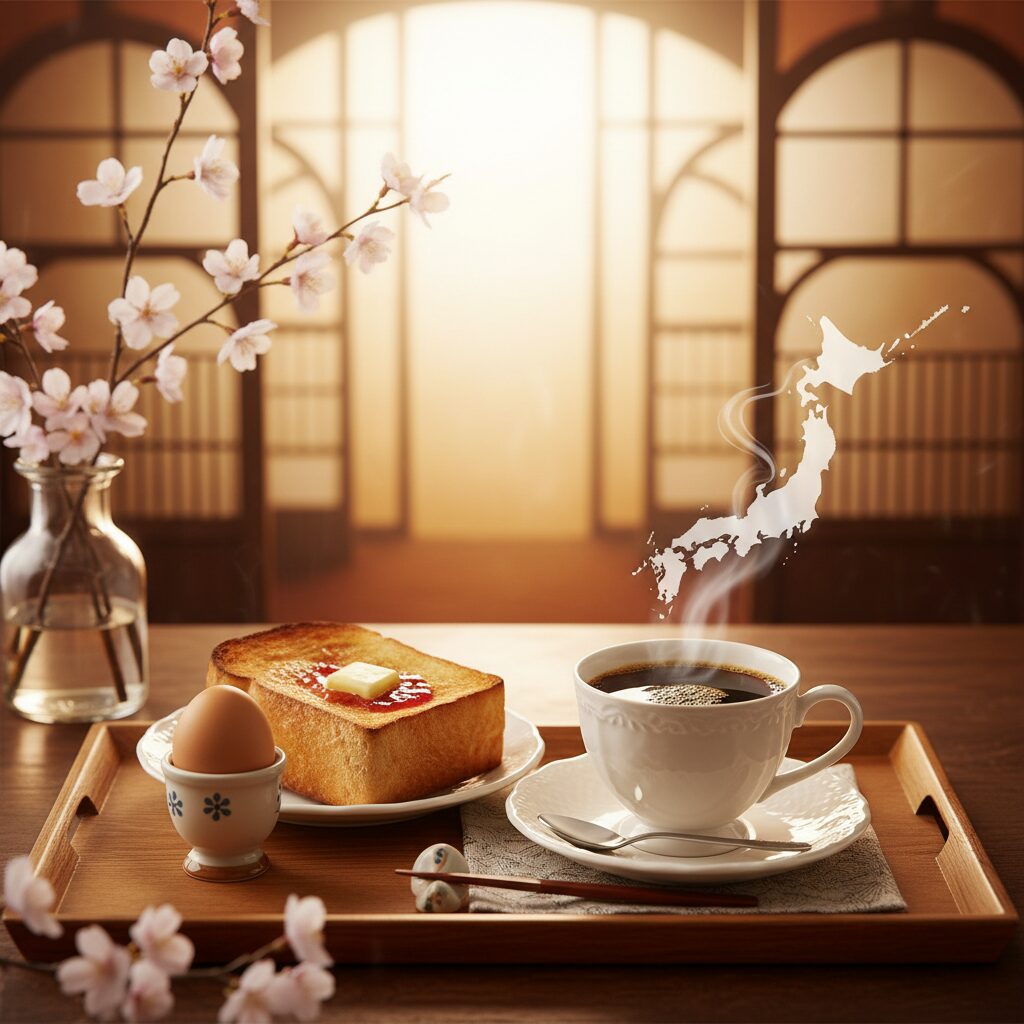
To find it, you have to step away from the gleaming, efficient chain cafes with their globally standardized menus and into a kissaten. These are Japan’s traditional coffee houses, sanctuaries of dark wood, worn velvet, and the rich, enveloping aroma of slow-dripped coffee. They are time capsules from the Showa Era (1926-1989), places where the clock seems to tick a little slower. It is here, between the hours of roughly 7 AM and 11 AM, that this small economic miracle takes place. You order a ¥500 coffee, and alongside it arrives a complimentary platter: a thick slice of toasted milk bread, a hard-boiled egg, and perhaps a small salad. It’s not a gimmick. It’s a cornerstone of the entire enterprise. To understand the “why” behind it, you have to understand the role the kissaten plays not just as a business, but as a vital piece of community infrastructure.
These intimate kissaten, with their enduring community spirit, mirror the time-honored practices of Shinto rituals that bind local traditions and daily life together.
The Anatomy of a Morning Set
Before diving into the history, it’s important to appreciate the quiet perfection of the Morning Service itself. While there are many variations, the classic set is a study in humble, satisfying elements that work together harmoniously. It’s a meal designed not to overwhelm but to gently begin the day.
The Coffee: The Heart of the Matter
The coffee is the price of admission. It’s what you’re truly paying for, and in a proper kissaten, it’s treated with great reverence. This isn’t the burnt, mass-produced espresso you grab on the go. Instead, it’s often siphon or flannel-drip coffee, prepared with careful precision by the shop’s owner, known as the “Master.” The process is a performance in itself: the bubbling water, the careful stirring, the slow, fragrant descent of the brew. The resulting cup is typically smooth, low in acidity, and richly flavorful. It invites you to sit, to linger, to read the newspaper often provided on a wooden rack. It sets the rhythm for the entire experience, which is slow, deliberate, and calm.
The Toast: A Pillar of Comfort
The highlight of the food plate is almost always the toast. This is no flimsy, pre-sliced supermarket bread. It’s a gloriously thick slice of shokupan, Japanese milk bread, often cut an inch thick or more. Shokupan boasts a uniquely soft, fluffy, and slightly sweet crumb, with a texture both pillowy and substantial. When toasted, the exterior turns a perfect golden-brown, offering a satisfying crispness that yields to a warm, steamy interior. It usually arrives pre-buttered, the butter melting into every crevice, or sometimes with small packets of jam or Ogura-an, a sweet red bean paste particularly popular in the Nagoya region, the undisputed heartland of Morning Service culture.
The Egg: A Simple, Perfect Protein
The third component of the trinity is the humble yude tamago, or hard-boiled egg. It typically comes warm, nestled in a small dish, its shell intact. There’s a small, satisfying ritual in gently tapping it on the table, peeling away the shell, and sprinkling it with the tiny pinch of salt provided. It’s a simple, unadorned serving of protein. Some places might offer a small, freshly made tamagoyaki (rolled omelet) or a scoop of egg salad, but the classic boiled egg remains the standard. Its simplicity is its strength; a clean, straightforward start to the day that complements the richness of the toast and the complexity of the coffee.
A Delicious Piece of Post-War History
The origin of this generous tradition is a source of local pride and debate, but most accounts trace it back to the post-war boom of the 1950s. The most widely recognized birthplace is Ichinomiya, a city in Aichi Prefecture that was a flourishing hub for the textile industry. Factory workers and businessmen held their meetings and breaks at local kissaten. According to the story, one particular shop owner, as a gesture of gratitude—a small act of sābisu (service) for his loyal customers—began offering a few peanuts and a hard-boiled egg with their morning coffee. It was a simple, inexpensive way to express thanks and make his regular patrons feel appreciated.
The idea quickly caught on. Rival shops soon followed, and the offerings grew more elaborate. Toast was added, then small salads, then fruit. It wasn’t charity; it was a clever and distinctly Japanese form of marketing. The Morning Service turned the kissaten from a place visited occasionally into a daily essential. It became the default starting point for numerous workers, retirees, and locals.
This business model is known as a loss leader. The shop might break even or even take a slight loss on the food, but it guarantees a steady flow of customers from the moment the doors open. Those customers build a relationship with the Master and the space. They might stay for a second cup of coffee, return for a pricey sandwich at lunch, or use the shop as their regular meeting spot. The “free” breakfast wasn’t the product; it was the invitation. It was an investment in loyalty, fostering a community of regulars who became the foundation of the business. This strategy thrived in an era of lifetime employment and neighborhood stability, where daily routines were predictable and consistent.
The Kissaten as a Community Living Room
To truly understand the significance of the Morning Service, you must stop viewing the kissaten as merely a café. In a country where homes tend to be small and private life is carefully separated from public life, the kissaten serves as an essential “third place.” It offers an accessible, comfortable, semi-private environment that is neither home nor work. It acts as a neighborhood living room where people can quietly share the presence of others.
For many elderly Japanese who may live alone, their morning visit to the local kissaten represents the most meaningful social interaction of the day. They are more than just customers; they are members. The Master knows their names, their usual orders, and how they are feeling. The Morning Service is a gesture of care, a dependable and comforting constant in their daily routine. It conveys, “Welcome back. We’re here for you. Begin your day with us.” You might find them reading the paper, softly chatting with the Master or fellow regulars, or simply observing the world from a favorite seat.
This ritual also benefits the sararīman, or office worker. Before stepping into the structured demands of the corporate world, the kissaten provides a moment of peaceful solitude. It’s a place to mentally prepare for the day, catch up on financial news, and enjoy a simple, wholesome meal without any hassle. The Morning Service supplies the nourishment, while the atmosphere creates a necessary buffer between the private space of home and the taxing world of the office.
The Master is the cornerstone of this entire ecosystem. Often a quiet, dignified figure who has managed the shop for decades, they curate the space and maintain its social fabric. They are the steady presence on which regular patrons depend. Their presence is as reassuring as the coffee they brew. The Morning Service is their daily act of opening their “home” to the neighborhood, a consistent expression of hospitality, or omotenashi.
Ritual vs. Transaction
The contemporary, globalized coffee chains operate on a fundamentally different philosophy. Starbucks, Tully’s, and similar brands prioritize speed, efficiency, and scalability. The experience is purely transactional: you place your order, pay, receive your product, and leave. The aim is to move customers through the line as quickly as possible. Seating is typically designed for brief visits, not extended stays. This model serves a purpose but remains essentially anonymous.
In contrast, the kissaten and its Morning Service offer the opposite approach. Their value isn’t convenience; it’s comfort. It’s not about a quick caffeine fix; it’s about the ritual of beginning your day slowly and deliberately. The generosity of the complimentary breakfast signals that you are invited to stay. This shifts the interaction from a mere purchase to a quiet participation in a community. You are not just a consumer; you are a guest. The price of your coffee provides not only a drink and a meal but also a place at the table—a fleeting sense of belonging in a peaceful, stable setting.
This is why many kissaten feel like they belong to another era. The dark wood, subdued lighting, and soft classical or jazz music all work together to create a refuge from the hectic pace of modern life. The Morning Service is the daily key that unlocks this sanctuary. It serves as an anchor of civility and tranquility in a world that often seems to lack both.
An Enduring Tradition in a Changing World
It’s true that the classic Showa-era kissaten are becoming a rare sight. The original generation of Masters is retiring, and their children often show little interest in inheriting the demanding, low-profit business. Cities are evolving, and fierce competition from polished, well-funded chain cafés makes survival tough for these small, independent shops. With every beloved neighborhood kissaten that closes its doors forever, a piece of local history disappears.
Yet, the spirit of the Morning Service remains surprisingly resilient. A new generation, nostalgic for the aesthetics and ambience of the Showa era, has started opening “neo-kissaten.” These places may offer slightly updated menus, use single-origin beans, or feature more modern designs, but they deliberately uphold the core principles of the originals. They realize that the charm was never just about the coffee or the décor; it was about the atmosphere and the sense of community cultivated there. Many proudly continue the tradition of the Morning Service, seeing it as the ultimate emblem of hospitality.
Moreover, the concept has been so well-received that it has been embraced and adapted by larger chains, especially in its birthplace around Nagoya. Chains like Komeda’s Coffee have built a nationwide empire on the foundation of the Morning Service, showing that the demand for this kind of value and comfort goes far beyond small, independent cafés. While the experience might be more standardized, the essential principle remains: order a coffee, and the toast and egg come with it.
So, the next time you find yourself in Japan early in the day, look for a place with a spinning barber pole sign and the subtle, sweet scent of coffee and toast. Step inside, sink into a deep velvet chair, and order a “Morning Set.” As the Master sets the simple, perfect meal before you, you’ll realize you’re partaking in something far more than just a bargain breakfast. You’re engaging in a ritual of community, a small but powerful legacy of post-war optimism, and a testament to the idea that the best things in life aren’t always reflected in a balance sheet. You’re not merely buying a cup of coffee. You’re buying a moment of peace. And that has always been worth paying for.