You’ve probably seen the images. Towering infernos lighting up a snowy night, men in traditional loincloths carrying massive, flaming torches through crowded streets, or giant characters of fire blazing on a mountainside. It’s spectacular, chaotic, and from an outsider’s perspective, perhaps a little insane. You see this and you have to wonder: what is going on here? Why this deep, primal connection to fire in a country so often associated with quiet temples, serene gardens, and meticulous order?
The answer is anything but simple, and it cuts to the very core of the Japanese spiritual landscape. These events, known as Hi Matsuri (Fire Festivals), are not tourist spectacles, though tourists are often welcome to watch. They are not historical reenactments. They are living, breathing rituals, some of the most potent and visceral expressions of faith you will ever witness. They are a direct confrontation with one of nature’s most powerful and ambivalent forces. Fire is a paradox: it gives warmth and light, it cooks food, it forges steel. It also consumes, destroys, and reduces everything to ash. In Japan, this duality isn’t just acknowledged; it’s embraced, channeled, and revered as a fundamental tool for engaging with the divine, purifying the community, and marking the passage of time.
To understand these festivals, you have to set aside the modern, sanitized view of religion as a quiet, indoor activity. This is something older, louder, and far more dangerous. It’s a physical conversation with the gods, held in a language of heat, smoke, and courage. It’s about facing the raw, untamable power of the universe and finding your place within it, not by conquering it, but by honoring it. So, let’s get closer to the flames and feel the heat, because only then can you start to understand the mindset that drives thousands of people to dance with fire every year.
The fire festivals embody a raw encounter with elemental forces, yet Japan’s appreciation for nature’s contrasting moods is also expressed in celebrating the bitterness of spring, where even the austere chill of winter gives way to transformative seasonal rituals.
The Sacred Element: Fire in Japanese Spirituality
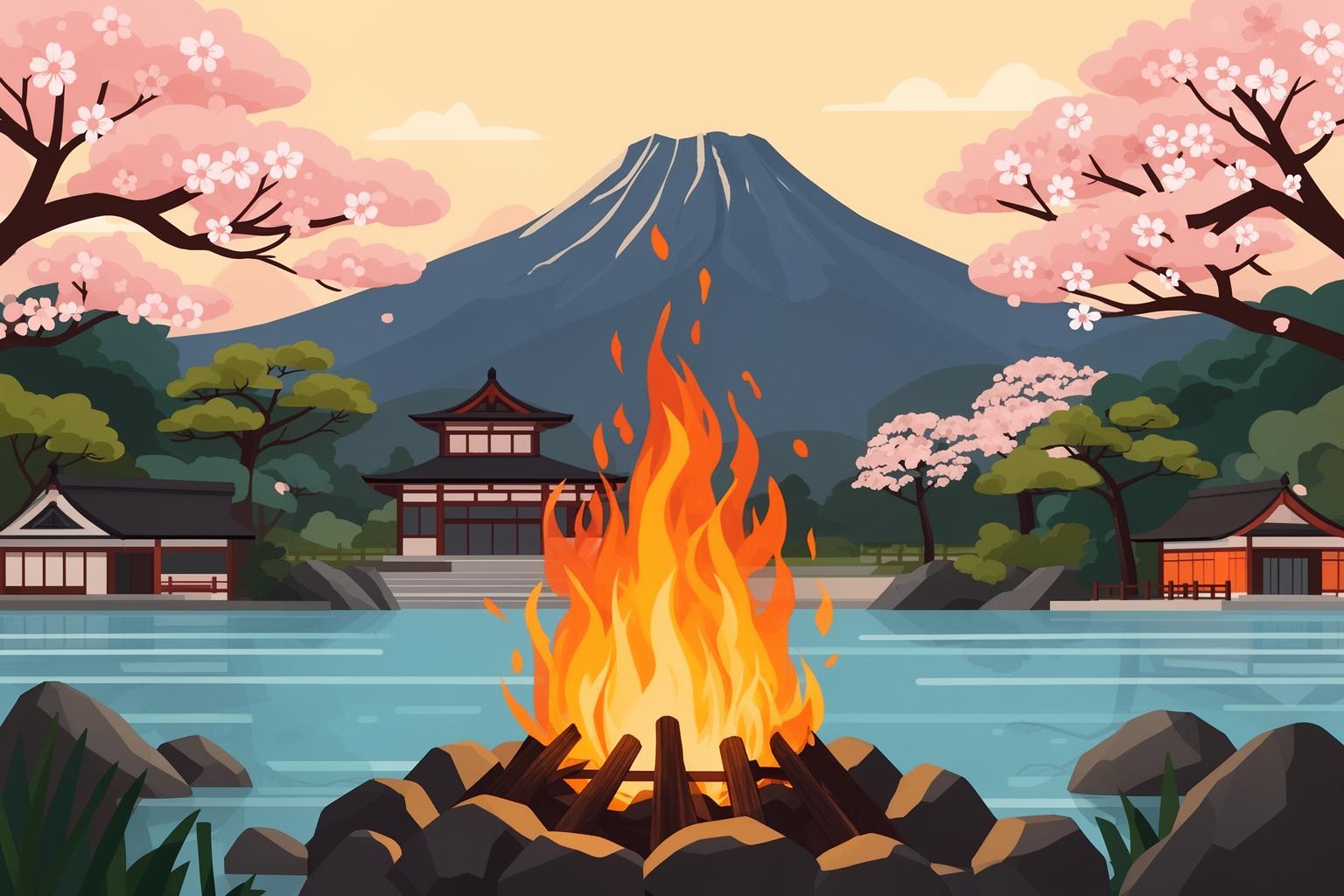
Before a single torch is lit, it’s essential to understand what fire symbolizes in the cultural foundation of Japan. It is more than just a chemical reaction; it acts as a living spiritual force. Its importance is intricately woven into the two major spiritual traditions that shape Japanese life: Shinto, the indigenous animistic religion, and Buddhism, introduced from the continent over 1,500 years ago.
Purification and Renewal (O-harai)
Central to Shinto is the idea of purity (kiyome) and impurity (kegare). Kegare is not sin in the Western sense; rather, it is a form of spiritual pollution or defilement that accumulates through encounters with death, illness, bloodshed, or even the everyday strains and negative emotions of life. If left unaddressed, it can bring bad luck, misfortune, and stagnation to an individual or a community. To restore harmony and fortune, kegare must be purified through a ritual cleansing known as o-harai.
Water is a common purifying element—consider the water basins found at the entrance of every shrine—but fire holds the greatest power. Its transformative energy does not merely cleanse impurity; it completely annihilates it. Fire burns away the misfortune of the past year, lingering resentments, and invisible spiritual tarnish. When you observe old talismans, good luck charms (omamori), and New Year’s decorations being thrown into a vast bonfire at a shrine in mid-January (dondoyaki), you are witnessing a communal form of o-harai. Participants are not just discarding old items; they are deliberately releasing the accumulated kegare of the previous twelve months, creating a pure, fresh start for the year ahead. The ascending smoke carries away the negativity, and the community renews itself. This belief is fundamental and explains why many fire festivals are held at significant calendar moments, such as the New Year or seasonal transitions.
A Conduit to the Gods (Kami)
In Shinto, the natural world is inhabited by countless gods, or kami—spirits residing in everything from mountains and rivers to trees and majestic rocks. Festivals (matsuri) serve as occasions for communication between the human world and the realm of the kami. Fire is one of the most potent means of communication.
The towering flames of a festival bonfire act as a beacon, a sacred landmark that draws the attention of the kami and invites them to descend to the festival grounds. The light cuts through the darkness, establishing a temporary sacred space where the divine can be present among humans. The smoke, especially that produced by burning sacred woods like cedar or cypress, is regarded as a physical messenger carrying the prayers, hopes, and gratitude of the community to the heavens. It is a fragrant offering and a direct connection to the divine.
In some esoteric Buddhist practices, this connection is even more pronounced. The goma fire ritual involves a priest chanting sutras while making offerings of wood, incense, and grains into a consecrated fire. The fire becomes a manifestation of a powerful deity, consuming the offerings and symbolically burning away the negative karma and worldly desires of the worshippers. The fire acts both as a destructive force, eliminating delusion, and a creative one, transforming prayers into blessings.
Primal Force of Nature
Japan is a land shaped by nature’s violent forces. Positioned on the Pacific Ring of Fire, it is a region defined by volcanoes, shaken by earthquakes, and battered by typhoons. This constant proximity to overwhelming natural powers has fostered a profound respect, bordering on awe and fear, for the untamable elements of the world. Nature is not something to be conquered or paved over; rather, it is something to be appeased, honored, and harmonized with.
Fire festivals directly express this worldview. They acknowledge and engage with a force far beyond human control. By ritualizing fire and courageously interacting with it within a structured traditional setting, communities do not seek to dominate fire. Instead, they show reverence for its power, seek its favor, and channel its destructive energy toward a positive, purifying result. It is a bold act of balancing on the edge between veneration and chaos, a deep recognition that humanity is part of nature, not separate from it.
A Calendar of Flames: Major Fire Festivals Across Japan
While the fundamental principles of purification and communication with the gods are universal, they take shape in an astonishing variety of rituals throughout the country. Each festival boasts its own distinctive history, local character, and specific intent. These are not interchangeable events but deeply meaningful expressions of a community’s identity and faith.
Nozawa Onsen Dosojin Matsuri: A Rite of Passage
Picture a small, snow-blanketed village tucked away in the mountains of Nagano. It’s the dead of winter, January 15th, and the air is piercingly cold. In the center of an open field stands a massive wooden structure, a temporary shrine or shaden, painstakingly built by the village men over several days. It is a masterpiece destined to be destroyed. As night falls, the village’s men aged 25 and 42 take their places. The 42-year-olds sit atop the shrine, singing and chanting, while the 25-year-olds form a protective circle at its base. These ages mark their yakudoshi, or unlucky years, and this ritual serves as their trial by fire.
Then, the rest of the villagers launch their assault. Carrying flaming torches fashioned from bundled reeds, they storm the shaden to set it aflame. The 25-year-olds at the base fiercely defend it, wielding pine branches to beat back the torches and attackers. It is a scene of exquisite, chaotic beauty. The night bursts with sparks, the roar of yelling men, the scent of burning reeds and sake, and the fierce heat of flames against the cold snow. This battle continues for hours, a genuine, unscripted clash.
What you see is not a reckless fight. It is a complex ritual. A rite of passage proving the strength and endurance of those in their yakudoshi years, purifying them of misfortune through trial. It is a prayer for a bountiful harvest and the health of the village’s children. Most importantly, it is a powerful act of community solidarity. Eventually, the defenders yield, and the shaden bursts into flame, casting a brilliant light across the valley. Together, the community has faced the fire and emerged stronger.
Kurama Fire Festival (Kurama no Hi Matsuri): Welcoming the Divine
Travel south to the mountains north of Kyoto on the evening of October 22nd, and you will encounter a different fiery energy. The Kurama Fire Festival is less of a battle and more of a procession, yet equally intense. It commemorates the transfer of the Yuki-jinja Shrine’s deity to the village of Kurama in the 10th century. The event reenacts the villagers welcoming the kami with torchlight.
As darkness falls over the mountain town’s narrow streets, small bonfires (kagaribi) are lit before each house. Then the procession begins. First come the children, carrying small, manageable torches, followed by teenagers and then the men, whose torches grow larger. The principal participants bear enormous pine torches (taimatsu) weighing over 80 kilograms, showering spectators with sparks. Dressed in traditional loincloths and braided rope skirts, the men strain under the load, chanting rhythmically: “Sairee, sairyo“, a local invocation for a successful festival.
Smoke thickens the air and the heat intensifies as hundreds of torches converge at the main shrine. The atmosphere is ancient and otherworldly. Here, fire is a jubilant welcome, a radiant display honoring the approaching deity. It lights the gods’ path and showcases the community’s devotion and physical endurance. This is a potent, mobile expression of faith, transforming the entire village into a flowing river of fire.
Nachi no Ogi Matsuri: The Waterfall’s Fiery Ablution
In the verdant, sacred Kii Mountains of Wakayama, the Nachi Fan Festival offers a breathtaking fusion of Shinto nature worship and Buddhist austerity. Held at Kumano Nachi Taisha, one of the three Grand Shrines of Kumano and a pilgrimage destination for over a thousand years, the festival venerates the spirit of Nachi-no-Otaki, Japan’s tallest waterfall and a revered kami.
On July 14th, twelve massive portable shrines called ogi-mikoshi are carried down the mountain trail from the shrine. These shrines, six meters tall and adorned with fans, represent the twelve deities of Kumano, with the waterfall as the foremost. Their journey ends at the base of the sacred falls, but first, they must be purified. This purification comes from twelve colossal, 50-kilogram torches, blazing and carried by men clad in white robes. When the mikoshi bearers meet the torch bearers on the stone path, a striking ritual unfolds. The torch bearers rush past the shrines, shouting and waving their enormous torches so that flames and sparks envelop the fan shrines. It is a baptism by fire. The fire cleanses the portable shrines before they encounter the pure, life-giving waters of the waterfall. Here, two of nature’s most powerful opposing forces, fire and water, unite in a ritual of ultimate purification—a spectacle of sound, color, and elemental power as ancient as the mountains themselves.
Gozan no Okuribi: A Farewell to the Spirits
Not all fire festivals are wild and tumultuous. Kyoto’s Gozan no Okuribi is a deeply solemn and beautiful event. It marks the conclusion of Obon, the mid-August period when ancestral spirits are believed to return to visit their living relatives. After days of family gatherings, grave visits, and offerings, it is time to guide the spirits back to their world. The Okuribi (literally “send-off fire”) serves as the city’s communal farewell.
On the evening of August 16th, five enormous bonfires are ignited on five mountains surrounding Kyoto, each shaped into a specific character or symbol. The most famous is the character for “large” (大) on Mount Nyoigatake. Others include the characters for “myo” and “ho” (referencing the Buddha’s wondrous teachings), a boat shape (funagata), and a shrine gate (torii-gata). Starting at 8:00 PM, these fiery figures are lit one by one, their orange glow visible across the city. There are no shouts, no chaotic energy. Instead, a quiet, contemplative atmosphere settles over Kyoto. People gather on riverbanks, rooftops, or simply gaze from windows, hands clasped in prayer. The fires serve as gentle, luminous guides for the spirits, ensuring they do not lose their way on the journey home. It is a deeply moving, large-scale act of communal remembrance and filial respect, using fire not for its wild energy, but as a steady, beacon-like light.
The Human Element: Community, Courage, and Controlled Chaos
To truly grasp fire festivals, you need to look beyond the flames and focus on the people who take part in them. These events serve as the lifeblood of their communities, powerful expressions of social unity that strengthen bonds in ways few other activities can.
More Than Just a Show
It bears repeating: these are not performances. For the participants, this is a sacred responsibility and a profound source of pride. The right to carry a particular torch or guard a specific part of a shrine is often passed down through families for generations. Preparing for the festival can take weeks or even months, involving everything from gathering the proper wood and reeds to practicing chants and undergoing ritual purification. Everyone plays a role, from elders who offer guidance to women who prepare food and support the men, to children taking part in their own smaller processions. The festival is a time when the entire community comes together and acts as one, reaffirming its shared identity and history.
This collective effort offers a strong counterbalance to the isolation of modern life. In an era of digital disconnection, the fire festival is a moment of intense, physical togetherness. You literally depend on the person next to you for your safety. This shared risk and purpose forge a bond that is immediate and profound.
The Thrill of Proximity
So why do people willingly get so close to danger? From a safe distance, the spectacle can be appreciated. But for the participants, proximity is everything. It’s about taikan—direct, physical, bodily experience. You cannot grasp the power of the fire deity merely by watching it on a screen. You must feel its heat on your skin, smell the acrid smoke in your nostrils, hear the deafening roar and crackle, and sense the shower of sparks on your head and shoulders. This sensory intensity is a form of spiritual communion. It shocks the system, clears the mind of everyday concerns, and leaves no doubt about the reality of the power involved. It is a moment of pure, unmediated presence. This physical bravery itself is an offering to the gods, a demonstration of sincerity and devotion.
The Unspoken Rules of Danger
To an outsider, a festival like the Nozawa Onsen Dosojin Matsuri may seem chaotic. But in reality, it is a form of controlled chaos. While the energy is genuine and the risks are real—burns and injuries are common—there is a deep, underlying structure. Unspoken rules, years of collective experience, and a profound level of social trust prevent the event from turning into a true disaster. Everyone understands how far to push, when to press forward, and when to pull back. The local fire brigades are present, but their role is mostly to handle the aftermath. Safety during the event depends on the skill and awareness of the participants. This ability to operate at the edge of chaos, managing immense risk through social cohesion and shared knowledge, is perhaps the most remarkable cultural feature of these festivals. It’s a high-stakes dance, and everyone knows the choreography.
Fire in the Modern Age: Tradition’s Unyielding Glow
In a highly modern and safety-conscious nation, it seems almost miraculous that these seemingly reckless traditions continue to exist. They constantly face challenges such as stricter safety regulations, the persistent threat of lawsuits, and the demographic reality of a shrinking, aging population in the rural areas where many of these festivals take place. Finding enough young men with the time, strength, and willingness to carry a 100-kilogram flaming torch is more difficult than it once was.
Continuity and Change
Still, the festivals persist. They evolve. Communities may implement new safety measures, slightly modify the route of a procession, or discover new ways to recruit participants. The growth of tourism has been a double-edged sword: it brings welcome economic benefits and outside interest but also risks turning a sacred ritual into a commercial spectacle. The communities hosting these festivals constantly navigate this tension, striving to welcome outsiders while preserving the authenticity and spiritual essence of their traditions. Yet, the core purpose—purification, prayer, community—remains unwavering.
Why Fire Still Burns Bright
The survival of fire festivals in 21st-century Japan reflects a deep human need. In lives that are often predictable, sterile, and lived through screens, these festivals provide a jolt of raw, unfiltered reality. They connect people to something ancient and elemental. They offer a tangible link to ancestors who performed the same rituals on the same land centuries ago. They serve as a humbling reminder of nature’s immense power and humanity’s small place within it. They create a sense of belonging and shared purpose that is becoming increasingly rare.
The fire festival stands as a declaration that even in the most advanced societies, there remains a place for myth, ritual, danger, and faith. It reminds us that being fully human sometimes means seeking out the heat, standing close to the flames, and experiencing the exhilarating, terrifying, and ultimately purifying power of fire both within and around us.