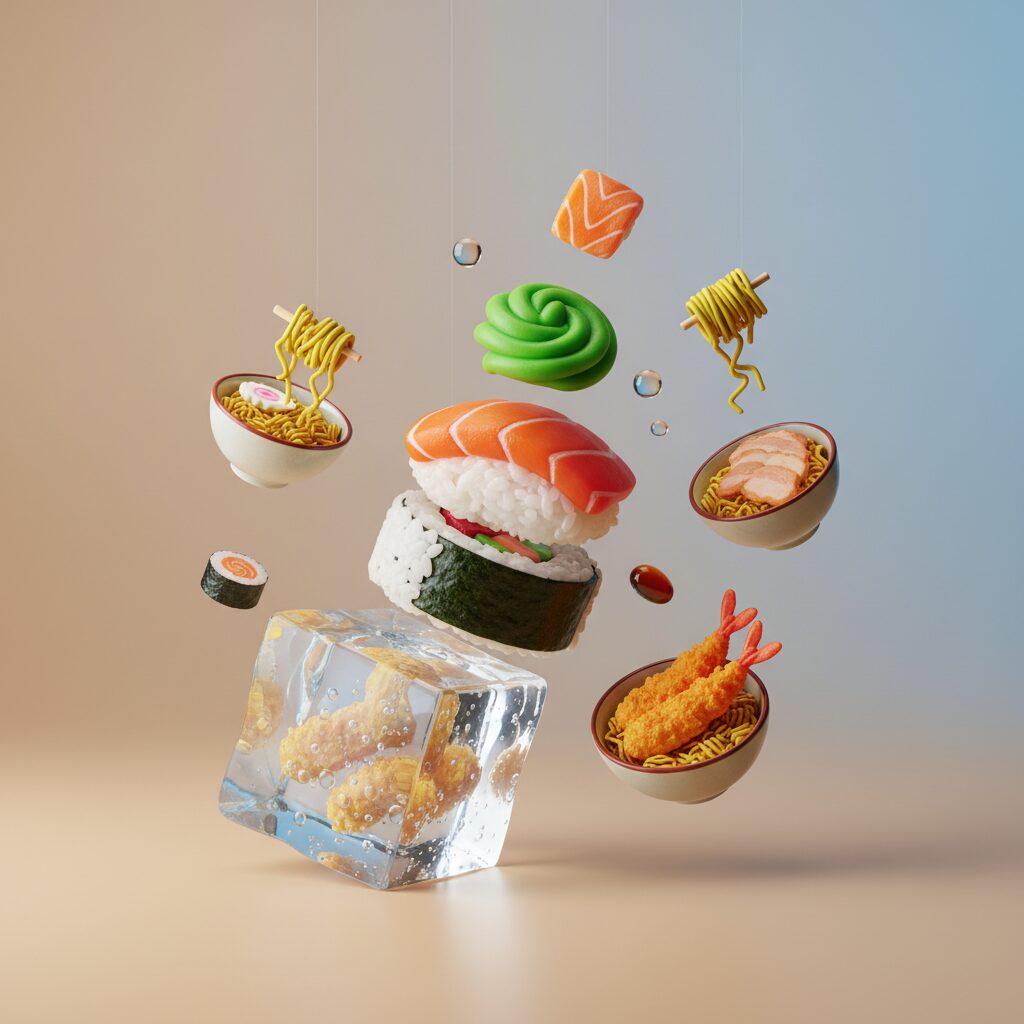
Walk down almost any commercial street in Japan, from a bustling Tokyo shotengai to a quiet lane in a regional city, and you will eventually come face to face with a display of such exquisite culinary artistry that it stops you in your tracks. A bowl of ramen, its broth gleaming under the lights, noodles perfectly suspended, a slice of chashu pork glistening with a delicate layer of fat. Next to it, a plate of tempura, its batter so light and crispy you can almost hear the crunch. And beside that, a perfect wedge of strawberry shortcake, its cream impossibly fluffy. You lean in closer, ready to order, only to realize the truth: it’s all fake. Every single, mouth-watering morsel is a lie, crafted from plastic and vinyl. This is the world of shokuhin sanpuru (食品サンプル), or Japanese food samples, and they are one of the most brilliant, practical, and culturally revealing fixtures of daily life in Japan. They aren’t just quirky window dressing; they are a silent language, a historical artifact, and a form of customer service so thoughtful it’s almost poetic. For anyone trying to understand the Japanese mindset, these plastic feasts offer more than just a preview of the menu—they offer a window into the culture itself.
This innovative interplay of artistry and everyday utility in Japan extends to the lively atmosphere of depachika discount events, where the visual allure of food is matched by the strategic charm of retail.
A History Forged in Wax and Wonder

The Birth of a Solution
The story of food models doesn’t start in the realm of high art but rather in practical problem-solving. In the early 20th century, during the Taisho and early Showa eras, Japan was undergoing rapid modernization and Westernization. New foods and ideas from the West were flooding into cities, finding their place in the dining areas of upscale department stores. However, there was a challenge. How could you sell dishes like omuraisu (omelet rice) or beef cutlets to a public that had never seen or tasted them? A written menu was abstract and unhelpful. Pictures were not yet common or high-quality enough to serve the purpose.
Enter Takizo Iwasaki, a craftsman from Gifu Prefecture, who is now celebrated as the father of the modern food sample. According to legend, in 1932, after noticing the patterns formed by dripping wax in water, he had a moment of inspiration. He created an incredibly realistic wax model of an omelet, so lifelike that his wife couldn’t distinguish it from the real dish. He realized he had something valuable. Restaurants and department stores quickly recognized its worth. These models were more than just decorations; they were three-dimensional, full-color advertisements that instantly conveyed what was on offer. They bridged the gap between curiosity and understanding, making foreign foods approachable and easing the anxiety of ordering unfamiliar dishes. The food sample emerged not from a desire for novelty but out of a need for clear, universal communication.
From Post-War Boom to Vinyl Perfection
The true surge in popularity of shokuhin sanpuru occurred during Japan’s post-war economic boom. As the country rebuilt and prospered, a lively restaurant culture flourished. With more people dining out and increased competition among establishments, effective marketing became essential. The food model was an ideal tool. It enabled a restaurant to display its entire menu on the sidewalk, attracting hungry office workers and families with a visual preview of what awaited them inside. However, the original wax models had a drawback: they were fragile and vulnerable to heat, fading and melting in the sun. The industry’s next major advance came with the shift to synthetic resins and polyvinyl chloride (PVC) in the 1970s and 80s. This new material was far more durable, its colors more vibrant, and it allowed for even greater realism. The craft evolved into an industry, with specialized workshops focused on producing these hyper-realistic replicas. This technological advancement secured the food sample’s place in the Japanese cityscape, ensuring its longevity for decades ahead.
The Art of the Unreal
The Shokunin Spirit in Miniature
To regard shokuhin sanpuru as simple plastic trinkets is to fundamentally miss the spirit behind their creation. Crafting them is a deeply respected art, driven by the ethos of the shokunin—an artisan devoted to the relentless pursuit of perfection in their chosen craft. This is far from a factory assembly line; it is a workshop of meticulous artists. The process is painstaking. Often, it starts with the restaurant providing an actual dish, which the artisans then use to form a silicone mold. Every grain of rice, scallion, and piece of ginger is precisely captured.
Next, liquid vinyl is poured into the molds and heated in an oven until it solidifies. Yet this is only the framework. The true mastery lies in the finishing touches. Craftsmen employ a mix of airbrushing, hand-painting, and delicate assembly to breathe life into the model. Over generations, they have developed secret techniques to mimic the most challenging textures. How can one capture the effervescent fizz in a glass of melon soda? The translucent sheen of raw fish? The delicate, web-like structure of tempura batter, known as hana (flowers)? Each challenge is met with creativity and obsessive attention to detail. This process is about more than just making food appear real; it is about honoring the chef’s creation through perfect replication.
Better Than Real: The Science of Appetite
Here’s a secret about food models: they are often crafted to appear even more appealing than the actual dish. This isn’t deception; it’s idealization. The colors may be slightly more vibrant, the arrangement of ingredients flawlessly composed, the gloss on a sauce just a bit more pronounced. The artists are masters of food psychology, understanding which visual cues stimulate our appetite. This practice is called shokuyoku o sosoru, or “whetting the appetite.” The models are designed to represent the perfect, everlasting version of the dish. They don’t wilt, fade, or cool. They portray the dish at its absolute peak, promising the ideal culinary experience. It is a form of visual exaggeration aimed to make your stomach growl even before you step inside. The goal is not just to inform, but to enchant.
The Silent Language of Service

The Ultimate Visual Menu
For any non-Japanese speaker who has ever been daunted by a wall of unfamiliar kanji on a menu, the shokuhin sanpuru display is a lifesaver. It acts as a universal language, crossing all speech and literacy barriers. You don’t need to know the term for grilled mackerel; simply pointing at the shiny, perfectly cross-hatched model in the window is enough. This simple gesture—kore o kudasai (this one, please)—is universally understood. This is a subtle, yet profound, expression of omotenashi, Japan’s distinctive hospitality that anticipates a guest’s needs. The restaurant has foreseen any potential confusion and offered an elegant, intuitive solution. It comforts the customer and eliminates friction in the ordering process, guaranteeing a smooth and enjoyable experience right from the start.
What You See Is What You Get
More than just displaying what’s on offer, the food sample acts as a binding agreement between the restaurant and the customer. The model isn’t merely an abstract depiction; it is a commitment to portion size, ingredients, and presentation. The bowl of ramen served at your table will have the same number of pork slices, the same sprinkling of corn, and the same half-a-jammy-egg as the one shown in the window. This concept of “what you see is what you get” is a fundamental element of trust in Japanese business. In a culture that values predictability and shuns unpleasant surprises, this consistency is deeply reassuring. It perfectly sets expectations. There’s no disappointment over a dish that appeared larger in the photo or arrived with fewer toppings than shown. The sample sets the benchmark, and the kitchen is expected to deliver it precisely, every time. The quality and cleanliness of the display itself also convey a strong message. A bright, well-lit, and dust-free case indicates a restaurant attentive to its details—a promising sign for the meal ahead. A dull, faded, or dirty display? Best to keep moving.
A Modern Icon with a Plastic Heart
From Sidewalk to Souvenir
In an era dominated by digital menus and online reviews, one might assume that the humble food model has become a relic of the past. Yet, it persists. Although some upscale, minimalist establishments have moved away from them, they remain widespread in the vast majority of Japanese eateries, from family restaurants and ramen shops to kissaten coffee houses. Their role, however, has evolved. The artistry of shokuhin sanpuru has bestowed upon them a new life as a pop-culture phenomenon. The most famous center for this is Tokyo’s Kappabashi Kitchen Town, a district brimming with restaurant supply stores. Here, both tourists and locals can admire shops dedicated entirely to fake food, from single pieces of sushi to elaborate banquet displays. These models are no longer confined to restaurant windows; they are now sold as quirky souvenirs, keychains, phone cases, and even DIY kits that allow you to create your own fake tempura or shaved ice. They have become a symbol of Japan’s unique fusion of tradition, craftsmanship, and playful kitsch.
Why Plastic Still Beats Pixels
The continued presence of shokuhin sanpuru despite digital alternatives highlights the appeal of the tangible. A photo on a screen is flat and fleeting. A physical model has presence. It occupies real space. You can walk around it, view it from multiple angles, and appreciate its three-dimensional texture and depth. It feels more genuine, more real, than a perfectly lit and potentially photoshopped image. It offers an analog solution in an increasingly digital world, providing a tactile connection to the food that a screen simply cannot replicate. The shokuhin sanpuru is a perfect microcosm of Japan itself: an innovation born from practical necessity, elevated into an art form through painstaking craftsmanship, and sustained by a deep cultural appreciation for clarity, honesty, and hospitality. The next time you find yourself captivated by a window display of plastic food, pause for a moment. You’re not just looking at a menu. You’re witnessing a piece of history, a work of art, and a delicious promise waiting to be fulfilled.