If you’ve ever watched a Japanese film, an anime, or even just a travel show, you’ve seen it. The food arrives—a steaming bowl of ramen, a perfectly arranged bento box, a simple plate of curry rice. Before anyone takes a bite, they bring their hands together, bow their head slightly, and murmur a single word: “Itadakimasu.” To the casual observer, it seems to be the Japanese equivalent of “Bon appétit,” “Let’s eat,” or perhaps a simple “Thanks for the food.” And while it serves that function, that translation is woefully incomplete. It’s like describing a symphony as “a bunch of sounds.” It misses the entire point.
“Itadakimasu” isn’t a declaration or a suggestion. It’s not about signaling the start of the meal for others. It is a quiet, personal moment of reflection and gratitude. It’s a verbal bow to the vast, interconnected web of life and labor that brought the meal to your table. This single word encapsulates a complex worldview, blending elements of Shinto reverence for nature, Buddhist respect for life, and a deeply ingrained cultural appreciation for the efforts of others. To understand “itadakimasu” is to get a glimpse into the Japanese psyche and the quiet philosophies that shape daily life. It transforms the simple act of eating from mere consumption into a mindful ritual of thanks.
This reflective pause opens up a broader view of Japanese culinary expression, where even the creative realm of gastronomic art in imitation cuisine challenges our perceptions of food and tradition.
Deconstructing the Word Itself

To truly understand it, you need to examine the word itself. “Itadakimasu” (頂きます) is the formal, humble form of the verb “itadaku” (頂く), which means “to receive.” However, Japanese has another, more commonly used word for receiving: “morau” (貰う). The distinction is important. You use “morau” for everyday exchanges among equals. For example, if a friend gives you a book, you “morau” it. But “itadaku” is used when receiving something from a superior—a boss, a teacher, or someone deserving of respect. It carries a unique nuance of humility, implying that you receive something from a higher place.
At the core, the character 頂 (itadaki) literally means “the peak” or “the crown of the head.” The connection is clear. To receive something with “itadaku” is to symbolically raise it above your head as a gesture of deep respect and gratitude. So, when you say “itadakimasu” before a meal, you are not merely saying, “I receive this food.” Instead, you are expressing, “I humbly and gratefully receive this food,” as if it were a gift given from a place of great significance.
This goes beyond social hierarchy; it embraces a spiritual and natural one. The “superior” here isn’t a person. It represents the entire universe of forces that created the meal. You acknowledge that you are the recipient of a great gift from nature, from the farmers, from the cooks, and from the chain of life itself. The phrase positions you as the humble beneficiary of a vast, intricate process, not just as a consumer who bought a product. It’s a powerful reframing that shifts the focus from entitlement to gratitude.
The Pillars of Gratitude
So, what exactly is the gratitude behind this phrase directed towards? It’s not an indistinct, abstract feeling. In the Japanese mindset, the thanks expressed in “itadakimasu” is aimed at several specific elements. It represents a multi-layered recognition of sacrifice, effort, and existence.
Gratitude for Nature: The Lives We Receive
At its most basic level, “itadakimasu” acknowledges sacrifice. Before becoming food, it was life. This applies not only to meat and fish but also to every grain of rice and each leaf of spinach. This perspective is deeply influenced by Japan’s two major spiritual traditions: Shinto and Buddhism.
Shintoism, Japan’s indigenous religion, is a form of animism. It believes that spirits, or kami, inhabit all things—not only people, but animals, plants, rivers, mountains, and even rocks. Nature is not an inert resource to be exploited; it is a living, breathing entity filled with divine presence. From this standpoint, every component of your meal is sacred in some form. To eat is to take that sacred life into yourself to sustain your own. Thus, “itadakimasu” is a way of saying, “I humbly receive the lives of these plants and animals. Thank you for your sacrifice, which allows me to live.”
Buddhism, which came to Japan in the 6th century, reinforces this with its central principle of respecting all sentient beings and its emphasis on the interconnectedness of all life. While Japanese cuisine is not strictly vegetarian, this Buddhist influence fostered an acute awareness of the life taken in eating. It’s not a moment of guilt but one of profound responsibility. If you are to take a life, it must be done with utmost gratitude, ensuring the sacrifice is not wasted. This is why wasting food is regarded as a serious disrespect—you are not merely discarding leftovers, but dishonoring the life given for your meal.
Consider a simple piece of grilled fish. Saying “itadakimasu” acknowledges the fish’s life in the ocean, the energy it consumed, and its ultimate sacrifice. It’s a moment to connect your existence with that of what you are about to eat, completing a circle of life and death with a word of thanks.
Gratitude for Labor: The Human Chain
Beyond the ingredients themselves, “itadakimasu” expresses thanks to every person whose effort made the meal possible. This concept often gets lost in modern, globalized food systems, where food appears seemingly by magic on sterile supermarket shelves. Yet in the Japanese context, this human chain is a vital part of the gratitude equation.
The appreciation extends to everyone involved. It’s for the farmer who toiled under the sun to grow the rice, battling weather and pests. It’s for the fisherman who rose before dawn and braved unpredictable seas to catch the fish. It’s for the vegetable harvester, the truck driver who transported them across the country, the vendor who carefully arranged them, and, of course, the person who stood in the kitchen—whether a world-class chef or your own mother—applying skill and care to prepare the final dish.
“Itadakimasu” is a silent salute to this unseen army of people. It acknowledges that you are at the end of a long, laborious chain of human cooperation. A meal is never the work of just one individual. By pausing to say this word, you show appreciation for the hard work, skill, and dedication of countless others. This fosters a sense of social connection and humility, reminding you that your own comfort and sustenance depend on the efforts of a broader community. It’s the opposite of a mindset that views food simply as a commodity to be bought and consumed without thought.
Gratitude for the Meal Itself: The Antidote to Waste
The third layer of gratitude is for the food as a gift, a blessing. By consciously acknowledging the life and labor behind it, you develop a deeper appreciation for the meal before you. This is closely linked to the important Japanese cultural concept of mottainai (勿体無い).
Mottainai is a richly expressive term that is difficult to translate with a single word. It conveys a deep sense of regret over waste. It’s the feeling you experience when something useful—whether food, time, or potential—is not used to its fullest. It goes beyond “wasteful”; it implies a type of sacrilege. How could you possibly squander something that required the sacrifice of life and the immense effort of so many people?
Saying “itadakimasu” prepares you for a mottainai-aware meal. It primes your mindset to value what you have been given. When you understand what went into every grain of rice in your bowl, you are far more likely to eat every last bit. This is why it is considered good manners in Japan to finish everything on your plate. It’s not merely about tidiness; it signals respect for the food and all who contributed to its creation. Leaving food behind suggests a lack of appreciation for the gift, implying that the sacrifices made were, in some small way, wasted. “Itadakimasu” is the beginning of a promise you make with your meal: I receive you with gratitude, and I will not let you go to waste.
‘Itadakimasu’ in Action: Ritual and Practice
This is not merely a philosophical concept; it is a practiced tradition instilled from infancy. It is among the first manners a Japanese child learns, serving as a fundamental element of shitsuke (upbringing or discipline). Throughout homes, kindergartens, and school cafeterias nationwide, children are taught to pause, place their hands together, and say “itadakimasu” collectively before eating.
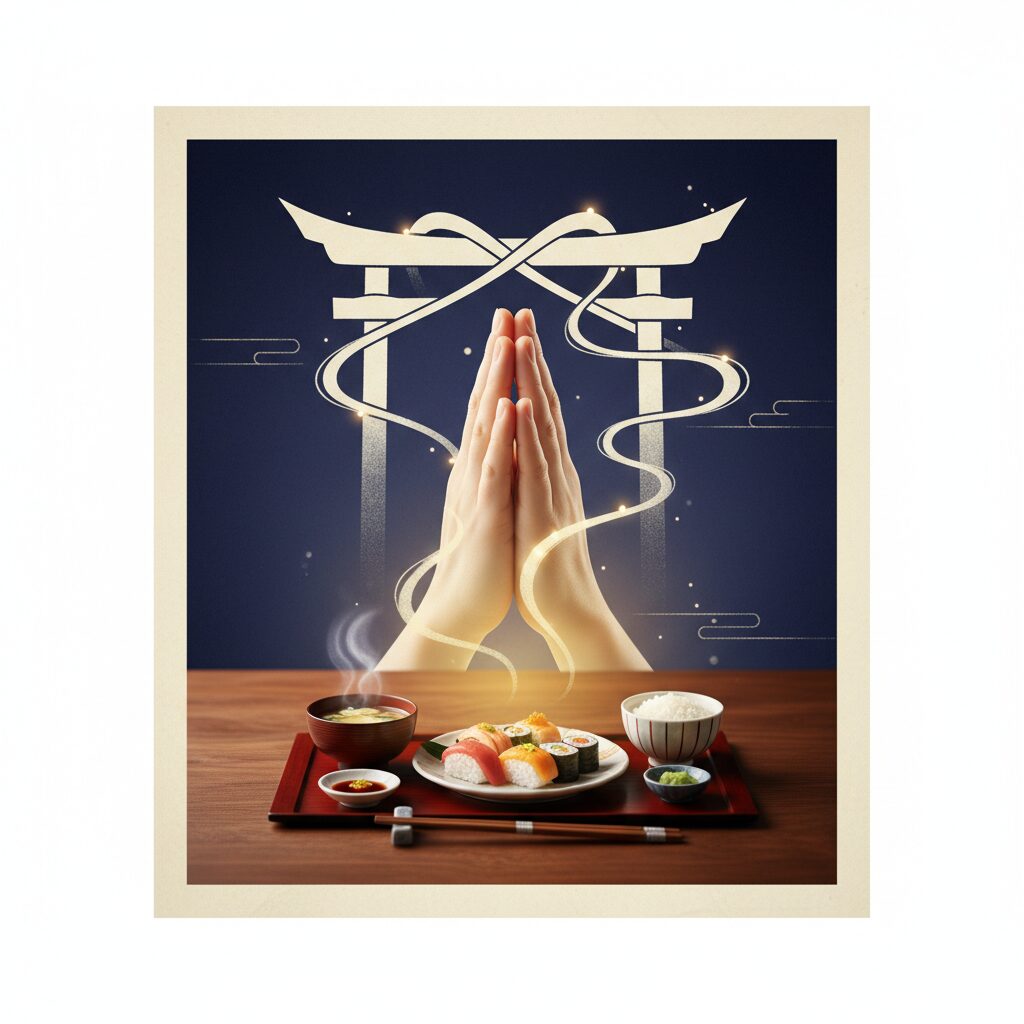
The physical gesture that often accompanies this phrase is known as gassho (合掌). This gesture, involving pressing one’s palms together, is the same as that used in Buddhist prayer. The act reinforces a mindset of respect and gratitude. It creates a moment of pause, a brief break between the impulse to eat and the act itself. Within this small space, the ritual invites mindfulness.
The ritual concludes with a closing phrase spoken after the meal: Gochisousama deshita (ご馳走様でした). If “itadakimasu” is the opening prayer, “gochisousama” is its counterpart at the end. The literal meaning is intriguing. Chisou (馳走) means “to run around” or “to exert great effort.” Originally, the term referred to the host dashing around on horseback to collect the finest ingredients to prepare a meal for a valued guest. Thus, saying “gochisousama deshita” essentially expresses, “Thank you for all the effort” or “Thank you for the feast you so diligently prepared.”
Like “itadakimasu,” this gratitude is extended to everyone. You say it to the chef when leaving a restaurant, to your host at a dinner party, and to the family member who cooked the meal. Even when dining alone, you direct it to the universe as a whole, acknowledging the full chain of labor. The pairing of “itadakimasu” before the meal and “gochisousama” afterward frames eating as a complete, self-contained ceremony of thankfulness from start to finish.
Beyond the Dining Table

The spirit of “itadakimasu” is so fundamental that it subtly influences various other facets of Japanese culture. It’s a philosophy centered on receiving in general. It involves accepting things—whether a physical gift, a piece of advice, or a business opportunity—with humility and an appreciation of their value.
This mindset sharply contrasts with a more transactional or individualistic perspective. In many cultures, the default might be, “I bought this, so I’m entitled to it,” or “I worked for this, so I earned it.” The “itadakimasu” approach doesn’t dismiss the importance of money or personal effort, but it adds a vital layer of interdependence. It reminds you that nothing is ever truly created or achieved in isolation. Your success, comfort, and very survival depend on a complex network of visible and invisible contributors.
This is evident in the way gifts are exchanged in Japan, accompanied by deep bows and expressions of gratitude. It’s present in the professional realm, where a project’s success is attributed to the team’s collective effort rather than a single individual’s brilliance. It reflects a cultural tendency to recognize one’s place within a larger system and to value the contributions of others that make your own existence possible. This single word, uttered daily at the dining table, continually reinforces this humble, interconnected worldview.
So, the next time you see someone in a film press their hands together and say “Itadakimasu,” recognize what it truly represents. It is not merely a polite formality. It is a moment of mindfulness, a compact philosophy, a silent prayer of thanks that links one person to the entire web of life. It’s a beautiful reminder that even the simplest act, like eating a meal, can be an occasion for profound gratitude and connection.
And perhaps you can bring a little of that spirit to your own table. Before your next bite, you don’t need to say the word, but you can embrace the feeling. Take a brief moment to look at your food and reflect on the sun, the soil, the water, the plants, the animals, and the many hands that brought it to you. In that instant, you’ll be embodying the deep and beautiful spirit of “itadakimasu.”