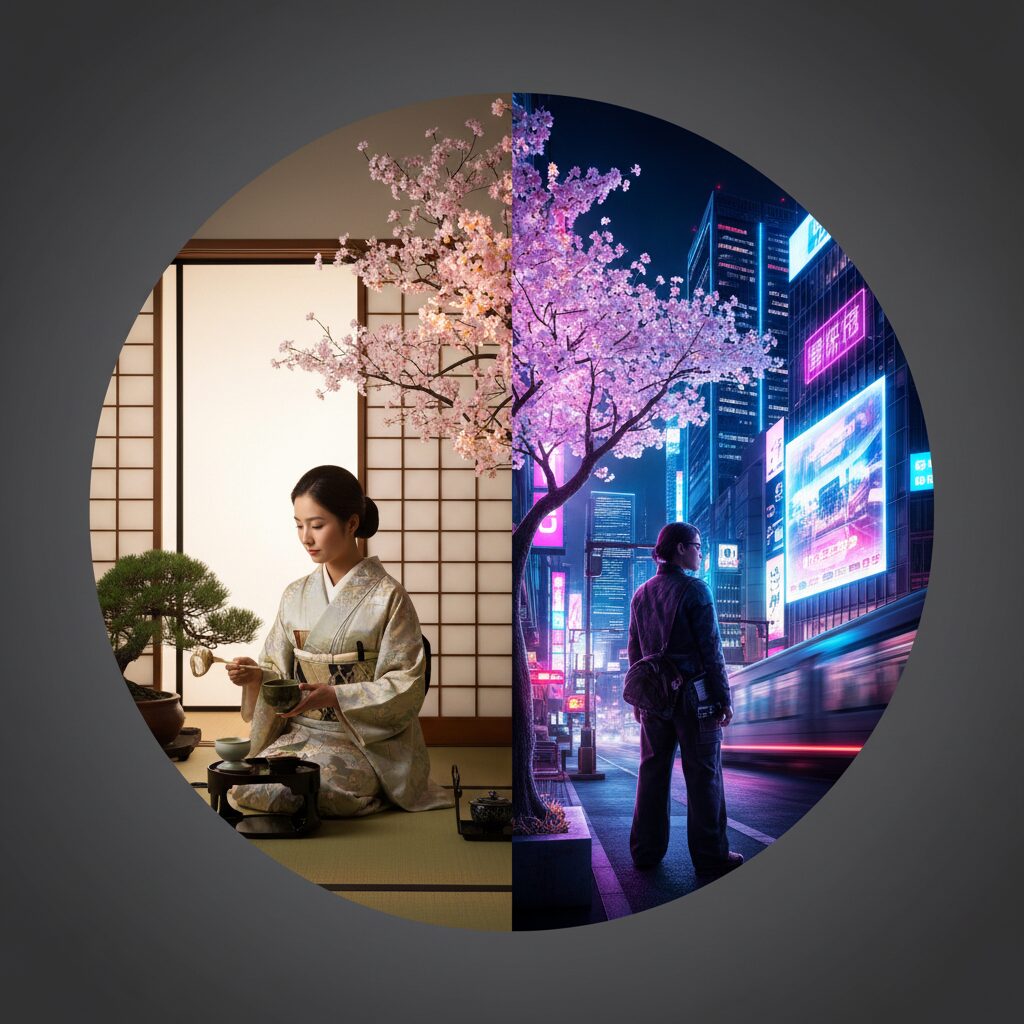
If you spend enough time in Japan, you’ll eventually have an encounter that leaves you utterly bewildered. It might be in a business meeting, where your Japanese colleagues nod enthusiastically at your proposal, showering it with praise, only for the project to quietly vanish without a trace. Or perhaps it’s after a dinner with a new friend who, upon parting, says, “We must do this again soon!” with genuine warmth, but your follow-up texts go unanswered. The Western mind, conditioned to value directness and transparent honesty, often short-circuits. Were they lying? Are they fake? Is everyone just being polite to your face?
The answer is far more complex and culturally profound than a simple yes or no. What you’ve encountered is the fundamental social dynamic of honne (本音) and tatemae (建前), the twin pillars that support the entire edifice of Japanese interpersonal relationships. Honne refers to one’s true feelings, desires, and opinions—the raw, unfiltered reality of your inner world. Tatemae is the public facade, the behavior and opinions one displays in public to maintain harmony and fulfill societal expectations. To understand these two concepts is to unlock the operating system of Japanese society. It’s the key to moving beyond the surface-level confusion and grasping the subtle, intricate dance of communication that defines daily life here.
This exploration of Japan’s intricate balance between genuine feelings and public facades invites readers to further appreciate traditions such as forest bathing, which, like honne and tatemae, reflects the nation’s distinctive cultural rhythm.
The Heart of the Matter: Defining the Duality
At first glance, the distinction between a private self and a public persona may not appear to be uniquely Japanese. After all, everyone does it to some degree. You don’t tell your boss you dislike his new haircut, and you probably tell your grandmother that her dry-as-dust fruitcake is delicious. What sets Japan apart is the degree, refinement, and social necessity involved. Honne and tatemae are not merely occasional white lies; they represent a constant, conscious code-switching learned from childhood.
Honne: The Unspoken Truth
Honne, literally meaning “true sound,” is the voice of your authentic self. It’s what you complain about to your spouse after a long day at work, the political opinion you share with your closest friends, the secret confession that a certain tradition bores you. It is genuine, spontaneous, and often deeply personal. Because it is so raw, expressing your honne is an act of vulnerability and intimacy. It is a privilege reserved for a very select few—your family, lifelong friends, and partner. These people form your innermost circle, your uchi (内), or “inside” group. Revealing your honne indiscriminately in public would be seen as childish, selfish, and socially disruptive. It would be like attending a formal gala in pajamas; simply inappropriate for the occasion.
Tatemae: The Harmony Mask
Tatemae, which can be translated as “facade” or “built in front,” is the carefully crafted performance necessary for smooth social interactions. It consists of the opinions, behaviors, and expressions that align with your role and the expectations of the situation. As an employee, your tatemae is to support your company’s objectives. As a shop clerk, it is to be unfailingly polite and helpful. As a host, it is to make guests feel welcome and comfortable. Tatemae is not about deception with ill intent. Its main purpose is to avoid conflict, prevent others from losing face, and maintain social harmony, or wa (和), the cultural glue holding Japanese society together. It functions as a shared script everyone understands, enabling interactions among relative strangers, or soto (外) people, to proceed smoothly and without friction. It is a form of social respect, expressing, “I value our relationship and this group’s harmony more than my personal need to voice every unfiltered thought.”
The Cultural Roots of a Two-Faced System
This social structure did not arise spontaneously. It is the natural result of centuries of history and deeply embedded philosophical values that have shaped the Japanese mindset. Recognizing its origins helps shift the concept from being seen as “weird” to being understood as culturally logical.
The Pressure of Proximity
Throughout most of its history, Japan has been a densely populated, resource-limited island nation. For centuries, communities centered around wet-rice cultivation, a task demanding immense, coordinated group effort. Even a single family’s refusal to cooperate on irrigation schedules or planting times could endanger the entire village’s harvest and survival. In this setting, individual desires were necessarily secondary to the needs of the group. Open disagreement and conflict were not merely unpleasant; they posed real dangers. This fostered a strong social imperative to get along, prioritize the group, and develop refined communication methods that avoided direct confrontation. Tatemae thus became a vital survival strategy.
The Influence of Confucianism
Contributing to this agricultural foundation is the lasting influence of Confucianism, which stresses a strictly hierarchical social order. Society is viewed as a web of interconnected relationships, each with defined duties and obligations: ruler and subject, parent and child, senior and junior. One’s identity is shaped by one’s role within this system. Tatemae represents the performance of that role. People behave according to their social position, showing respect to those above and consideration to those below. This rigid framework reinforces the notion that public behavior should be governed by duty and expectation rather than personal preference.
Uchi-Soto: The Deciding Factor
The most practical way to understand when honne and tatemae apply is through the concept of uchi-soto, or “inside-outside.” Japanese society is mentally structured into concentric circles of relationships. Your uchi group is your inner circle: family, close colleagues, teammates. Within this group, barriers are lower, and more honne can be shared. Everyone else belongs to the soto, or “outside,” category, including customers, acquaintances, people from other companies, and strangers. Interactions with soto individuals are almost exclusively governed by tatemae. This explains why a Japanese person can seem formal and reserved one moment, then open and relaxed the next. It is not a flip in personality but a change in audience. As a foreigner, you are almost always considered soto by default. Gaining entry into someone’s uchi circle is a gradual process based on time and trust.
Reading the Signs: Honne and Tatemae in the Wild

Once you understand what to look for, you begin noticing this dynamic unfolding everywhere. It’s the unspoken language that supports countless everyday interactions.
The Business World
The Japanese workplace functions as a stage for tatemae. In meetings (kaigi), the main objective often isn’t to debate or decide but to formally approve a consensus already established behind the scenes. This pre-meeting lobbying and consensus-building is known as nemawashi (根回し), literally “turning the roots.” Junior employees rarely, if ever, openly contradict their superiors. They nod and agree, even if they have doubts. Their honne might be shared later over drinks with trusted colleagues. A common tatemae expression used when a proposal is gently declined is kentou shimasu (検討します), “we will consider it,” or chotto muzukashii desu ne (ちょっと難しいですね), “it’s a little difficult.” These are almost always polite ways of saying no, allowing the other party to save face.
Social Gatherings
In social settings, tatemae appears as a highly refined system of compliments and indirectness. When visiting someone’s home, the host will likely describe their nice apartment as a “messy place” and any food served as a “humble offering.” In response, guests are expected to lavish praise. This is a scripted ritual rather than a literal exchange. Likewise, invitations are dealt with delicately. A direct “No, I don’t want to go” is too blunt. Instead, people use vague excuses like “I’ll have to check my schedule” or “That day might be a little inconvenient for me.” It’s up to the inviter to read the air—kuuki wo yomu (空気を読む)—and grasp the implied refusal without prompting a direct confrontation.
The Art of the Nomikai
One of the few socially accepted outlets for honne is the nomikai, or after-work drinking party. Alcohol acts as a social lubricant that temporarily relaxes workplace rigidity. Fueled by beer and sake, a subordinate might feel free to express their true feelings (honne) about a project to their boss, who is culturally expected to accept this gracefully. It serves as a pressure-release valve, captured by the saying sake no seki de wa burei wo yusu, meaning “impoliteness is permitted at a drinking party.” Of course, there are boundaries, but it’s an intriguing space where the lines between honne and tatemae intentionally blur.
Is It Dishonest? Reframing the Western Perspective
People from individualistic cultures, where authenticity and self-expression are regarded as paramount virtues, often view the honne-tatemae dynamic as hypocritical or two-faced. However, this is a fundamental misunderstanding. In the Japanese context, tatemae is not dishonesty; it represents social intelligence and empathy. It involves consciously choosing to prioritize others’ comfort and group harmony over one’s desire for individual expression.
Consider the social courtesies in your own culture. When a cashier asks, “How are you?” you respond, “Fine, thanks,” even if your life feels chaotic. You don’t burden them with your personal troubles. This is a form of tatemae. Japan simply applies this principle more broadly and deliberately, recognizing that society cannot function if everyone expresses every thought and impulse without restraint.
For outsiders, navigating this system doesn’t mean changing who you are or abandoning your values. It means developing a new kind of literacy—learning to listen not only to what is said but also to the pauses, hesitations, and context. It means understanding that a vague, non-committal response can be a kindness, a gentle way of declining without embarrassment. It involves building trust gradually, demonstrating that you respect harmony, and earning the privilege of being welcomed into someone’s uchi circle, where their honne is shared.
In the end, honne and tatemae are not about deceit. They reflect the delicate, ongoing negotiation between the individual and society. This system stems from a deep belief that protecting others’ feelings and maintaining group peace is a higher virtue than blunt honesty. Though it may seem confusing at first, with patience and attentiveness, you come to appreciate the subtle beauty of a society functioning through a complex, unspoken code of mutual respect.