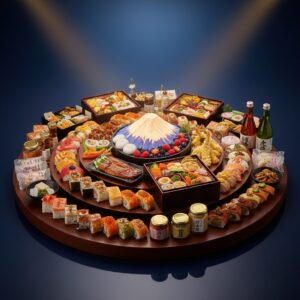
Stand on the platform of any major train station in Japan—Tokyo, Kyoto, Sendai, it doesn’t matter which—and you will witness a quintessential travel ritual. Amid the river of commuters and the hushed announcements of departing trains, you’ll see people gathered before walls of brightly colored boxes. They aren’t just grabbing a quick bite. They are participating in something far more profound. They are choosing an ekiben, a station-sold bento box, and in doing so, they are engaging with one of the most elegant and deeply rooted aspects of Japanese travel culture. To the uninitiated, it might look like a simple, convenient meal solution. A pre-packaged lunch to be eaten on the go. But that perspective misses the point entirely. The ekiben is not merely food; it is a narrative in a box. It’s a portable expression of regional identity, a meticulously crafted piece of culinary art, and a quiet ceremony that transforms the act of travel itself. It represents a pause, a moment of appreciation for place and craft, all savored against the backdrop of Japan’s fleeting landscapes. Understanding the world of ekiben is to understand a core part of the Japanese approach to food, journey, and the beauty found in transient moments.
The intricate tale of ekiben complements the rich tapestry of Japan’s culinary traditions, inviting curious travelers to further explore the detailed artistry behind Japanese bento that beautifully mirrors each region’s unique flavor.
A Taste of Place, Perfectly Packaged
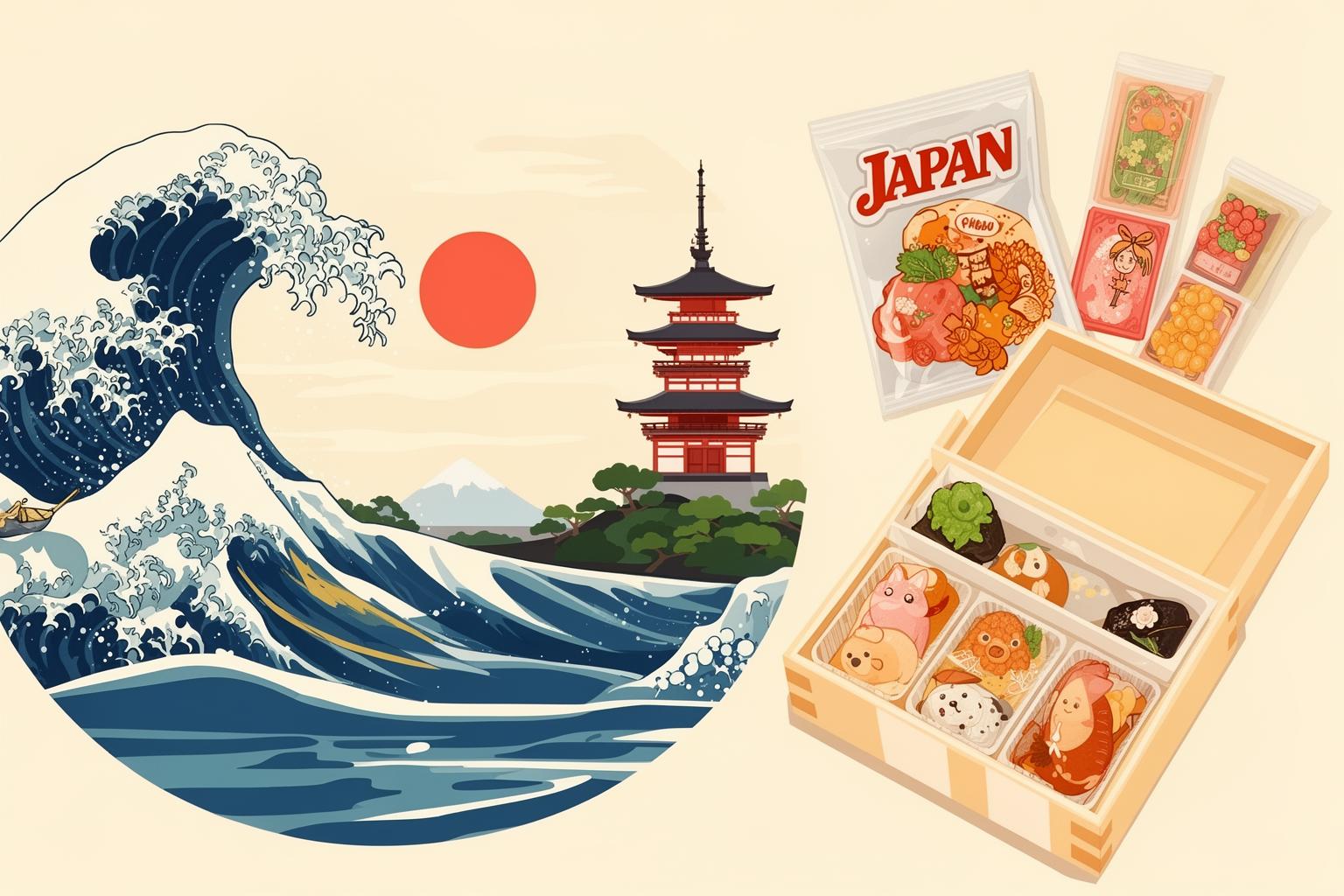
The fundamental brilliance of the ekiben lies in its deep connection to place. This is not generic, mass-produced travel fare. An ekiben is intensely local, serving as a culinary ambassador for the region it represents. Every prefecture—and often individual cities or even specific train stations within them—proudly offers its own unique creations made from local specialties. The concept embodies a form of edible terroir, providing a direct link between the landscape outside your window and the meal on your tray table. This transforms a train journey from merely moving between points A and B into a rolling gourmet tour across the country.
Imagine boarding a Shinkansen in Hokkaido, Japan’s northernmost island. The ekiben you select will likely be a treasure trove from the sea. Perhaps it’s the renowned Ika Meshi from Mori Station—a whole squid simmered in sweet soy sauce and stuffed with sticky rice. This simple, rustic dish speaks volumes about the region’s fishing heritage and culinary traditions, evoking the cold, pristine waters surrounding Hokkaido. Traveling south to Sendai, you’ll encounter ekiben centered on grilled beef tongue, or gyutan, the city’s iconic specialty. A box filled with finely grilled slices of tongue over barley rice is more than just a meal; it’s a declaration of Sendai’s identity.
This regional distinctiveness is a source of great pride. Vendors aren’t merely selling lunch; they are preserving a local legacy. Take the legendary Toge no Kamameshi from Yokokawa Station in Gunma Prefecture. First introduced in 1958, this ekiben is a masterpiece in both content and presentation. It’s a warm dish of seasoned rice, chicken, chestnuts, bamboo shoots, and other mountain delicacies, all cooked and served in an individual, reusable ceramic kamameshi pot. Eating it feels hearty, traditional, and deeply comforting, conjuring the experience of a home-cooked meal enjoyed in the mountains. The fact that you get to keep the elegant Mashiko-yaki ceramic pot as a souvenir further strengthens the bond between the meal, the place, and your travel memory. The weight of the pot in your hands is a tangible link to Yokokawa long after the train has departed.
This concept holds true everywhere. In Toyama, you’ll find Masu no Sushi, a beautiful, round cake of pressed trout sushi wrapped in bamboo leaves that subtly infuse the rice with fragrance. In Mie Prefecture, home to the famed Ise Grand Shrine, you might discover a luxurious ekiben featuring local spiny lobster or tender Matsusaka beef. Each box tells a story—a curated taste of the local land, sea, and culture—offered for the traveler to savor.
The Art of the Container
In Japan, presentation is never an afterthought; it is a fundamental aspect of the experience. This philosophy is perfectly embodied in the ekiben, where the container (o-bento-bako) is often as carefully designed and appreciated as the food it holds. The box is far more than disposable packaging. It serves as the stage for the culinary performance, and in many instances, it is a work of art on its own, crafted to please the eye and elevate the ritual of the meal.
This commitment to form extends well beyond a simple printed cardboard sleeve. Ekiben containers are made from a diverse range of materials, each selected to complement the food and evoke a sense of place. Traditional boxes crafted from thin, fragrant wood like cedar or cypress are common. They not only offer an elegant appearance but also fulfill a practical role, as the wood naturally absorbs excess moisture from the rice, keeping it at the ideal texture while imparting a subtle, clean fragrance. Opening a wooden bento feels like revealing something precious and natural.
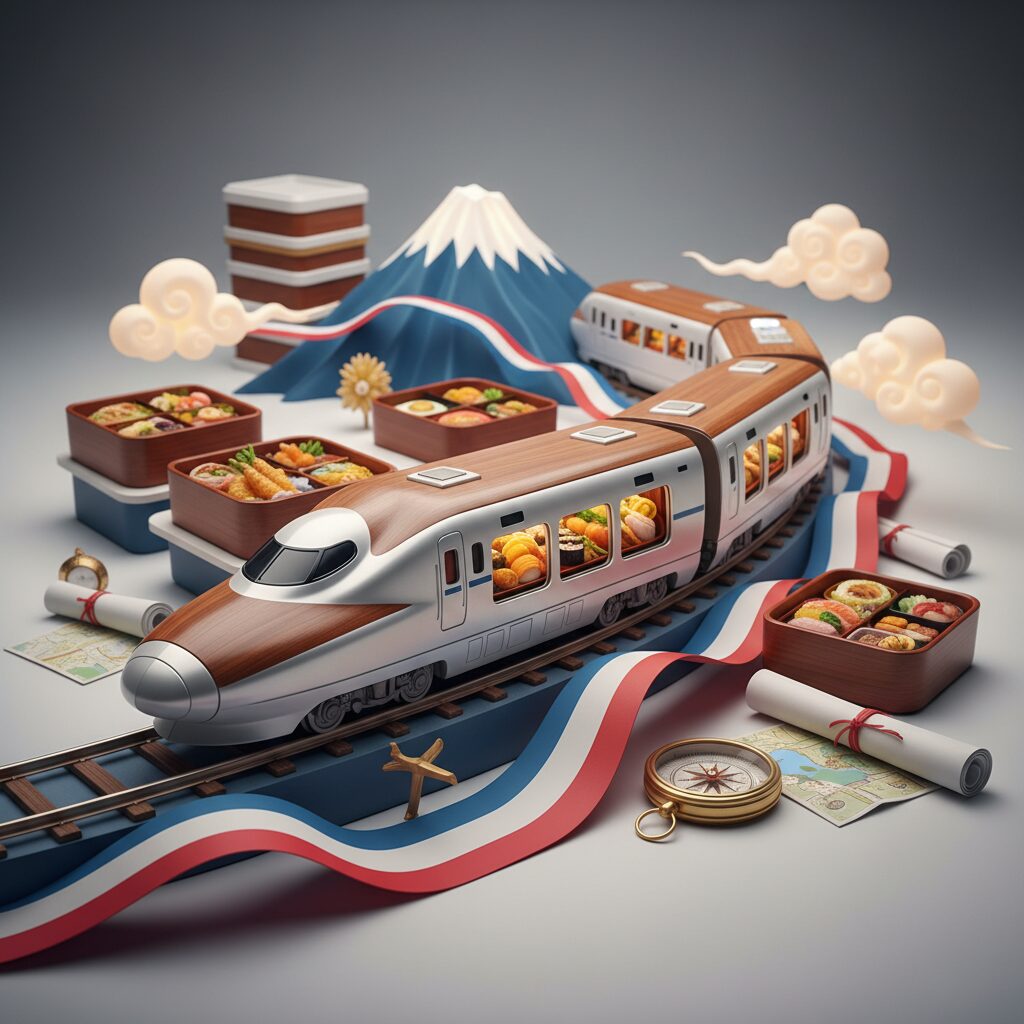
There are also the more playful and imaginative designs. Ekiben can be found in ceramic pots, such as Toge no Kamameshi, or even in miniature plastic models of Shinkansen bullet trains, which are particularly popular with children and train fans. At Fukui Station, the Echizen Kani Meshi (snow crab rice) is typically sold in a bright red container shaped like a crab. This isn’t merely a gimmick; it’s a form of visual storytelling. Even before you lift the lid, the box’s shape conveys the key ingredient and the coastal region you’re visiting. It creates anticipation and transforms the meal into a fun, memorable occasion.
The Theater of the Unveiling
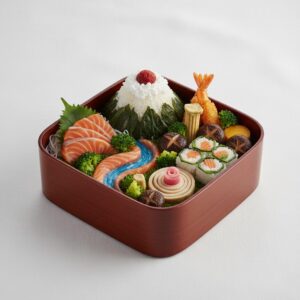
The true enchantment of the ekiben experience comes to life at the moment of unveiling. After settling into your train seat, you set the box on the fold-down tray, untie the string or slide off the paper band (hashigaki), and lift the lid. This is a moment of quiet revelation. Inside, you do not find a haphazard mix of food, but rather a carefully arranged tableau of colors, shapes, and textures.
Japanese cuisine follows the aesthetic principle of moritsuke, the art of arrangement, which is vividly displayed in every ekiben. Each ingredient is thoughtfully placed to create a harmonious and visually appealing composition. You’ll notice the vibrant orange of a simmered carrot alongside the deep green of a snow pea, the glossy brown of a shiitake mushroom, and the bright yellow of a slice of tamagoyaki (rolled omelet). This aligns with the unofficial rule of go-shiki, or five colors (red, green, yellow, white, and black), believed to produce a meal balanced both nutritionally and aesthetically.
The layout exemplifies organized complexity. Rice serves as the base, but rarely appears plain. It may be seasoned, mixed with other ingredients (takikomi gohan), or neatly topped with sesame seeds or pickled ginger. The main protein—whether grilled fish, sliced beef, or fried chicken—takes center stage. Surrounding it are a variety of supporting elements: assorted pickles (tsukemono) to cleanse the palate, simmered vegetables (nimono) offering gentle, savory notes, and perhaps a small sweet treat (wagashi) for dessert. Each component is nestled in its own compartment or separated by a decorative plastic leaf (baran), ensuring the flavors remain distinct until you decide to combine them. This meticulous arrangement reflects respect for both the ingredients and the person who will enjoy the meal. It transforms a simple lunch into a curated tasting experience, a miniature, edible garden meant to be savored one deliberate bite at a time.
A Ritual for the Journey

Beyond the food itself, eating an ekiben on a train is a ritual that profoundly enhances the travel experience. It offers a moment for quiet reflection, a refined pause in a world that often hurries from one destination to another. The train provides a unique setting for this ritual. Unlike a plane, where you are cut off from the world below, or a car, where your attention must remain on the road, a train journey in Japan offers a comfortable seat and a large window showcasing a constantly shifting landscape. This becomes the stage for your meal.
As the train glides smoothly past rice paddies, coastal towns, and into mountain tunnels, you open your chopsticks and begin to eat. The rhythm of the train sets the pace for your meal. There is no hurry. Each bite offers a chance to savor the flavors of the region you are passing through. You may be enjoying sea bream from the Seto Inland Sea just as you glimpse its sparkling waters outside the window. Or you might be tasting Kobe beef as the train nears Shin-Kobe Station. This harmony between taste and place creates a deep and immersive sense of being fully present in the journey.
This intentional, mindful act of eating contrasts sharply with how travel food is often consumed elsewhere—an overhastily eaten sandwich in a car or a greasy snack grabbed at a noisy airport. The ekiben ritual invites you to slow down. It carves out a half-hour of personal time solely dedicated to the enjoyment of a good meal and the beauty of the passing scenery. It is a moment of tranquility, a private ceremony that marks the journey and elevates it from mere transit to a genuinely restorative experience. In this way, the ekiben serves as a focal point for mindfulness, a tasty anchor in the flow of time and space.
A Connection to Time and Memory
Part of the enduring charm of the ekiben is its profound link to history and nostalgia. It is not a recent invention but a tradition stretching back more than a century, intertwined with the development of Japan’s railway system. The very first ekiben is believed to have been sold in 1885 at Utsunomiya Station. It was simple: two onigiri (rice balls) with pickled daikon radish, wrapped in bamboo. Yet, it set an important precedent—offering local, portable food for train travelers.
As the rail network expanded throughout Japan, so did the culture of ekiben. It became an essential and beloved part of any long-distance train trip. For generations of Japanese people, the ekiben is closely tied to special memories: childhood family vacations, school trips, or a first solo journey away from home. The taste of a particular ekiben can evoke a strong sense of nostalgia, transporting one back to a specific time and place. It is a shared cultural touchstone, a collective memory of journeys taken.
This historical significance ensures that ekiben are more than just food; they are a living tradition. At major stations, Ekiben-ya Matsuri—shops that celebrate ekiben—bring together famous varieties from across the country in one place. These shops are more than food vendors; they are culinary museums. People often seek out renowned, long-established ekiben to taste a piece of history for themselves. This act of eating is also a form of participation in a tradition passed down through generations, linking modern travelers to all those who have made similar journeys before.
The Craft Behind the Counter
Ultimately, the world of ekiben exemplifies the spirit of Japanese craftsmanship, known as shokunin. Behind every exceptional ekiben is a devoted producer, typically a small, local, family-run business that has spent decades, or even a century, honing its craft. These are not large, impersonal corporations but artisans who infuse their skill and pride into their product.
Many vendors focus on just one or two signature ekiben, fiercely guarding their recipes and techniques. They maintain close relationships with local farmers and fishermen to ensure the finest seasonal ingredients. The preparation is meticulous and labor-intensive, often beginning in the early morning to guarantee the boxes are fresh for the first trains of the day. This is slow food in a fast-paced world.
This commitment serves as a form of cultural preservation. In an era of globalization and food homogenization, the ekiben industry stands as a proud symbol of regional uniqueness. The producers do more than create food; they safeguard their local culinary heritage and share it with the world, one beautifully packed box at a time. When you purchase an ekiben, you are supporting these local artisans and their dedication to quality. You are tasting the culmination of years of refinement, a passion for local ingredients, and an unwavering conviction in the value of a well-prepared meal.
So the next time you find yourself on a Japanese train platform, don’t simply view the rows of boxes as a quick lunch. See them for what they really are: a gallery of regional art, a library of local histories, and an invitation to take part in a beautiful and meaningful ritual. Choosing an ekiben means choosing to connect with Japan on a deeper level. It’s a decision to transform your journey into a destination itself, finding great satisfaction in the simple, elegant, and profoundly Japanese pleasure of a perfect meal in a box.