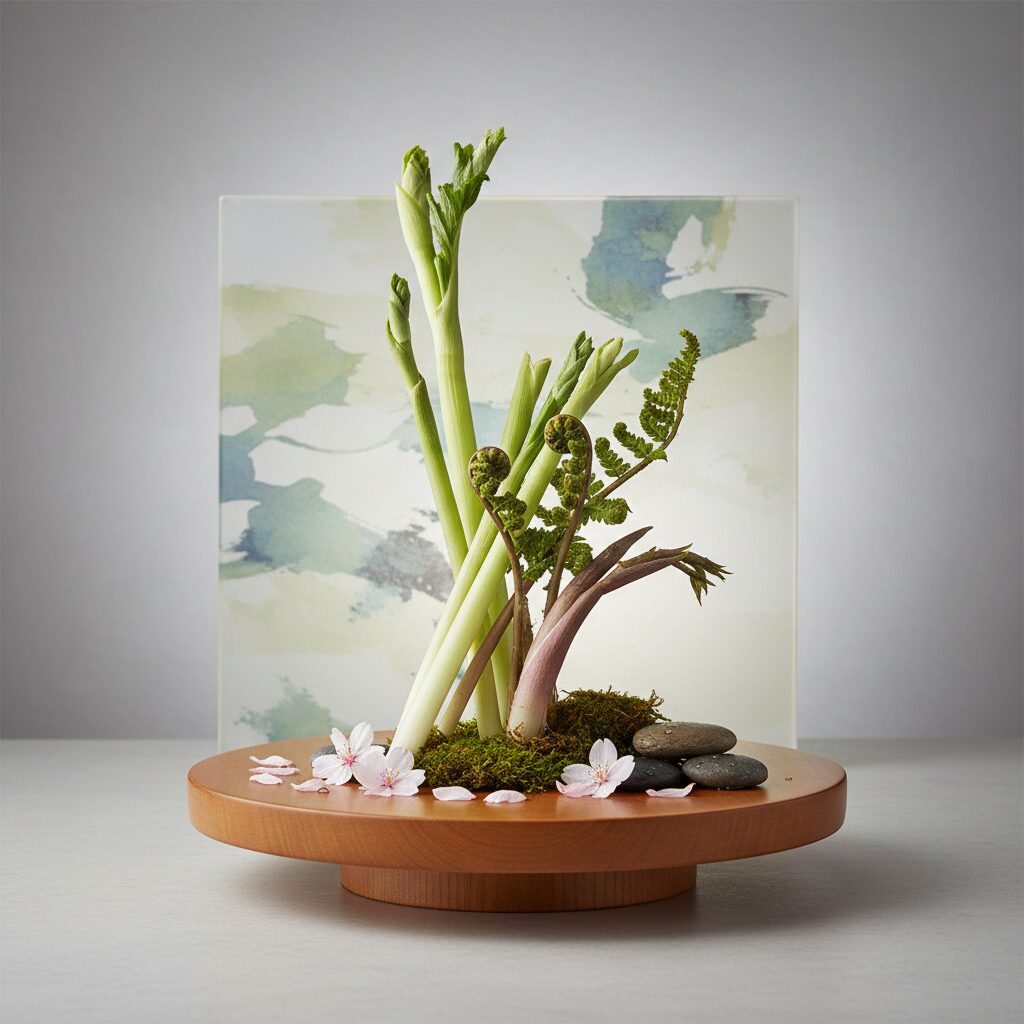
When most people think of spring in Japan, they picture cherry blossoms. They imagine pale pink clouds of petals drifting over parks, picnics under the trees, and the soft, sweet transience of it all. And they’re not wrong. But that’s only half the story—the pretty, palatable, tourist-friendly half. The other side of spring, the one that’s deeper, wilder, and arguably more Japanese, doesn’t taste sweet at all. It tastes bitter.
This is the world of sansai, or “mountain vegetables.” These aren’t the neat rows of daikon and cabbage you see in a farmer’s field. Sansai are the wild, foraged greens, shoots, and buds that erupt from the mountainsides as the last snows of winter finally recede. They are the first real taste of the new season, a jolt to a system grown sluggish on winter stews and preserved foods. Their defining characteristic isn’t sweetness or crispness, but a powerful, challenging bitterness—a flavor that tells a story of survival, purification, and deep connection to the untamed landscape.
Forget what you know about seeking out only pleasant flavors. To understand sansai is to understand a different kind of culinary philosophy, one where bitterness isn’t a flaw to be masked, but a quality to be respected and thoughtfully balanced. It’s an invitation to taste the thaw, to eat the mountain itself, and to experience a side of Japanese cuisine that remains profoundly local and fiercely seasonal.
This deeper taste of spring invites culinary enthusiasts to further explore the cultural significance of wild mountain vegetables, where every bitter bite tells a story of nature’s resilience.
What Exactly is Sansai?
First, let’s clear up a common misconception. The term for regular, cultivated vegetables is yasai (野菜). Meanwhile, sansai (山菜) literally means “mountain bounty” or “mountain vegetables.” This distinction is essential. Yasai are predictable, reliable, and available for extended seasons thanks to modern agriculture. Sansai, on the other hand, are ephemeral, appearing only for a few weeks each year, entirely dependent on nature’s timing.
Foraging for sansai, an activity called sansai-tori, is a valued tradition in rural communities. It demands intimate knowledge of the local environment, the skill to differentiate between edible and dangerous plants, and a profound respect for the ecosystem. You don’t just take; you harvest only what you need, leaving plenty behind so the plants can flourish for years to come. This isn’t a trip to the supermarket—it’s a dialogue with the forest.
While the exact varieties differ by region, several stars of the sansai world appear on menus and in homes throughout Japan each spring:
Fukinoto (Butterbur Scape)
Often the very first to emerge, pushing its tightly furled, pale green shoot through the lingering snow patches. Fukinoto is intensely aromatic with a strong bitterness. It marks the season’s arrival and is often served as tempura, where the hot oil crisps the outer leaves and softens the bitter core, or minced and blended with miso to make a potent condiment called fuki-miso.
Tara no Me (Angelica Tree Bud)
Known as the “king of sansai,” tara no me are the young shoots of the Japanese angelica tree. Plump and resinous, they offer a complex, nutty flavor that balances their mild bitterness. They are almost exclusively enjoyed as tempura, which yields a creamy interior and a crisp exterior. Their popularity has led to some semi-cultivation to meet demand.
Kogomi (Ostrich Fern Fiddleheads)
These are the tightly coiled young fronds of the ostrich fern, resembling a violin scroll. Kogomi is one of the more approachable sansai, with a milder bitterness and a pleasant, slightly slippery texture akin to okra, and a flavor similar to a wilder, more robust asparagus. It’s delicious when blanched and served in a sesame dressing (goma-ae) or simply seasoned with soy sauce and bonito flakes.
Warabi (Bracken Fern)
Another fiddlehead, warabi is more common but needs careful preparation. When raw, it contains toxins. The traditional method of rendering it safe—boiling with wood ash or baking soda to neutralize harmful compounds—exemplifies the deep knowledge associated with these wild foods. Once treated, it has a subtle flavor and a pleasantly chewy texture, often simmered in dashi.
The Philosophy of Bitterness
In Western culinary traditions, bitterness is often seen as a flaw. We breed it out of vegetables, mask it with sugar, or use it sparingly as a subtle accent. In Japan, however, bitterness (nigami) is regarded as one of the five fundamental flavors, and in the context of sansai, it takes center stage. The key lies in understanding why.
Traditional Japanese and Chinese medicine suggests that spring foods should have a bitter quality. The idea is that after a long winter of consuming heavy, preserved, and rich foods to stay warm, the body becomes sluggish and laden with toxins. The sharp, astringent compounds in sansai are believed to act as a natural detoxifier. They are thought to stimulate the liver and kidneys, awaken the digestive system, and literally scrub the winter sludge from within. Eating sansai is less about mere nourishment and more about a ritual of purification. It’s a physical reset, a way to realign your body with the awakening world outside.
This harshness in wild plants is collectively known as aku (アク). The term lacks a precise English equivalent. It includes bitterness, astringency, and even mild toxicity—the plant’s natural defense mechanisms. The art of preparing sansai centers on the process of aku-nuki, or “removing the aku.” This doesn’t mean eliminating bitterness altogether, but taming it, balancing it, and making it enjoyable while preserving its essential character. Techniques like blanching, soaking in cold water for hours or days, or boiling with ash are all part of this transformative method. It’s a form of culinary respect, acknowledging the wild power of the plant and skillfully turning it into something not just edible, but profound.
The Hunt: A Ritual of Place and Time

To truly appreciate sansai, you need to understand that the experience begins long before the food reaches your plate. It starts in the mountains with the act of foraging. This isn’t a trendy pastime picked up from a blog; it’s a tradition rich in local knowledge and passed down through generations. Foragers, often elderly residents of mountain villages, are intimately familiar with the landscape. They know which slopes receive the morning sun and where fukinoto will appear first. They know the exact trees where koshiabura (another prized bud) grows. They also know to be cautious of bears, which emerge from hibernation hungry for the same spring shoots.
This practice connects people to their immediate environment in a way that modern city life cannot. It strengthens the bond with the satoyama—the borderland ecosystem between village foothills and deep forests. This is a landscape shaped by both humans and nature, where forests are managed for charcoal and firewood, and the undergrowth offers seasonal harvests. The health of the satoyama is closely linked to the well-being of the village.
When you eat sansai gathered by someone, you taste more than just a vegetable. You experience the unique soil of a mountain, the quality of that year’s meltwater, and the accumulated wisdom of the forager who knew exactly where and when to find it. Every bite tells a story—a narrative of effort, risk, and reward that makes the flavor infinitely richer.
How to Experience the Taste of the Mountains
Although you might not be trekking into Akita’s mountains with a basket yourself, you can still enjoy sansai in Japan during spring, typically from late March to early June. The experience is most authentic in rural areas, especially in mountainous regions such as Tohoku, Nagano, and Niigata, where sansai is a fundamental part of the local cuisine. Even in cities like Tokyo, upscale restaurants and traditional izakaya often feature sansai dishes on their menus.
The preparations are nearly always simple, intended to showcase the unique character of each vegetable rather than mask it.
Tempura
A plate of assorted sansai tempura is perhaps the classic way to savor them. A light, crisp batter and a brief fry in hot oil mellow the bitterness and lock in the fresh, aromatic flavors. The heat transforms textures, making buds like tara no me creamy and shoots like udo tender. It’s an approachable and incredibly delicious introduction.
Ohitashi
This method offers a purer expression. The sansai is quickly blanched, plunged into ice water to retain its vibrant green color, and then steeped in a light dashi broth, often with a splash of soy sauce. This technique softens the texture and allows the vegetable’s nuanced, earthy flavors and characteristic bitterness to shine through in a clean, elegant manner.
Goma-ae (Sesame Dressing)
For sansai with a bolder character, such as kogomi or blanched warabi, a dressing made from ground sesame seeds, sugar, and soy sauce is a classic match. The nutty richness and subtle sweetness of the sesame paste beautifully counterbalance the green, bitter notes of the vegetables, creating a perfectly balanced side dish.
With Noodles or Rice
Finely chopped sansai may be mixed into rice (sansai gohan) or served atop a bowl of hot soba or udon noodles. In this context, the vegetables act as a vibrant, seasonal accent, their sharp flavors cutting through the richness of the broth or the starchiness of the grains. It’s a modest yet deeply satisfying way to enjoy the season.
Ultimately, sansai is an acquired taste. The first bite of fukinoto can surprise a palate used to sweetness. But this flavor reveals a truth about Japan that a thousand cherry blossoms cannot. It speaks of resilience, the harshness of winter yielding to the vigorous life of spring. It celebrates a connection to the wild land that endures even in this hyper-modern nation. It reminds us that sometimes, the most rewarding flavors aren’t the easiest—they are those that challenge us, awaken us, and capture a fleeting moment on a mountainside, far away.