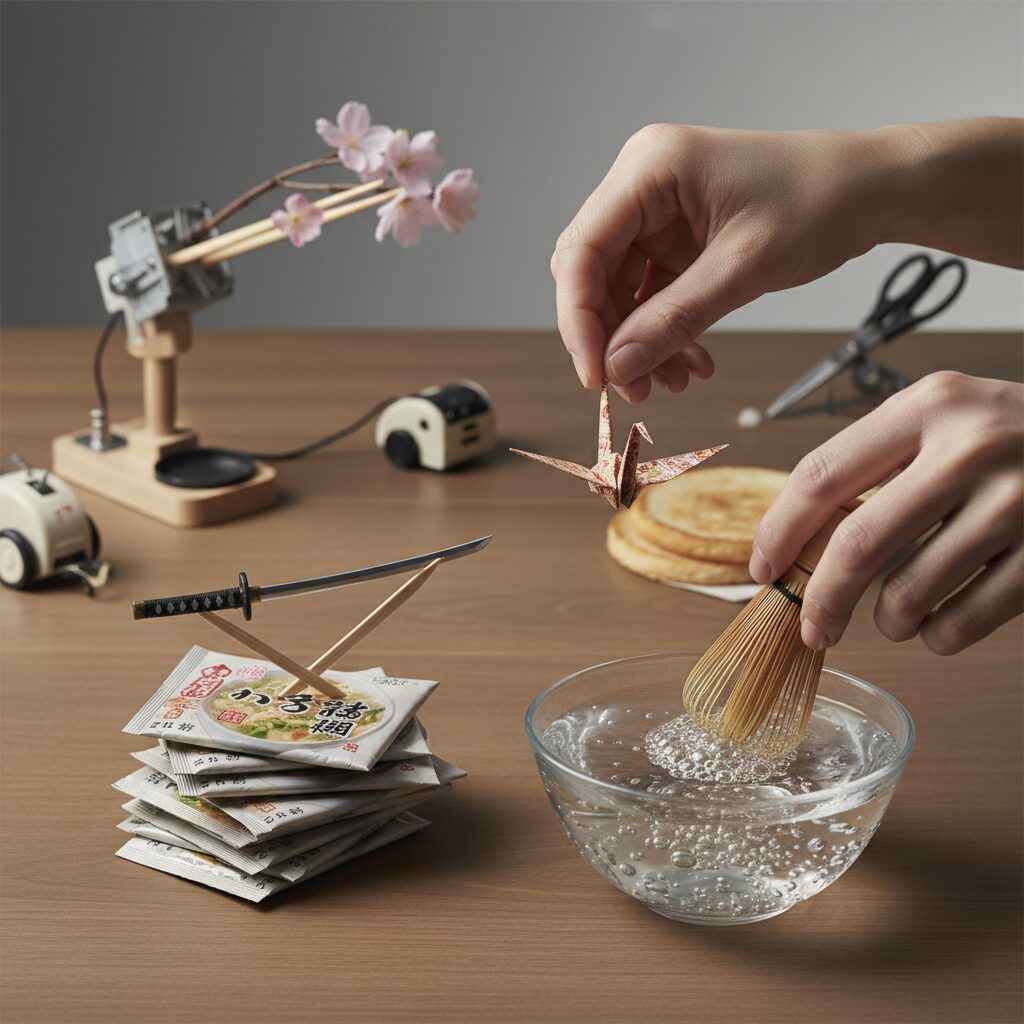
A friend of mine once asked me, with genuine confusion, about her coworker in Tokyo. “She’s smart, she’s ambitious, works in finance,” my friend explained, “but she spends every Saturday—and a small fortune—learning how to… whisk tea. Just whisking tea, over and over. What’s the point?”
It’s a perfectly logical question from an outsider’s perspective. In a world obsessed with productivity, efficiency, and quantifiable results, dedicating years, even a lifetime, to something as seemingly impractical as the tea ceremony, flower arranging, or calligraphy can seem baffling. These aren’t side hustles. They don’t pad a resume or generate income. They are, by most modern metrics, gloriously, profoundly useless.
And yet, in Japan, these pursuits are not just considered hobbies. They are revered as serious, disciplined paths of self-cultivation. Millions of people, from high-powered executives to quiet homemakers, devote themselves to these practices with the gravity one might associate with mastering a medical degree or a concert instrument. They are not simply passing the time; they are shaping their very being.
This isn’t about learning a quaint, old-fashioned craft. It’s about engaging with a deep-seated cultural philosophy that finds immense value in the process, not the product. It’s about understanding that the most transformative journeys don’t always lead to a practical destination. To understand modern Japan, you have to understand why a person would spend a decade learning the perfect way to fold a silk cloth, wipe a bamboo scoop, and present a bowl of tea—and consider that time exceptionally well spent. So, let’s unpack the beautiful, complex logic behind Japan’s devotion to the art of ‘uselessness’.
Embracing constant self-reflection further illuminates how even Japan’s most seemingly impractical pursuits serve as profound pathways to personal growth.
The Difference Between a Hobby and a “Path” (道, dō)
First, we need to adjust our vocabulary. In the West, an activity done for pleasure or relaxation is called a “hobby.” It’s something you pick up, enjoy, and can easily set aside. It exists on the outskirts of your ‘real’ life—your career, family, and responsibilities. In Japan, while the idea of a casual hobby does exist, traditional arts fall into a completely different category.
Many of these disciplines end with the character 道, pronounced dō or michi, meaning “the way” or “the path.” So you don’t simply practice the tea ceremony; you walk the sadō (茶道), the Way of Tea. You don’t just do flower arranging; you follow the kadō (華道), the Way of Flowers. The same applies to shodō (書道), the Way of Calligraphy, and the martial arts, collectively known as budō (武道), the Way of the Warrior.
The inclusion of dō is crucial. It elevates the activity from a mere pastime to a lifelong spiritual and philosophical journey. The aim is not to “complete” the skill or reach a point where you can say, “I have now mastered tea.” Such a notion is nearly inconceivable in this context. The path is infinite. The practice itself is the destination.
This shift in perspective is essential. A hobby is meant to serve you, providing relaxation or entertainment. A dō, however, is something you serve. You commit yourself to its discipline, history, and challenges. It represents a dedication not only to an activity but to a tradition and a lifelong method of self-improvement. The emphasis moves from external accomplishment to internal growth. You’re not simply learning to arrange flowers; you’re cultivating patience, an appreciation for asymmetry, and a deep awareness of the changing seasons.
It’s Not About the Tea, It’s About the Whisking
To truly understand the mindset of dō, you must appreciate its intense, almost reverential emphasis on the process rather than the product. The final result—the bowl of tea, the calligraphic scroll, the floral arrangement—is almost incidental. It serves as a fleeting record of a moment of practice, but the true value lies in the precise, prescribed actions that produced it.
Let’s revisit the tea ceremony. A guest in a tea room isn’t simply there to drink matcha. They are there to witness a carefully choreographed performance, a form of moving meditation. Every gesture is governed by centuries of tradition, known as kata (型), or prescribed forms. The way the host folds the fukusa (silk cloth), the exact angle at which the tea bowl is turned, the number of times the bamboo whisk (chasen) moves back and forth—none of it is random. These movements have been honed over generations to be as graceful, efficient, and aesthetically pleasing as possible.
For the practitioner, the objective is to perform these kata so flawlessly that they become second nature. This demands intense concentration. You cannot be distracted by your emails, your grocery list, or the argument you had yesterday. You must be fully present, your mind focused entirely on the task at hand: the weight of the bamboo ladle, the sound of the hot water, the feel of the ceramic in your hands.
Here, the influence of Zen Buddhism, deeply intertwined with these arts, becomes evident. The practice aims to quiet the restless ego, the “noisy mind” that is constantly judging, analyzing, and worrying. By surrendering to the strict discipline of the kata, the practitioner can reach a state of mindfulness, becoming fully absorbed in the present moment. The product—the bowl of tea—may be delicious, but its true purpose is to act as a vehicle for that moment of focused calm. The real work is internal.
The Structure of Learning: From Shu-Ha-Ri to the Iemoto System
The manner in which these arts are taught also reflects their gravity. You don’t merely watch a few online videos and give it a shot. Instead, you enter a structured, hierarchical realm with its own ancient logic for passing down knowledge, ensuring the tradition remains preserved.
Shu-Ha-Ri (守破離): The Three Stages of Mastery
At the heart of this pedagogy is the concept of Shu-Ha-Ri, a three-stage learning model that applies to everything from martial arts to tea.
The first stage is Shu (守), which means “to protect” or “to obey.” This beginning phase requires the student to precisely copy the master’s teachings as they are presented. There is no space for interpretation or personal creativity. The student learns the fundamental rules, the basic kata, and practices them rigorously. They absorb the tradition in its purest form, trusting the process and internalizing the forms until they become automatic.
Next comes Ha (破), meaning “to break” or “to detach.” After thoroughly absorbing the fundamentals and building muscle memory, the student can start to experiment. Having mastered the rules, they may begin to bend them, question the traditions, explore variations, and incorporate their own personality and understanding into the practice. This stage involves conscious innovation, resting on a strong foundation of discipline.
The final stage is Ri (離), “to leave” or “to separate.” This highest level of mastery occurs when the practitioner has completely internalized the art and is no longer confined by its rules or forms. The technique becomes a natural extension of their being. They can move freely and spontaneously while remaining perfectly aligned with the principles of their art. They are not breaking the rules but have transcended them, becoming the art itself. This ultimate goal is a state of effortless perfection known as mushin (無心), or “no mind.”
The Iemoto (家元) System: A Pyramid of Tradition
The Shu-Ha-Ri journey usually unfolds within the iemoto system, a traditional guild-like structure overseeing most classical arts. At the top of this hierarchy stands the iemoto, the grand master or head of a school (e.g., the Urasenke school of tea ceremony). This individual is the hereditary leader of the lineage, holding ultimate authority over the correct forms and philosophy of their school.
Students join a local branch under a licensed teacher, who was certified by a senior teacher, and so on, up to the iemoto. Advancement is marked by a series of licenses and certifications, which may take years or even decades to earn. This system is formal, often costly, and requires considerable dedication. It fosters a strong sense of community and lineage, emphasizing that you are not just acquiring a skill but becoming part of a chain of tradition that extends back centuries.
Finding Freedom in Restriction
To many Westerners, who are brought up on ideals of individual expression and creative freedom, this system can seem stifling. A world of rigid kata, strict hierarchies, and years of copying a master appears to be the very opposite of creativity. However, this is a fundamental cultural misunderstanding.
In Japanese aesthetic philosophy, strict form is not a constraint; it is the key to liberation. The endless repetition of kata is intended to engrain the technique into your nervous system, shifting it from your conscious mind to your subconscious body. Once this occurs, you are freed from the burden of thinking about the mechanics. Your mind is liberated to focus on the more subtle, profound elements of the art—the feeling, the spirit, the connection with the season, and the interaction with your guest.
Consider a concert pianist. They spend years practicing scales and exercises—their kata. They do this so that when performing a sonata on stage, they don’t have to think about finger placement. The technique becomes automatic. This freedom allows them to devote their attention fully to musicality, emotion, and expression. The discipline of scales creates the freedom for artistry.
This is exactly the reasoning behind the dō arts. By mastering a restrictive form, you gain access to a deeper kind of freedom. You reach the state of mushin, “no mind,” where you can act with perfect, intuitive grace. The archer in kyūdō (the Way of the Bow) does not consciously aim; the arrow is released when mind, body, and spirit are perfectly aligned. The calligrapher doesn’t think about the character; the brush flows as an extension of their energy. This freedom is found not by breaking the rules, but by internalizing them so completely that they vanish.
Why Bother in the 21st Century?
So why does this philosophy continue to resonate so deeply in hyper-modern Japan? In a society famed for technological innovation and an unyielding work ethic, what draws people to these slow, inefficient, and seemingly impractical pursuits?
An Antidote to Modern Life
Perhaps the strongest reason is that these practices offer a powerful counterbalance to the stresses of modern living. In a world filled with constant digital distractions, endless notifications, and the pressure to multitask, a dō practice provides a sanctuary of deep, focused concentration. For the two hours spent in the tea room or at the dojo, you are unreachable. You must be fully present. This intentional inefficiency acts as a rebellion against a culture obsessed with instant gratification. You cannot rush the whisking of tea. You cannot speed up a perfect brushstroke. The practice compels you to slow down, breathe, and fully inhabit the moment.
The Pursuit of Tangible Beauty and Self-Discipline
In an era when much of our work and social interaction is abstract and digital, taking place on screens within a placeless cloud, traditional arts offer a profound connection to the tangible, physical world. There is great satisfaction in the cool touch of a ceramic bowl, the earthy aroma of wet ink on paper, the sharp fragrance of a freshly cut flower stem. These are real experiences, engaging all the senses.
Additionally, the discipline required fosters virtues valuable in every aspect of life. Patience, perseverance, meticulous attention to detail, and respect for one’s tools and mentors are all integral to the learning process. The quiet confidence gained from gradually mastering a challenging physical skill is something that cannot be downloaded or purchased. It must be earned, one session at a time.
Connecting with Cultural Identity
Lastly, for many Japanese people, practicing a traditional art creates a deep, personal bond with their cultural heritage. Visiting a temple in Kyoto or admiring an ancient painting in a museum is one thing; embodying the aesthetics and philosophies of one’s culture through personal practice is quite another. By learning the Way of Tea, you are not merely studying history—you are participating in a living tradition, experiencing firsthand the principles of harmony, respect, purity, and tranquility (wa, kei, sei, jaku) that have guided practitioners for centuries. It is a way to understand one’s identity from the inside out.
So, when we observe someone dedicating their life to an apparently “useless” art, we are not witnessing a frivolous hobby. We are witnessing a profound act of self-cultivation. The point is not the utility of the final artifact. The point is the transformation of the person holding the whisk, brush, or flower. These arts serve an internal purpose—they are tools for refining the spirit, for finding a quiet center in a noisy world, and for connecting with the enduring beauty of tradition. Ultimately, perhaps the most valuable lessons we can learn are those with no practical purpose at all.