You see it your first time on a crowded Tokyo train. A man in a perfectly tailored suit, briefcase nestled between his knees, is fast asleep. His head dips forward in a steady, rhythmic bob, perfectly in sync with the sway of the carriage. Back in Canada or the States, this might earn a few side-eyed glances, a quiet judgment about a late night out or simple laziness. Here, nobody bats an eye. A few minutes later, in a corporate conference room, a senior manager seated at the far end of the table has her eyes closed, breathing deeply. Her colleagues drone on with the PowerPoint presentation, completely unbothered. She isn’t being rude; she’s just exhausted.
This isn’t just napping. This is inemuri (居眠り), a uniquely Japanese social phenomenon that often baffles outsiders. The word itself offers the first clue to its cultural acceptance. It’s a compound of two characters: i (居), from the verb iru, meaning “to be present,” and nemuri (眠り), which means “sleep.” The direct translation, “sleeping while present,” captures a paradox that is fundamental to understanding Japanese society. It’s a form of socially sanctioned public sleep, a micro-hibernation conducted in the very places where one is expected to be most alert: the office, a classroom, the commuter train.
To the uninitiated, it looks like a simple case of dozing off. But inemuri is a complex performance, governed by unspoken rules and freighted with cultural meaning. It’s a public display that communicates not laziness, but diligence. It’s a quiet testament to having worked so hard, for so long, that the body has simply reached its limit. This isn’t a sign of someone shirking their duties; it’s often seen as evidence of someone who has fulfilled them to the point of collapse. Understanding inemuri is to understand the immense pressures, the social obligations, and the quiet resilience that define daily life in modern Japan.
This nuanced approach to rest is paralleled by the restorative practice of forest bathing, which further illustrates how everyday rituals in Japan are thoughtfully designed to foster balance and renewal.
More Than Just a Nap: The Semantics of Sleep
To understand the concept of inemuri, you first need to unlearn your preconceived ideas about sleep. In the West, sleep is generally viewed as a binary state: you are either awake or asleep. These two states are separate activities that occur in distinct places—one in the world, the other in bed. However, the Japanese language offers a more nuanced vocabulary that reflects a different cultural reality.
Inemuri differs from a nap, known as hirune (昼寝). Hirune is a deliberate and intentional act of resting. You might take a hirune on a weekend afternoon at home on the sofa. It suggests a withdrawal from your social and professional duties. You have clocked out, both literally and figuratively, to recharge. Neru (寝る) is the general verb for sleeping, referring to the kind you do at night in your futon for several hours.
In contrast, inemuri represents a liminal state. It is a temporary, opportunistic lapse into sleep that happens within a social setting where one has not withdrawn. The person practicing inemuri remains in their assigned social space—the student at their desk, the employee at the meeting table, the commuter on the train. They have not excused themselves. Physically and officially, they are still present. This distinction is crucial.
By remaining in place, the individual fulfills their primary social responsibility: presence. In a group-oriented culture, merely being there and participating in the collective is of utmost importance. Leaving a meeting because you are tired would be seen as a selfish act, prioritizing personal needs over the group’s agenda. Inemuri provides a clever compromise, allowing for a brief moment of physical rest without constituting a social breach. You are rebooting your internal hard drive while the main system continues to operate. It’s a tolerated loophole, a way to snatch a few moments of rest without officially abandoning your position.
The Unspoken Rules of Socially Acceptable Sleep
Like many aspects of Japanese culture, inemuri is governed by a subtle and complex set of unwritten rules. It’s not an open invitation to fall asleep anywhere. You can’t simply sprawl out under the conference table and start snoring. The act of inemuri must convey that the sleep is an involuntary result of exhaustion, rather than a deliberate sign of disrespect. The key is to maintain an appearance of engagement, even while unconscious.
Maintaining Social Form
The most critical rule is to preserve your physical place and posture. You must remain upright. On a train, this means sitting in your seat, perhaps resting your head against the window or nodding forward. Leaning onto the shoulder of a stranger is a serious breach of etiquette. It invades their personal space and turns your private fatigue into their public issue. In a meeting, it means sitting at the table, maybe with your head supported by your hand as if deep in thought, or with your head slightly bowed. The body must continue to fulfill its social function, even if the mind has momentarily checked out.
This physical restraint signals that the person is still, to some degree, connected to their social obligations. The body language communicates: “I am so tired I can barely keep my eyes open, but I am still attempting to show respect for this space and the people within it.”
Context and Hierarchy
The acceptability of inemuri largely depends on the context and social status. It is usually acceptable during passive activities: a long commute, a university lecture, or a lengthy internal meeting where you are not the primary speaker. Conversely, it is unthinkable during active engagements, such as one-on-one conversations with a superior or while presenting to a client. The tacit agreement is that inemuri is appropriate during times when immediate, active participation is not required.
Hierarchy plays an important role as well. A senior manager, or buchō, dozing off in a meeting is often seen as a sign of their heavy responsibilities. It’s assumed they stayed up late handling important company matters. Their exhaustion symbolizes dedication. In contrast, for a new employee, the same behavior might be viewed as boredom, disrespect, or a lack of discipline. A junior staff member has not yet earned the privilege to be visibly exhausted. Their role is to absorb information and show unwavering attentiveness. This double standard highlights how inemuri is linked to status and perceived contribution.
The Art of the Quick Recovery
A vital aspect of successful inemuri is the ability to quickly return to alertness when needed. If the meeting leader asks you a direct question, you are expected to suddenly wake, perhaps with a slightly embarrassed “My apologies,” and immediately re-engage. This reinforces the idea that you were in a light, shallow sleep, not a deep, oblivious one. It shows you were still “present” enough to be called back to attention. This skill to switch between states is part of the performance, suggesting a mind that is never truly off duty.
A Badge of Exhaustion: The Cultural Logic Behind Inemuri
So why is this practice so widely accepted? The answer is deeply rooted in Japan’s work ethic and its cultural appreciation of diligence. In a society where long working hours have traditionally been celebrated, exhaustion is not viewed as a weakness; rather, it is a visible sign of effort and sacrifice.
The Performance of Diligence
Japan’s post-war economic growth was driven by a famously committed workforce. The ideal of the “corporate warrior,” or kigyō senshi, who sacrifices personal time and even health for the company’s benefit, became firmly embedded in the national mindset. While this model is now being questioned, its influence remains. In this context, inemuri serves as a non-verbal demonstration of one’s dedication.
An employee sleeping at their desk is not regarded as wasting company time. Instead, the narrative often frames it as a sign of extreme commitment: “Look at Tanaka-san. He must have stayed until midnight finishing that report. He’s completely exhausted.” It becomes tangible proof that you are giving your best. It’s a performative gesture, whether intentional or not, that aligns with the cultural value of gambaru, the perseverance through hardship. In a culture that may offer less direct verbal praise, inemuri can be a quiet, accepted way to show your worth and work ethic.
A Consequence of Urban Life
Beyond corporate culture, the practical realities of life in Japan’s vast metropolitan areas make inemuri necessary. The average commute time in the Greater Tokyo Area often exceeds an hour each way. For many, this involves several train transfers and long periods of standing or sitting. This “stolen” time on the train becomes one of the few chances in a busy day for a brief rest. The train is a transitional space, neither home nor work, and its rhythmic movement is famously sleep-inducing. It has effectively become the public bedroom for millions of weary commuters.
Moreover, Japanese homes tend to be small, with thin walls. In a multi-generational household, finding a quiet place for a nap at home can be challenging. The anonymity of public spaces like trains or libraries offers a unique kind of privacy, allowing a brief personal shutdown amidst the crowd.
The Modern Evolution of a Tired Tradition
As Japan navigates societal changes, the perception and practice of inemuri are gradually evolving. The national dialogue on work-life balance and the risks of overwork, highlighted by the stark term karōshi (death from overwork), has gained considerable attention.
A Shift in Workplace Norms
Younger generations are increasingly challenging the traditional model of complete dedication to the company. Start-ups and tech firms, influenced by global trends, are encouraging more flexible work hours, remote working options, and prioritizing efficiency over long hours. As the value of being physically present in the office for 12-hour days declines, the symbolic status of inemuri as a mark of commitment may also be fading. Companies that proudly promote employee well-being are less inclined to praise those who sleep at their desks.
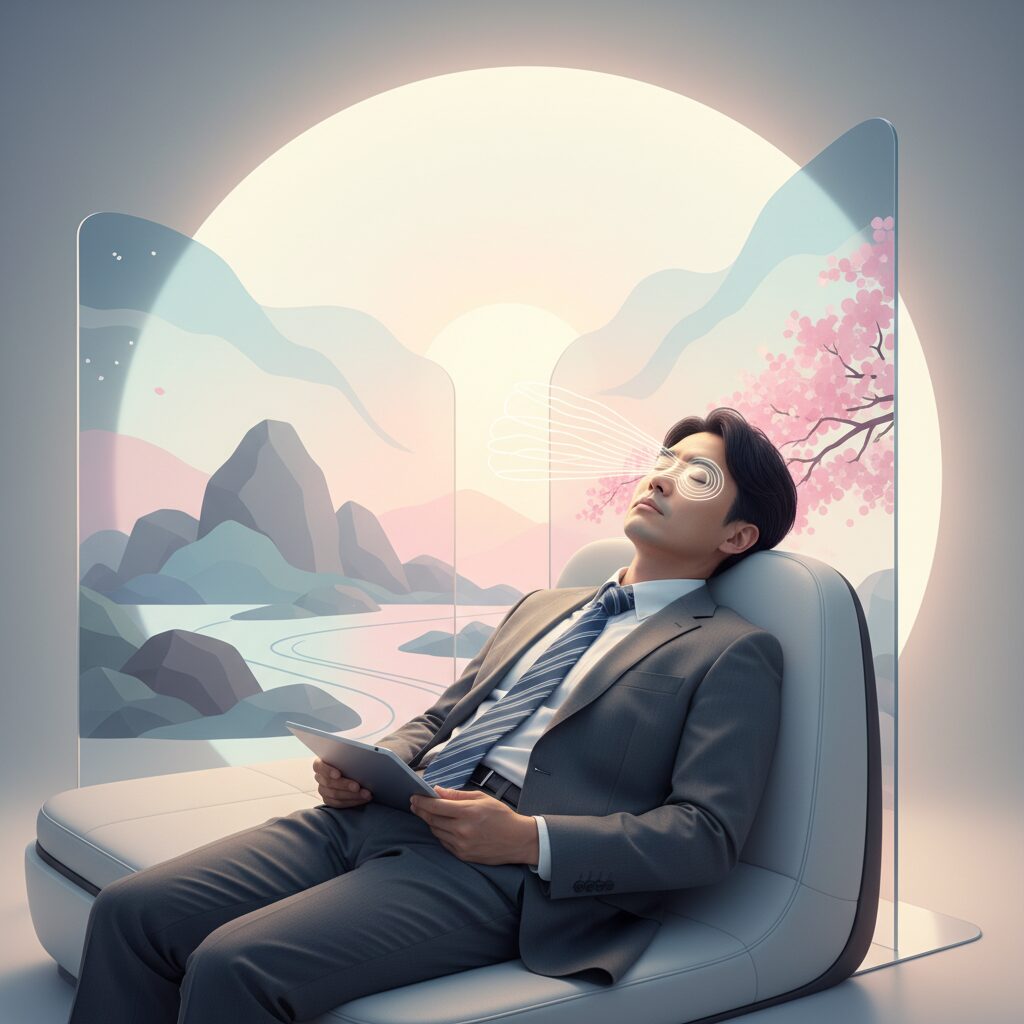
Some progressive companies are even establishing designated napping pods or quiet rooms, effectively legitimizing rest by moving it from the public desk area to a private, authorized space. This approach medicalizes the issue—addressing fatigue as a condition to manage for improved productivity, rather than a cultural expression of diligence. Essentially, it represents the westernization of napping, substituting the ambiguous inemuri with the explicit intent of hirune.
Still a Common Sight
Despite these shifts, inemuri is unlikely to vanish anytime soon. The core factors—lengthy commutes, intense academic demands on students, and persistent pressure to show up and be present—remain firmly entrenched. The nightly sight of heads nodding off on the last train home continues to be an everyday reality for millions. It is a deeply rooted cultural habit and a practical coping mechanism for the relentless pace of modern urban life.
What inemuri reveals is a society’s intriguing and profoundly human response to a difficult dilemma: how to balance overwhelming demands on time and energy with the unyielding social expectation to always belong to the group. It is a silent, subconscious negotiation unfolding daily in offices, classrooms, and train cars nationwide. The next time you see someone slumped in their seat, eyes closed to the world, remember you are not witnessing laziness. Instead, you are observing a quiet testament to perseverance, a brief moment of surrender in a culture that values endurance above all else.