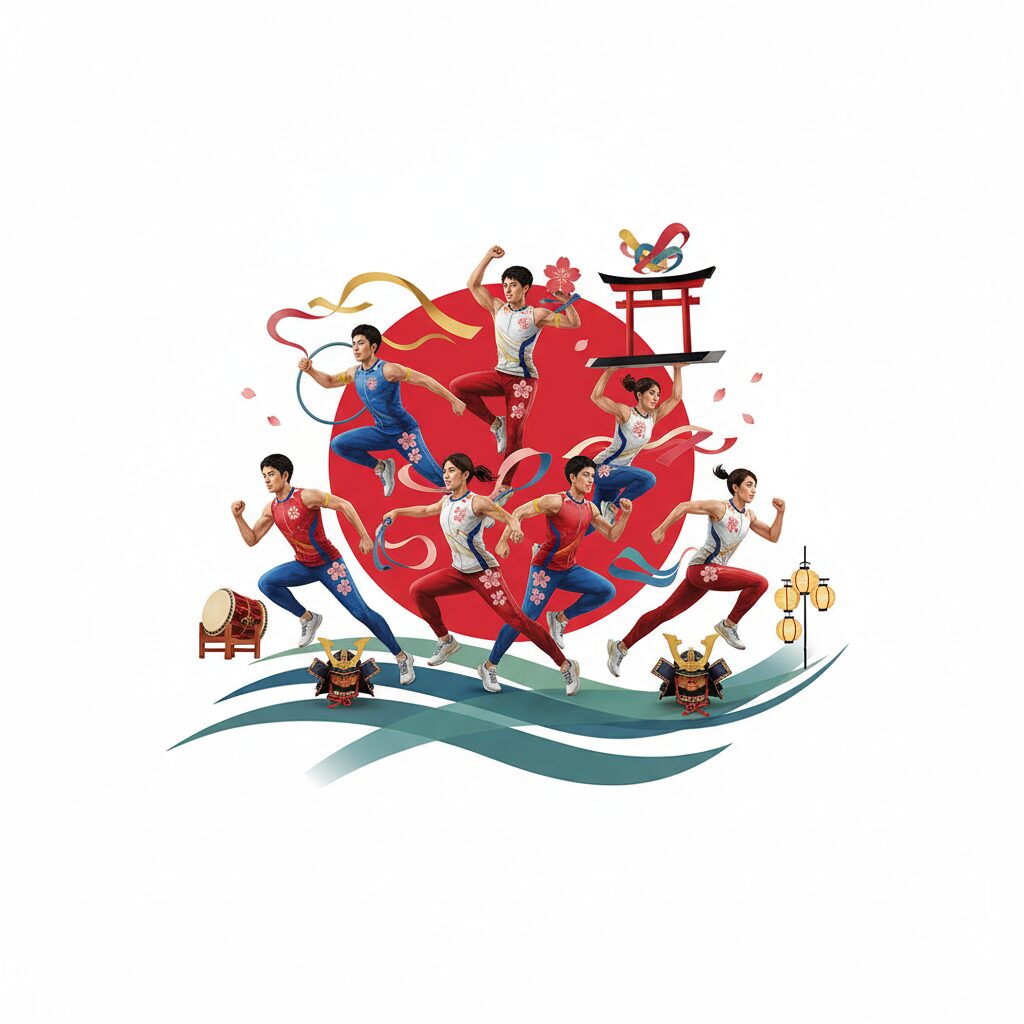
If you find yourself in Japan on a clear, breezy weekend in May or October, you might hear it before you see it: the faint sound of a brass band playing an upbeat march, the rhythmic beat of a taiko drum, and waves of synchronized cheering carrying over the rooftops. Follow that sound, and you’ll likely stumble upon one of the most revealing and vibrant rituals in modern Japanese life: the Undokai, or school sports day.
At first glance, it looks familiar. It’s a field day, a sports carnival. Kids are running races, parents are taking pictures. But linger for more than a few minutes, and you’ll notice things that don’t quite align with the casual, slightly chaotic sports days of the West. The sheer precision of it all is the first clue. Students march onto the field in perfect formation, their coloured hats—typically red for one team, white for the other—bobbing in unison. The opening ceremony is conducted with the gravity of a national event. Every event, from the simplest dash to the most complex group performance, has been practiced for weeks, if not months. The entire day unfolds according to a minute-by-minute printed schedule handed out to every family.
And it’s not just for the kids. The sidelines are a spectacle in themselves. Parents and grandparents arrive at dawn to lay down blue tarps, claiming prime viewing spots with the strategic foresight of generals. They come armed with multi-tiered, exquisitely prepared bento lunch boxes and professional-grade cameras with telephoto lenses. This isn’t just a day to watch your child run; it’s a full-blown community pilgrimage. For an outsider, this is the moment the experience shifts from being a charming local event to a profound cultural lesson. You realize you’re not just watching a school sports day. You’re watching a microcosm of Japanese society in action, a grand, open-air theatre where the nation’s core values are performed, reinforced, and passed down to the next generation. This is the Japan you can’t read about in a guidebook, and understanding the Undokai is a key to understanding the country itself.
The meticulous coordination seen at the Undokai finds a parallel in Japan’s dynamic work culture, where precision and passion drive every endeavor.
The Grand Rehearsal: Precision Before Play
One of the first things that strikes an observer is that Undokai is less a day of spontaneous athletic competition and more a carefully choreographed performance. The actual event is merely the culmination of a long and demanding rehearsal period. In the weeks leading up to it, regular classes are often shortened to make room for hours of practice on the school grounds. The sun-drenched fields transform into a stage for endless drills.
Students practice their entrance march, learning to step in time and turn corners with military precision. They rehearse the group calisthenics, known as rajio taiso (radio exercises), performed in unison by the entire student body to start the day. Each team prepares its respective 応援合戦 (ōen-gassen), or cheering battle—a complex routine of chants, dances, and flag-waving meant to intimidate the opposition and boost morale. Nothing is left to chance. Every movement, every cheer, is refined until it becomes second nature.
This intense focus on preparation teaches a core Japanese value: the process is as important, if not more so, than the final result. The aim isn’t merely to win the relay race; it’s to demonstrate discipline, endurance, and the ability to work flawlessly within a large group. The opening and closing ceremonies frame the day with a seriousness that can be surprising. Speeches are delivered by the principal, local dignitaries, and student representatives. The national flag is raised and lowered with solemn respect. This formality is not just for show; it elevates the event from a simple day of fun to an important civic ritual. It conveys to the children that their efforts are part of something bigger than themselves—that they belong to a school, a community, and a nation, and that such membership carries expectations of discipline and respect.
It Takes a Village: The Community on Display
While the students take center stage, the Undokai is equally about the community that supports them. It is one of the rare events in the school year where the entire network surrounding a child’s life—parents, siblings, grandparents, teachers, and even local neighbors—comes together in one place. The school momentarily shifts from being just an educational institution to acting as the town square.
The commitment of the families is remarkable. The well-known ‘blue tarp dash’ is a genuine event, with parents lining up outside the school gates before dawn to claim a good spot. This is not viewed as an inconvenient hassle but as an essential display of parental support. Not securing a prime location is seen not just as a personal shortcoming but as a potential source of embarrassment.
Then there is the bento. The Undokai bento is nothing less than a culinary masterpiece. Mothers often stay up late the night before or rise early to prepare an elaborate, multi-layered feast. These are far from simple sandwiches and fruit. We’re talking about perfectly shaped rice balls (onigiri), decorative sausages cut into octopus shapes, vibrant vegetable arrangements, and fried chicken (karaage), all arranged with an aesthetic finesse that could move a food stylist to tears. This meal, enjoyed with family and friends during lunch, is a key part of the day. It represents love and effort, and there is a subtle, unspoken rivalry among mothers to create the most striking presentation.
By bringing everyone together, the Undokai strengthens the ties that bind the community. It reinforces the collective identity of being a member of a certain neighborhood or a parent at a particular school. It is a day of shared purpose, pride, and experience, gradually weaving the social fabric tighter with each passing year.
The Philosophy of the Field: Lessons in ‘Wa’ and ‘Ganbaru’
At the core of the Undokai lies a curriculum of social values. It is on this dusty sports field that abstract concepts central to Japanese culture become tangible and deeply felt by children. The entire day serves as a hands-on lesson in collectivism and the significance of the group.
Team Red vs. Team White
From the moment students enter elementary school, they are usually split into two teams for the Undokai: 赤組 (akagumi, the red team) and 白組 (shirogumi, the white team). This straightforward binary division is a stroke of brilliance. It dissolves pre-existing friendships and cliques, instantly creating a new, all-encompassing identity. For this single day, your main loyalty is to your color. Every action you take benefits the team. Individual successes are celebrated, but only because they contribute points to the team’s overall score. The ultimate goal is the team championship banner, a shared victory.
The Virtue of Effort (Ganbaru)
In the West, sports often focus primarily on winning. In Japan, while winning is valued, the emphasis is on ganbaru (頑張る)—giving your absolute best effort and persisting through challenges. The Undokai is filled with moments that honor this spirit. A young child who stumbles and falls during a race but courageously gets up and finishes long after the others have crossed the finish line will often receive the loudest, most heartfelt applause of the day. Their tears are greeted with cheers of encouragement. The message is clear: giving up is the only true failure. Effort, struggle, and resilience are virtues to be publicly recognized and praised.
Harmony and Cooperation (Wa and Kyōryoku)
Many of the most iconic Undokai events are deliberately designed to be impossible without flawless group cooperation. They serve as physical metaphors for the Japanese ideal of social harmony, or 和 (wa). The centipede race (mukade kyōsō), where a line of students has their ankles tied together and must run as one, is a chaotic yet powerful lesson in finding a shared rhythm. The giant ball roll (ōdama korogashi), where a team maneuvers a massive inflatable ball around a course, requires everyone to push in unison. These games aren’t about individual speed or strength; they emphasize subordinating one’s ego and impulses for the smooth functioning of the group.
A Catalogue of Coordinated Chaos: The Classic Undokai Events
To fully appreciate the spirit of Undokai, one needs to understand the distinctive events that compose the day. These are not typical track and field contests; they are inventive, often elaborate games designed to test teamwork and provide unforgettable spectacles.
Kumitaiso (Group Gymnastics)
Perhaps the most dramatic and controversial of all Undokai events is kumitaiso. This involves students, usually in the upper grades of elementary or middle school, collaborating to form large human structures, culminating in giant, multi-level pyramids. It is a stunning display of trust, balance, and interdependence. Each child plays a crucial role, and the failure of one can cause the entire formation to collapse. The weight of their peers literally rests on their shoulders. While it stands as the supreme symbol of collective effort and shared risk, in recent years it has faced significant criticism due to the high risk of injury, prompting many schools to reduce or eliminate the most hazardous formations.
Kibasen (Cavalry Battle)
The kibasen is a controlled contest that channels competitive energy into a team-based format. Groups of four students form a “horse”—three on the bottom linking arms, with a fourth, the “rider,” perched on their shoulders. The goal is for riders to snatch the hats or headbands off opposing riders. It’s a frantic, strategic, and exciting event that demands strength from the base, agility from the rider, and continuous communication and strategy throughout the unit.
Tamaire (Ball Toss)
A seemingly simple game, tamaire is a frenzy of collective effort. A tall pole with a basket at the top is placed in the center of each team’s area. At the signal, all students begin throwing small beanbags or balls (tama) into their basket simultaneously. It’s not about precise aim but about overwhelming the target with sheer volume. For a minute of pure chaos, the air is filled with flying balls as everyone contributes to the single goal of filling the basket. The counting of the balls at the end, often done individually with the whole school counting along, is a moment of great excitement.
The Unspoken Curriculum
If the school’s official curriculum covers subjects like math and language, the Undokai imparts the unofficial curriculum: how to be part of Japanese society. It serves as a practical lesson in social dynamics. Students learn about hierarchy as older students (senpai) take on the responsibility of leading and guiding the younger ones (kōhai). They understand the importance of fulfilling their specific roles, no matter how small, for the success of the whole group. They are taught to manage their emotions in public, celebrating victory with humility and accepting defeat gracefully. They learn that their individual identity is deeply connected to the groups they belong to.
This is the ‘aha!’ moment for the foreign visitor. You realize that the careful organization isn’t just about efficiency; it’s about fostering respect for order and systems. The synchronized movements aren’t merely for visual appeal; they teach the body and mind to move in harmony with others. The strong community involvement isn’t just about support; it demonstrates that the group’s efforts and the children’s growth are the responsibility of the entire community. You’re not just watching children play games. You are witnessing a society actively shaping its next generation of citizens.
A Tradition in Transition?
Like any deeply rooted cultural tradition, the Undokai is not exempt from the challenges posed by a changing society. The event today differs somewhat from how it was thirty years ago. Increasing safety concerns have led many schools to reconsider high-risk activities such as kumitaiso. The intense summer heat, influenced by climate change, has caused many regions to shift the event from its traditional autumn date to late spring. Some schools, addressing worries about excessive competition and the pressure it places on less athletic children, have attempted to downplay the winning-and-losing aspect by introducing more non-competitive, cooperative games.
Moreover, changing family dynamics have played a role. With more dual-income households, it can be more difficult for both parents to attend. The declining birthrate results in fewer children, smaller schools, and sometimes less of the grand scale that characterized the Undokai of the past. Yet, despite these changes, the fundamental spirit of the day persists. The core values of teamwork, perseverance, and community continue to hold significant importance.
The View from the Blue Tarp
To sit on a blue tarp on a sunny Saturday, surrounded by the hum of a thousand conversations, the scent of sunscreen and delicious bento, and the sounds of children giving their all for the glory of the Red or White team, is to receive a privileged glimpse into the heart of Japan. It’s easy at first to misinterpret the event, seeing only rigidity and a lack of individual expression. Yet as the day progresses, you witness the laughter, the tears, and the genuine camaraderie. You notice the pride in a grandfather’s eyes and the love packed into a mother’s lunchbox.
You come to understand that the Undokai is a finely tuned system for building community. It cultivates a deep sense of belonging and shared identity that is both powerful and profound. It’s a day when the usually invisible threads connecting people—to their families, schools, and neighborhoods—become visible, celebrated, and strengthened. It is, quite simply, one of the most honest and revealing cultural performances Japan offers, unfolding not in a theatre, but on the humble, dusty grounds of a local school.