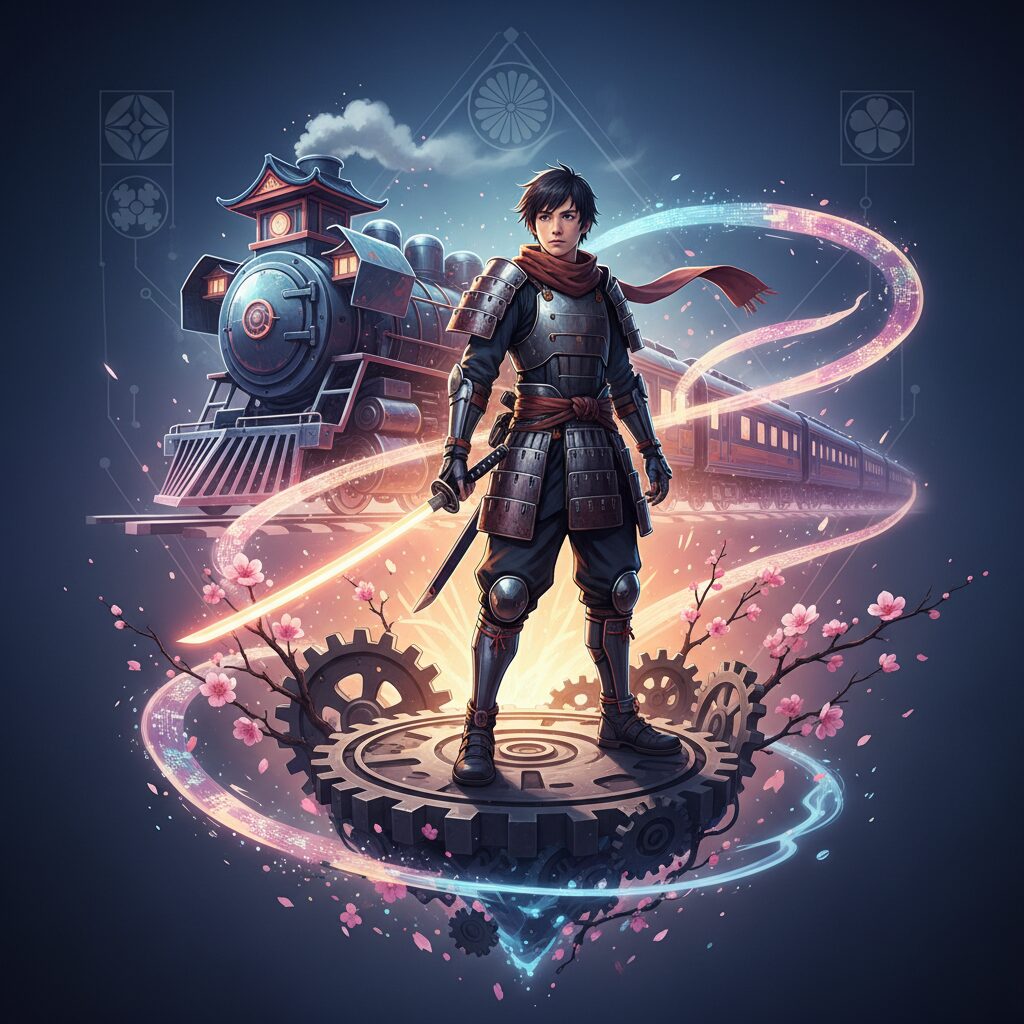
You know the scene. It’s late, the only light in the room is the glow of a screen, and a tiny, pixelated hero is running back and forth in a digital forest, fighting the same low-level slime monsters over and over again. The battle music has become a hypnotic drone. This isn’t about excitement; it’s about the grind. It’s about methodically earning just enough experience points—XP—to level up. It’s a core loop of almost every Japanese Role-Playing Game (JRPG) ever made, from Dragon Quest to Final Fantasy. It’s tedious, it’s repetitive, and it’s absolutely essential.
Now, swap the screen for a window overlooking Tokyo at 9 PM. Swap the pixelated hero for a young office worker in a crisp, slightly rumpled suit, staring at a spreadsheet. The slime monsters are endless rows of data that need to be checked. The hypnotic battle music is the low hum of the office air conditioner. He’s not fighting a dragon; he’s perfecting the formatting on a PowerPoint slide for a 9 AM meeting. He’s not doing it for glory. He’s doing it because it’s what you do. He’s grinding.
It might sound like a stretch, but the more time you spend in a traditional Japanese corporate environment, the more you realize it’s not a stretch at all. The underlying logic, the psychological rewards, and the entire social structure of the Japanese workplace often feel like they were designed by the same people who created the world of Ivalice or Hyrule. The daily life of a salaryman is, in many ways, the most immersive, high-stakes JRPG ever conceived. It’s a game where the rules are unwritten, the leveling is slow, and the ultimate prize isn’t a magical sword, but a stable life and a respectable retirement. The parallels aren’t just cute coincidences; they reveal something fundamental about the Japanese mindset regarding effort, progress, and one’s role within a larger collective quest.
Japanese office life isn’t just a grind of endless spreadsheets—it’s also a journey into honne and tatemae that unveils the delicate balance between private truth and outward conformity.
The Grind as the Goal
In the West, the “grind” is often viewed as a necessary evil—the tedious part you have to endure to reach the rewarding part. You grind in a game to become strong enough to defeat the exciting boss. You grind at work to earn a promotion or bonus. The grind is simply a means to an end. In Japan, however, both in games and workplaces, the grind is frequently the goal itself. The process becomes the performance.
The Virtue of Repetition
Consider the early moments of a JRPG. You start off weak, poorly equipped, and the world is full of creatures that can easily overpower you. So what do you do? You don’t rush to confront the main villain. Instead, you spend hours battling slimes, bats, and goblins around the starting town. Each victory yields a small amount of XP and a few coins. It’s a slow, painstaking accumulation process. The game doesn’t reward flashy, risky moves; it rewards persistence. It teaches that strength is built not through isolated acts of brilliance but through the patient, disciplined repetition of basic tasks.
Now, imagine a Japanese office. A junior employee might spend their entire first year doing little more than making copies, taking meeting notes, answering phones, and pouring tea for guests. They are essentially fighting level-one slimes. An architect won’t design a skyscraper on day one; they may spend months or even years drafting detailed components of a larger building. A marketing professional might spend weeks analyzing market data and preparing detailed reports their boss barely glances at. The goal of these tasks isn’t just their direct output. It’s about fostering discipline, attention to detail, and respect for the process. It demonstrates your willingness to endure the grind. This connects deeply with the cultural concept of gambaru (頑張る). Often translated as “to do one’s best,” it holds a much deeper meaning of perseverance—gritting your teeth and enduring hardship without complaint. Spending long hours on seemingly trivial tasks is a visible sign of your gambaru spirit. You aren’t merely working; you’re performing your dedication to the group. The grind becomes a ritual that validates your worth.
Effort Over Innate Talent
JRPGs rarely focus on a chosen one who is effortlessly brilliant from the outset. The hero is usually a blank slate, an ordinary village boy who becomes powerful through steady effort. His strength is earned, one XP at a time. This reflects a deeply rooted cultural belief that values acquired skill over natural talent. The person who stays late every night mastering a task is often more respected than the prodigy who gets it right immediately but doesn’t demonstrate the same level of visible effort.
The office grind physically embodies this belief. It’s a system designed to reward endurance. The long hours, meticulous attention to detail, and willingness to redo work until it’s perfect—that’s how you accumulate corporate XP. It’s less about having groundbreaking ideas and more about showing you can be a reliable, hardworking part of a larger machine. The grind levels the playing field; anyone, regardless of background or inherent talent, can succeed if they’re willing to invest the time. It’s a harsh but, in its own way, democratic system.
The Leveling System: Seniority as XP
So you’ve been grinding for some time. You’ve defeated thousands of slimes, and your XP bar is finally full. Ding! You’ve leveled up. Your stats automatically increase, you might learn a new spell, and you’re a little tougher than before. This progression is slow, predictable, and largely passive—a direct result of the time and effort you’ve invested. This is, perhaps, the most striking parallel of all: the Japanese seniority system.
Nenkō Joretsu: The Unskippable Cutscene of Career Progression
The traditional Japanese corporate ladder is based on a system called nenkō joretsu (年功序列), which means “seniority by length of service.” In this model, your salary, position, and level of responsibility are determined mainly by how many years you’ve been with the company. It is the literal embodiment of an XP bar that fills gradually over time.
You and your cohort of fellow new hires—your dōki (同期)—all begin at Level 1 together. You form the starting party. For the first several years, you all progress at nearly the same pace. You receive similar small, incremental pay raises each year. Promotions occur at predictable intervals. There’s rarely a fast track for a star performer to leapfrog their seniors. Doing so would disrupt the harmony, the wa (和), of the group. It would be like a JRPG character suddenly jumping from Level 10 to Level 50. It breaks the game.
Your seniors, or senpai (先輩), are the higher-level party members. They guide you, teach you the ropes, and sometimes shield you from the “monsters” (difficult clients or demanding executives). You, the kōhai (後輩), are expected to listen, learn, and show respect. This relationship serves as your tutorial. Over time, as you accumulate years of service—your XP—you will eventually become a senpai yourself, guiding the next generation of Level 1 recruits. It’s a long, unskippable cutscene of a career, but it provides a strong sense of stability and predictability.
The Party Is Everything
In a Western RPG, you might create a lone wolf character who can master everything. In a JRPG, the focus is almost always on the party. You have your warrior, your black mage, your white mage, and your thief. Each plays a specialized role, and success depends on making them work together harmoniously. The brash warrior who charges in alone will quickly be defeated. Success is collective.
This perfectly sums up the Japanese office. The individual is secondary to the department (bu, 部) or the section (ka, 課). The goal is not to be the star employee but to contribute to the group’s success. The well-known Japanese proverb, “The nail that sticks up gets hammered down” (deru kui wa utareru), captures this principle. Your performance is measured by how well you support your team. Do you share information? Do you stay late to help a struggling colleague? Do you anticipate your manager’s needs? These actions build trust and prove you are a good party member. The system is designed to smooth out individualism’s sharp edges in favor of a cohesive, predictable group dynamic.
Job Classes and Skill Trees
When you begin a JRPG, you often select a job class—such as a Fighter, a Monk, or a Red Mage. This selection determines your path. A Fighter will never master the ultimate black magic spell, and a White Mage will never possess the highest physical attack. Your potential is directed along a specific, predetermined skill tree.
The Lifetime Employment Skill Tree
Traditionally, the Japanese career path has reflected this structure through the system of lifetime employment (shūshin koyō, 終身雇用). The process starts with shinsotsu ikkatsu saiyō (新卒一括採用), the simultaneous hiring of fresh graduates. Companies bring in young people straight from university as blank slates, aiming to employ them until retirement.
When you enter a company like Mitsubishi or Sony, your “job class” becomes “Mitsubishi Man” or “Sony Woman.” You aren’t recruited for a specific, pre-existing skill set; rather, you are hired for your potential to be shaped. The company invests heavily in training you, but it’s a very particular kind of training. You absorb the company’s unique processes, internal politics, and proprietary software. You rotate through various departments every few years—sales, planning, accounting—to develop a comprehensive understanding of the organization. You are acquiring skills on the “Mitsubishi” skill tree. These skills are extremely valuable within the company but often do not transfer easily elsewhere. Switching companies mid-career was traditionally regarded as disloyalty, like a Paladin suddenly wanting to become a Dark Knight—it was a betrayal of your party.
Zangyō: The Limit Break of Corporate Life
In many JRPGs, a special meter fills as you take damage or perform actions. When full, you can unleash a powerful “Limit Break” or “Overdrive”—a special attack that can shift the tide of a tough battle. It represents a burst of extraordinary effort beyond your normal limits.
This is the role of zangyō (残業), or overtime, in the Japanese workplace. It is not merely working extra hours; it is a demonstration of extreme dedication. When a major project deadline approaches—the corporate boss battle—staying at the office until midnight, sleeping at your desk, and working through the weekend become the expected Limit Break. It signals to everyone in the party that you are willing to sacrifice your personal life force (your time and energy) for the collective objective. It is a costly but powerful special move. While the West increasingly emphasizes work-life balance, in many traditional Japanese companies, the willingness to unleash your zangyō Limit Break remains a key indicator of your commitment to the quest.
The Boss Fights and the Final Fantasy
All the grinding, the slow leveling, the careful party management—it all culminates in the boss fight. These are the dramatic punctuation marks in a long journey of repetition. They are the moments that challenge everything you’ve learned and push your party to its limits.
In the corporate world, these boss fights are the crucial presentations, the final negotiations with an important client, the annual budget reviews, or the launch of a new product. These are intense, focused periods where the entire team must unite. The preceding months of grinding—the endless meetings, the late-night report writing, the internal consensus-building (nemawashi)—were all preparation for this moment. Everyone knows their role. The section chief (kachō) acts as the party leader, directing strategy. The veteran employees deploy their most refined skills. The junior members support by ensuring the materials are flawless and the logistics are managed. Victory isn’t rewarded with individual bonuses or flashy promotions. Instead, it earns a collective sigh of relief, a respectful bow from the boss, and maybe a team dinner with plenty of beer. The reward is the shared experience of conquering a great challenge together. The party has survived and can now return to grinding for the next boss.
And what is the endgame? What is the ultimate fantasy this entire system is built around? It’s not necessarily becoming the CEO. For most players, the final goal is reaching teinen (定年), the mandatory retirement age, typically between 60 and 65. After a lifetime of loyal service to one company, you receive your taishokukin (退職金), a lump-sum severance payment. This is the treasure chest at the end of the final dungeon. It’s the reward for seeing the long, arduous quest through to its end. The grand prize is a life of stability, predictability, and the security of having fulfilled your role in the social contract. It is a quiet, honorable victory.
The Cultural Script: Why the Game Resonates
It’s no coincidence that the JRPG genre was born and perfected in Japan. These games didn’t invent the concept of grinding; rather, they brilliantly gamified a cultural mindset that was already deeply embedded.
The structure of the Japanese workplace—and by extension, the JRPG—is shaped by centuries of social and economic history. The Confucian focus on group harmony, respect for elders, and a clear social hierarchy serves as the foundational code. The rigid bureaucracy of the samurai era laid the groundwork for corporate structure. The rapid industrialization during the Meiji period demanded a disciplined, collective workforce. Most significantly, the post-war economic miracle established the social contract: in return for absolute loyalty and tireless effort, the company guaranteed absolute security. This was the great national quest.
JRPGs surged in popularity during the 1980s, at the height of Japan’s economic bubble. They embodied the perfect fantasy for a generation groomed to enter this very system. The games offered a map and mythology for the life they were expected to live. They taught that persistence, loyalty, and teamwork were the highest virtues, turning the very real principles governing society into a fantasy world.
Naturally, the game is evolving. The economic stagnation of the “Lost Decades” has eroded the promise of lifetime employment. Younger generations, raised with the internet and a broader global outlook, are less willing to sacrifice their personal lives for corporate loyalty. They’re beginning to pursue side quests, shifting careers like multi-classing, and questioning if the final treasure chest justifies the 40-year grind. The old game is being patched and updated—sometimes awkwardly—with new ideas like remote work and performance-based pay.
Yet the old logic endures. It’s still evident in how meetings are conducted, the expectations set for new hires, and the lasting popularity of JRPGs themselves. These games offer more than mere escapism; they provide a peculiar kind of comfort. They depict a world that, despite dragons and magic, operates on clear, understandable, and deeply familiar rules: work hard, trust your team, respect the process, and in time, you will level up. It’s a compelling narrative that continues to shape the rhythm of life for millions in Japan, long after the console is turned off.