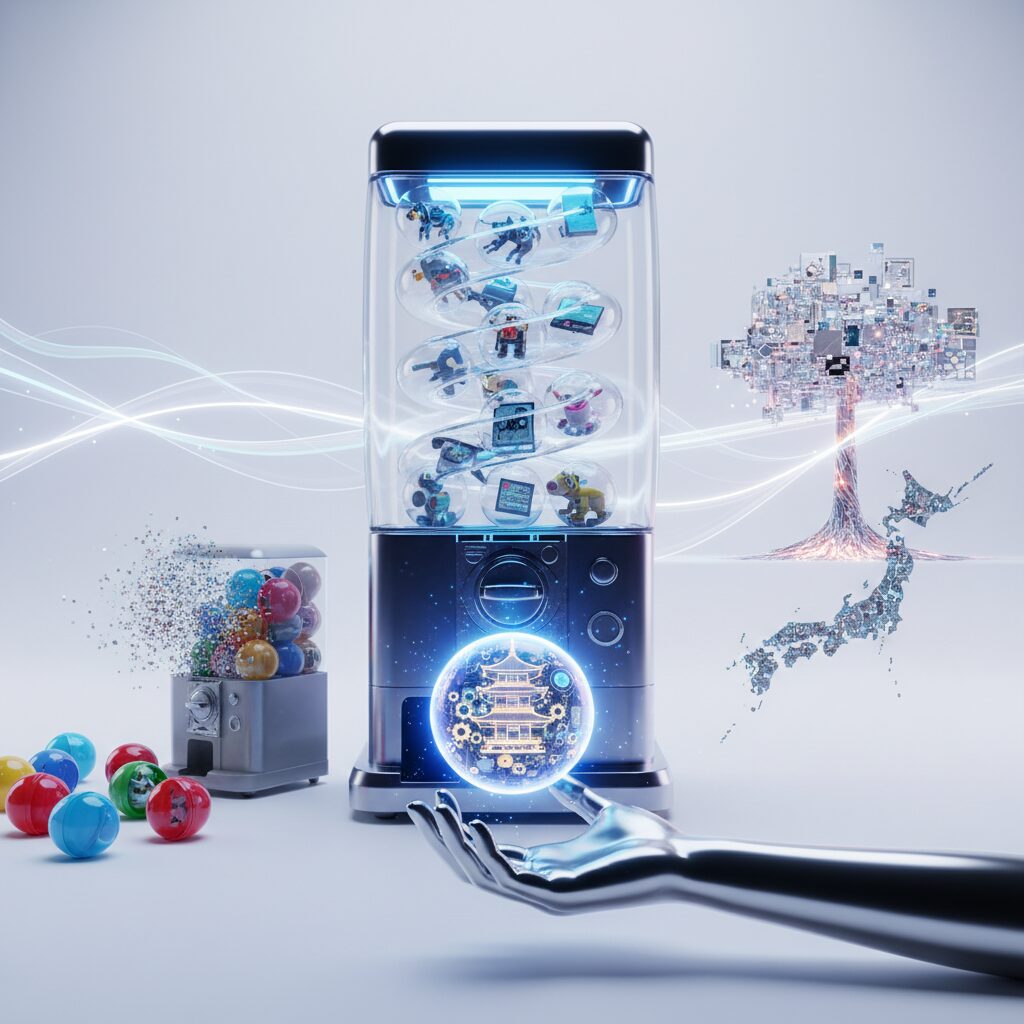
You’ve seen them. Clustered in front of electronics stores in Akihabara, lined up in silent rows at airports, or tucked away in a corner of your local supermarket. They are the ubiquitous gachapon machines: chests of plastic bubbles, each promising a small, mysterious treasure for a few hundred yen. To the casual observer, they look like simple toy dispensers for children, a way to quiet a nagging kid for a few minutes. And for a long time, that’s exactly what they were.
But look closer. Watch who’s feeding coins into the slots. You’ll see teenagers, yes, but you’ll also see office workers in suits, stylish young women, and serious-looking men in their forties. They turn the crank with a familiar, practiced motion. They listen for the heavy gacha-gacha sound of the mechanism turning, followed by the satisfying pon as the capsule drops into the tray. They open the plastic sphere not with childish glee, but with the focused intensity of a collector. Inside isn’t a cheap, poorly molded cartoon character, but a hyper-detailed miniature of a praying mantis, a perfect replica of a vintage Sony cassette player, or a tiny, surrealist sculpture of a cat admiring its own biceps. This is the modern world of gachapon, and it is a universe away from simple child’s play.
The evolution from cheap trinket to sophisticated collectible didn’t happen by accident. It’s a story that mirrors the shifts in Japanese post-war society, the rise of otaku culture, and a deep-seated appreciation for craftsmanship and miniaturization. It’s a subculture built on a unique blend of nostalgia, the psychological thrill of the unknown, and the very adult desire to curate one’s own tiny, perfect world. So, how did a vending machine that started as a novelty import become a cornerstone of a multi-billion yen industry fueled by adult collectors? It’s a journey from the penny arcade to the art gallery, one capsule at a time.
The meticulous attention to detail found in gachapon collectibles mirrors the creative spirit thriving elsewhere, as seen in the unique charm of zakka cafes throughout Japan.
From American Novelty to Japanese Mainstay
Like ramen and baseball, gachapon exemplifies Japan’s ability to take a foreign idea and transform it into a distinctive cultural phenomenon. The predecessor of the gachapon machine originated in the United States, where it dispensed gumballs and simple trinkets. Japan first encountered these machines in the mid-1960s when a man named Ryuzo Shigeta, later known as the “Gacha-Gacha Ojisan,” began importing them. He stocked them with small, inexpensive toys and placed them in candy shops and supermarkets.
During the first decade or so, the experience was basic. The machines were often bulky, the prizes generic—little plastic cars, indistinct animals, or simple whistles. Quality was not a priority. The excitement came solely from the process: inserting a coin, turning the crank, and receiving a surprise. It was an affordable, low-risk form of entertainment aimed primarily at children with a few yen to spend. The name gachapon is onomatopoeic, perfectly capturing the two-part sound: the gacha-gacha of cranking the handle and the pon of the capsule dropping into the dispenser. In those early days, it was the sound, rather than the content, that defined the product.
The Bandai Revolution: A New Kind of Prize
The landscape began to change dramatically in the late 1970s when major toy manufacturers, most notably Bandai, entered the capsule toy market. Bandai didn’t just view a vending machine as a means for sales; they recognized it as a new distribution channel. Their insight was revolutionary: what if the prize inside wasn’t simply a random toy, but something people genuinely wanted to collect? What if it was connected to something they already loved?
Their first major success came from linking gachapon to the wildly popular manga and anime series Kinnikuman (known as M.U.S.C.L.E. in the West). They produced small, unpainted rubber figures of the series’ strange cast of wrestling superheroes, called Kinkeshi (a portmanteau of Kinnikuman and keshigomu, meaning eraser). Suddenly, gachapon wasn’t just about receiving a toy; it was about obtaining the toy. Children were no longer content with just one capsule. They wanted to collect every character. They aimed to complete the entire set.
This marked the birth of gachapon as a collecting hobby. By associating the capsules with popular intellectual property, Bandai transformed the experience from a one-time purchase into a passionate pursuit. The figures’ quality, while simple by today’s standards, was a notable improvement over the generic trinkets of the past. Each character was instantly recognizable, capturing the essence of the original material. This formula proved incredibly successful and was replicated with other enormous franchises like Gundam, Dragon Ball, and Sailor Moon. The generation of children who grew up in the 1980s, eagerly trying to collect all the Kinkeshi or SD Gundam figures, became the first generation of adult gachapon collectors.
The Otaku Effect: Niche Appeal and Soaring Quality
As the children who grew up collecting Kinkeshi moved into their teens and twenties during the 1990s and 2000s, two developments occurred: their tastes became more refined, and they began earning their own disposable income. This period also saw the rise of otaku culture entering the mainstream—a broad term describing individuals with passionate, often obsessive interests, especially in anime, manga, and video games. These fans sought more than generic toys; they wanted faithful, high-quality representations of their favorite characters and mechs.
Toy companies recognized a lucrative market ready to be explored. Gachapon manufacturers launched a quiet competition focused on quality, detail, and niche appeal. The target audience shifted beyond children to devoted adult collectors. Prices gradually increased from 100 yen to 200, then 300 yen, enabling the use of better materials, more intricate molds, and detailed paintwork.
This era also gave rise to specialist makers like Kaiyodo, celebrated for their museum-quality figures. Their Choco-Q series, which paired highly detailed, scientifically accurate animal figures with chocolate eggs, demonstrated that demand for miniature quality extended beyond anime fandom. They applied the same precision to their gachapon products, creating figures that resembled miniature sculptures rather than toys. Suddenly, gachapon items could grace display shelves instead of gathering dust in toy boxes. The market diversified, catering to every imaginable niche: historical armor, famous Buddhist statues, ultra-realistic miniature food replicas, and eccentric, surreal art projects. Gachapon had found its adult audience.
The Psychology of the Crank: Why Adults Get Hooked
The lasting appeal of gachapon for adults goes beyond toy quality. It is deeply tied to powerful psychological triggers that make turning the crank irresistible.
The Thrill of the Hunt
At its heart, gachapon is a game of chance—a low-stakes form of gambling. You know the set of possible outcomes, but not which exact one you’ll receive. This uncertainty creates a strong dopamine feedback loop. The anticipation as you turn the crank, the suspense as the capsule rolls down, and the final reveal provide a small but intense thrill. The chance of obtaining a rare “secret” item included in some sets intensifies this excitement. It’s a miniature treasure hunt.
The Joy of Completion
Humans have an innate desire for order and completion, and gachapon taps directly into this collector’s drive. Manufacturers release their products in distinct series, typically consisting of five to seven items. Seeing the display card featuring the full set sparks the urge to collect them all. Each new, unique capsule brings you closer to completing the collection, offering a tangible sense of achievement. The annoyance of receiving duplicates is part of the experience, making the final completion all the more rewarding.
Affordable Luxury and Accessible Art
In a country where living space is limited and many upscale hobbies are costly, gachapon provides an affordable form of indulgence. For just a few hundred yen—the price of a cup of coffee—you can own a beautifully designed, finely crafted object. It’s a guilt-free dose of retail therapy. Companies like Kitan Club pushed these boundaries further with concept-driven gachapon. Their Koppu no Fuchico (“Fuchico on the Cup”) series, featuring a tiny office lady designed to perch on a glass rim, became a cultural sensation. Unconnected to any anime, its charm lay purely in its whimsical, slightly surreal concept and graceful execution. It was affordable, portable art.
The Modern Gachapon Universe: A Destination in Itself

Today, gachapon is more than just a product; it’s an experience. The once-dingy corner machines have been replaced by expansive, brightly lit specialty stores that can only be described as “gachapon department stores.” In areas like Tokyo’s Akihabara and Ikebukuro, shops feature thousands of machines stacked from floor to ceiling, each offering a gateway into a different hyper-specific world. Entire floors are devoted to anime characters, animals, humorous novelties, and miniature replicas of everyday objects.
This has become a destination activity. Visitors come to these stores to explore the vast selection, admire the creativity on display, and spend hours hunting for particular sets. Price points have also diversified. While the 300-500 yen machines remain standard, “premium gachapon” costing 800, 1000, or even 2000 yen have become common. These capsules contain larger, more intricate items with features such as articulated joints, light-up elements, or detailed accessories.
The hobby’s legitimacy is further reinforced by a thriving secondary market. In otaku-focused shops and online, collectors buy, sell, and trade duplicates to complete their sets. This ecosystem, complete with market values for rare items, transforms gachapon from a simple purchase into a genuine, tradable collectible, akin to stamps or baseball cards.
Ultimately, the immense variety of modern gachapon serves as a fascinating, real-time reflection of Japanese culture. Whatever is trending or captivating the public’s imagination is likely to be immortalized in a gachapon capsule. From viral internet memes and popular food trends to miniature recreations of public infrastructure like post boxes and train station signs, gachapon chronicles the cultural moment. It acts as a physical archive of Japan’s obsessions, both big and small.
More Than Just a Toy
The journey of gachapon is the tale of a simple mechanism that evolved alongside its audience. It started as an inexpensive thrill for children but refused to be left behind as they grew older. Instead, it matured with them, embracing their complex fandoms, their appreciation for artistry, and their adult sense of nostalgia. It recognized that the desire for a small, perfect surprise does not diminish with age.
To dismiss gachapon as merely a toy machine is to completely miss the point. It serves as a platform for remarkable creativity, a vehicle for personal expression through collecting, and one of the most accurate and democratic reflections of Japanese pop culture. It perfectly captures the nation’s love for miniaturization (mono no aware as applied to tiny objects), its obsession with detail, and the profound joy found in a small, well-crafted item. Within each plastic sphere lies the potential for a perfect little discovery—a tiny capsule holding a surprisingly large piece of Japan’s modern soul.