
You’ve probably seen them, even if you didn’t know what they were called. You’re walking through the quiet grounds of a Shinto shrine, or perhaps hiking a mountain path deep in the Japanese countryside. You come across a magnificent, ancient camphor tree, its branches sprawling like something out of a myth. Or maybe it’s a cluster of immense, moss-covered boulders, sitting with a quiet, undeniable presence. And wrapped around the trunk of that tree or stretched across the face of those rocks is a thick, twisted rope of dried rice straw, often adorned with white, zig-zagging paper strips. Your first thought might be practical: Is it holding something together? Is it some kind of support? But the rope isn’t structural. It’s symbolic. This is a shimenawa (注連縄), and its presence transforms a simple natural object into a profound statement. It’s a marker that tells you to stop and pay attention, because you are in the presence of the divine. These sacred ropes are one of the most elegant and visible expressions of Shinto, Japan’s indigenous faith, and understanding them is key to understanding the Japanese relationship with nature, purity, and the very ground they walk on. They are a visual language communicating a fundamental belief: that gods, or kami, don’t just live in purpose-built halls of worship, but are present all around us, in the silent power of a waterfall, the steadfastness of a stone, and the enduring life of a centuries-old tree. Once you learn to read their meaning, the entire landscape of Japan begins to look different.
Discovering how sacred symbols transform natural objects into profound expressions of belief parallels Japan’s culinary philosophy, where even a single perfect dish embodies an art form that celebrates both tradition and excellence.
The Boundary Between Worlds
At its essence, a shimenawa serves as a boundary marker. It establishes a sacred barrier called a kekkai, dividing the pure, consecrated realm of the kami from the ordinary, everyday human world. Think of it as a spiritual velvet rope. Crossing inside its boundary means stepping into a purified space, a shin’iki (神域), where reverence is expected. The rope functions both as a protective ward and a welcoming sign—it keeps impurities out while highlighting the sacredness of what lies within. Its role is to safeguard the purity of a place and to honor the deity believed to dwell there.
More Than Just a Rope: Defining the Sacred Space
The term shimenawa itself provides insight. Though the precise etymology is debated, the characters 注連縄 can be understood as an “enclosing rope.” This straightforward meaning conceals its profound significance. The shimenawa doesn’t create sacredness; rather, it acknowledges and pays respect to what already exists. Shinto is an animistic religion, perceiving divine spirits, or kami, in all things. A striking natural feature—a towering tree, a uniquely shaped rock, a roaring waterfall—is regarded as a possible dwelling place for a kami. Such an object is called a yorishiro (依り代), literally an “approach substitute,” serving as a physical anchor for the divine spirit. The shimenawa is the visible sign that marks an object as a yorishiro. It is humanity’s way of recognizing the divine’s chosen residence. It declares, “We see you. We honor this place.”
Where the Divine Dwells
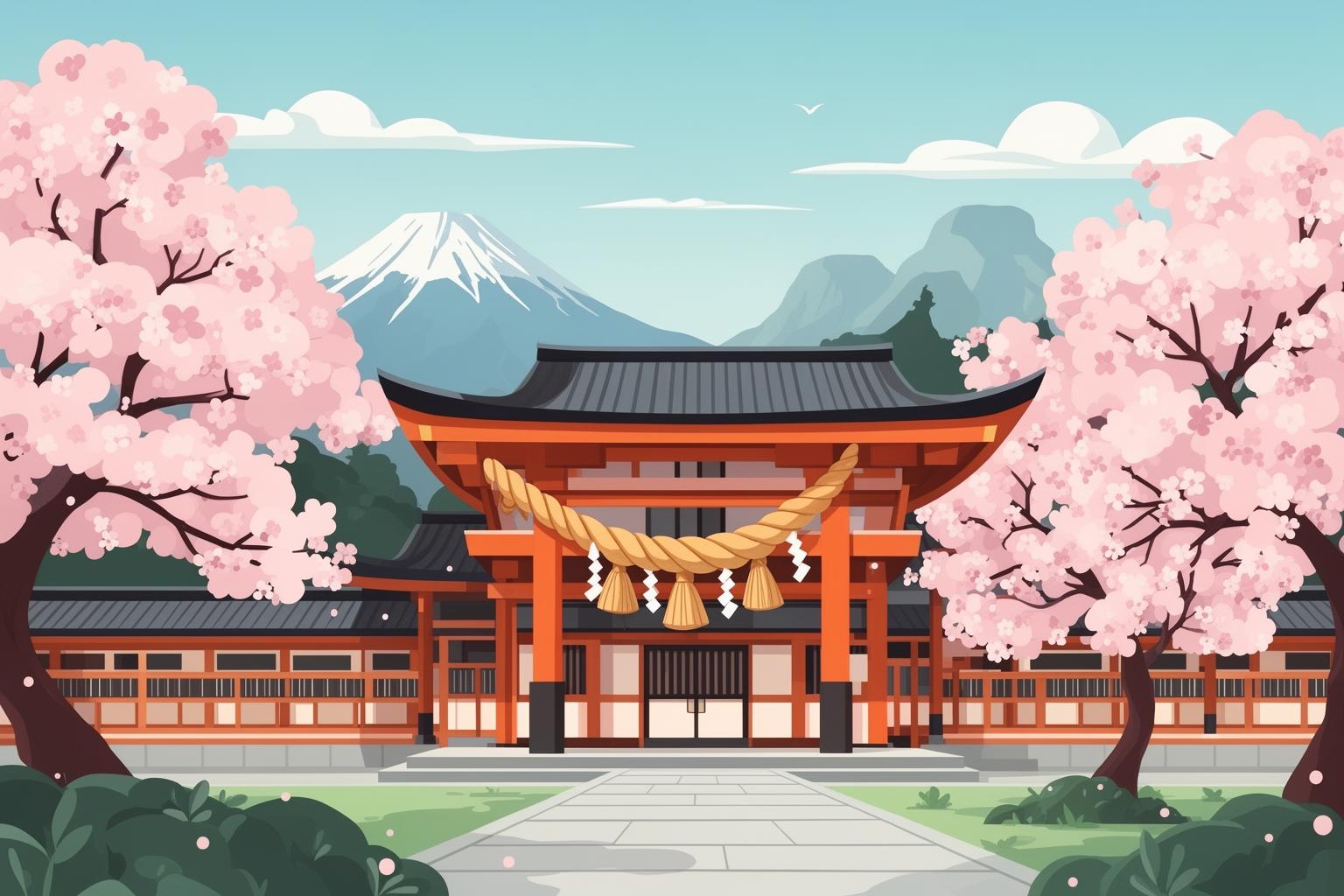
Shimenawa appear throughout Japan, fulfilling this same essential function. They are most commonly seen at Shinto shrines. Massive, heavy ropes often hang from the torii gates that signal the entrance to shrine grounds, marking your passage from the secular to the sacred. They’re also found above the entrance to the haiden, or hall of worship, where visitors offer prayers. The most renowned and visually striking example is the enormous shimenawa at the Kagura-den hall of Izumo Taisha in Shimane Prefecture. Stretching over 13 meters in length and weighing more than five tons, it stands as a tribute to the power of the enshrined deity. Perhaps the most poetic use of shimenawa is on natural yorishiro. The famous Meoto Iwa, or “Wedded Rocks,” off Ise’s coast are two sea stacks linked by a massive shimenawa. The rope, replaced three times yearly during a special ceremony, celebrates the union of the two kami believed to inhabit the rocks and, by extension, the sacred bond of marriage. Across Japan—from grand national shrines to small neighborhood groves—you’ll find these ropes respectfully tied around the silent, natural abodes of the divine.
The Art and Soul of the Rope
A shimenawa is far more than just an ordinary piece of rope. Its materials and craftsmanship carry profound symbolism, transforming the act of rope-making into a Shinto ritual in itself. The entire procedure is infused with notions of purity and reverence, reinforcing the rope’s sacred purpose even before it is hung.
Woven from the Harvest
Shimenawa are traditionally crafted from rice straw, or wara. This choice is deliberate. Rice has sustained Japanese civilization for thousands of years, serving not only as a staple food but also as a divine blessing. The agricultural cycle has long been closely linked to the Shinto ritual calendar, a connection that remains strong today. By using straw from the rice harvest—often from the year’s first and purest crop—the rope becomes a direct manifestation of the land blessed by the kami. It symbolizes a cycle of gratitude: the kami provide the life-giving rice, and people, in turn, use part of that gift to create sacred objects that honor them. This tangible connection between the divine, nature, and humanity imparts profound spiritual significance to the shimenawa.
The Ritual of Creation
The act of twisting the straw is a sacred task. Those who make shimenawa, often shrine priests or devoted community members (ujiko), may engage in purification rituals before starting. The weaving follows a strict pattern, with the straw always twisted in a left-hand direction, a method known as hidari-nai (左綯い). In Shinto belief, the left side is often considered sacred or pure, associated with the divine, while the right side is linked to the human or profane realm. This seemingly small detail ensures the rope is imbued with sacred energy from its very creation. The resulting rope embodies concentrated purity and power. Styles vary, ranging from uniform thickness to the distinctive daikon-jime style, which is thick at one end and tapers toward the other, resembling a Japanese daikon radish.
The Hanging Ornaments: Shide
Almost as recognizable as the ropes themselves are the white paper streamers hanging from them, known as shide (紙垂). Made from washi (Japanese paper), they are folded into a distinctive zig-zag shape meant to mimic a bolt of lightning. Their symbolism is twofold. First, white represents ultimate purity and sanctity in Shinto. Second, lightning is viewed as a powerful and mysterious expression of the kami‘s energy. Thus, the shide serve as conduits or antennae for this divine power, further sanctifying the space marked by the shimenawa. They flutter in the wind, offering a constant, silent invocation of the sacred presence.
Reading the Landscape: What Shimenawa Tell Us
Once you grasp the meaning of shimenawa, the Japanese landscape transforms from mere geography into a sacred scripture. These ropes serve as punctuation marks, indicating where the boundary between the physical and spiritual realms is thinnest. They unveil a worldview in which humanity is not the ruler of nature, but a respectful cohabitant alongside its spiritual forces.
Animism in Plain Sight
The custom of adorning natural objects with shimenawa is the clearest and most public expression of Shinto animism. It proclaims that holiness is not limited to temples and scriptures, but is intrinsic to the world itself. This outlook contrasts sharply with many Western religions, where the divine is often perceived as a singular, transcendent entity separate from creation. In Shinto, divinity permeates the world. An ancient, gnarled tree is honored not merely for its age and beauty, but as a living vessel of a kami. Its life force represents a divine presence. The shimenawa invites us to see that tree not just as wood and leaves, but as a being imbued with spiritual meaning. This viewpoint nurtures a profound and enduring respect for the environment, a respect that has shaped Japanese culture for centuries. It powerfully reminds us that the rustling leaves or crashing waves can be forms of divine communication.
A Language of Respect and Awe
Putting up a shimenawa is an act of communal reverence. It signals that a community has acknowledged something powerful and worthy of awe in their environment. This act cultivates a sense of ifu (畏怖), a Japanese term blending fear, reverence, and deep awe in the presence of something overwhelmingly mighty and sacred. You don’t merely admire a large rock; you face it with awareness of its immense history and the spiritual energy it holds. The shimenawa directs this emotional and spiritual response. It teaches you where to focus your reverence. It’s not about “worshipping a rock” in a simplistic way, but about recognizing the divine essence embodied by the rock. It is a humble and beautiful gesture that places humanity in respectful dialogue with the forces of nature.
Beyond the Shrine: Shimenawa in Daily Life
While most commonly linked to shrines and sacred natural sites, the principle of the shimenawa extends into various facets of Japanese culture, highlighting how deeply ingrained these Shinto ideas of purity and sacred space are in the national consciousness.
The New Year’s Connection
By late December, shimenawa appear on the doors of homes, shops, and offices throughout Japan. These are a special type of New Year’s decoration known as shimekazari (注連飾り). Essentially, they are temporary, domestic shimenawa. Their purpose is to purify the home, ward off misfortune, and welcome the toshigami, the New Year’s deity believed to visit on New Year’s Day to bring blessings and good fortune for the coming year. These decorations tend to be more elaborate than those found at shrines, often including auspicious symbols such as a daidai (a bitter orange, whose name is a pun meaning “from generation to generation”), ferns, and even a small lobster. After the holiday, they are taken to a shrine to be burned in a sacred bonfire, respectfully returning them to the divine.
Sumo’s Sacred Belt
One of the most striking and unexpected places to encounter a shimenawa is in sumo wrestling. The highest-ranked wrestler, the yokozuna, is the only one permitted to wear a large, pure white shimenawa around his waist during the dohyō-iri, or ring-entering ceremony. This is not merely a champion’s belt. It signifies that the yokozuna is more than just an athlete; he is a living yorishiro, a human vessel for divine power. The sumo ring, or dohyō, is considered sacred, purified with salt before each day’s matches. The yokozuna’s wearing of the rope is a Shinto ritual that re-sanctifies the ring and affirms his connection to the gods of strength and valor. It vividly illustrates how the sacred boundary concept embodied by the shimenawa can extend to a person, elevating them to a semi-divine status within their field.
So, the next time you see one of these sacred ropes in Japan, you’ll understand you’re witnessing more than just an artifact of an ancient religion. You’re seeing a living tradition—a frame that Shinto places around a part of the world, inviting a closer look. The shimenawa marks purity, symbolizes respect for nature, and serves as a tangible link between the human and the divine. It does more than decorate the landscape; it reveals a sacred geography, encouraging you to view the world not only with your eyes but also with a sense of wonder and reverence for the spirits that quietly inhabit it.