Walk through Akihabara on a Saturday afternoon, or stand outside the Tokyo Dome before a major concert, and you’ll witness a particular kind of energy. It’s not just excitement; it’s a focused, communal hum of anticipation. You see groups of people, often dressed in matching colors, clutching decorated fans and clear files, their faces alight with a kind of reverent purpose. They aren’t just fans waiting for a show. They are participants in a cultural ritual, adherents to a modern faith. They are engaged in oshikatsu.
The term itself is a neat portmanteau: oshi (推し), meaning the person or character one supports with all their might, and katsu (活), short for katsudō (活動), meaning activities. So, “activities to support your fave.” A simple translation, but one that utterly fails to capture the sheer depth, complexity, and life-altering significance of the phenomenon. In the West, we have fandom. We have stans. But oshikatsu operates on a different plane. It’s not just a hobby; for millions in Japan, it’s a framework for life, a source of community, and a powerful engine of personal identity. It’s a subculture that has become so mainstream it’s now a fundamental pillar of the social and economic landscape. To understand modern Japan, you have to understand why someone would buy a hundred copies of the same CD just for the chance to shake a singer’s hand for ten seconds, and why that act feels not just logical, but meaningful.
Such unwavering dedication is part of a broader spectrum of personal expression in Japan, as seen in the vibrant world of Japanese car culture where innovation and passion converge.
Beyond Fandom: The Vocabulary of Devotion
To understand the mindset of oshikatsu, you first need to learn its language. This goes beyond slang; it’s a vocabulary that reflects a particular worldview, one that elevates support to a noble, almost spiritual endeavor.
Your journey starts with choosing your oshi. This is the idol, anime character, voice actor, or stage performer you devote yourself to. The term derives from the verb osu, meaning “to push” or “to endorse.” You actively propel your chosen one toward success. This is a key difference from simply “liking” someone. It implies action and responsibility. If your oshi climbs the rankings, it’s because you and fellow fans helped push them there. Their success is your success.
Within a group, you might have a top favorite, your ichiban (number one). But a truly committed fan may raise their oshi to the level of kamioshi (神推し)—literally, your “god oshi.” This isn’t typically meant in a deeply religious sense, but the quasi-divine terminology is significant. It casts the oshi as a higher being, someone who offers light and inspiration. A common phrase you’ll hear is sonzai ga tōtoi (存在が尊い), meaning “their existence is precious.” It expresses deep gratitude, as if the fan feels blessed simply to live alongside their idol. The oshi isn’t just an entertainer; they are a source of spiritual nourishment.
The activities themselves are called oshigoto (推し事), a clever play on the word for a regular job, shigoto (仕事). This redefines the effort and expense not as mere entertainment, but as meaningful work. Going to concerts, purchasing merchandise, streaming music videos repeatedly to increase views, and organizing fan projects are all part of this “oshi work.” It adds weight and legitimacy to what outsiders might dismiss as a casual hobby. When someone says they’re busy with oshigoto, they mean it. It’s a serious dedication that demands time, planning, and often a substantial budget.
The Anatomy of Support: Rituals and Routines
Oshikatsu is defined by active participation. It is not a passive form of distant admiration; rather, it is a full-contact support sport, complete with established rituals and dedicated physical spaces that turn fandom into a tangible, collective experience.
The Concert as a Sacred Space
A Japanese idol concert is a spectacular display of breathtaking unity. The focal point is not only the stage; it is the audience. Thousands of fans, waving color-coded, electronically controlled glow sticks, move in perfect harmony. The sea of lights shifts from blue to pink to green simultaneously, directed by a central command to align with the idol on stage or the mood of the song. It serves as a visual embodiment of the collective spirit.
Fans don’t merely watch—they actively perform. They memorize intricate, synchronized chants and hand gestures known as wotagei. These are not impromptu shouts of excitement but carefully rehearsed routines, a responsive liturgy to the idol’s performance. The air vibrates with call-and-response shouts, precisely timed to fill the spaces in the music. Being in the midst of this is to feel engulfed by a singular, powerful entity, all breathing and cheering as one for a shared purpose. The individual dissolves, replaced by the strength of the collective. It is, in its own way, a deeply spiritual experience—a form of communion.
Fans often bring handmade uchiwa (flat fans) adorned with their oshi’s name and messages of love and support. The aim is to catch the idol’s eye, to earn a wave or a nod—a fleeting moment of perceived connection known as fan sābisu (fan service). This brief recognition from the stage affirms all the time, money, and effort invested. It is a blessing from the deity.
The Pilgrimage for Merchandise
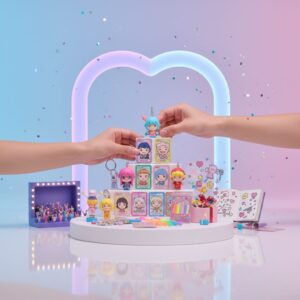
Devotion in oshikatsu frequently manifests through consumption. Merchandise, or guzzu (グッズ), is more than a keepsake; it is a physical symbol of loyalty, a means to financially back the oshi and exhibit one’s affiliation.
The industry thrives on creating scarcity and urgency. Limited-edition keychains, acrylic standees, photo cards, and posters are released in waves, often available only at select venues or for a brief period. This transforms acquiring items into a quest. Fans line up for hours at pop-up shops, trade feverishly on social media, and travel nationwide to secure a specific piece of memorabilia.
The clearest example is the music industry. A single CD might be issued in multiple versions, each with distinct covers or bonus tracks. More importantly, they frequently include tickets for handshake events or voting slips for annual “general elections” ranking the idols’ popularity. This cleverly turns the CD from just music into a tool of influence. Fans do not buy multiple copies just because they love the songs; they purchase numerous votes or chances for brief, personal interactions with their oshi. This quantifies support and transforms fans into quasi-shareholders, directly investing in their idol’s career path.
Special collaboration cafes open for a few weeks, offering themed food, drinks, and exclusive merchandise. These cafes become temporary shrines, social gathering spots where fans perform ritualistic photo shoots of their acrylic standees beside lattes and trade new acquisitions. It is a tangible expression of the fan community.
The Social Glue: Why Oshikatsu Builds Community
At its core, oshikatsu serves as a powerful remedy to one of the defining anxieties of modern life: loneliness. In a world where work hours are long, social circles often diminish after school, and forming deep connections can be difficult, oshikatsu offers an immediate, ready-made community.
A Cure for Modern Atomization
When you declare your oshi, you are sending out a signal. Fellow fans of the same oshi will find you. Suddenly, you share a common language, shared goals, and a shared emotional landscape. You can discuss for hours the subtle brilliance of a particular performance, analyze the subtext of a blog post, or strategize on how best to collectively boost music video views. These are your people. The bond is instant and intense, forged in the heat of a common passion.
This is especially important in a culture that often values group harmony (wa) and clearly distinguishes between in-groups (uchi) and out-groups (soto). The world of oshikatsu creates an ideal uchi. Within this group, you are understood. Your passion isn’t strange; it’s the norm. The strong emotions you experience are validated because everyone around you shares them. This fosters a powerful sense of belonging that can be hard to find elsewhere.
Shared Purpose, Shared Identity
The structure of idol groups, especially large ones like AKB48 and its sister groups, is designed to nurture this sense of shared purpose. The idols are constantly competing with each other for spots in the next single or for better stage positions. Their careers are visibly and directly tied to their popularity, measured by fan votes. This turns support into a compelling, high-stakes game.
Fans of a specific idol become a team, a campaign staff. They organize voting blocs, pool resources to buy CDs, and launch social media efforts to promote their oshi. Her success becomes their collective project. When she moves from the back row to the front, it feels like a personal and shared victory. This joint struggle and triumph create bonds as strong as those formed on a sports team or in a business endeavor. It gives participants a sense of agency and purpose that might be missing from their daily lives or careers.
A Safe Harbor for Passion
While Japanese society is evolving, overt, unrestrained displays of individual emotion can still be discouraged in professional and public settings. There is a pressure to maintain a calm, composed facade (tatemae). Oshikatsu provides a sanctioned, structured space where it is not only acceptable but encouraged to be intensely passionate.
At a concert, you can scream. You can cry when your oshi delivers a moving speech. You can experience pure joy. These emotions are channeled through the rituals of fandom—the chants, the glow sticks, the merchandise—giving them a safe and predictable outlet. It is a catharsis that is both personal and collective. It allows for an emotional release that society often does not accommodate, offering an essential form of psychological relief.
The Economics of Emotion
Oshikatsu is inseparable from the enormous economy it drives. This is not a grassroots movement that corporations simply adopted; rather, it was, in many respects, intentionally created from the outset to foster precisely this type of intense, monetizable devotion.
The Idol as a Product, The Fan as a Stakeholder
The creator of the modern idol system, Yasushi Akimoto, developed a model centered around the idea of “idols you can meet.” By making idols accessible through handshake events and daily theater performances, he dismantled the barrier between performer and audience. These idols were not distant, flawless celebrities; they were relatable girls from the neighborhood, striving to fulfill their dreams. Fans were encouraged to witness their growth, setbacks, and successes. This story of relatable struggle is deeply engaging, making fans feel like caretakers or supporters personally invested in the idol’s path.
Every yen spent represents a vote of confidence, a real contribution to that journey. The industry has mastered the craft of turning emotional bonds into financial support. While this may seem cynical, and in some ways it is, for fans it doesn’t feel exploitative. Instead, it feels empowering. It is the main way they can actively engage in their oshi’s narrative.
Beyond Pop Stars
Although J-pop idols serve as the most recognizable face of oshikatsu, the mindset has extended into numerous other areas. The worlds of anime and manga play a major role, with fans dedicating themselves to particular characters. They purchase merchandise, visit collaboration cafes, and even travel to real-world sites featured in their favorite series. Voice actors (seiyū) now enjoy idol-like careers, performing their own concerts and attracting large, devoted fanbases.
The 2.5D musical trend—stage adaptations of anime, manga, and video games—is another significant venue. Fans will watch the same production repeatedly to support a specific actor, buying their merchandise and following their career with passionate loyalty. Even specialized interests such as historical figures, sports teams, and mascots have formed oshikatsu communities. This framework is adaptable; it can be applied to anything or anyone who inspires fervent dedication.
A Devotion with a Cost
Portraying oshikatsu as an entirely positive force would be misleading. Despite the sense of community and purpose it offers, the intensity of the culture can also have a darker side.
The most apparent drawback is the financial burden. The pressure to keep up with merchandise releases and purchase enough CDs to make an impact can be overwhelming. Stories of fans spending their entire paycheck or going into debt for their oshi are fairly common. It can become a genuine addiction, where the validation gained from participating in the fandom outweighs financial prudence.
There is also a considerable emotional cost. Relying so heavily on the success and actions of another person for one’s happiness is inherently risky. When an oshi becomes involved in a scandal—often something as trivial as being photographed with a romantic partner, which breaks the illusion of romantic availability—the sense of betrayal among fans can be profound. When an idol suddenly “graduates” (retires), it can create a huge void in a fan’s life, as their main source of identity and community vanishes overnight.
The parasocial nature of the relationship is intrinsically one-sided. The fan invests their time, money, and limitless emotional energy, while receiving in return a carefully staged performance of appreciation. Although the connection feels genuine, it is ultimately a relationship between a consumer and a product, and this imbalance can lead to deep disappointment.
More Than a Hobby, It’s an Identity
Despite its potential drawbacks, oshikatsu keeps growing because it fulfills a profound and fundamental set of human needs: the need for community, purpose, and something to believe in. In a secular, stable, and often predictable society, it offers drama, passion, and meaning.
To dismiss it as trivial or frivolous is to entirely miss the point. Oshikatsu is a complex social ecosystem providing a framework for navigating modern life. It serves as a source of genuine friendship, a motivator for personal growth, and a vibrant, creative outlet. The fans are not merely passive consumers; they actively participate, co-creating the narrative of their oshi’s success.
It stands as a testament to the human desire to dedicate oneself to something larger than the self. Whether that focus is a sports team, a political cause, a religion, or a smiling girl singing on stage in a frilly dress, the underlying impulse remains the same. For many in Japan, oshikatsu is more than just a pastime. It is the work of the heart, the organizing principle of their lives, and the lens that brings color and meaning to the world.