You see it happen in the quiet corners of Japan, away from the neon glow of Shibuya and the crush of tourists in Kyoto. You might be walking down a suburban street and notice a massive, ancient camphor tree rising from a tiny, manicured island in a sea of asphalt. It’s encircled by a thick rope of woven straw with white paper zig-zags dangling from it. Or maybe you’re hiking a mountain path and come across a clearing where a collection of large, moss-covered boulders sit, similarly adorned. There’s no temple building, no priest, no donation box. Just a rock, a rope, and an air of deep, abiding reverence. You stop and wonder, “What am I looking at? Why is this old tree, or this simple stone, being treated like something holy?”
The answer is a key that unlocks one of the most fundamental layers of the Japanese spiritual and cultural psyche. It’s the concept of Yaoyorozu no Kami (八百万の神), the eight million gods. Except “eight million” isn’t a literal census of the divine. It’s a poetic, classical way of saying “innumerable,” “infinite,” “countless.” It’s the idea that divinity isn’t confined to a remote heaven or a handful of powerful, named deities. Instead, it’s a vital force that permeates everything. The sun, the mountains, and the sea, of course. But also the wind, a waterfall, a river, a uniquely shaped rock, a thousand-year-old tree, the fox that darts across the path, and even the well in the backyard or the stove in the kitchen. This isn’t just charming folklore. It’s the spiritual operating system of Japan, an ancient animist worldview that continues to shape aesthetics, social behavior, and the nation’s relationship with the natural world in ways most visitors never see.
This deep-rooted appreciation for the natural world is also captured in the practice of forest bathing, which transforms a simple walk into a soulful communion with the living landscape.
Not a Pantheon, but a Presence
When Westerners hear the word “gods,” their minds often default to the Greek or Roman pantheon. We imagine Zeus on Olympus, a powerful, anthropomorphic figure throwing lightning bolts, or Mars leading armies into battle. These gods have distinct personalities, epic stories, and a tendency to meddle, often messily, in human affairs. The Japanese concept of kami is fundamentally different and far more expansive.
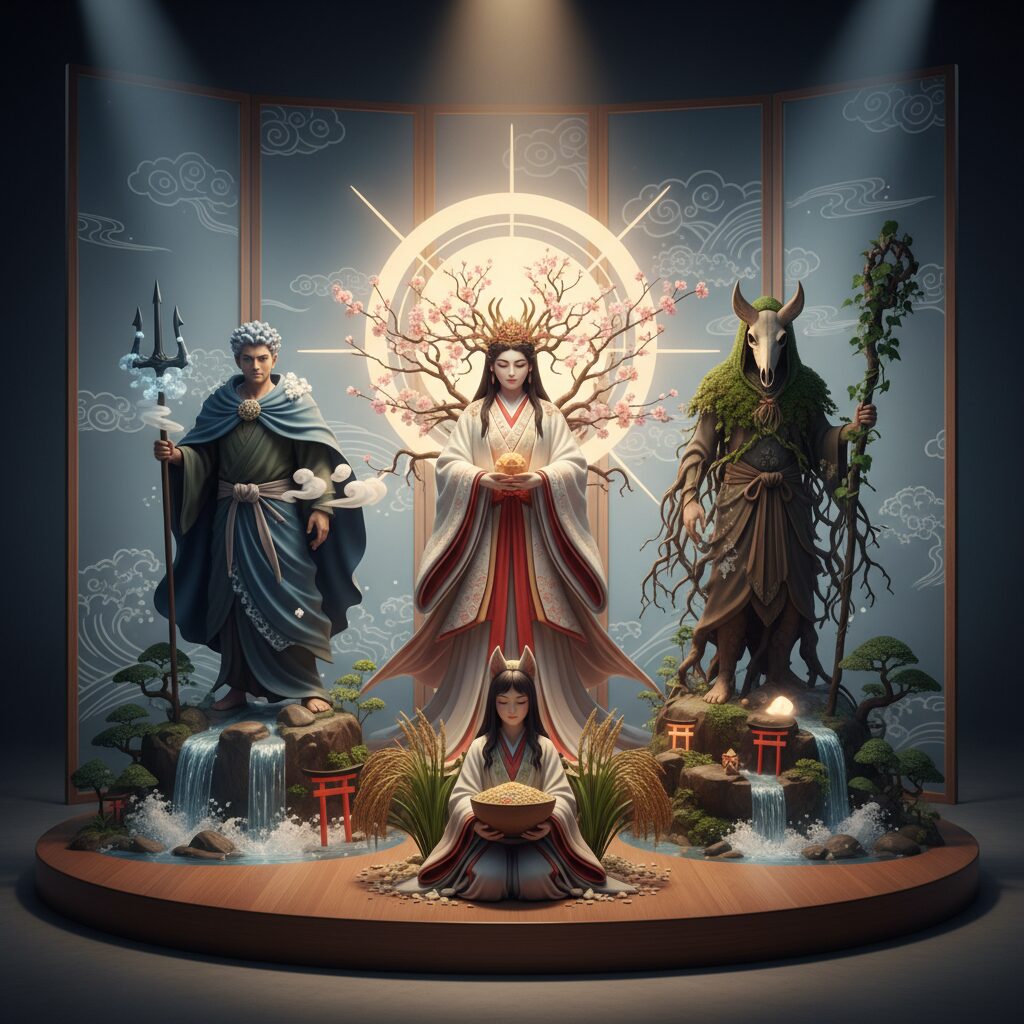
While Shinto does include a pantheon of major deities—personified natural forces like Amaterasu Omikami, the sun goddess from whom the imperial line is believed to descend—the vast majority of the “eight million” are not characters in a celestial tale. They are presences. Essences. The inherent spiritual energy of a place or thing. A kami is less a “who” and more a “what.” It’s the raw power and awe you experience standing at the base of a thundering waterfall. It’s the enduring stillness of a mountain that has stood for millennia. It’s the life-giving force of rain, rice, and rivers. A kami can be a creative force, a protective spirit, or simply the concentrated essence of a place that holds significance.
This is why there is no single, neat definition. A kami can be a grand, nationally revered deity enshrined at a prominent site like Ise Jingu. But it can also be the deeply local guardian spirit of a single village, known only to the families who have lived there for generations. It can be the spirit of an ancestor, a fallen hero, or even an exceptionally skilled artisan. This fluid, all-encompassing nature of divinity means the sacred isn’t something you must visit a special building to find. You are already living within it. The world is not inert matter awaiting human intervention; it is a living tapestry of spiritual forces, and a profound sense of respect is the fitting response.
The Animist Heart of Shinto
This belief system forms the foundation of Shinto, Japan’s indigenous religion. The term “Shinto” (神道) itself means “the way of the kami,” and at its core is animism—the belief that all things, from animals and plants to rocks and rivers, possess a spirit or consciousness. It is one of humanity’s oldest spiritual expressions, but in Japan, it was not replaced by later organized religions; instead, it was incorporated into the cultural fabric, coexisting harmoniously with Buddhism for centuries.
So, how does an ordinary, unassuming rock become sacred? The key concept here is yorishiro (依り代), which roughly means “approach substitute” or “vessel.” A yorishiro is a natural object or man-made item believed to attract a kami or serve as its temporary dwelling during religious ceremonies. The object itself is not worshipped; it is revered because it houses a divine presence. The most common yorishiro are those that inspire awe due to their age, size, or unique shape—such as towering trees, large boulders, or entire mountains.
This is where the straw ropes called shimenawa (注連縄) come into play. When you see a shimenawa wrapped around a tree or rock, it marks the boundary between the sacred and the ordinary. The rope serves as a sign that says, “This area is pure. A kami dwells here. Show respect.” The white paper streamers dangling from the rope, known as shide (紙垂), symbolize purification and are believed to ward off evil. The rope is not meant to protect the object but to announce the divine presence within it. It provides a visual cue that transforms an ordinary part of the landscape into a spiritually significant site—an open-air shrine without walls or a roof. It invites you to pause, recognize the spirit of the place, and move through the world with greater awareness.
Reading the Spiritual Landscape
Once you learn to identify these signals, you begin to see them everywhere, and Japan’s landscape reveals its hidden spiritual language. The reverence for ancient trees, for instance, is connected to the belief in kodama (木霊), spirits said to inhabit these trees. These spirits are not necessarily good or evil, but powerful. Cutting down a tree believed to house a kodama is thought to bring misfortune, a belief that has helped preserve many magnificent old trees throughout the country, which are often honored as shinboku (神木), or sacred trees.
Likewise, naturally formed rock arrangements, called iwakura (磐座), have served as worship sites since before shrine buildings existed. These are regarded as some of the oldest and purest forms of Shinto altars. A famous example is the Meoto Iwa (夫婦岩), or “Wedded Rocks,” located just off the coast near Ise. These two boulders, one large and one small, are connected by a massive shimenawa and symbolize the union of the creator deities Izanagi and Izanami. They are not merely rocks in the sea but embody the divine union that formed the Japanese archipelago.
An intriguing extension of this animist worldview is the concept of tsukumogami (付喪神). According to this folklore, household tools and objects, after existing for a hundred years, can gain a spirit and become animated. An old umbrella, a neglected zither, or a well-used tea caddy might develop limbs and a personality. While it sounds playful, this idea reflects a deep cultural respect for craftsmanship and the objects used daily. It expresses the belief that one should not be wasteful (mottainai), and that objects that serve you over time deserve care, as they carry a part of the life lived around them.
How This Mindset Shapes Modern Japan
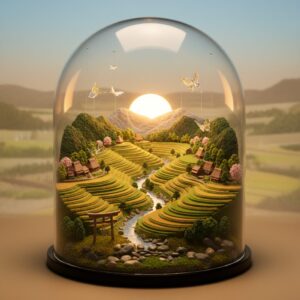
The belief in Yaoyorozu no Kami is far from being merely a historical artifact. Its principles remain deeply ingrained in the modern Japanese mindset, influencing everything from high art to everyday etiquette. For example, Japanese aesthetics are profoundly shaped by this belief. The design of a traditional Japanese garden goes beyond simply creating a beautiful scene. It aims to form an idealized natural landscape, a miniature world where kami would feel at home. The careful arrangement of rocks, the raked gravel symbolizing water, and the borrowed scenery from the surrounding hills all contribute to evoking a sense of natural harmony and tranquility.
The aesthetic of wabi-sabi, which embraces beauty found in imperfection, impermanence, and rustic simplicity, also originates here. A cracked tea bowl or a weathered wooden pillar is valued precisely because it bears the marks of time and use, revealing its inner character—its spirit. It is an appreciation for an object’s authenticity, rather than just its outward perfection.
This perspective also subtly influences social conduct. The notable cleanliness and orderliness of public spaces in Japan, often admired by visitors, stem partly from a cultural sensibility that shared spaces are not empty, inert places. There is an unspoken understanding that one should not defile a place, as every location possesses its own spirit and deserves respect. It is not about an omnipresent God punishing littering; rather, it reflects a pervasive, impersonal ethos of maintaining harmony and preserving the inherent sanctity of the surrounding world.
Naturally, this spiritual ecosystem is thriving in Japanese pop culture. Anyone who has seen a film by Hayao Miyazaki and Studio Ghibli has witnessed Yaoyorozu no Kami in action. My Neighbor Totoro tells a story of nature spirits, great and small, visible only to children. Spirited Away showcases a mesmerizing world inhabited by a dazzling variety of gods and spirits, from the mighty Radish Spirit to the memorable Stink Spirit, revealed to be a polluted river god. These films go beyond fantasy; they are a contemporary retelling of Japan’s oldest spiritual tales, introducing the animist worldview to a new generation.
A World That’s Alive
For most Japanese people today, belief in Yaoyorozu no Kami is not tied to strict religious doctrine. One can be mostly secular and still feel a natural inclination toward this worldview. It’s a cultural intuition, a perspective passed down through centuries. It’s the feeling that prompts someone to clap their hands and bow briefly before a particularly striking tree or to sense unease at the idea of a beautiful old building being demolished.
It represents a deep orientation toward the world—one that views it not as a collection of resources to be controlled and exploited, but as a living, breathing community of beings and essences, with humans as just one part. It nurtures a relationship with nature based on respect and coexistence rather than domination.
So next time you’re in Japan and see a simple straw rope around a stone in a quiet neighborhood, you’ll understand what you’re observing. It’s not merely a folk decoration or a historical relic. It’s a silent declaration. It marks a sacred space, a home for one of the countless presences that animate the world. You’re glimpsing a mindset where the divine is not distant in some faraway heaven, but right here—in the ancient tree, the weathered rock, and the very air you breathe.