Walk into almost any onsen or public bathhouse in Japan, and you’ll likely see a sign that stops many foreign visitors in their tracks. It might be a simple pictogram of a tattooed figure with a large red ‘X’ through it, or a line of Japanese text politely but firmly stating the house rules. For the uninitiated, it can feel like a personal rejection, a bafflingly strict gatekeeping of one of the country’s most sublime experiences. Why can’t you have tattoos? Why the elaborate, multi-step washing ritual before you even get in the water? Why is everyone so quiet?
These questions are completely valid. From the outside, the rules governing Japan’s bathing culture can seem arbitrary, even discriminatory. But they are anything but. They are the visible surface of a deep cultural bedrock, built from centuries of spiritual beliefs, social contracts, and historical context. To ask why onsen have these rules is to ask a question about the very nature of purity, community, and belonging in Japan. This isn’t a simple list of dos and don’ts you can memorize from a travel guide. This is about understanding the soul of the place. Forget the tourist-brochure gloss. To truly grasp the onsen, you have to look past the water and into the mindset that sanctifies it. It’s a world where the act of bathing transcends mere hygiene and becomes a ritual of social and spiritual renewal. And like any ritual, it has a logic all its own.
Delving further into Japan’s intricate dance between tradition and modernity, one may also notice that the evolution of body-con aesthetics mirrors the subtle cultural shifts reflected in its celebrated bathing rituals.
The Sacred Spring: Shinto Purity and the Soul of Water
Before understanding the rules of the bath, you must first grasp the significance of water in Japan. In the West, water cleans; in Japan, it purifies. This distinction is essential, rooted deeply in Shinto, Japan’s indigenous religion.
Shinto is a belief system centered on reverence for nature and the pursuit of purity. It revolves around the concept of kegare, which loosely means defilement, pollution, or impurity. Kegare is not a moral sin as in the Abrahamic traditions; rather, it is a spiritual stain caused by contact with death, disease, blood, and even negative emotions. It disturbs one’s natural state of purity and harmony (hōjō). The remedy for kegare is misogi—purification, commonly achieved through contact with flowing water. This can be seen whenever you visit a shrine: before approaching the main hall, you pause at a water basin called a chōzuya to rinse your hands and mouth, a simplified form of misogi to cleanse yourself before engaging with the divine.
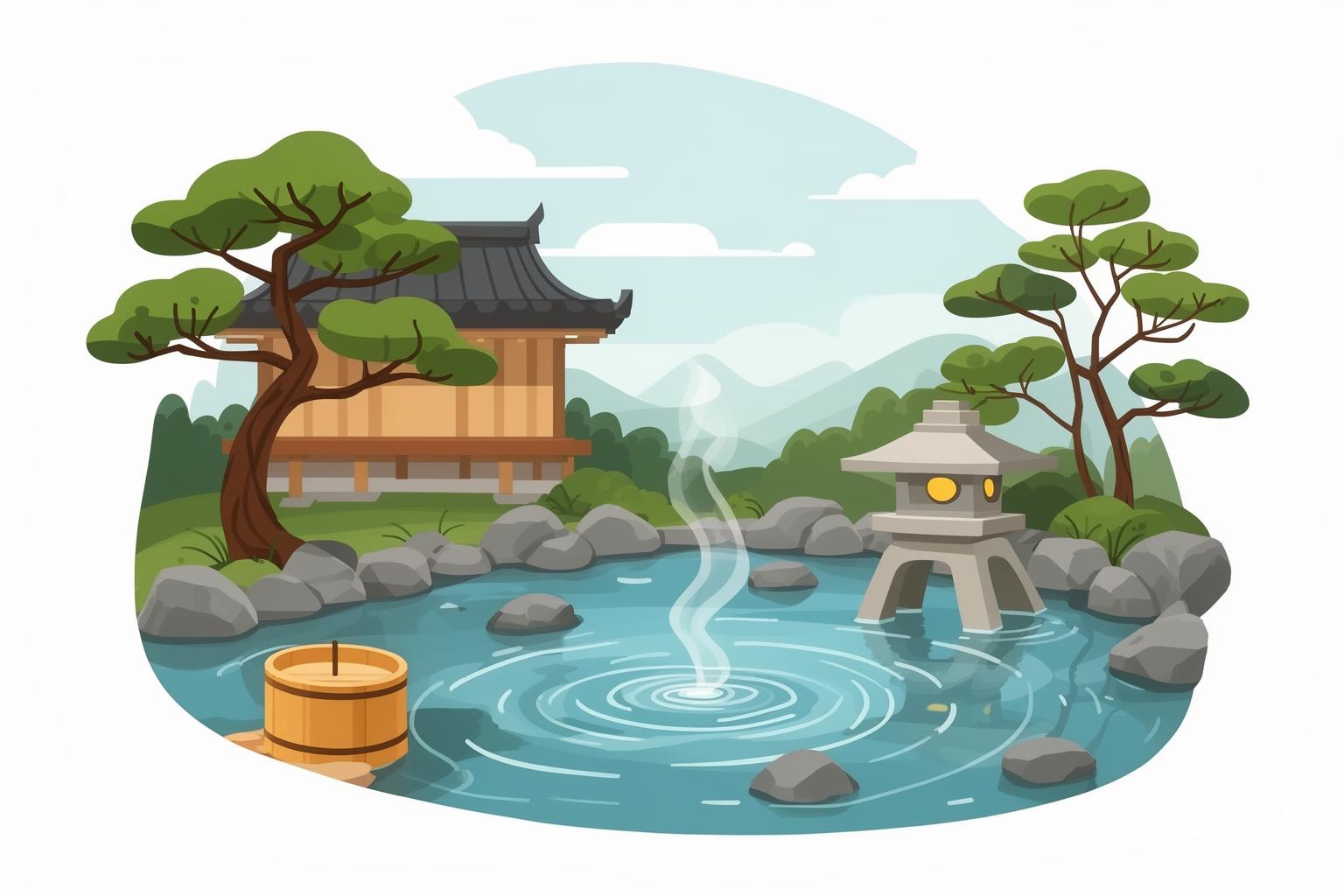
The onsen, a natural hot spring arising from the volcanic heart of the archipelago, represents the ultimate form of this principle. It is a large-scale, immersive misogi. The water, naturally heated by the earth and enriched with minerals, is regarded as a gift from the gods (kami), carrying sacred and restorative power. Entering an onsen is more than cleaning your body; it is about washing away the kegare from the outside world—the stress of work, the grime of the city, the fatigue of travel. It serves as a spiritual reset.
This belief forms the foundation of all related practices. Bathwater is not merely water; it is a sacred, communal medium of purification. Therefore, preserving its purity is of utmost importance. Just as you wouldn’t wash muddy boots in a church font, you don’t bring the outside world’s dirt into the onsen tub. That’s why the thorough pre-bathing wash is not merely a recommendation but a strict rule. You cleanse your physical body with soap and water to purify your spirit in the sacred bath. Breaking this rule is not only unhygienic; culturally, it is seen as sacrilege.
The Social Contract: Hadaka no Tsukiai and the Public Bath
While the onsen derives its spiritual essence from Shinto, the customs of communal bathing were formalized in the sentō, or public bathhouse. For centuries, most Japanese households lacked private baths. The local sentō was a vital neighborhood institution, as important as the rice merchant or tofu maker. It served as the community’s living room—a place for sharing news, building friendships, and breaking down social barriers.
This gave rise to the idea of hadaka no tsukiai, meaning “naked communion” or “naked friendship.” In Japan’s highly stratified and hierarchical society, the sentō acted as the great equalizer. Once the robes were removed, the CEO and factory worker, the grandmother and young mother, were all simply individuals. Stripped of uniforms, business suits, and kimonos that marked their status outside, they could engage with a rare openness and vulnerability. This shared nudity created a distinctive form of intimacy and social unity.
However, this powerful social dynamic can only work if everyone follows a strict, unspoken agreement of mutual respect. The bath is a shared space, and its harmony relies on the collective effort of all present. This is the social logic underpinning the rules. You keep your voice low not just out of politeness but to maintain a tranquil atmosphere for everyone. You tie up your hair to prevent it from floating in the shared water. You don’t splash or swim because it’s a place for quiet soaking, not play. You dry off before returning to the changing room to keep the floors dry and safe for others.
Each rule reflects consideration for the group. The onsen and sentō are a microcosm of Japanese society, where group harmony (wa) often takes precedence over individual desires. Your personal comfort or convenience comes second to preserving the integrity and calm of the communal space. By entering the bath, you implicitly accept this social contract. The rules are not meant to limit you; rather, they allow everyone, including yourself, to fully enjoy the restorative power of the water and the community.
The Ink Issue: A Deep History of Tattoos and Social Stigma
Now we come to the most controversial rule of all: the tattoo ban. For a visitor from a culture where tattoos are a form of personal expression, art, or remembrance, this can seem profoundly unfair. It’s easy to interpret it as a kind of aesthetic prejudice. However, the Japanese aversion to tattoos in bathhouses is almost entirely unrelated to art or personal choice. It stems from a deep-rooted historical and social reflex directly linked to crime and intimidation.
From Punishment to Rebellion
The connection between tattoos and criminality in Japan is not a recent development. During the Edo Period (1603–1868), authorities began using tattoos, called irezumi (literally “inserting ink”), as a method of punishment. Criminals were marked with rings on their arms or characters on their foreheads, creating a permanent, visible sign of their outcast status. This established the initial, powerful public perception that tattoos were for those who existed outside the boundaries of respectable society.
Ironically, this stigma was later embraced by certain counter-cultural groups. Firemen, known for their dangerous work and daredevil reputations, started getting elaborate, heroic tattoos as symbols of virility and protection. Gamblers, laborers, and other figures of the ukiyo, or “floating world,” did the same. For them, tattoos were a mark of defiance, a badge of honor showing they were tough, fearless, and lived by their own rules. The artistry of Japanese tattooing, wabori, thrived in this climate of rebellion.
The Yakuza Connection
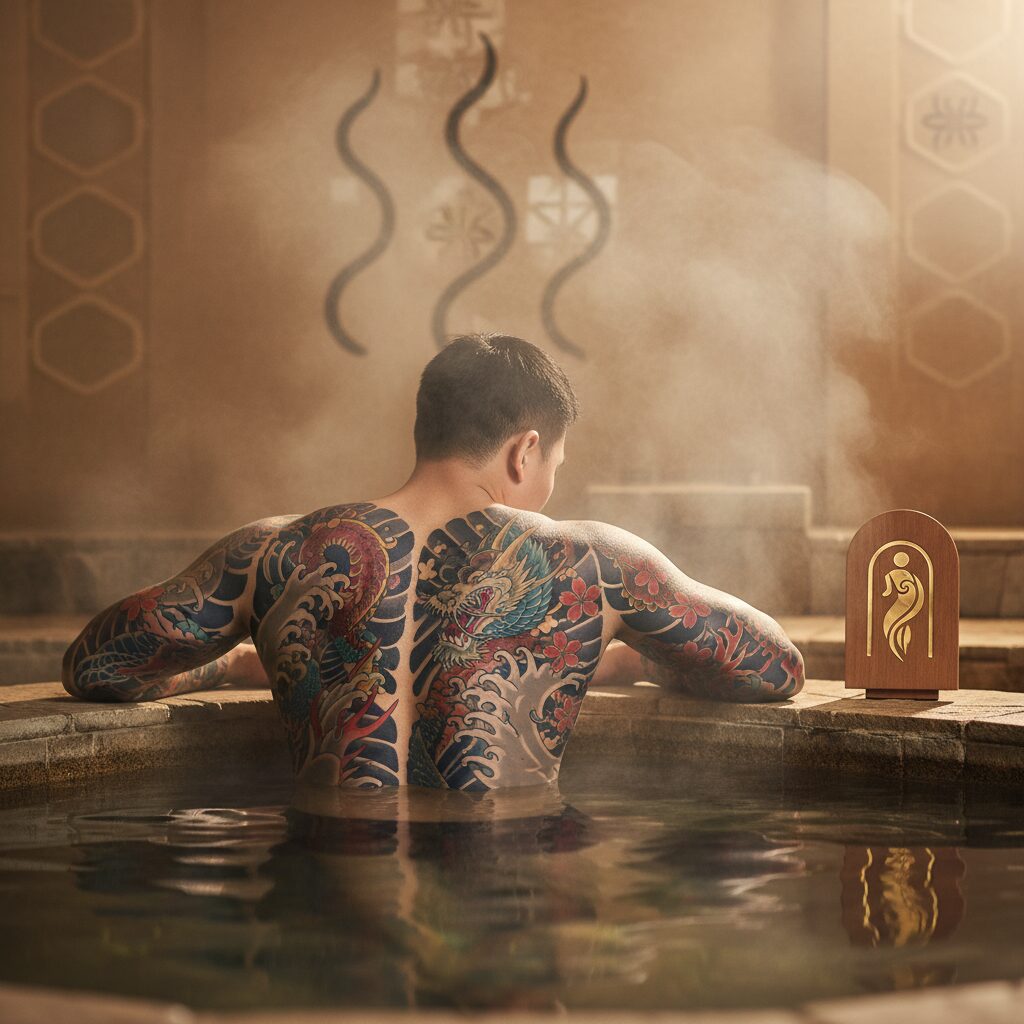
In the 20th century, the historical stigma was reinforced by the yakuza, Japan’s organized crime syndicates. They adopted the full-body tattoo suit, or horimono, as their signature emblem. These intricate designs featuring dragons, koi fish, and mythological heroes were not merely decorative; they symbolized loyalty to their organization, a testament to enduring pain, and a powerful tool of intimidation.
The onsen and sentō became the primary venues where this intimidation played out. When a man with a full horimono entered a bathhouse, his identity was unmistakable. His presence could immediately disrupt the peaceful, communal atmosphere of hadaka no tsukiai. Other guests, especially families with children, would feel threatened and uneasy, often leaving promptly. For small, family-run bathhouses, having yakuza members as frequent visitors could drive away the entire clientele.
The “No Tattoos Allowed” sign was a direct, pragmatic response to this issue. It was a business decision and a self-protection measure. It provided owners with a clear, impersonal reason to deny entry to organized crime figures without triggering a direct confrontation. The rule was never intended to target a foreign tourist’s small rose tattoo on their ankle or a kanji character on their shoulder. Instead, it was a broad policy designed to address a specific social problem at home: keeping the yakuza out and ensuring the average citizen felt safe.
Even today, although the yakuza’s influence has diminished, the cultural association remains deeply embedded, especially among older generations who recall when the threat was far more tangible. For many Japanese people, seeing a large traditional tattoo in a bathhouse still evokes an automatic feeling of fear or discomfort. The ban endures not out of disdain for the art, but out of a desire to preserve the onsen’s delicate atmosphere of peace and safety for everyone.
The Practical Etiquette: A Step-by-Step Guide to the ‘Why’
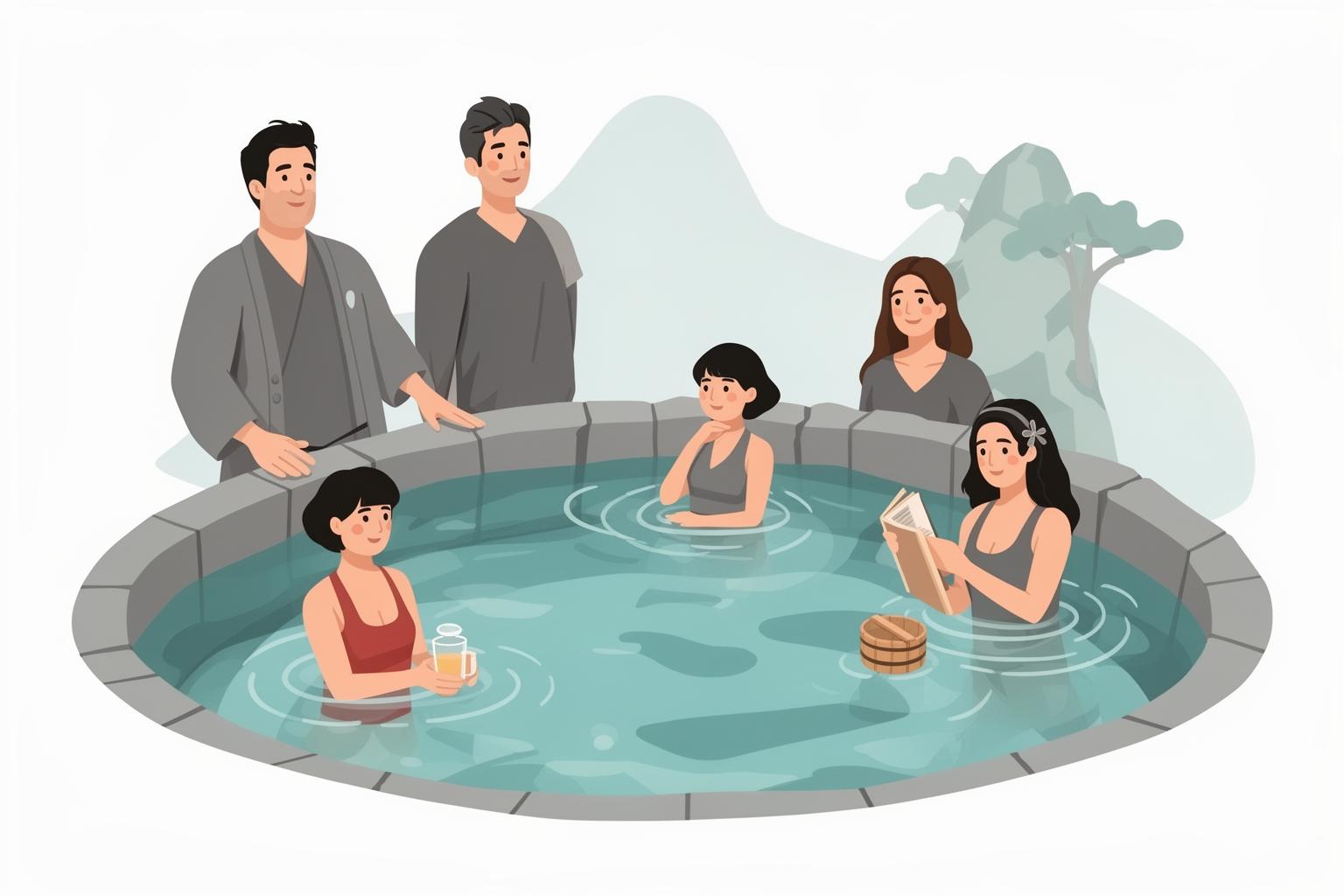
Grasping the core principles of purity and community helps the specific rules of onsen etiquette fall into place. They become more than a random list of chores, instead forming a logical sequence of actions intended to honor the space and its occupants.
The Cleansing Ritual: Before the Bath
Your onsen experience begins not in the hot water, but at the washing stations. You will find rows of small plastic stools, faucets, and shower heads, typically equipped with soap, shampoo, and conditioner. This step is the most important.
First, you perform kakeyu, using a basin to scoop hot water from a tap (or sometimes a small trough supplied from the main bath) and splash it over your body, starting with your feet and moving upward. This helps your body adjust to the temperature.
Next, you sit on the stool and wash yourself thoroughly from head to toe. This is not a quick rinse. You must scrub and wash with soap, just as you would in your own shower at home, then rinse off completely, ensuring no suds remain. The reasoning is simple: you are removing all physical dirt and soap residue to enter the main bath perfectly clean. You are fulfilling your part of the social contract by keeping the shared water pure for everyone who follows.
Tools and Conduct: In the Water
Once clean, you may finally enter the bath. You will have a small towel, roughly the size of a washcloth. This towel is for modesty while walking around and for scrubbing your body at the washing station. It must never be dipped into the bath water. Doing so is considered unclean. Most people place it on their head, which helps cool them down, or set it on the rocks beside the bath.
Entry into the water should be slow and gentle. The onsen is a sanctuary for quiet reflection, not a swimming pool. There should be no jumping, splashing, or swimming. Voices should be kept low and conversations brief. Many people choose not to speak at all, preferring to simply soak in meditative silence. You should also avoid dunking your head or face in the water. The goal is to soak, relax, and let the minerals work their magic.
The Exit: Preserving the Dry Space
The final act of consideration occurs when you leave. Before returning to the changing room (datsuijo), you are expected to use your small towel to wipe most of the water from your body. This is essential for keeping the changing room floor as dry as possible. A wet, slippery floor is a hazard, and it’s regarded as disrespectful to track puddles of water into the dry area where people are dressing. It is one last gesture showing you think of the collective, completing the cycle of respect that defines the entire experience.
A Tradition in Flux: The Onsen in the 21st Century
Japan is evolving, and so is its relationship with tattoos and bathing. With the significant influx of international tourists and the rising popularity of tattoos among younger Japanese generations, the once strict and unwavering ban is beginning to show signs of loosening.
The Japanese government, keen to boost tourism, has gently encouraged onsen operators to reconsider their policies, suggesting they differentiate between small “fashion tattoos” of visitors and the full-body suits linked to the yakuza. Responses have varied, but positive changes are underway.
Nowadays, you can find online lists of “tattoo-friendly” onsen. Many facilities now permit entry if visitors can cover their small tattoos with waterproof patches or bandages. Some luxury ryokan with private onsen rooms (kashikiri-buro) provide an ideal solution, allowing anyone to bathe without worry. However, numerous traditional, local sentō and onsen, especially in rural areas, continue to uphold the old rules—not out of hostility, but from a desire to respect and protect the expectations of their longstanding local customers.
In the end, the onsen remains a sacred space governed by a deeply rooted cultural logic. It is a place where the physical act of washing is elevated to a spiritual act of purification and where individual desires are set aside for the harmony of the group. Though the rules may seem intimidating, they are not designed as barriers to exclude. Rather, they are invitations—inviting participation in a ritual of respect, to appreciate the importance of the collective, and to experience a profound sense of peace and renewal that can only be found when everyone honors the unspoken code of the water.