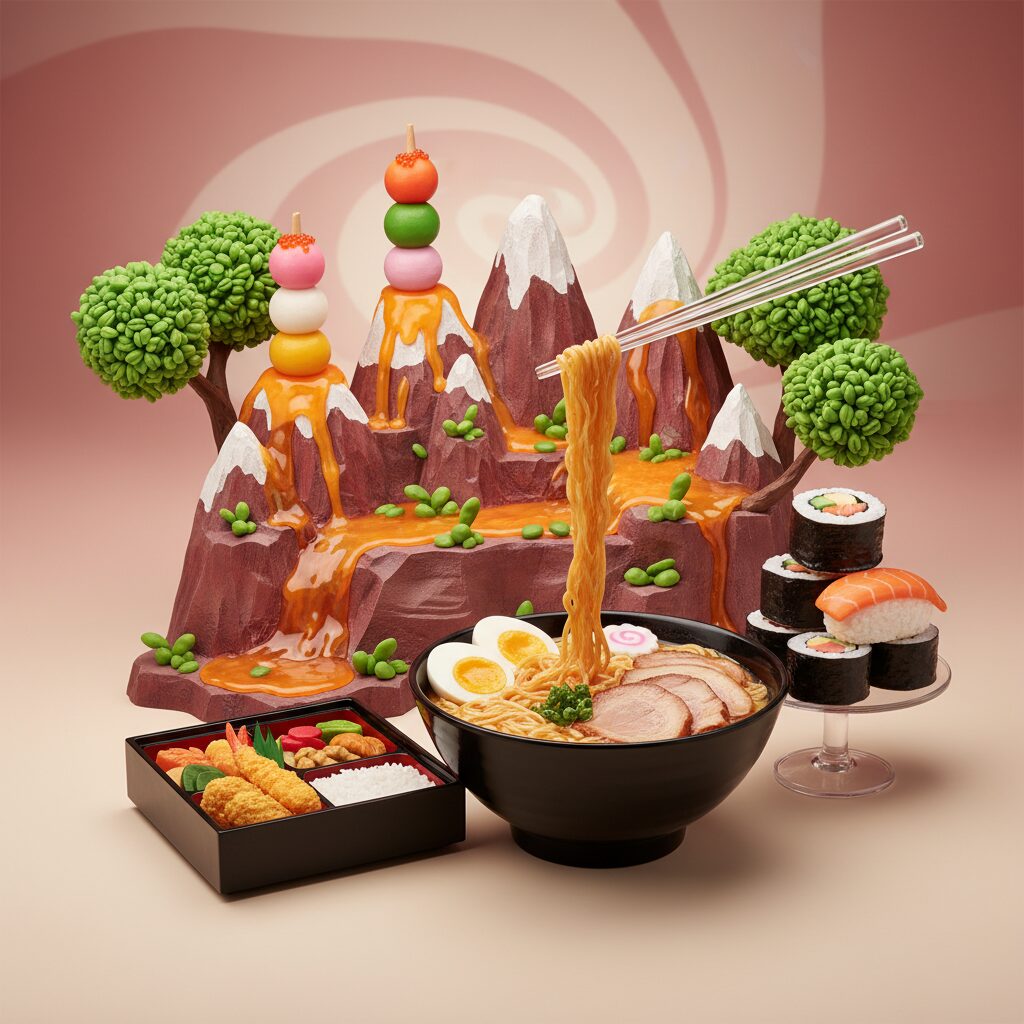
So you’re walking down a side street in a city like Osaka or Tokyo, maybe exploring a classic shotengai—one of those covered shopping arcades that hum with local energy. You pass a family-run restaurant, the kind with a dark wooden facade and a blue curtain, a noren, hanging in the doorway. Before you even have a chance to peek inside, you’re greeted by a glass case. Inside, bathed in a soft, clinical light, sits the entire menu, rendered in impossibly perfect, glistening plastic. A bowl of ramen with a gravity-defying splash of broth frozen mid-air. A plate of spaghetti Neapolitan with each strand meticulously coiled. A pork cutlet, or tonkatsu, with a cross-section revealing its juicy interior, its breaded crust a flawless golden-brown. This is shokuhin sampuru, the ubiquitous fake food samples of Japan.
To a first-time visitor, these displays can seem a little baffling, maybe even kitschy. They feel like a relic from a bygone era, a analog solution in a digital world. Why go to the extraordinary expense and effort of creating hyper-realistic models of every dish when a simple menu with photos would suffice? It’s a fair question. But to dismiss these plastic feasts as mere decoration is to miss a fascinating window into the Japanese psyche, particularly its deeply ingrained philosophy of customer service. These displays are not just advertisements; they are a visual contract, a tool for radical transparency, and a quiet expression of omotenashi, the country’s signature brand of anticipatory hospitality. They exist to eliminate one of the most common anxieties of dining out: uncertainty. And in doing so, they tell you everything you need to know about how Japan approaches the relationship between a business and its customer.
Japanese attention to detail in these displays mirrors the cultural significance of concluding traditions, inviting one to explore how the final shime ritual captures the essence of a memorable night out.
A History Cooked in Wax
The story of shokuhin sampuru doesn’t start in the high-tech labs you might expect, but rather in the early days of Japan’s modernization. In the 1920s, during the Taisho era, department stores were transforming into grand temples of consumerism. Their basement food courts, or depachika, introduced the public to a variety of Western and Chinese dishes—such as omelets, curries, and fried prawns—that many Japanese had never encountered before. Words on a menu were abstract and unhelpful. How large is the dish? What accompanies it? What does it even look like?
This posed a challenge for restaurateurs, who needed a way to visually communicate these unfamiliar foods to a curious yet hesitant public. The solution came from a man named Takizo Iwasaki. According to legend, after observing drops of hot wax falling into water and forming flower-like shapes, he had a sudden inspiration. He created a wax model of an omelet so lifelike that his wife couldn’t distinguish it from the real thing. In 1932, he founded Iwasaki Works, the company that would dominate the industry. The initial models were made from fragile, heat-sensitive paraffin wax, a meticulous process requiring great skill. These early pioneers were not just making models; they were shaping a new form of commercial communication.
After World War II, the technology advanced. Fragile wax was replaced with durable polyvinyl chloride (PVC), a plastic that could be molded, painted, and detailed with remarkable precision. This innovation turned sampuru into a nationwide phenomenon, spreading from department stores to nearly every type of restaurant imaginable. The purpose, however, stayed the same: to show rather than just tell. It was a communication tool born from a specific historical context, one that valued clarity and education as key elements of good service.
The Psychology of a Perfect Parfait: Eliminating All Doubt
At its essence, the food sample is an exercise in managing expectations. It is a promise brought to life in three dimensions. When you see that plastic model of katsu curry, you immediately understand what you’re getting: the size of the pork cutlet, the ratio of rice to curry, the type of pickles served on the side. There will be no surprises or disappointments. This commitment to eliminating ambiguity is a fundamental aspect of Japanese customer service.
Consider the common worries when ordering from a menu in an unfamiliar place. You wonder about portion sizes—will it be too much or too little? You’re unsure about the ingredients, especially if there’s a language barrier. The sampuru display resolves all these concerns in a single, elegant glance. For tourists, it’s a godsend, a universal language that transcends words. For parents with picky children, it’s a lifesaver; a child can simply point to the colorful plastic dessert they want. For everyone, it’s a tool for quick decision-making. You can instantly gauge the value by comparing the price tag next to the model with the actual meal’s appearance.
This goes beyond mere convenience. It reflects a cultural preference for visual information and a deep-rooted desire to avoid causing trouble or inconvenience, both for the customer and the staff. By presenting all necessary information upfront, the restaurant anticipates a dozen potential questions. It smooths the ordering process, making it efficient and seamless. The customer doesn’t need to feel hesitant or embarrassed asking, “How large is the large ramen?” because they can see it for themselves. This visual transparency fosters immediate trust. The restaurant is saying, “We have nothing to hide. What you see is exactly what you will get.” It’s a sign of respect for the customer’s time, money, and peace of mind.
An Expression of Omotenashi
To truly grasp the why behind shokuhin sampuru, you need to understand the concept of omotenashi. Often translated as “hospitality,” that word doesn’t fully convey its depth. Omotenashi is a proactive, anticipatory style of service—anticipating a guest’s needs before they even realize them and fulfilling those needs without expecting anything in return. It’s selfless, meticulous, and carried out with genuine care.
Food samples serve as a perfect, though unspoken, example of omotenashi in practice. The restaurant owner has foreseen your potential questions, language barriers, and indecision. They’ve invested in a solution that quietly addresses these concerns before you even enter. This thoughtfulness embodies kikubari (気配り), another vital cultural value emphasizing attentiveness to detail and considerate action. The display conveys the message, “We’ve considered your experience from your viewpoint and want to make it as smooth and enjoyable as possible.”
This philosophy also applies to the quality of the food models themselves. A cheap, poorly made sampuru would be worse than none at all, as it would imply a lack of care. A restaurant’s commitment to high-quality, realistic models reflects its pride and dedication to culinary excellence. The logic goes: if they put this much effort into the plastic food, imagine the care taken with the real dishes. It’s a subtle yet powerful indication of professionalism and reliability.
The Art and Craft of the Unreal Meal
What often gets overlooked in discussions about their function is the remarkable artistry behind shokuhin sampuru. These are not machine-produced trinkets mass-manufactured. Most are still handcrafted by skilled artisans in small workshops, many clustered in the town of Gujo Hachiman in Gifu Prefecture, the spiritual heart of the industry.
The process uniquely blends culinary expertise with artistic skill. Technicians typically begin by making a mold from the actual food prepared by the restaurant to ensure precise accuracy. They then pour liquid PVC into the molds, bake it, and begin the meticulous work of painting and detailing. This is where true mastery is evident. An artisan may spend hours perfecting the gleaming sheen on a single slice of raw tuna, the delicate air bubbles in tempura batter, or the subtle char marks on grilled eel. They employ airbrushes, fine-tipped paintbrushes, and proprietary techniques to achieve a level of realism that can genuinely fool the eye.
This dedication to craft is not solely for visual appeal. The model’s effectiveness depends on its realism. It must be an accurate representation to fulfill its role as a visual contract. This commitment to precision and detail reflects another cultural value inherent in the sampuru. It embodies the same spirit that drives a master sushi chef or traditional woodworker. In Japan, the manner in which something is done is as significant as the result. The care put into the fake food serves as a reflection of the care invested in the real food.
Still Relevant in the Instagram Age?
In an era dominated by smartphones, QR code menus, and Instagram feeds overflowing with food photography, it’s easy to question whether the era of plastic food models is coming to an end. Are they relics of the past, doomed to be replaced by glowing screens? Perhaps, but their enduring presence suggests they fulfill a role that a digital image simply cannot.
A photograph is a flat, two-dimensional depiction, whereas a sampuru is a three-dimensional object occupying real space. It lets you appreciate depth, volume, and scale in a way a photo cannot. You can walk around the display case, viewing the meal from multiple angles. This physicality is compelling. It makes the food appear more real, more tangible, and ultimately more appealing.
Moreover, the sampuru has become an integral part of Japan’s dining visual culture. It’s a tradition, a cultural fixture that diners have come to expect. It offers a charming, analog warmth that a cold digital menu lacks. The industry itself is evolving too. Artisans now craft sampuru for a global audience, and these models have become popular souvenirs, keychains, and even DIY kits for tourists who want to try their hand at making plastic tempura.
In the end, the shokuhin sampuru persists because the philosophy behind it remains timeless. It is a simple, brilliant answer to a universal challenge. It acts as a tool of transparency, a gesture of hospitality, and a testament to a culture that prioritizes the customer’s comfort and clarity. The next time you find yourself captivated by a window full of perfect plastic food, pause for a moment. You’re not just seeing a menu. You’re witnessing a deeply held belief system, beautifully and oddly rendered in PVC. It’s a silent promise that inside, you will be well cared for.