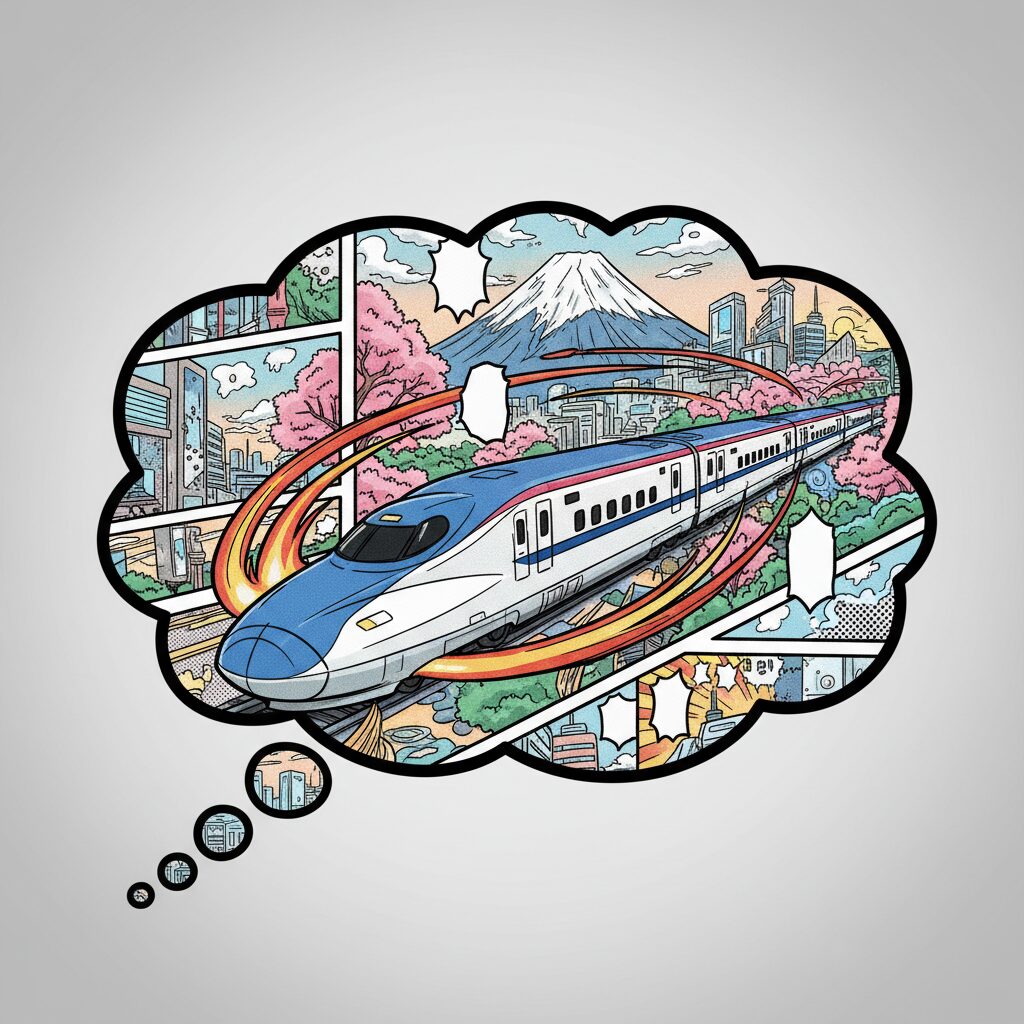
You see it the moment the train doors slide shut. The initial shuffle settles, the crisp announcement for the next station chimes, and then, a quiet transformation. The car, packed with bodies, becomes a silent, moving library. A salaryman in a crisp suit, his briefcase on his lap, isn’t scrolling through financial news but is lost in a world of ninjas and pirates. A woman in her forties, perhaps on her way to a part-time job, follows the delicate lines of a historical romance. A university student, backpack wedged between his knees, devours a thick weekly anthology with an almost professional speed, his thumb expertly flicking the pages from right to left. They are all reading manga. Openly, unashamedly, as normally as one might check the time.
For a visitor, this can be a curious sight. In many Western cultures, the comic book is still shaking off a stubborn, decades-old reputation as juvenile entertainment—something for kids, or at best, a niche hobby for a specific subset of adults. To see it embraced so publicly by people from every walk of life, on their daily commute, raises an obvious question. Why is this so normal here?
The answer isn’t a simple one. It’s not just about a fondness for cartoons. It’s a complex and fascinating story woven from the fabric of Japanese history, the unique pressures of its urban society, and a fundamentally different understanding of what a comic can be. It reveals a culture where visual storytelling was never relegated to the nursery, but instead evolved into a sophisticated medium as diverse and respected as literature or film. To understand the salaryman reading One Piece on the Yamanote Line, you have to understand that he’s not escaping into a childish fantasy. He’s simply continuing a story that has been part of his world for decades, in a medium that was built for moments just like this.
The everyday immersion in manga on crowded trains mirrors the surprising diversity of Japan’s urban life, as seen in the cyberpunk trucking subculture, where innovation and tradition seamlessly intersect.
A Medium, Not a Genre
The most important distinction to understand is that in Japan, manga is not considered a genre; it is a medium. This is not merely a matter of semantics—it serves as the fundamental principle on which everything else is based. In English, the term “comics” often evokes a particular image, usually involving superheroes in capes or funny animals, implying a specific type of content. In contrast, the Japanese word “manga” (漫画) is closer in meaning to terms like “novel” or “film.” It refers to the format, not the content. It simply means stories told through pictures. And just like novels or films, those stories can cover virtually any subject.
This perspective allows for an astonishingly wide range of content, carefully segmented to appeal to every niche within the population. The publishing industry does not view its audience as a single entity; rather, it recognizes dozens of distinct demographics and produces manga tailored specifically for each group. This is where the various categories like shonen, shojo, seinen, and josei come into play.
From Corporate Dramas to Historical Epics
Most outsiders are familiar with shonen (少年), literally meaning “boy,” manga such as Dragon Ball or Naruto, which target a young male audience and emphasize action, adventure, and friendship. Similarly, shojo (少女), or “girl,” manga like Sailor Moon or Fruits Basket generally focus on romance and emotional relationships aimed at a young female audience. However, the story goes beyond that. For the adults on the train, it’s just the beginning.
This is where seinen (青年), manga for adult men, comes into the picture. These are not simply more violent versions of shonen stories. They are narratively intricate, thematically mature works that delve into philosophy, politics, history, and the harsh realities of the human condition. Consider Takehiko Inoue’s Vagabond, a beautifully illustrated and reflective exploration of the life of legendary swordsman Miyamoto Musashi, which functions as much as a philosophical examination of violence and enlightenment as it does an action series. Or think about Monster by Naoki Urasawa, a gripping psychological thriller about a talented surgeon drawn into a pursuit of a sociopathic killer, raising complex moral dilemmas. These stories require intellectual and emotional engagement comparable to any esteemed literary novel or prestige television drama.
Likewise, josei (女性), manga for adult women, moves beyond the teenage crushes of shojo to address the complexities of adult life. It explores office politics, the challenges of marriage and motherhood, financial worries, and navigating romantic relationships in one’s twenties, thirties, and beyond. Works like Akiko Higashimura’s Princess Jellyfish provide a humorous and touching portrayal of a group of female otaku striving to save their shared home, tackling themes of self-acceptance and creativity. These stories are relatable, grounded, and speak directly to the real-life experiences of adult women.
A Story for Every Passion
Beyond these broad demographic labels lies a universe of genres so specific it’s almost overwhelming. There isn’t simply “sports manga”—there are manga about basketball (Slam Dunk), volleyball (Haikyuu!!), cycling (Yowamushi Pedal), and even the niche Japanese card game of karuta (Chihayafuru). There is an entire genre devoted to cooking, ranging from the extravagant culinary battles of Food Wars! to the quiet, contemplative tales set in a late-night diner like Midnight Diner.
Want to learn about wine? The Drops of God follows a young man’s quest to identify thirteen legendary wines and became so influential that it genuinely boosted sales of the vintages it featured. Interested in the life of a classical pianist? Forest of Piano has you covered. Space exploration? Space Brothers. The complexities of the Japanese financial world? Sanctuary. This is the key. Because manga can be about anything, there is a manga for everyone, regardless of age, gender, or interest. It is a medium that reflects the full spectrum of human experience, making it a perfectly natural and logical choice for adult reading.
The Weight of History on a Crowded Train
The deep integration of manga into adult life didn’t develop overnight. It is the outcome of a lengthy cultural evolution, with origins tracing back centuries before the first train ever traveled through Tokyo. The Japanese cultural affinity for visual storytelling is profound and deeply rooted.
From Frolicking Animals to Floating Worlds
Art historians often identify the Chōjū-jinbutsu-giga (Scrolls of Frolicking Animals), a series of four paper scrolls from the 12th century, as among the earliest precursors to manga. These extraordinary ink drawings portray anthropomorphic rabbits, monkeys, and frogs engaged in human activities, ranging from wrestling to religious ceremonies. Without any text, they tell their stories solely through sequential images—a foundational principle of manga. They demonstrated, centuries ago, the power of a flowing visual narrative.
Later, during the Edo period (1603–1868), the emergence of ukiyo-e (pictures of the floating world) woodblock prints further solidified this visual language. Artists like Katsushika Hokusai, famous for The Great Wave off Kanagawa, also created collections of sketches called Hokusai Manga. Although not narrative in the modern sense, these books contained thousands of dynamic images depicting every aspect of life in Japan—people, animals, nature, and mythology. The term “manga” itself, meaning “whimsical pictures,” was popularized by these works, embedding the concept of drawn images as a legitimate and popular form of mass art.
The Post-War Revolution
This historical foundation laid the groundwork for manga’s surge in the post-World War II period. In a nation rebuilding itself, manga magazines, printed on inexpensive, widely available paper, provided an affordable and accessible source of escapism and entertainment for a population eager for new stories. However, it took a visionary to transform manga from simple amusement into a true art form. That visionary was Osamu Tezuka.
Often regarded as the “God of Manga,” Tezuka was a creative powerhouse. He introduced a revolutionary, cinematic style to the page. Inspired by the films of Walt Disney and European cinema, he employed dynamic panel layouts, varying camera angles, close-ups, and long shots to create a sense of motion and pacing that was unprecedented at the time. More importantly, he told complex, ambitious stories that treated manga not as mere distraction, but as a medium for profound themes. His epic series Phoenix spans millennia, exploring concepts of reincarnation, mortality, and the search for meaning. In Astro Boy, he addressed discrimination and the nature of humanity through the story of a robot boy. Tezuka single-handedly elevated the medium, demonstrating that comics could be art, literature, and philosophy simultaneously. The generations raised on his work—and those of artists he inspired—are today’s adults and grandparents. For them, manga was never “just for kids.” It was the dominant cultural medium of their youth.
The Commuter’s Bubble
While history and content detail what people are reading, the unique environment of the Japanese commute reveals why they choose to read there. To grasp this, one must understand the sociology of the Japanese train—a peculiar space that is both intensely public and deeply private at the same time.
An Oasis of Personal Space
A rush-hour train in a major Japanese city exemplifies organized density. People are packed in more tightly than one might imagine, yet the space operates under a set of strict, unspoken rules. You avoid making eye contact. You refrain from speaking on your phone. You keep your music contained within your headphones. You minimize your physical and auditory presence. The collective goal is silent endurance. Within this environment, a strong social norm arises: the creation of a personal bubble.
To endure the crush and monotony of a long commute, commuters turn inward. Manga serves as the perfect tool for this inward retreat. A physical manga book or anthology is a self-contained world. It requires no Wi-Fi, makes no noise, and disturbs no one. It enables full immersion, effectively constructing a mental barrier against the stifling closeness of hundreds of strangers. Unlike a smartphone, which often feels like an extension of work or social obligations, manga represents pure, uninterrupted storytelling. It is a portable portal—an acceptable and efficient way to carve out a slice of private peace in an overwhelmingly public space.
The Convenience Store Connection
The widespread availability of manga is another vital factor. Manga isn’t a niche item needing a special trip to a dedicated store; it is a daily staple sold on nearly every corner. The key to this distribution network is the konbini, or convenience store.
Step into any 7-Eleven, Family Mart, or Lawson in Japan, and you will see a magazine rack. On it, the latest issues of weekly and monthly manga anthologies await. These are large, phone-book-sized magazines like Weekly Shonen Jump, Weekly Young Magazine, or Big Comic Spirits, each containing chapters from a dozen or more ongoing series. Printed on inexpensive, recycled paper, they are designed for quick consumption. A commuter can pick up the latest issue on their way to the station for a few hundred yen, read it on the train, and perhaps leave it on the overhead rack for another passenger afterward. This system turns manga from a considered purchase into a casual, weekly ritual as commonplace as buying a morning coffee. It guarantees a steady, fresh supply of stories is always within easy reach.
Deconstructing the Stigma That Isn’t There
Ultimately, the reason adults read manga on the train is that the social stigma a foreigner might anticipate simply does not exist. The cultural environment where such a stigma could develop was never fertile. This absence of shame results from all the factors we’ve discussed: a broad and mature medium, a long history of visual storytelling, and a society that grew up with it.
A Lifelong Narrative Companion
Consider the salaryman in his fifties reading One Piece. That series began in 1997. It’s entirely possible he has been following Monkey D. Luffy’s adventures for over twenty-five years. He started reading it in his twenties, and the story has remained a constant companion through his career, marriage, and perhaps raising his own children. The characters have aged, and while he has aged more, they have grown together. Why would he suddenly stop reading? To abandon the series would be like quitting a beloved TV show a few seasons before the finale. There is no social cliff at age 18 or 21 when it suddenly becomes inappropriate. It’s his story, and he’s seeing it through.
This creates a powerful, shared cultural literacy. Major manga series are cultural touchstones, referenced in advertisements, variety shows, and everyday conversation. Knowing the latest plot developments in a popular series is no different from knowing the results of last night’s baseball game or the storyline of a hit TV drama. It’s part of the collective conversation.
The Freedom of Urban Anonymity
The urban environment itself provides a layer of insulation. In the vast, anonymous flow of people passing through stations like Shinjuku or Shibuya, there is a marked lack of judgment about personal habits. Your fellow passengers are strangers you will likely never see again. Their opinion of your reading material holds no relevance to your work, family, or social standing. This creates a sphere of personal freedom. As long as you aren’t disturbing the harmony of the shared space, you are free to spend your time as you wish. Reading manga is a quiet, solitary act and therefore perfectly acceptable.
In the end, the simplest reason is often the most profound: it’s just normal. It has been normal for decades. When an activity is practiced by millions of people across all ages and professions, it ceases to be remarkable. It becomes part of everyday life’s texture, a detail in the urban landscape as common as vending machines or station jingles. The sight of an adult reading manga on the train doesn’t register as unusual to the Japanese person sitting next to them because it’s a sight they’ve seen their entire life. It is the outsider who applies the lens of judgment, the preconceived idea that cartoons are for kids. In Japan, that notion was never allowed to take root.
So the next time you’re on a Japanese train and witness that quiet communion between a reader and their paper world, you’ll understand what you’re seeing. It’s not a refusal to grow up. It’s the visible expression of a rich literary tradition, a response to the pressures of modern urban life, and a quiet moment of personal joy in a culture that mastered the art of storytelling with pictures.