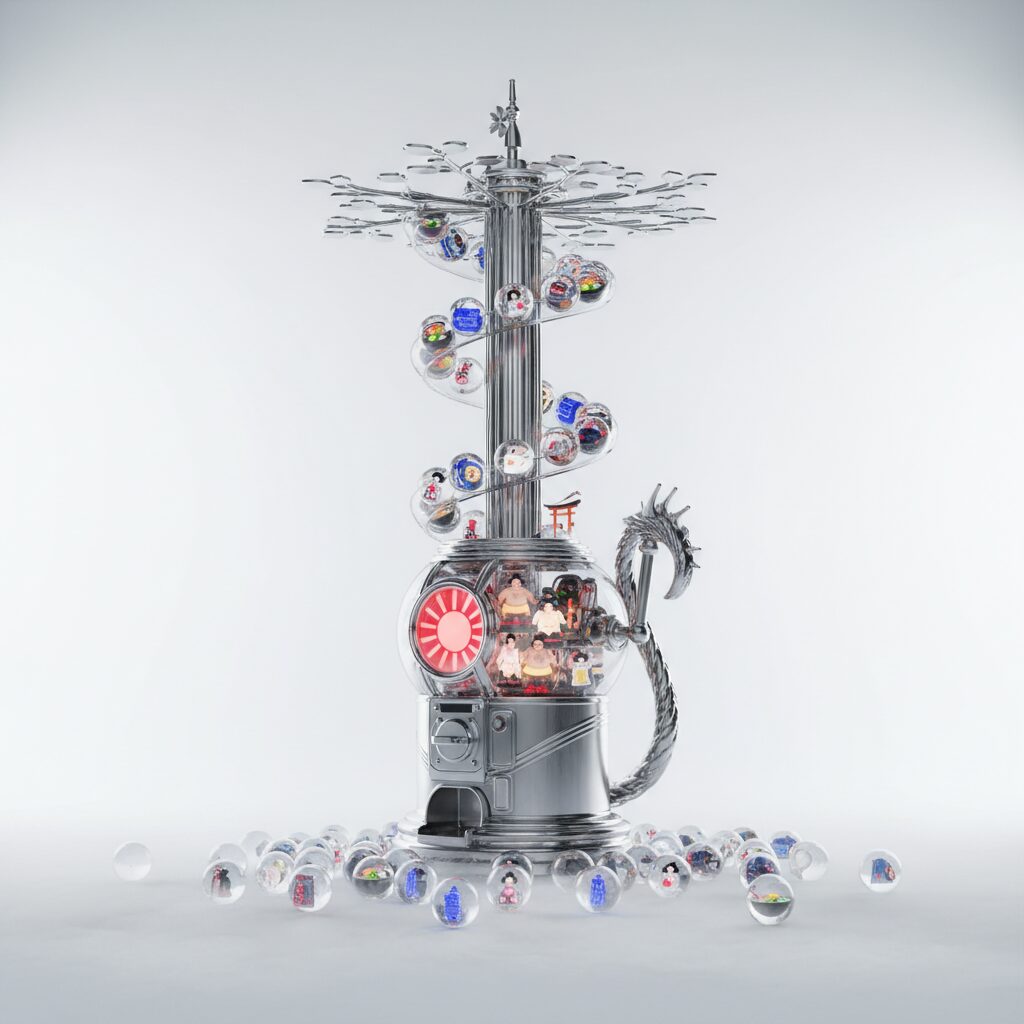
Walk into almost any electronics store, train station, or shopping arcade in Japan, and you’ll eventually face a wall of them. Dozens, sometimes hundreds, of identical machines stacked in vibrant, chaotic banks. Each one features a clear window filled with plastic capsules and a colorful placard displaying the treasures within. This is the world of gachapon, a universe of capsule toys that has become an inescapable and deeply revealing part of the Japanese cultural landscape. To an outsider, it might look simple, even childish: you put in a few coins, turn a crank, and get a random toy. But to dismiss it as a mere vending machine is to miss the point entirely. Gachapon is not just about the toy. It’s a ritual. It’s a distillation of several core pillars of the Japanese mindset: a profound appreciation for intricate detail, a cultural love affair with surprise, and an ingrained collector’s spirit. It’s a tiny, affordable gamble that offers a window into what this society values, miniaturized and sealed in a plastic ball.
This exploration of miniature marvels reflects a broader cultural phenomenon, mirroring the passion and transformation seen in Japanese otaku culture.
The Crank, The Clunk, The Reveal: A Ritual of Surprise
The physical act of playing gachapon is a ritual in itself. You don’t simply buy an item; you participate in a process. First comes the selection. You scan the walls, your eyes shifting from a set of hyper-realistic miniature succulents to a series of cats wearing fruit hats, to intricately detailed models of classic Sony Walkmans. You pick your machine, your potential fate. Next is the payment, sliding your hundred-yen coins in with a satisfying metallic clink. The final, pivotal moment is turning the crank. It offers a slight resistance—gacha—followed by the heavy, gratifying drop of the capsule—pon. This two-part onomatopoeia is the source of the name, a sound that perfectly captures the experience of anticipation and release.
This acceptance of the unknown is deeply embedded in Japanese culture. Consider omikuji, the paper fortunes randomly drawn from boxes at shrines and temples. You pay a small fee for a chance at a blessing or a warning, embracing whatever fate brings. Gachapon follows a similar concept. You know the set of possible outcomes, but you have no influence over which specific one you’ll get. Will it be the rare, sought-after character in the series? Or the fourth common one you already own? This small, controlled measure of uncertainty is thrilling. In a society that highly values order, predictability, and social harmony, gachapon provides a safe, low-stakes way to toy with chaos. It’s a moment of pure, unfiltered potential. For a few hundred yen, you acquire not just a tangible object, but a moment filled with suspense and surprise. This ritual is the predecessor to the modern “unboxing” craze, a deeply satisfying cycle of anticipation and reward honed in Japan over decades.
Worlds in the Palm of Your Hand: The Art of Miniaturization
Once you open that plastic sphere, a second layer of cultural significance emerges: the object itself. Japanese gachapon are seldom the cheap, poorly molded trinkets you might find in a supermarket machine elsewhere. Instead, they are often marvels of miniaturization, reflecting a cultural obsession with detail, precision, and craftsmanship on a tiny scale.
This isn’t just about miniaturizing objects; it’s about capturing their essence. A gachapon depicting a bowl of ramen won’t be a simple lump of orange plastic. It will feature individually sculpted noodles, glistening broth, a perfectly placed slice of chashu pork, and a delicate sliver of green onion. A capsule containing a miniature power tool might include moving parts and manufacturer logos so tiny you need to squint to read them. This dedication to authenticity is remarkable. It arises from a broader aesthetic principle in Japan that values immense beauty in the small and intricate. It’s the same drive behind the meticulous art of bonsai, the carving of intricate netsuke toggles for kimono sashes, and the delicate arrangement of food in a bento box. In each case, the aim is to create a complete, perfect world within a limited space.
These tiny objects are more than toys; they are miniature sculptures. Companies like Bandai, Takara Tomy, and Kaiyodo hire skilled artists and designers who use advanced 3D modeling and injection-molding techniques to achieve a level of detail that seems impossible for a 300-yen item. This commitment to quality transforms the gachapon from disposable novelties into collectible works of art. It reflects a society that reveres craftsmanship regardless of scale. The notion that something inexpensive should be poorly made is foreign here. Instead, the challenge is to deliver the highest possible quality within strict limits of price and size.
The Collector’s Impulse: Completing the Set
The gachapon business model cleverly capitalizes on the human desire for completion. A single gachapon toy is rarely standalone. It’s almost always part of a series—five different poses of a shiba inu, six types of miniature Japanese street food stalls, eight classic Nintendo consoles. The display card on the machine shows all the options, planting a seed in your mind: the urge to collect them all. This is where true obsession begins.
Getting one is a surprise. Getting the one you want is a victory. But completing the whole set is a quest. This transforms playing from a one-time amusement into an ongoing hobby. It encourages repeated plays, turning casual users into dedicated collectors. This “gotta get ‘em all” mentality is a powerful motivator. You’ll see adults feeding coin after coin into a machine, their faces focused, hoping to get that final, elusive piece to finish their collection. This quest fosters community. Collectors trade duplicates online or in specialty shops in places like Akihabara or Nakano Broadway. Friend groups pool money to play a machine multiple times, sharing the results to help one another complete their sets. It becomes a social activity, a shared language of desire, disappointment, and triumph.
This drive isn’t unique to Japan, of course, but the gachapon ecosystem offers a perfect, endlessly refreshing outlet for it. New series are released monthly, catering to every imaginable taste and niche. The hunt never truly ends; it simply moves on to the next captivating set. It’s a system that taps directly into the brain’s reward centers, creating a powerful cycle of hunting, acquiring, and organizing.
From Anime to Anatomical Models: The Universe of Niche
Perhaps the most striking feature of gachapon culture is its astonishing and bewildering diversity. While popular anime and manga characters are a consistent favorite, they make up only a small part of what’s offered. The world of gachapon acts as a reflection of Japan’s myriad subcultures and highly specific interests. There truly is a gachapon for nearly everything.
Looking for a set of miniature Japanese public toilets? There’s a gachapon for that. How about a series of animals praying? Or perhaps animals enjoying a sauna? They exist. You’ll find gachapon featuring historical samurai helmets, famous sculptures like the Venus de Milo or Michelangelo’s David, various species of poisonous frogs, and intricately detailed anatomical models of the human circulatory system. Tiny, perfectly replicated traffic cones, miniature office furniture, or an entire series dedicated to people—and animals—bowing in apology (dogeza) are all available.
This immense creativity highlights a culture that not only accepts but actively celebrates niche passions. It implies that no hobby is too odd, no topic too ordinary to deserve being immortalized in high-quality plastic. The gachapon market is an egalitarian space where a series about fungi can sit side by side with one featuring the latest blockbuster anime character. This mirrors a society where it’s perfectly fine to have deep, fervent, and occasionally eccentric interests. In a nation that often values group harmony, gachapon offers a subtle, personal means to express individuality through the choices one makes in collecting. It acts as a validation of unique tastes—a small trophy that says, “Someone else out there thinks this is cool, too.”
In the end, the humble gachapon machine is much more than just a simple toy dispenser. It serves as a cultural icon, a compact and interactive lesson in the Japanese mindset. It represents the excitement of randomness, the appreciation for the tiny and detailed, the profound joy of collecting, and the celebration of endless variety. Each turn of the crank is a small investment in a moment of pure, unexpected delight—a tiny, perfect surprise in an otherwise orderly world.