If you’ve spent any time with Japanese media or eaten at an authentic restaurant, you’ve heard it. That moment just before the first bite, hands often clasped together, a slight bow of the head, and the quiet utterance: “Itadakimasu.” The common translation you’ll find in travel guides is “Let’s eat,” or perhaps a slightly more formal “Thanks for the food.” Both are, to be blunt, completely inadequate. They capture the timing but miss the soul of the phrase entirely.
Saying itadakimasu is like saying “bon appétit” in the same way that a deep bow is like a casual nod. They occupy the same space but operate on entirely different planes of meaning. This isn’t an invitation to dig in or a simple expression of thanks to the chef. It’s a moment of profound, mindful gratitude. It’s a secular prayer that acknowledges the vast, invisible web of life, labor, and sacrifice that made the meal in front of you possible. The literal meaning is closer to “I humbly receive,” and understanding that shift from “let’s eat” to “I receive” is the key to unlocking a fundamental aspect of the Japanese worldview. It’s a single word that holds a philosophy of respect for nature, an appreciation for human effort, and a deep-seated awareness of interdependence. Before we dive into its Buddhist roots and cultural significance, let’s first break down what is actually being said and received.
The deep mindfulness encapsulated in itadakimasu echoes the late-night allure of a drunken ramen ritual that also celebrates Japan’s rich culinary heritage.
The Meaning Beyond the Words

The true significance of itadakimasu resides in its humility. It quietly acknowledges that you are the recipient of a long and intricate chain of events. To reduce it to a simple “thanks” overlooks the many directions from which that gratitude arises.
“I Humbly Receive”
The term itself originates from the verb itadaku (頂く), a humble form of “to receive” or “to get.” Its roots are beautifully symbolic. The base word, itadaki (頂き), means “the peak” or “the crown of the head.” The verb evolved from the practice of lifting something above your head to show deep respect when receiving it from someone of higher status. Imagine a vassal accepting a gift from their lord. This gesture signifies reverence and humility.
When you say itadakimasu before a meal, you are metaphorically enacting this same humble reception. You are not taking; you are being given. This subtle linguistic choice transforms the act of eating. It is no longer merely consumption to satisfy hunger but becomes a sacred acceptance. This contrasts sharply with Western mealtime expressions. “Bon appétit” wishes the diner a good appetite, while “Enjoy your meal” focuses on the diner’s pleasure. They center on the consumer. Itadakimasu, on the other hand, centers on the gift and the grace in receiving it.
A Web of Gratitude
So, what exactly is being received? It’s more than just the plate of food. The phrase encapsulates thanks to every element that contributed to your meal. It is a moment to recognize a complex and beautiful network of sacrifice and effort.
First and foremost, it is gratitude for the life contained within the food itself. It is a moment of reverence for the plants and animals that gave their life force, their inochi (生命), so that you could sustain yours. The crisp cabbage, the rich pork, the glistening rice—each was once living. Itadakimasu quietly honors that sacrifice.
Then, the gratitude extends outward to the people involved. It thanks the farmer who endured sun and rain to grow the vegetables. It thanks the fisher who braved the early morning waters. It thanks the rancher who cared for the animals. It honors everyone in the supply chain—the distributors who transported the goods, the grocers who stocked them, and finally, the person who stood in the kitchen to transform these raw ingredients into a meal. Whether it’s your mother, a partner, or a chef at a ramen counter, their labor is part of the gift you are about to receive. Itadakimasu silently pays tribute to them all.
Spiritual Roots and Cultural Soil
This deep sense of gratitude is not a recent invention; it is woven from the fabric of Japan’s two principal spiritual traditions, Buddhism and Shinto, which have coexisted for centuries and shaped the nation’s fundamental values.
Buddhist Echoes: The Value of Life
Buddhism, with its central principle of compassion for all living beings, offers the most direct philosophical foundation for itadakimasu. A key Buddhist teaching emphasizes the interconnectedness of all life and a profound respect for it. Taking a life, even for sustenance, is considered a serious act. Although not all Japanese are practicing Buddhists, this principle has permeated cultural awareness.
Itadakimasu represents the practical expression of this belief. It is a moment of mindfulness, a pause to honor the lives surrendered for your nourishment. This is not intended to induce guilt or advocate vegetarianism, but rather to foster a sober respect for the exchange that is about to occur. By acknowledging this sacrifice, you implicitly commit to avoiding wastefulness. You receive life energy to sustain your own, and with that comes a responsibility to treat this gift with the utmost respect. This attitude forms the very basis of the cultural aversion to waste.
Shinto Harmony: Reverence for Nature
While Buddhism emphasizes the lives of individual beings, Shinto, Japan’s indigenous faith, instills reverence for the greater forces of nature itself. Shintoism is animistic, holding that divinity, or kami (神), exists in all things—from mountains, rivers, and ancient trees to the wind, rain, and even the rice itself. Within Shinto belief, rice is especially sacred, possessing its own divine spirit.
From this viewpoint, itadakimasu is also an expression of gratitude toward the natural world. It is a thank you to the sun that provided energy, the rain that supplied water, and the earth that offered soil. It acknowledges nature’s bounty and signifies harmony with these powerful, divine forces. It positions humans not as rulers of the environment, but as grateful participants within it. Eating becomes a ritual of communion with the natural world, a way to internalize the very energy of the kami that surround you.
Itadakimasu in Action: A Lifelong Ritual
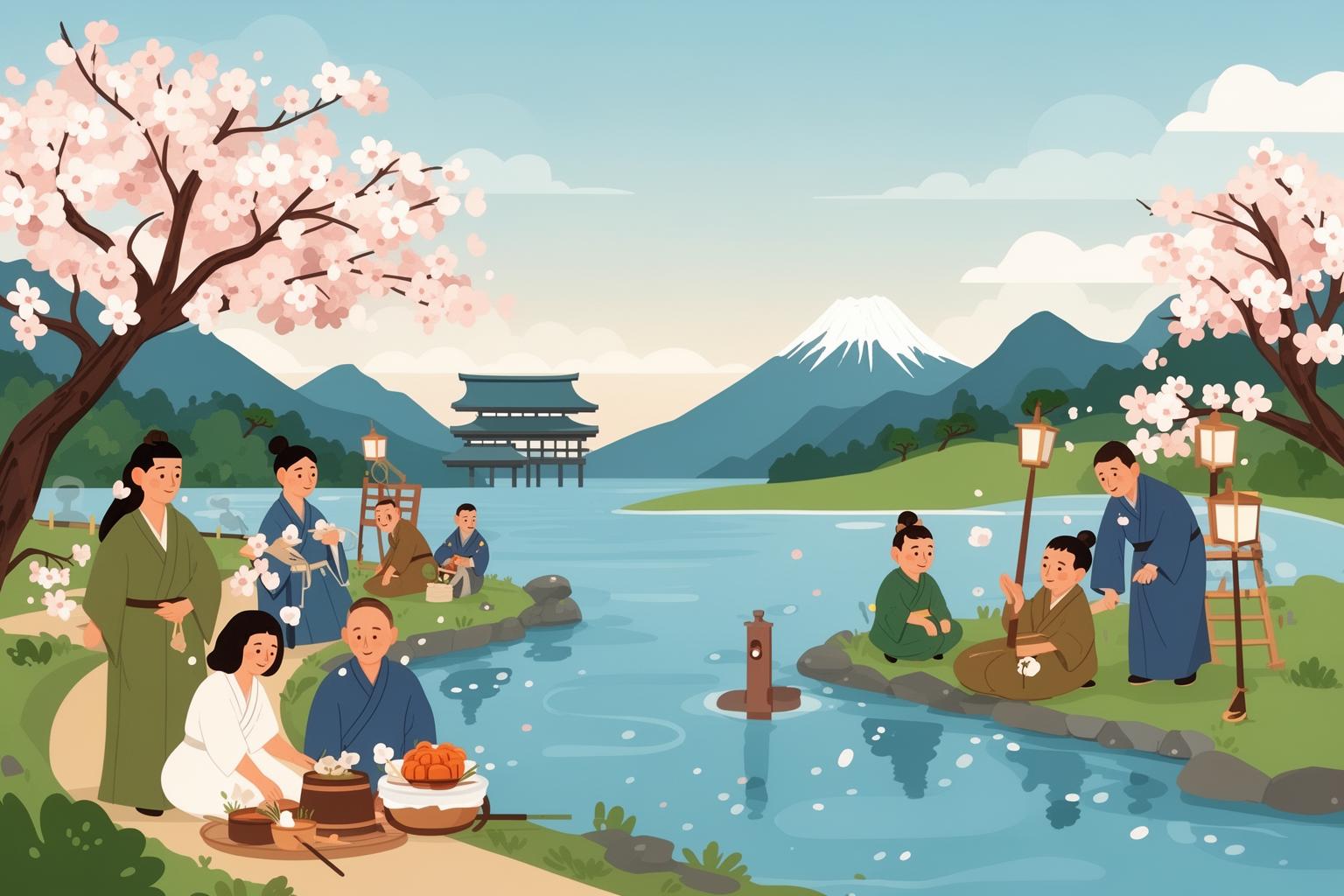
In Japan, itadakimasu is not an abstract idea debated by theologians; it is a lived, everyday practice taught from the moment a child begins to speak. It is a form of cultural muscle memory, reinforced in every home and school.
A Childhood Lesson
The ritual serves as a cornerstone of early education. During school lunch, known as kyushoku (給食), the whole class recites it together before eating. A student monitor might lead by saying, “Let’s put our hands together,” and the room will echo with the chorus of “Itadakimasu!” This daily, communal repetition transforms the phrase from a simple formality into an ingrained habit, an essential part of the mealtime rhythm. It teaches children from an early age that food does not simply appear; it is the result of effort, nature’s generosity, and life given. It lays a foundation of gratitude and mindfulness that endures throughout life.
The Physical Gesture
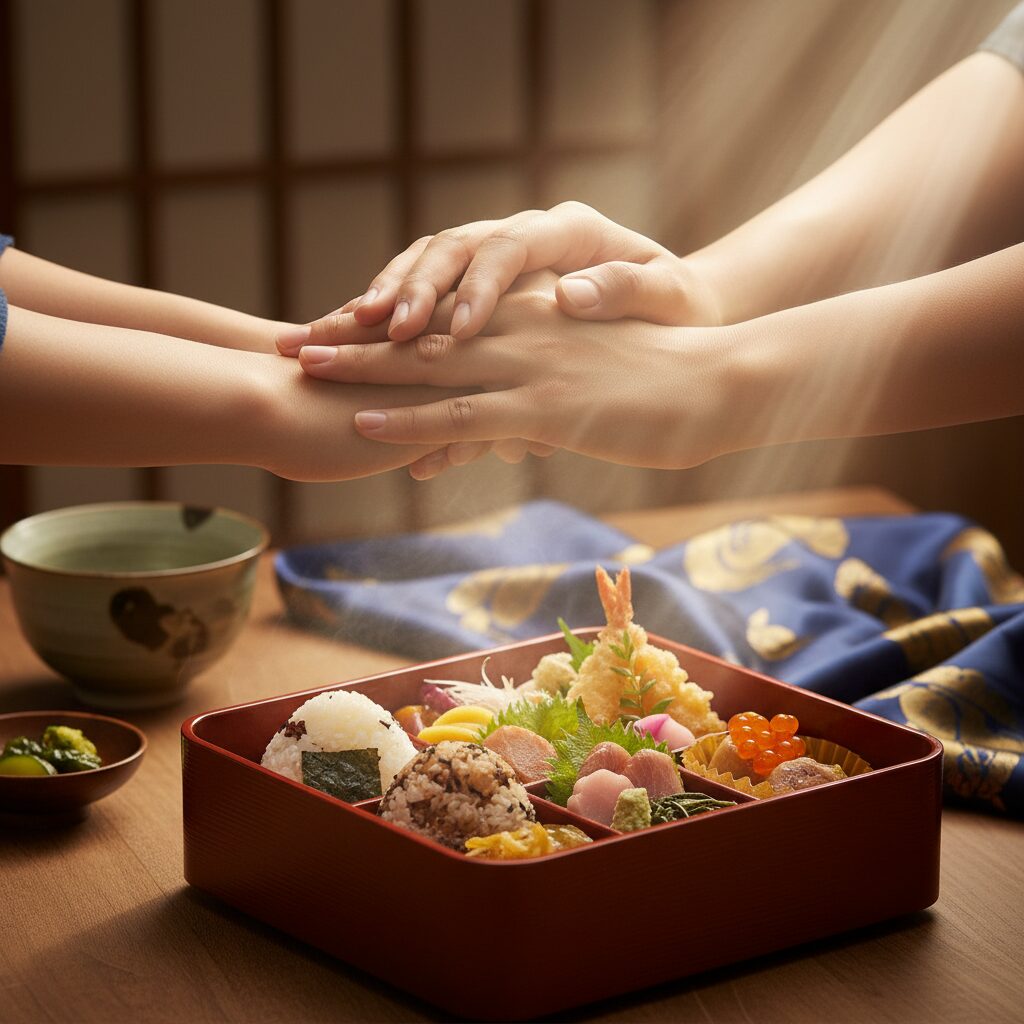
Often, the words are accompanied by a physical gesture called gassho (合掌), where the hands are placed together in a prayer-like position. The chopsticks are held in the hands, or if resting on the table, the hands come together in front of the chest as the head bows slightly. This small physical act carries great significance. It centers the mind, calms the body, and turns a fleeting thought into a purposeful action. It creates a pause, marking a clear boundary between what came before the meal and the act of eating itself. It is a moment to fully arrive at the table, to be present with your food before you begin.
The Closing Bracket: Gochisousama
The ritual of gratitude does not end with the first bite. It concludes after the meal with a corresponding phrase: “Gochisousama deshita” (ご馳走様でした). The characters for chisou (馳走) mean “to run around,” evoking the effort and hustle involved in preparing a feast. Saying this expresses explicit acknowledgment of that hard work. It thanks the host, the chef, and everyone involved in the “running around” that brought the meal to the table. If itadakimasu opens the ritual of eating with humble reception, gochisousama closes it with heartfelt appreciation.
More Than Just Manners
Grasping the meaning of itadakimasu shows that it is much more than mere politeness. It embodies a practical philosophy that actively influences behavior and perception, fostering values that may be more important now than ever before.
An Antidote to Wastefulness
The essence of itadakimasu is the cultural foundation for the idea of mottainai (もったいない), a term expressing deep regret over wastefulness. When you take a moment to consciously recognize the network of life and labor involved in your food, you become far less likely to handle it carelessly. Leaving food on your plate, especially rice, is regarded as highly disrespectful. It dishonors the life given and the effort invested. Finishing every last grain is not simply about thriftiness; it is the natural result of the gratitude expressed before the meal. It fulfills the promise to receive the gift with appreciation.
A Moment of Presence
In a world full of distractions, where meals are often rushed in front of screens, itadakimasu acts as a powerful, built-in mindfulness practice. It requires a pause. It urges you to put aside your phone and daily worries, focusing instead on the bowl before you. This brief, two-second meditation connects you to your food, your body, and the world beyond your plate. Long before “mindful eating” became popular, this was simply how things were done in Japan, distilled into one simple, meaningful word.
Therefore, itadakimasu is not just something said before eating. It is a worldview—a philosophy of interdependence, humility, and gratitude distilled into a daily ritual. It reminds us that we are not isolated consumers but part of an immense, complex system of giving and receiving. It recognizes that to live, something else must give its life, a transaction that deserves our deepest respect. You don’t need to speak Japanese to embrace this spirit. The next time you sit down to eat, wherever you are, take a moment. Pause. Look at your food. Reflect on its origins—the earth, the sun, the rain, the hands that grew it, and the hands that prepared it. In that quiet moment of acknowledgment, you will grasp the true, profound essence of itadakimasu.