Imagine the sharp, clean air of late December in Japan. Steam billows from a wooden tub, carrying the sweet, earthy scent of cooked rice into the cold. A small crowd is gathered in a circle, their breath fogging in front of them. At the center, a man lifts a wooden mallet, impossibly heavy, high above his head. He pauses, a silent breath, and then brings it down with a thunderous thwack into a large, hollowed-out log. A moment later, another person, kneeling, darts their hand into the steaming mass inside the log, folding it with impossible speed before the mallet comes down again. Thwack. Fold. Thwack. Fold. This is mochitsuki, the traditional pounding of rice to make mochi for the New Year. On the surface, it looks like a brutal, back-breaking chore, a relic from a time before industrial food production made life easier. And you have to wonder, why would anyone choose to do this? In a country famed for its efficiency and convenience, this ritual is the complete opposite. It’s slow, dangerous, and demands a level of coordinated effort that seems almost absurd. But you’re not just watching people make rice cakes. You’re watching them build a community. This isn’t about the mochi itself. It’s about the intense, unspoken, perfectly synchronized partnership required to create it. It is, quite possibly, the most profound team-building exercise you will ever witness.
The communal rhythm of mochitsuki finds a kindred spirit in Japan’s culinary landscape, where exploring the mastery of Japanese depachika unveils another facet of the nation’s rich food traditions.
More Than Just Rice: The Soul of Mochi
Before appreciating the immense effort involved in the pounding, it’s important to recognize that what’s being pounded is more than just food. In Japan, mochi carries profound spiritual meaning that elevates it well beyond a simple starch. This isn’t the pastel-colored, ice-cream-filled treat found in supermarket freezer aisles. Authentic mochi is made from a single ingredient: mochigome, a special variety of glutinous short-grain rice with a higher starch content that gives it its distinctive elastic and chewy texture.
From Grain to God-Food
In Shinto, Japan’s native religion, rice is more than a staple crop; it is a sacred gift. Each grain is believed to harbor a divine spirit or life force, known as inadama. The steaming and pounding of mochigome is a ritual that transforms these individual grains into one unified, pure white mass. The resulting mochi is viewed as a vessel for that divine energy, symbolizing life, vitality, and purity. It becomes a sacred food, a worthy offering to the gods (kami) to invoke their blessings for the year ahead. When people eat mochi, they partake in that divine essence, absorbing the strength and spirit of the rice gods to sustain them in the coming months. This belief infuses the entire process with reverence. The participants are not merely cooks; they are caretakers of a sacred transformation.
The New Year’s Connection
Why is this elaborate ritual so tightly connected to New Year’s? In Japan, Oshogatsu (the New Year period) is the most significant holiday of the year. It is a time for thorough cleaning, settling debts, and purifying the home and spirit to welcome the toshigami, the New Year deity who brings luck and prosperity. Mochi plays a central role in these customs. The most iconic form is the kagami mochi, or “mirror rice cake,” composed of two round mochi discs, a smaller one stacked atop a larger one, topped with a bitter orange called a daidai. This display is placed on the family’s Shinto altar or a place of honor in the home as an offering to the toshigami. Its round shape is said to resemble an ancient bronze mirror, a sacred object in Japanese mythology believed to house a god’s spirit. Beyond decoration, mochi is the key ingredient in ozoni, a traditional soup eaten as the first meal of the New Year. Each region—and indeed every family—has its own version of ozoni: some with clear dashi broth, others with rich miso; some with round mochi, others with square. Yet mochi remains a constant. Eating it is an act of prayer, a way to consume blessings while hoping for a long, resilient life that stretches just like mochi itself.
The Anatomy of a Pounding: A Symphony of Effort
The essence of the mochitsuki experience lies in its choreography. It is a raw, physical performance requiring precision, trust, and a shared rhythm that borders on telepathy. It is a delicate dance between brute strength and subtle timing, where every participant plays a vital, interdependent role. There is no margin for error, and no one can accomplish it alone.
The Tools of the Trade
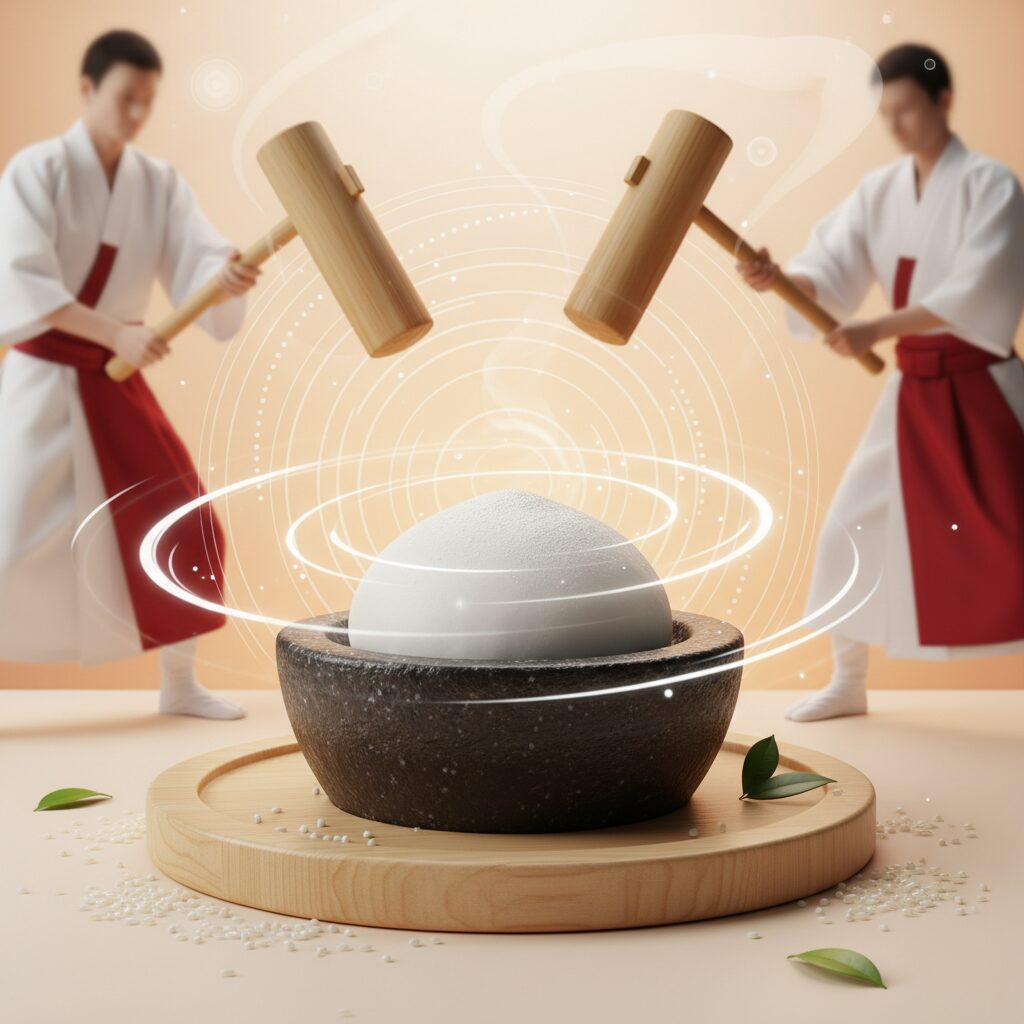
The stage for this performance is set with two essential instruments. The first is the usu, a massive mortar typically carved from a solid tree trunk or a block of stone. An usu is not something purchased casually; they are heavy, costly, and often passed down through generations within families or communities. It symbolizes a connection to the past, serving as a physical anchor for the tradition itself. Its counterpart is the kine, an exceedingly heavy, long-handled wooden mallet used for pounding. Lifting the kine demands significant upper-body strength, and wielding it accurately requires concentration and practice. These are no ordinary kitchen tools but ceremonial implements embodying the seriousness and communal significance of the task.
The Players and Their Roles
While crowds may gather to help with smaller chores, the heart of mochitsuki relies on the seamless collaboration of two primary roles, with a crucial third role enabling their success. Each role demands distinct skills, but all require total focus.
First is the Steamer (Mushikata). Their work begins long before the mallet’s first swing. They are responsible for washing, soaking, and steaming the mochigome to perfection. This foundation is critical; if the rice is too hard or too mushy, the ideal consistency cannot be achieved, regardless of the pounders’ skill. This role demands patience, experience, and an intuitive grasp of the ingredients. They are the silent architects of the entire process.
Next is the Pounder (Tsukite). This role is the most visually striking, defined by power and endurance. The tsukite wields the kine, swinging it in a high arc to deliver forceful, crushing blows to the steamed rice in the usu. The aim is not merely to smash the rice but to methodically break down the grains, releasing starches that bind them together. While it appears to be pure strength, rhythm is equally important. The pounder must maintain a steady, consistent beat—a tempo their partner can anticipate and trust. They serve as the operation’s percussive heartbeat.
Finally, and most critically, there is the Turner (Kaeshite). This person brings an element of high-stakes trust to the ritual. Kneeling beside the usu, the kaeshite plunges bare hands into the steaming rice between every mallet strike. In that brief pause, they must quickly fold and turn the sticky dough to ensure even pounding. To keep their hands from sticking, they dip them in a bowl of cold water (te-mizu), but this offers little protection from the heat or the danger posed by the descending kine. The kaeshite’s role requires extraordinary courage, lightning-fast reflexes, and an almost psychic connection with the pounder. They must anticipate the rhythm, sense the dough’s progress, and trust implicitly that the mallet will fall exactly where and when intended. A moment’s hesitation or misjudgment could crush fingers. This role elevates mochitsuki from mere labor to a breathtaking display of mutual reliance.
The Rhythm of Creation: Aioi no Kokyu
The magic linking the pounder and the turner is known as aioi no kokyu, which translates to “synchronized breathing” or “shared rhythm.” This invisible bond ensures safety and success. Coordination often takes the form of rhythmic calls, or kakegoe. The pounder might shout “Yoi-sho!” while raising the mallet, and the group may answer with another “Yoi-sho!” as it is brought down. These are not just cheers; they serve as the metronome for the entire process. The turner listens closely to these cues, timing movements to the precise cadence of the pounder’s breath and voice. There is no room for verbal negotiation—it is all intuition, sound, and anticipation. When pairs have worked together for years, vocal cues may fade, replaced by an intuitive understanding of each other’s motions. This synchronized effort, the perfect harmony of power and precision, embodies the ritual’s very essence. It is a physical manifestation of trust and a powerful reminder that the most demanding tasks can only be overcome through complete unity.
The Taste of Togetherness: From Labor to Feast
After what feels like an eternity of intense, rhythmic pounding, the transformation is complete. The separate grains of rice have disappeared, replaced by a smooth, glossy, and remarkably elastic white dough. The air, once charged with tension and the sharp crash of wood striking wood, now settles into a warm hum of accomplishment. The most strenuous part of the work is finished, but the communal experience is only just beginning.
The Communal Reward
The large ball of freshly made mochi, still radiating heat, is quickly moved from the usu to a spacious table generously dusted with katakuriko (potato starch) or mochiko (rice flour) to keep it from sticking. Now, everyone is invited to join in. Hands that were idle moments before—those of children, grandparents, neighbors, and friends—reach in to pinch off pieces of the warm, soft dough. There is a tangible sense of joy and relief in the atmosphere. The intense, focused labor transitions into a relaxed, celebratory mood. Laughter and conversation flow freely as people shape the mochi into small, round cakes. This is the moment of reward. It marks the shift from a highly structured, high-risk task to an open, inclusive celebration. The mochi, crafted through the vigorous efforts of a few, now belongs to the entire community. Sharing this final step reinforces the belief that everyone has a role in the tradition, whether wielding the mallet or simply savoring the fruits of that effort.
An Endless Variety of Flavors
Freshly made mochi, or tsukitate, is a revelation. It is warm, soft, and carries a subtle sweetness from the rice that is entirely lost in its mass-produced, packaged versions. The true delight lies in eating it immediately after it’s made. The small, round pieces are rolled in an assortment of toppings, turning the table into a palette of flavors and textures. A classic choice is kinako, a fine powder of roasted soybean flour often mixed with sugar, which offers a nutty, comforting sweetness. Another favorite is anko, a sweet paste made from adzuki red beans, providing a rich, earthy contrast to the plain mochi. For a savory twist, there is isobeyaki, where mochi is dipped in soy sauce and wrapped in a crisp sheet of nori seaweed. And for a sharp, refreshing bite, there is karami mochi, served with grated daikon radish and a splash of soy sauce. This variety ensures there is something to satisfy everyone. This shared meal is the perfect conclusion to the ritual. It is the moment when the abstract ideas of community, hard work, and divine blessing become a tangible, delicious reality. The flavor is inseparable from the experience of making it; it tastes like teamwork.
Why It Endures in a World of Convenience
Let’s be honest. In modern Japan, no one needs to do mochitsuki. You can easily buy perfectly good, vacuum-sealed mochi in any supermarket. For those seeking something fresher, powerful electric mochi-makers can steam and pound rice at the push of a button, turning what used to be an hours-long task into a simple appliance-driven process. Traditional mochitsuki is, by all practical measures, inefficient, laborious, and outdated.
The Decline and the Revival
Unsurprisingly, the practice declined over many years. As families grew smaller and communities became less close-knit, the tremendous effort needed to organize a mochitsuki event became a major obstacle. The heavy usu and kine were tucked away in sheds or barns, gathering dust as a new generation chose convenience instead. The rhythmic pounding that once marked the arrival of the New Year in neighborhoods nationwide grew softer and, in many places, stopped entirely. But recently, a fascinating resurgence has begun. Communities, local businesses, schools, and even families are intentionally bringing back this demanding tradition.
A Deliberate Act of Connection
This revival isn’t driven by nostalgia alone. It’s a conscious rejection of the very convenience that nearly erased it. In an era of digital screens and social isolation, mochitsuki provides something modern life often lacks: a profound and tangible human connection. It compels people to put down their phones, be physically present, and collaborate toward a shared goal. It’s a ritual that cannot be replicated with an app. You cannot outsource the trust between the pounder and the turner. You cannot digitize the sensation of warm mochi being shaped by dozens of hands. Companies are hosting mochitsuki events for employees, seeing it as a much more effective team-building activity than any corporate retreat. Schools organize them to teach children the importance of tradition, effort, and cooperation. Neighbors pool resources to bring the sound of the kine back to their streets, strengthening bonds weakened by the fast pace of modern urban life. Mochitsuki endures precisely because it is challenging. It’s a deliberate choice to engage in something that demands patience, physical effort, and deep trust. It reaffirms that some things—community, shared struggle, and the taste of something earned together—are worth the inefficiency. It’s how, at the turn of each year, people remind themselves what it truly means to be part of a team, a family, or a community: moving in rhythm, trusting each other, and creating something vital together.