You’ve been hiking for eight hours. Your legs are trembling, your pack feels like it’s filled with stones, and a cold alpine wind is starting to bite. The trail has been a solitary battle of will against granite and gravity. Then, through the mist, you see it: a simple wooden structure perched on the mountainside, a curl of smoke rising from its chimney. This is the yamagoya, the Japanese mountain hut. You push open the door, expecting a rustic, free-for-all hiker’s refuge. Instead, you step into a world of quiet, ordered precision that feels a world away from the wild chaos of the mountain you just conquered. This isn’t a shelter; it’s a system. And you, the exhausted hiker, are now a part of it.
Westerners, particularly those accustomed to the sprawling lodges of national parks or the rugged individualism of backcountry cabins, often experience a kind of culture shock in a Japanese yamagoya. It’s not a hotel. It’s not quite a hostel. It’s a highly structured, intensely communal living space governed by a set of unspoken rules that can feel both baffling and profound. Why are mealtimes fixed to the minute? Why are you assigned a sleeping space barely wider than your shoulders? Why does every single action, from taking off your boots to packing your bag, seem to follow an invisible script? The yamagoya is more than just a place to rest; it’s a microcosm of Japanese society, a high-altitude lesson in the delicate balance between the individual and the group. Understanding the logic of the mountain hut is a shortcut to understanding the deeper currents of Japanese culture itself.
This delicate balance between personal effort and collective order finds a parallel in Japan’s natural rhythms, as illustrated by its 72 micro-seasons, which reveal another layer of the country’s intrinsic discipline.
More Than a Roof: The Philosophy of the Yamagoya
To understand the logic behind the yamagoya, you first need to grasp its fundamental purpose: safety. These huts are not tourist attractions built for comfort and leisure. They serve as crucial infrastructure, strategically situated in harsh and often dangerous environments to provide shelter from typhoons, sudden snowstorms, and the relentless exhaustion that can cause fatal errors. This core principle of safety underlies every rule, expectation, and seemingly strict procedure.
Many of these huts have histories spanning decades, sometimes more than a century. They did not arise as commercial ventures catering to a growing tourist market. Instead, they developed naturally from simple shelters used by spiritual pilgrims journeying to sacred peaks or by hunters and loggers seeking refuge from the elements. Their evolution was driven by necessity, not by a desire to offer an “experience.” This history is embedded in their very design. The emphasis has always been on maximizing function, efficiency, and the ability to save lives in a landscape that is both beautiful and unforgiving.
When you step inside a yamagoya, you are instantly equalized. On the trail, you are an individual. Inside the hut, you become part of a temporary community. Your job title, your income, the brand of your expensive outdoor gear—all of this becomes irrelevant. The mountain acts as the great leveler. Here, your sole identity is “hiker,” and your only responsibility is to coexist peacefully and considerately with everyone else seeking the same refuge. The hut operates on the understanding that everyone recognizes this, that all are present for the same reasons and willing to adapt for the collective good.
The Choreography of Arrival and Departure
The moment you arrive, your education in the yamagoya social contract begins. It is a dance of practiced motions and quiet mindfulness, and you are expected to master the steps quickly.
Checking In: The First Challenge
Your initial action is not to collapse onto a bench or drop your pack. Instead, you must remove your muddy hiking boots. Every yamagoya has a genkan, an entrance area where outdoor footwear is strictly prohibited. You will be given a plastic bag for your boots and directed toward shelves or cubbies for storage. Then, you slip into a pair of communal slippers. This rule is absolute. It represents a core principle of Japanese life, intensified in the mountains. The hut’s interior is a clean, shared living space, and tracking in dirt and grime from the trail violates that shared sanctity. This is the first and simplest gesture of respect.
The check-in process itself is quick and straightforward. You will likely fill out a small form with your personal details, emergency contact, and planned route for the next day. This is not mere bureaucracy; it is a safety precaution for mountain rescue teams. Payment—almost always in cash, so come prepared—is made, and the hut staff will assign you a number or tag for your sleeping spot. There is no bargaining or requests for a “better” place by a window. You are a part of a system designed to keep everyone safe and sheltered overnight. Your role is to accept your place and blend in smoothly.
The Art of Managing Your Gear
In the West, hikers often spread their gear across a hostel room or cabin floor, creating a personal zone of controlled chaos. Attempting this in a yamagoya would be a significant social faux pas. Space is a precious commodity, and every inch is accounted for. There are specific areas for everything.
Wet rain gear belongs in a designated drying room. Backpacks must be stored on assigned racks or shelves, never in sleeping quarters or hallways where they could block traffic. Trekking poles are left outside. Your personal belongings—the essentials for evening and morning—should be packed into a smaller bag. The expectation is that you minimize your footprint. Your presence should not inconvenience others. This is not just about tidiness; it reflects the cultural imperative to avoid causing trouble or meiwaku for others.
The Pre-Dawn Departure
The morning departure is a masterclass in silent, coordinated movement. Many hikers aim to hit the trail well before sunrise, hoping to witness the goraikō, the breathtaking view of dawn from a mountain peak. This means rustling and packing often begin as early as 3 or 4 AM.
Etiquette here is crucial. Experienced hikers will have packed most of their gear the night before, leaving only essentials out. Headlamps are set to red light to avoid disturbing sleepy neighbors. Zippers are closed slowly. Plastic bags, which can make a surprising amount of noise in the stillness, are handled with great care or avoided entirely. Conversation is kept to an absolute minimum, whispered quietly. It is a silent ballet of mutual consideration, a collective effort that allows everyone to depart on their own schedule without disturbing those remaining behind.
Communal Living, Distilled
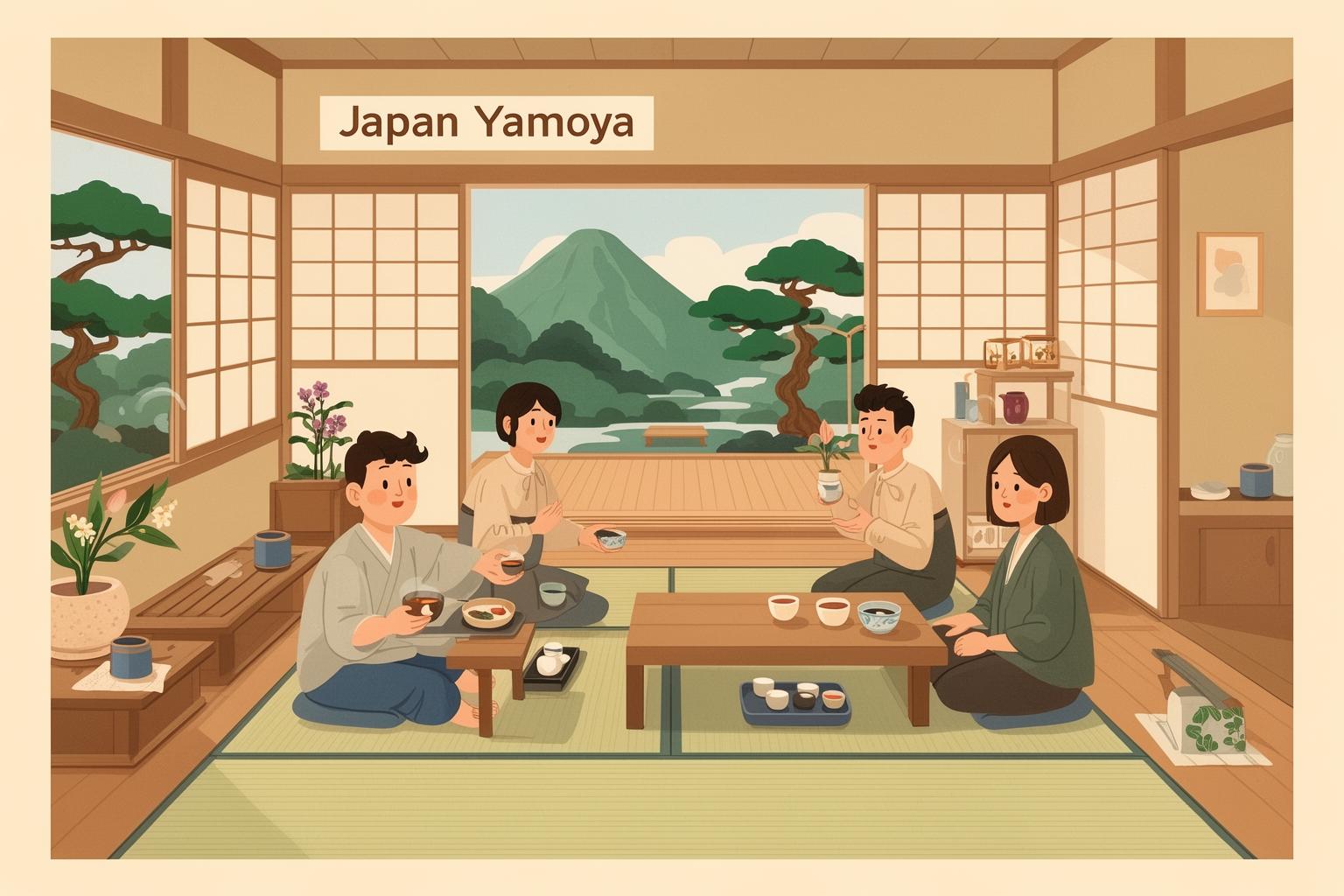
The essence of the yamagoya experience lies in its radical communality. From meals to sleeping arrangements, the usual concept of personal space and individual choice is temporarily set aside in favor of a system designed to benefit the entire group.
The Mealtime Ritual
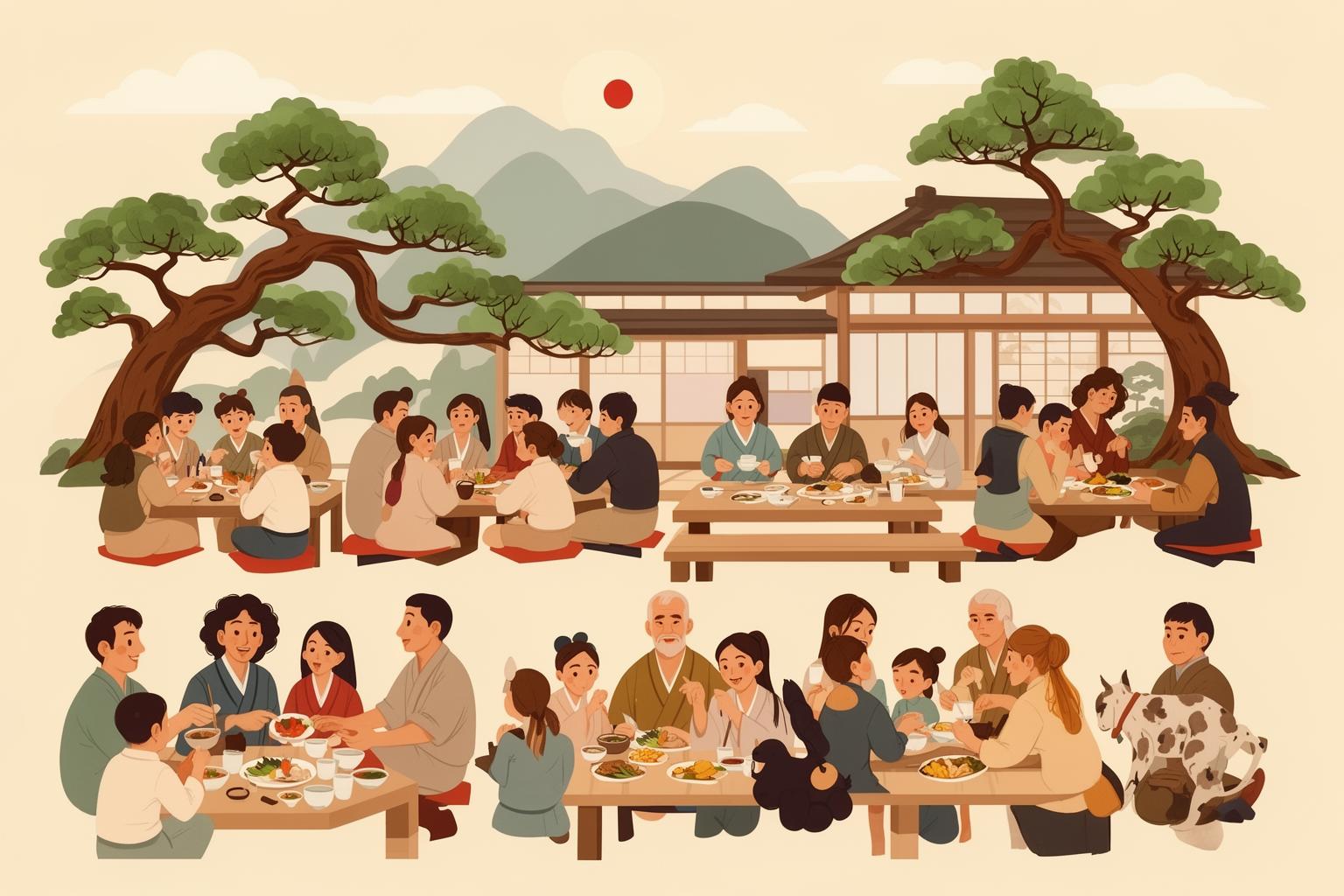
Dinner and breakfast are not casual, drop-in events. They follow a strict schedule with set start times. When the bell rings or staff call out, you head to the dining hall and take your seat. Seating is almost always at long, communal tables, and you sit wherever there is an open spot. You don’t reserve seats or select your companions.
The food is simple, hearty, and intended for one purpose: to replenish your body. Don’t expect a menu. Dinner often consists of a set meal such as Japanese curry with rice, maybe a piece of fish, some pickled vegetables, accompanied by miso soup and tea. It’s calorie-dense and comforting. Breakfast is similarly standardized: rice, miso soup, a raw egg, and a slice of salmon. You eat what is provided.
This ritual reinforces the sense of community. Everyone shares the same meal at the same time, occupying the same space. When finished, the process remains structured. In many huts, you are expected to return your tray, bowls, and chopsticks to a designated return window. You are a participant in the system, not a customer being served. This simple practice emphasizes that the smooth running of the hut relies on everyone’s cooperation.
Sleeping Arrangements: The “Sardine Can” Experience
For many non-Japanese hikers, the sleeping conditions are the biggest challenge. During peak season, especially in popular huts on mountains like Fuji, you will sleep literally shoulder-to-shoulder with strangers. Sleeping areas typically include wide, elevated wooden platforms or tatami mat rooms where futons are laid out in a continuous line. Your allocated space might be barely more than 50 centimeters wide. Privacy is virtually nonexistent. You will hear every sigh, snore, and rustle from those next to you.
This can be very unsettling for those from cultures that highly value personal space. But once again, the logic comes down to safety and efficiency. The aim of the yamagoya is to provide shelter to as many people as the mountain can accommodate. Turning people away during bad weather could be a death sentence. Hence, space is used with ruthless efficiency. Individual comfort is secondary to the collective need for shelter. Complaints about cramped conditions are seen as deeply selfish. The unspoken expectation is that you accept the situation gracefully, understanding that your minor discomfort is part of a system designed to keep everyone safe. It is a profound exercise in subordinating personal preference for the sake of group harmony, or wa.
The Scarcity Mindset: Water, Power, and Waste
Life in a mountain hut constantly reminds you that resources are limited. Water is often collected rainwater or sourced from a mountain spring, and it may be scarce. Hot water is a luxury, if available at all. Electricity usually comes from a generator that runs for only a few hours in the evening. When “lights out” is announced—typically around 8 or 9 PM—the whole hut goes dark. You are expected to be inside your sleeping bag and quiet.
The most important rule concerns waste. The principle is gomi wa mochikaeri—you carry out everything you carry in. Every food wrapper, empty bottle, and used tissue. There are no trash cans. Leaving garbage behind is considered a serious sign of disrespect, not only to the hut staff who would have to carry it down, but to the mountain itself. It directly violates the ethic of not burdening others. This rule is absolute and reflects a broader environmental awareness and cultural belief in personal responsibility.
The Unspoken Social Contract
Ultimately, life in the yamagoya is guided by a social contract that depends more on observation and intuition than on explicit rules.
The Role of the Hut Staff (Yama-bito)
The people who operate the huts, the yama-bito or “mountain people,” are not hotel managers or hospitality workers. They are experienced mountaineers. Their main responsibility is to oversee a crucial piece of safety infrastructure. They provide weather updates, offer vital advice on trail conditions, and coordinate with rescue teams in emergencies. Their authority within the hut is absolute, and their rules are not mere suggestions. These directives stem from years of experience in a setting where errors can be fatal. To question or challenge them is not only impolite but also shows a lack of understanding of the seriousness of your environment.
Reading the Air (Kūki o Yomu)
More than anywhere else, the yamagoya is a place where you must kūki o yomu, or “read the air.” This quintessentially Japanese social skill involves sensing the atmosphere and adjusting your behavior to fit the prevailing mood and expectations without any verbal instruction. No sign will notify you to keep quiet after 9 PM; you are expected to notice the silence and comply. No one will directly tell you to organize your gear; you are expected to observe how others manage their space and follow suit.
The social pressure to conform is gentle yet pervasive. It arises from the collective behavior of everyone around you. The system is self-regulating. By observing and imitating, you become part of the hut’s temporary, harmonious community. Failing to do so marks you as an outsider unwilling to engage in the shared social reality.
***
In the end, staying in a yamagoya is much more than just a night’s lodging. It is a social crucible. It removes the insulating layers of modern, individualistic life and forces you into direct contact with the core principles of Japanese society: collective responsibility, deep consideration for others, the sanctity of shared space, and the relentless pursuit of group harmony. The physical challenge of climbing the mountain is a personal one, testing your strength and endurance. But the moment you enter the hut, the test becomes social.
Though the profound lack of privacy can be unsettling, the experience offers a powerful counterbalance to our often-isolated lives. It serves as a tangible reminder that we are part of a larger community, and that our actions, however small, affect those around us. For one night, you trade personal freedom for collective security. You learn to make yourself smaller, quieter, and more attentive. The mountain teaches you about your own limits, but the yamagoya teaches you about your place among others. It is a lesson in shared humanity, delivered at 3,000 meters.