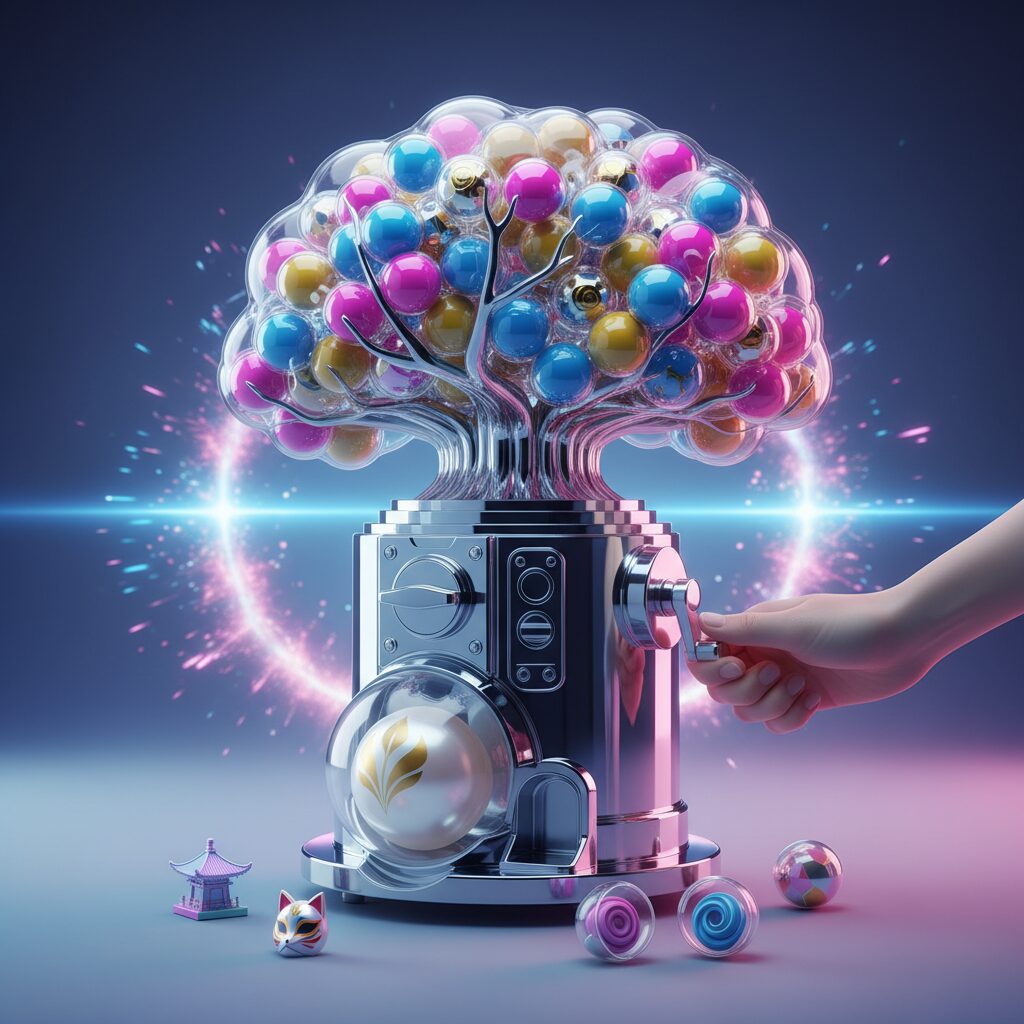
You’ve seen them. You can’t miss them. Lined up in silent, colorful armies, they greet you at the entrance to electronics stores, cluster in the hidden corners of train stations, and form entire walls in dedicated shops in Akihabara or Nakano. They are the gacha machines, or gachapon as they’re affectionately known in Japan—a name that perfectly mimics the two key sounds of the experience: the heavy “gacha” of the crank turning and the satisfying “pon” as the plastic capsule drops into the tray. At first glance, it’s simple. You put in a few hundred yen, turn the knob, and get a small toy. A childish diversion, right? Something to keep the kids quiet while the parents shop. But then you look closer. You see adults—men and women in office attire, university students, serious-looking hobbyists—meticulously feeding coins into the slots, their faces a mixture of intense concentration and hopeful anticipation. This isn’t just a nostalgic pastime. In Japan, collecting gacha has evolved into a massive, multi-billion yen subculture, a serious hobby that speaks volumes about consumer psychology, craftsmanship, and the Japanese love for the niche and the miniature. Forget the cheap, flimsy trinkets you might remember from Western candy machines. This is an entirely different universe, one where artistry, absurdity, and the thrill of the hunt converge in a tiny plastic sphere.
Japan’s multifaceted cultural landscape not only fuels the intricate world of gacha but also resonates in the dynamic energy of anime yankii culture, where street edge meets animated flair.
From Cheap Thrill to Collector’s Game

The rise of gacha from a simple pastime to a serious collector’s item is fundamentally a story of quality. The concept itself is not originally Japanese; it evolved from coin-operated gumball and toy vending machines that gained popularity in the United States. When these machines were introduced to Japan in the 1960s, they dispensed simple, inexpensive plastic toys primarily aimed at children. For decades, they remained a pocket-money indulgence. The transformation began in the 1990s and early 2000s, when manufacturers started reconsidering what could fit inside a capsule. Companies like Bandai, a major toy manufacturer, and Kaiyodo, famous for its highly detailed figurines, began competing not only on character licensing but also on artistic quality. They started creating gacha that were more than toys—they became miniature sculptures. The paintwork grew more intricate, the plastic molds more dynamic, and the themes more refined. Suddenly, a 300-yen capsule might hold a museum-quality replica of a notable frog species, a perfectly scaled miniature of a mid-century modern chair, or a detailed, multi-part figure of an anime character requiring careful assembly. This shift was pivotal. It elevated the product from a disposable bauble to a coveted object. Adults who valued design, detail, and craftsmanship found a reason to stop and turn the crank. They were not just buying a toy; they were acquiring a small, exquisitely made item worthy of display. This dedication to quality completely transformed the audience, creating a devoted adult market willing to pay for—and passionately pursue—excellence in miniature.
The Psychology of the Crank
To grasp the obsessive appeal of gacha collecting, you need to recognize the powerful psychological mix it delivers. Essentially, it’s a form of low-stakes gambling, a precisely crafted dopamine delivery system. With just a few coins, you experience a strong dose of anticipation and surprise. You know the set of possible outcomes—the six different cats wearing fruit hats, the eight miniature Showa-era home appliances—but you don’t know which exact one you’ll receive. This uncertainty drives the entire experience. Will you get the common one you already own, or the rare, secret one you’ve been pursuing for weeks? The moment between turning the crank and opening the capsule is a brief, perfect bubble of suspense. When you get what you want, the feeling is euphoric. When you receive a duplicate, it only fuels the urge to try just one more time. This “one more try” impulse is what built the industry. Beyond the excitement of the chase, gacha taps directly into the primal human instinct to collect and complete sets. Manufacturers excel at creating series that beg to be finished. Obtaining one adorable Shiba Inu in a bowing pose is charming. Collecting all five to form a full, apologetic canine board meeting is an irresistible goal. This drive for completion turns a casual purchase into a focused quest. Additionally, gacha offers a dose of what you might call “accessible luxury.” In a world of costly collectibles and expensive hobbies, gacha provides an affordable entry point. For the price of a coffee, you can possess a tiny, tangible piece of art, a beautifully crafted token of a fandom you love, or an amusingly absurd object that brings a moment of pure joy. It’s a small, manageable indulgence in a life that can often seem chaotic.
A Universe in a Capsule: The Sheer Variety

One of the biggest misconceptions about gacha is that it revolves solely around anime and manga characters. While these do form a significant portion of the market, the true brilliance of the gacha world lies in its astonishing and almost overwhelming diversity. Without exaggeration, there is a gacha series for virtually every imaginable interest, no matter how niche. This vast range is what gives the subculture its remarkable reach. The categories are endless. There is the hyper-realistic miniature genre, showcasing everything from intricately detailed plates of sushi and ramen to flawlessly replicated power tools, camping gear, and vintage cameras. These appeal to those who value craftsmanship and the novelty of seeing everyday items perfectly miniaturized. Then there is the expansive and delightful realm of the absurd, where Japanese creativity truly flourishes. Think of series like “Shakurel Planet,” featuring animals with enormous, protruding chins, or cats sporting inexplicably muscular arms, office workers who are secretly pigeons, or public statues of historical figures caught in dynamic breakdancing poses. This surreal and often bizarre humor is a huge attraction, providing a form of comedy that is both surprising and ideal for sharing online. Beyond the strange, there are artistically and design-oriented gachas. Collaborations with renowned illustrators, museums, and designers yield capsules containing tiny prints, miniature versions of famous sculptures, or iconic furniture pieces. Recently, the realm of “practical gacha” has also surged in popularity. Now, you can find tiny, functional tote bags, pouches for lip balm, character-themed cable organizers, and even reusable shopping bags, all dispensed from gacha machines. This incredible variety ensures that no one is excluded. Whether your passion lies in frogs, Japanese temples, mid-century furniture, construction vehicles, or simply the weird and wonderful, there is a gacha machine somewhere in Japan waiting for your coins.
The Gacha Ecosystem
The culture of gacha extends well beyond the moment of purchase. A complex social and economic ecosystem has developed around it, turning the hobby into a more interactive and communal experience. The pursuit of gacha takes place in several key locations. The most common is the “gacha wall,” rows of machines found in large stores like Yodobashi Camera or in video game arcades. These offer a wide but curated selection. For the truly devoted, however, the destination is the gacha specialty store. Places like the massive “Gashapon Department Store” in Ikebukuro serve as temples to capsule toys, housing thousands of machines under one roof. Fans can spend hours wandering the aisles, hunting for the latest releases and obscure series. But what happens when you get a duplicate—a dabu-tta in Japanese collector slang? This is where the community aspect shines. In front of popular gacha spots, it’s common to see collectors with small trays displaying their duplicates, looking to trade with others to complete their collections. This spontaneous bartering system is a crucial part of the social fabric of the hobby. For those who want to avoid the randomness of the draw entirely, a thriving aftermarket exists. Specialty collector shops in areas like Akihabara and Nakano Broadway buy and sell individual gacha. Capsules are opened in-store, and figures are sold individually in small plastic bags, with prices varying according to rarity. Common figures may be cheaper than the original machine price, while rare “secret” items can be marked up significantly. Complete, sealed sets are also available from the start. The presence of this robust secondary market is the ultimate proof that gacha is a serious collector’s game, with established market values influenced by supply, demand, and rarity.
More Than Just Plastic

Ultimately, the gacha phenomenon is captivating because it perfectly encapsulates several broader currents in Japanese culture. It represents a modern manifestation of Japan’s long-standing aesthetic admiration for miniaturization. From the intricate netsuke carvings of the Edo period to the painstaking art of bonsai, the culture’s artistic DNA is deeply rooted in rendering things in small, flawless detail. Gacha are the 21st-century, mass-produced evolution of this concept. The phenomenon also reflects Japan’s pervasive character culture. In a society where government agencies, train lines, and even tax offices have adorable mascots, it makes sense that there would be an accessible, affordable way to physically own a piece of that world. Gacha acts as the main physical channel for thousands of characters, both well-known and niche, transforming abstract affection for a design into a tangible collection. It also functions as a form of social currency. Sharing your latest gacha unboxing on social media, showcasing your collection at work, or trading with friends fosters a sense of shared identity and community. It’s a language expressed through small, specific objects that says, “I’m someone who appreciates incredibly detailed miniature bread,” or “I share your passion for this obscure anime.” So, the next time you pass by a wall of gacha machines, don’t write them off as mere distractions. Take a closer look at the creativity, craftsmanship, and quirky humor packed inside those tiny plastic capsules. Each one is a small, affordable gateway into a unique corner of Japanese culture. It’s not just about the toy you receive; it’s about the thrill of the hunt, the joy of collecting, and the satisfaction of owning a tiny, perfect fragment of a universe you cherish.